Cognitive Psychotherapy and Cognitive Behavioral Therapy: Correcting the Way We Think
Psychotherapie.com has reported on mental health and effective psychotherapeutic methods since 1996. Our articles are invitations to self-knowledge. We show what psychotherapists, psychiatrists and the media so often overlook: successful psychotherapy is a division of labor. The psychotherapist identifies the thinking errors that cause the suffering and gives instruction in correcting them — but the correction itself is the patient's own work. Effective psychotherapy often takes less time than most people think: for panic disorder, guidance from Britain’s National Institute for Health and Care Excellence (NICE) recommends a total of 7 to 14 hours of cognitive behavioral therapy.
Publisher’s Offer
Cognitive Psychotherapy via Video
A written summary of every session, included in the fee For self-pay patients, in German or English
Democracies choose their leaders through a procedure that tests a great deal — but not what matters. Elections do not test competence, and elected incompetence does not recognize its own deficiency. What that can cost may be studied in documented events at the Health Directorate of the Canton of Zurich.
An old saying claims that a man needs women in his youth but has no money for them, and in old age has the money but no longer needs women. Dr. Friedrich Weihenruh, sixty-eight and widowed for half a year, tests it against Hemingway, Plato, and Cicero, against the data of sex research, and against himself.
Twenty years of the therapeutic society: the number of psychotherapy practices in Switzerland has doubled within two years, the majority of new disability pensions are granted on psychiatric grounds — and the number of the sick has nonetheless barely risen. Professionals call this the treatment-prevalence paradox.
A woman asks a question in front of a painting from 1888 that sounds naive and is nothing of the kind. Dr. Friedrich Weihenruh takes it along to a professional training event, has seventy psychotherapists look at the same painting, and finds the thinking errors where they always are: not on the canvas but in the audience.
A businessman orders a Day-Block of Cognitive Psychotherapy (DCP) for his daughter the way one orders a tradesman. What happens that day is not what he ordered: Livia learns to examine her own thoughts — and whoever can do that is no longer measured by anyone else's yardstick.
In mild to moderate depression the effect of antidepressants against a dummy medication is small to not demonstrable. Correcting one’s own thinking, by contrast, works—and it goes on working above all once the treatment is long over. What the research will bear, and where its limits lie.
A man whose agoraphobia has kept him tied to his house for 15 years walks out across the fields one day and discovers that he is enjoying himself. A year later he is avoiding more than before. What happened between those two days explains, more precisely than any outcome trial, why the psychotherapy of an anxiety disorder is either an ordeal or a pleasure — and what that depends on.
Between 1997 and 2001, the editors of Psychotherapie received letters from former patients of a much-praised anxiety clinic. They all report the same thing: expensive, accompanied, unsuccessful. They describe what behavioral research would identify as an error only seven years later — and what the most reliable mark of a failed anxiety treatment is.
For anxiety and panic disorders, psychotherapy clinics are an expensive illusion: this account, written for the journal Psychotherapie in 2001 by a patient of the Christoph Dornier Foundation in Marburg, is one of the most precise documents we have on how an anxiety treatment fails when the most important step is missing — and the patient names that step himself: the cognitive work.
On the second attempt the patient does almost everything right: he sets the procedure himself and finds himself happy doing it. That he thinks for himself makes the psychotherapist angry. The close of this patient's account shows that what was missing from this exposure treatment was not courage but cognitive psychotherapy.
Sapiosexuality celebrates intelligence and means an IQ of 120. Anyone above that is not desired but endured. The erotic tenderness of contradiction, drawn from the wellspring of one’s own thinking, is something other than admiration for a mind not one’s own — and whoever misses the difference will spend a lifetime mistaking thought for its semblance.
A device that answers at any hour, never contradicts and never tires drives out two things at once: the feeling of being forsaken—and the silence in which a person thinks by talking to himself. The first is a relief. The second is a loss. Why a machine that always answers weakens the capacity for human attachment—and what that means for a society.
In 2001 a lifestyle magazine devoted a special issue to cheating as a national sport. Asked for rules on how to cheat, the psychotherapist answered with a sentence that seemed out of step with the times even then: “Trust is the foundation of the partnership.” A quarter of a century later, the balance sheet is in.
In the lockdown of 2020, I transformed outpatient cognitive psychotherapy into Written Cognitive Psychotherapy (WCP). Priority for this invention belongs to Johann Peter Hebel. In 1811, the director of the Karlsruhe Lyceum described a treatment that consisted of nothing but two letters and cured a patient on whom every physician in Amsterdam had failed.
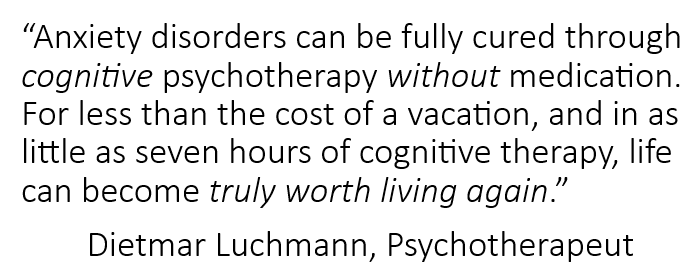
On October 12, 2001 - a few weeks after September 11 - FOCUS TV visited the Angstambulanz, the anxiety outpatient clinic in Stuttgart. Before the camera sat Volker G., 26: ten years of anxiety and panic disorder, neither recognized nor treated by general practitioners, neurologists, internists, and psychotherapists, the diagnosis finally found by himself in a bookstore — and then cured by ten hours of cognitive psychotherapy for around 1,500 euros.
It is not the gift that makes you ill, but how the gifted person perceives it and has learned to think about it. Many gifted people experience their giftedness as a handicap without recognizing the cause. Cognitive psychotherapy corrects the cognitive errors with which they turn their otherness into a problem.
Client-centered psychotherapy in the tradition of Carl Rogers is regarded as the gentlest school of psychotherapy: it listens, it mirrors, it imposes nothing. The best way to learn how that feels is to try it. Thomas is listening to you — exchange a few sentences with him and write down what is on your mind.
At the Anxiety Clinic on Lake Zurich, the healing of agoraphobia begins not on a psychoanalyst's couch but at a table at Brasserie Schiller in Zurich — over an espresso. Beyond the window lies the Sechseläutenplatz, the largest inner-city expanse in Switzerland and the cause of a “spread of the agoraphobia epidemic” in Zurich.
In the spring of 1933, as Germany sank into dictatorship, the philosopher and later Nobel laureate Bertrand Russell wrote a sentence that has since been quoted a million times over and misunderstood almost as often. Russell meant politics. Yet without knowing it, he described a psychological law.
You searched for “cognitive behavioral therapy” and landed here. Because what search engines, self-help guides, and even Google’s artificial intelligence sell you as one and the same are in truth two different things—and the difference decides whether you make progress in weeks or spend years of your life in illusions.
Psychotherapeutic records are the most intimate data a person leaves behind — and long since a commodity, a means of extortion, and a piece of evidence against the very person who confided in a psychotherapist or a machine. A survey of the damage that has already occurred.
Gert Postel, a trained mailman with a secondary school diploma, practiced for eighteen months as a senior physician at the Saxony State Hospital for Psychiatry, Psychotherapy, and Neurology. What distinguishes the impostor Postel from licensed psychotherapists who practice methods with no evidence of efficacy?
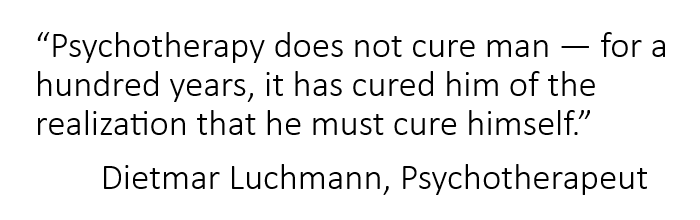
On the cognitive paradox of mental health you should understand before wasting years of your life with the wrong psychotherapists. Psychotherapy does not cure man. Man must cure himself.
Accompanying the narcissism fairy tale "The Glass Heart," the author explains how psychological defense mechanisms can be bypassed by offering narcissists an alternative script. At the same time, the psychology and cognitive psychotherapy of narcissism are elucidated.
A psychotherapeutic fairy tale on the cognitive psychotherapy of narcissism. The narrative illustrates the development, maintenance, and therapeutic overcoming of narcissistic personality organization in the language of fairy tale, conveying cognitive-psychotherapeutic principles through narrative.
NATO has declared the human mind a battlefield. In Switzerland, this battlefield is cultivated by the Association of Swiss Psychotherapists (ASP). Is this a national security risk?
L'OTAN a déclaré l'esprit humain champ de bataille. En Suisse, ce champ de bataille est exploité par l'Association suisse des psychothérapeutes (ASP). Est-ce un risque pour la sécurité nationale ?
La NATO ha dichiarato la mente umana campo di battaglia. In Svizzera, questo campo di battaglia è coltivato dall'Associazione svizzera degli psicoterapeuti (ASP). È un rischio per la sicurezza nazionale?
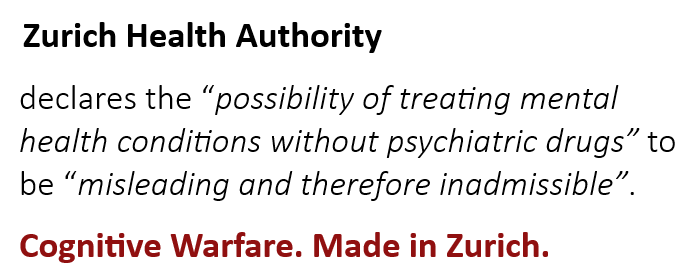
A documentation of how the Association of Swiss Psychotherapists (Assoziation Schweizer Psychotherapeutinnen und Psychotherapeuten, ASP) instrumentalizes the Zurich Health Directorate under Natalie Rickli to shield its members’ inefficient methods from scientific progress.
The motion introduced by National Councillor Philippe Nantermod in the Swiss Parliament is not an attack on the sick but on a system that profits from their illness. The only quality controller this system cannot corrupt is the patient who pays out of pocket.
La motion déposée au Parlement suisse par le conseiller national Philippe Nantermod n'est pas une attaque contre les malades, mais contre un système qui profite de leur maladie. Le seul contrôleur de qualité que ce système ne peut corrompre est le patient qui paie lui-même.
La mozione presentata al Parlamento svizzero dal consigliere nazionale Philippe Nantermod non è un attacco ai malati, bensì a un sistema che lucra sulla loro malattia. L'unico controllore della qualità che questo sistema non può corrompere è il paziente che paga di tasca propria.
Psychotherapy in Switzerland: Under Councillor Natalie Rickli, the Zurich Health Directorate brands the international state of research as "misleading" and threatens psychotherapists with professional disbarment if they inform patients about efficient cognitive psychotherapy.
Members of the Association of Swiss Psychotherapists (ASP) can be identified by the title "Psychotherapeutin ASP" / "Psychotherapeut ASP" — members who are "disturbed" by rapid recovery without psychotropic medication, and by the notion "that a life could be fully worth living again after just a few hours of psychotherapy."
"Remove psychotherapy from the catalog of mandatory health insurance benefits," demand Swiss parliamentarians. Motion 25.4533 is the only way to enforce quality assurance in psychotherapy. The IKP Institute for Body-Centered Psychotherapy Zurich as a case in point: scientifically unfounded services billed to mandatory health insurance.
Klaus Grawe held the Chair of Clinical Psychology and Psychotherapy at the University of Bern. He provided the scientific evidence: cognitive psychotherapy is clearly superior in effectiveness to all other psychotherapeutic methods — and in particular to psychoanalysis and person-centered psychotherapy.
The child of the materialistic zeitgeist knows the price of everything and the value of nothing. Mental health counts for nothing — until it is lost. An analysis of how a cognitive disorder with no diagnostic code ruins lives: values neglect.
The beguiling siren songs calling for artificial intelligence (AI) to be deployed in psychotherapy are growing louder. In truth, the digital soul doctor is no healer but a dangerously potent echo chamber — one that does not correct the cognitive errors of mental disorders but can amplify them with terrifying logic.
A chronicle of reason in the time of madness, March 2020. When Switzerland resolved to abolish rational thinking and the Neue Zürcher Zeitung fueled mass hysteria, the cognitive anxiety clinic on Lake Zurich went into American exile.
The psychotherapy profession is destroying its own legitimacy by demonstrating, convincingly, time and again: there is not too little psychotherapy but too much psychotherapeutic inefficiency — in the country with the highest density of psychotherapists in the world.
A young physician learns, in a half-day cognitive forest walk, to place her own moral compass above the crumbling structures of a sick society — in order to have a family and five children.
From the madness of maximizing returns on capital to the wisdom of inner happiness: how a wealthy man discovers that his most valuable asset is not his money but his mental health.
On a banker's attempt to sell an inflatable flamingo. Or how to respond with empathy, nonetheless, to a call from a banker trying to foist ruinous US dollar certificates on his clients.
Executive suicides regularly make headlines and reveal how the humiliation triggered by a professional demotion can lead to self-destruction. A fable about the discovery of inner worth.
A portrait of the personality profile that leads to the summit — and into the abyss. An analysis of the causes behind recurring executive suicides that reveals why those in the second tier are especially at risk, and how strategic self-regulation provides protection.
This therapy report recounts, with unusual candor and honesty, how a German physician - victimized by a diseased health care system for over a decade - cured his own anxiety disorder in just eight hours through cognitive psychotherapy.