What Does Self-Healing Through Cognitive Psychotherapy Cost?

You ask what it costs to heal an anxiety disorder or depression through our cognitive psychotherapy? If your first thought at this question is of money, you have not yet understood what effective psychotherapy is: it is work. Work on your own thinking, on your own self, on the picture of yourself and of the world around you. No one can take this work off your hands—we cannot either. We can only show you how it is done.

Mental Health Is a Cognitive Achievement of One’s Own

“Mental health is not an achievement of the health system—it is the achievement of the self-thinking person upon himself.”1 So wrote Dietmar Luchmann on August 14, 2025, in an article on Switzerland as a paradise of psychotherapeutic inefficiency.1 On September 1, 2025, the Association of Swiss Psychotherapists (ASP)2 thereupon revealed its business model: its members are “disturbed”3 that “anxiety disorders can be healed in as little as eight to ten hours.”3

Think this fact through to its conclusion: psychotherapists are “disturbed”3 when their clients become well.

A reader commented on the reprint of the article1 on Switzerland as a paradise of psychotherapeutic inefficiency on “Inside Paradeplatz,” Zurich, on August 18, 2025: “Fantastic article! For over twenty years I went to therapy and ended up sicker than at the start. Again and again new tentative diagnoses, pathologized personality traits, ‘deficits’ here and ‘traumas’ there. One is conditioned, quite literally, into a victim full of incapacity. What freed me then was to shift the focus away from the problematic toward the functional. […] I feel like a former cult member.”

So if you ask what psychotherapy costs, ask first not about money but about the value of mental health4 and about your lifetime. And ask about your choice: a cognitive instructor who shows you how to become, in a few hours, the best therapist for yourself—or a state-licensed prattler, paid by your health insurer, who exploits you for twenty years with structureless conversations: “empathic, friendly, therapeutically decorated. But devoid of substance.”1

The good news: even if you have let yourself be psychotherapeutically exploited for twenty years, you can reach, after “eight therapy hours,” an “entirely livable life,” as a physician who was himself affected described his ten-year ordeal with psychotherapists and psychotherapy. Only his self-healing, after instruction through the cognitive psychotherapy of Dietmar Luchmann, ended the exploitation.5

What Costs You Nothing

Before any fee falls due, we examine together with you whether our offering is suitable for you at all—free of charge. The suitability test on our registration page and the initial assessment of your problem account at registration cost you nothing. You pay only once we invite you, after a positive initial assessment, to the psychodiagnostic and probationary assessment, and you decide, after informed examination, to work with us.

What You Pay

Cognitive psychotherapy consists of two clearly delimited sections: the psychodiagnostic block, common to all three paths, and the actual work of change, which you perform on one of three paths—written, video-supported, or in the personal day block.

First Section—the Psychodiagnostic Block

In written dialogue we deepen your problem account, analyze your learning history, and examine whether your self-diagnosis holds up to reality or must be corrected, and whether our cognitive psychotherapy is the right path for you.

Flat fee: USD 400.

Should it turn out that a different treatment is indicated, we tell you so honestly—before you have paid for a single hour of psychotherapy.

Only on the basis of the psychodiagnostic and probationary assessment can it be seriously estimated how much time you will need in total, in the second section, to reach your goals—and which of the three paths is the right one for you.

One Psychodiagnostic Block, Three Psychotherapeutic Paths

The psychodiagnostic block is the shared point of entry to our psychotherapy; its findings determine whether you continue in writing, by video, or in a day-block. These are the three paths of cognitive psychotherapy for anxiety.

Second Section—Cognitive Psychotherapy in Three Paths

The actual work of change you perform on one of three paths. They differ not in the method but solely in the channel—and therefore in the effort they bind. Per working hour (60 minutes):

  • Written Cognitive Psychotherapy (WCP): USD 130
  • Video-Supported Cognitive Psychotherapy (VCP): USD 230
  • Day-Block Cognitive Psychotherapy (DCP): USD 320 plus expenses

Valid upon registration through Psychotherapie.com and advance payment. Depending on where you live, the costs of psychotherapy may be covered by private insurance providers.

The gradation follows not the quality of the result but the effort bound. The written word can be worked on in pieces, without a fixed appointment and without a place; the video conversation requires a fixed, appointed hour; the day block a whole day together with place, travel, and expenses. The least expensive path is at the same time the most effective: whoever writes thinks most thoroughly and keeps a lasting record. Whoever prefers conversation buys comfort—and pays for it with the higher price and with that measure of effectiveness which fleeting speech forfeits against the lasting word.

A Day-Block of Cognitive Psychotherapy (DCP) for the Highly Motivated

The day-block in direct, face-to-face conversation, as we have practiced it for more than thirty years, is the most demanding and the fastest path to freedom from anxiety. How it unfolds is vividly recounted in the psychotherapy report of a physician who overcame his anxiety disorder in the cognitive day-block after ten years astray, and in an article on the cognitive psychotherapy of agoraphobia in Zurich.

The guideline of the British National Institute for Health and Care Excellence (NICE) provides “a total of seven to fourteen therapy hours” for the cognitive treatment of anxiety disorders—without psychotropic drugs.6

From this, the total cost range for the psychotherapy of anxiety disorders can be calculated transparently—depending on the chosen path:

  • Written (WCP): USD 400 + 7 to 14 × USD 130 = USD 1,310 to USD 2,220.
  • Video-supported (VCP): USD 400 + 7 to 14 × USD 230 = USD 2,010 to USD 3,620.
  • In the day block (DCP): USD 400 + 7 to 14 × USD 320 = USD 2,640 to USD 4,880, plus expenses.

That is inexpensive for an effective psychotherapy without psychotropic drugs. Even the most expensive path remains, expenses aside, within the range of a single annual vacation: the “vacation expenditure of the Swiss population” amounts to USD 6,303 per capita per year7,8. Unlike vacation expenditure, the investment in cognitive psychotherapy has a documented return of 400 percent9,10.

At these financial costs, no one here has yet failed who was determined to free himself, with our help, from his anxiety disorder or depression.

What You Do Not Pay—and Do Not Suffer

The financial costs of our cognitive psychotherapy can be calculated transparently. About the hidden costs of an insurance-funded psychotherapy, one keeps silent—which does not mean they do not exist.

With us you do not pay for the years-long management of your problems, as the cognitive warfare of the “Psychotherapists ASP”11 discloses as a business model. With us you pay for the acquisition of the ability to solve your problems durably yourself. Our “maxim is: efficient treatments, limited to an average of ten hours—instead of years-long therapies in which the therapists exploit their clients.”12 So the Tagesspiegel documented, on August 20, 2004,12 the cognitive working method of the psychotherapist Dietmar Luchmann.

With us you do not pay for psychotropic drugs that chemically sedate you. We enable you to think for yourself.

With us you do not pay with your data; instead you enjoy a maximal data-security guarantee. Because Dr. Dietmar Luchmann, LLC, works exclusively with self-payers outside the health system, the compulsory disclosure of your client data to health insurers, insurers, and authorities is eliminated. Only the psychotherapist who attends to you knows your identity.

With us you do not pay with the risks of the opaque conditions of a sick system whose aim is “the conversion of all the healthy into the sick.”13 Our General Terms and Conditions (GTC) regulate openly what is regularly concealed in the insurance system: confidentiality, data flows, duties to cooperate, liability, remuneration. Some prospective clients perceive this transparency as threatening, because they are not accustomed to having the terms of a treatment laid out precisely on the table before treatment begins. We understand that. But we change nothing about it. The GTC are our self-protection; they preserve for us the freedom to work exclusively with people whom we can also lead to success. In the insurance system you, as a client, have the same or more far-reaching obligations—only no one tells you so. What looks threatening is in truth the opposite: the assurance that you know what you are getting into.

The True Exclusivity

This brings us to the decisive question: why do we select our clients at all?

The answer is banal and honest. Every psychotherapist at Dr. Dietmar Luchmann, LLC, is so experienced and financially independent that he works with cognitive psychotherapy because he takes joy in the work. Joy in this work, however, arises from one thing alone: therapeutic success in efficient time with highly motivated people. From this it follows necessarily that we accept only those people who want to heal themselves—with our guidance, but through their own thinking, reading, and writing.

More than 90 percent of all prospective clients fail already at our registration page, because they shy away from the modest exertion of thinking—of writing down their “problems as the result of a misdirected learning history” in a useful manner, in the necessary detail and extent. They seek a practitioner who removes the problem while they themselves passively—as at the dentist—hold their mouth open. This practitioner they will not find with us.

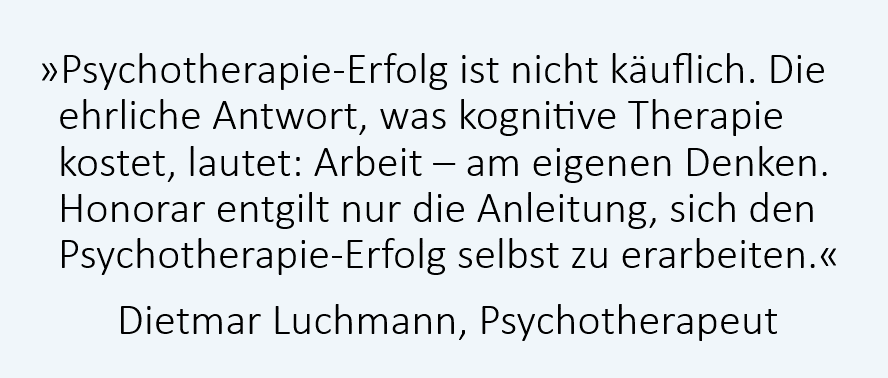
Quote by psychotherapist Dietmar Luchmann: Success in psychotherapy is not for sale. The fee compensates only the guidance toward earning that success yourself.

For “psychotherapists do not heal,” Dietmar Luchmann explained. “They have never healed. Not a single psychically suffering person in this world has ever been healed by a psychotherapist. These people have, without exception, healed themselves—by changing their thinking and, as a result, feeling and acting differently. The psychotherapist was at best the signpost and instructor who showed them how it is done.”14

That, precisely, is our service: psychological and psychotherapeutic instruction for your self-therapy and self-healing in a few hours. What this costs, you now know. What your mental health is worth to you4, you decide—through your readiness to use our expertise and instruction in order to heal yourself.

Our Offer
Self-Therapy for Self-Thinkers

Written Cognitive Psychotherapy (WCP) by Dr. Dietmar Luchmann, LLC, provides assistance for self-help to enable the self-healing of psychological disorders:

1. Discover WCP
2. Take Suitability Assessment
3. Start Self-Therapy

Sources

1 Luchmann, D.: Switzerland as a Paradise of Psychotherapeutic Inefficiency. Psychotherapie. August 14, 2025.

2 Dr. Dietmar Luchmann, LLC: The Association of Swiss Psychotherapists (ASP) Is “Disturbed” by Scientific Psychotherapy Standards. Psychotherapie. February 16, 2026.

3 Quotations from the letter of the “Association of Swiss Psychotherapists (ASP),” signed by Gabriela Rüttimann as “President,” dated September 1, 2025, to the Health Directorate of Zurich. The letter is available as a PDF copy. Documentation.

4 Luchmann, D.: The Value of Mental Health — Value Neglect and Psychotherapy. Psychotherapie. October 20, 2025.

5 Nordes, N.: Record of a Misdiagnosis — A Physician's Experience with Psychotherapists and Psychotherapy. Psychotherapie. March 11, 2003.

6 National Institute for Health and Care Excellence (NICE): Generalised anxiety disorder and panic disorder in adults: management. Clinical guideline. 15 June 2020. [Original text, section 1.3.15: “CBT in the optimal range of duration (7 to 14 hours in total) should be offered.” Section 1.3.20: “Benzodiazepines are associated with a less good outcome in the long term and should not be prescribed for the treatment of individuals with panic disorder.”]

7 State Secretariat for Economic Affairs (SECO): Naturnaher Tourismus in der Schweiz. Bern: State Secretariat for Economic Affairs (SECO), 2002, p. 95.

8 Federal Statistical Office (FSO): Reisen der Schweizer Wohnbevölkerung 2021. Neuchâtel: Federal Statistical Office (FSO), October 2022.

9 Luchmann, D.: “400 Percent Profit Through Cognitive Psychotherapy — Is That a Joke, Doctor?”. Psychotherapie. July 12, 2025.

10 Schuler, D., Tuch, A., Buscher, N. & Camenzind, P.: Psychische Gesundheit in der Schweiz. Monitoring 2016 (Obsan Bericht 72). Neuchâtel: Swiss Health Observatory, 2016, p. 14.

11 Luchmann, D.: Cognitive Warfare of the Association of Swiss Psychotherapists (ASP). Psychotherapie. March 16, 2026.

12 Kast, B.: «Der Graben ist größer denn je». Psychotherapeuten streiten darüber, welche Methode von der Kasse bezahlt werden soll. Tagesspiegel, Berlin, August 20, 2004, p. 25.

13 Dörner, K.: Gesundheitssystem: In der Fortschrittsfalle. Deutsches Ärzteblatt, September 20, 2002, vol. 99, no. 38, pp. A2462–A2466. [Quote, section 11, p. A2464ff.: “Competition forces the opening up of new markets. The goal must be the conversion of all the healthy into the sick, that is, into people who consider themselves, as far as possible lifelong [...], psychically in need of expert therapeutic, rehabilitative, and preventive manipulation in order to be able to ‘live healthily.’ This already succeeds quite well in the area of physical illnesses, but even better in the area of mental disorders, especially since there is no shortage of theories according to which almost no one is healthy.”]

14 Luchmann, D.: Why Cognitive Psychotherapy Is Demonstrably the Most Effective — but Helps the Fewest. Psychotherapie. March 31, 2026.

Your Comment

Do you have remarks, suggestions, or additions regarding this article? Do you have personal therapy experiences? We welcome substantial feedback.

Your email address will not be published. It is used solely for potential inquiries by the editors.