Nantermod's solution is correct. His reasoning falls short.
The numbers are indisputable. Since the introduction of the referral model (Anordnungsmodell) in 2022, the costs of psychotherapy covered by mandatory health insurance (OKP) have exploded from 528 million to 922 million Swiss francs — a 75 percent increase in three years, with a projected annual growth of 130 million francs. Nantermod is right to call this unsustainable in his Motion 25.4533 of December 16, 2025.
Yet his motion contains a sentence that undermines the entire argument — one so deferentially worded that you have to read it twice to grasp its full implications:
"This motion calls into question neither the benefit nor the clinical relevance of psychotherapy."
Philippe Nantermod, FDP National Councillor "Motion 25.4533: Remove psychotherapy from the catalogue of mandatory health insurance benefits to reduce premiums"1
Let that sink in. Costs are exploding because the system incentivizes endless talk sessions, and the author of the motion hastens to assure everyone that he has no intention of questioning this inefficient chatter. He considers it "clinically relevant" that people are socially supervised for years at public expense without ever getting well.
This is a tactical error of strategic magnitude. Anyone who refuses to question the efficacy of today's mass psychotherapy while seeking to cut its funding creates the impression of a heartless attack on the mentally ill. Nothing could be further from the truth.
The far stronger argument - and the only one that justifies this motion on medical rather than merely fiscal grounds - is this: Financing psychotherapy through mandatory health insurance is not just expensive. It is psychotherapeutically counterproductive. It destroys the only quality assurance mechanism that actually works in psychotherapy: the patient's personal responsibility.
"Mental health is not a service delivered by the health care system — it is the achievement of the thinking individual on his own behalf."
Dietmar Luchmann, Psychotherapist Switzerland as a Paradise of Psychotherapeutic Inefficiency. Psychotherapie. August 14, 20252
The Federal Council's Response: Potemkin Quality Assurance
On February 11, 2026, the Federal Council rejects the motion and points to an impressive arsenal of institutional oversight mechanisms: restrictions on referral authority, limits on the number of sessions per referral, cost approval after 30 sessions with a psychiatric case review, the WZW criteria (Wirksamkeit, Zweckmässigkeit, Wirtschaftlichkeit — efficacy, appropriateness, cost-effectiveness), Health Technology Assessments, and a "comprehensive evaluation" whose report is due in the first half of 2026.1
It sounds like a well-designed system. It is, in fact, a chimera. Examine each mechanism individually and you will find that none of them controls what it purports to control.
The WZW criteria evaluate "psychotherapy" as a category — not individual methods. This is the equivalent of declaring "medication" generically effective because antibiotics cure infections — and thereby legitimizing inert compounds along with them. The empirically proven efficacy of cognitive methods serves as a shield for open-ended therapies with no defined objectives. The psychotherapy researcher at the University of Bern, Klaus Grawe,3 demonstrated as early as 1994 that cognitive psychotherapy for anxiety disorders and depression "is, on average, highly significantly more effective than psychoanalytic therapy and client-centered therapy" (p. 670).3 More than 30 years later, all methods continue to be reimbursed equally.
Cost approval after 30 sessions: A psychiatrist assesses whether continued treatment is necessary. That sounds like oversight. But what incentive does a psychiatrist who profits from the same system of long-term treatment have to declare a psychotherapy complete? It is like asking the fox to audit the henhouse.
Health Technology Assessments: "Interested parties" may submit requests to review the obligation to provide coverage at any time, the Federal Council writes. Which "interested parties"? The professional associations that have no economic interest in dismantling their own business model? The psychotherapists who would fear for their revenues if efficacy standards were tightened? Here, the wolf is appointed shepherd — and the Federal Council calls it "expedient."
As "expedient" as the Zurich Directorate of Health4 making itself serviceable to the Association of Swiss Psychotherapists (ASP)5 for the purpose of preserving a system of psychotherapeutic inefficiency?
The "comprehensive evaluation": They are evaluating a system whose perverse incentives have been documented in the professional literature for decades and whose costs are visibly growing at an exponential rate. Evaluations are the Valium of politics: they calm without curing. And they buy time — for the providers, not for the patients and victims of the system.
The Federal Council concludes: "The Federal Council considers the existing processes to be expedient and sufficient." That is the core sentence of its position. And it is wrong. The existing processes are not the solution. They are the institutional disguise of the problem.
The Structural Flaw: Psychotherapists Police Themselves
To understand why institutional quality assurance systemically fails in psychotherapy, one must state an uncomfortable truth: It is not the government oversight authorities - from cantonal health directorates to the Federal Office of Public Health (BAG) - but the providers of inefficient therapies who control the definitions of what counts as "quality."
The professional associations of psychotherapists set the quality standards. The same associations control the continuing education curricula, the licensing requirements, and the professional-political agenda. Their standards do not protect the quality of psychotherapy; they protect "methodological diversity" — a euphemism for the fact that demonstrably less effective methods, and methods without any scientifically accepted evidence of efficacy, are recognized and reimbursed as equivalent.
The Association of Swiss Psychotherapists (ASP)5 is precisely such a professional association — so successful in its advocacy for inefficient psychoanalytic, depth-psychological, existential-analytic, bioenergetic, and body-centered therapy methods that the Zurich Directorate of Health4 even "expediently" assists it in suppressing the dissemination of the international research finding "that anxiety disorders could be cured in eight to ten sessions or that life could be fully worth living again after just a few therapy sessions."4
A cognitive psychotherapist who eliminates an anxiety disorder in ten sessions is considered "superficial" in this system. A psychoanalytically oriented therapist who treats the same patient for ten years is considered "thorough." The absurdity of this valuation is self-evident — but it is systemic.
Any psychotherapist in Zurich who makes the efficiency of his method the benchmark calls into question the business model of the majority. The majority does not respond with better psychotherapy but with the instrumentalization of the Zurich Directorate of Health,4 which "expediently" protects the interests of those whose therapy methods are "highly significantly"3 less effective or not internationally recognized as scientifically validated because they lack evidence of efficacy.
Indeed, the Zurich Health Directorate, on official letterhead, qualifies the references by efficient psychotherapists to their "rapid therapeutic results"4 as "misleading and therefore impermissible"4 — and openly threatens the psychotherapist who had published the current state of the research, should he fail to submit a "statement of position," with revocation of his professional practice license: This "impugns" his "trustworthiness pursuant to Art. 24 of the Psychology Professions Act (PsyG), which results in the revocation of the professional practice license (Art. 27 PsyG)." The psychotherapist's suggestion that, before compelling a "statement of position," the authority first verify the "absurdity" of the allegations itself through the standard administrative procedure of "a glance at the incriminated website" was rejected by the Health Directorate.
Anyone who finds this hard to believe should ask Health Director Natalie Rickli4 why the supervisory authority for which she bears political responsibility protects inefficient psychotherapists from competition rather than - as its statutory mandate to ensure high-quality health care requires - protecting patients from inefficient psychotherapists.
Recognizing the System's Stupidity and Malice
Readers without access to the inner workings of the medical-psychiatric complex can scarcely imagine that the "health care system" does not aim at their health but at "the conversion of all healthy people into patients," as a psychiatrist and medical director disclosed in the Deutsches Ärzteblatt (item 11, p. A2464).6
Klaus Dörner, who taught psychiatry at the University of Witten/Herdecke and directed the Westphalian Psychiatric Hospital in Gütersloh from 1980 to 1996, explains the logic of profit maximization in the health care system in plain language:
"Competition forces the opening of new markets. The goal must be the conversion of all healthy people into patients — that is, into people who believe themselves to be in lifelong need of [...] psychological manipulation by experts in the form of therapy, rehabilitation, and prevention in order to be able to 'live healthily.' This is already working quite well in the area of physical illness, but it works even better in the area of mental disorders, since there is no shortage of theories according to which almost no one is healthy."
Klaus Dörner Gesundheitssystem: In der Fortschrittsfalle [Health Care System: Trapped in Progress]. Deutsches Ärzteblatt. September 20, 20026
The Psychotherapy Reality: More Like Ten Years Than Ten Sessions
When the critique of Switzerland as a paradise of psychotherapeutic inefficiency2 was published on August 14, 2025, the media outlets that republished the article received many comments in agreement. One comment read almost like a case report:
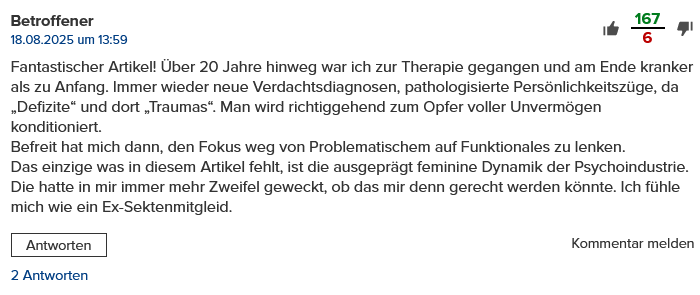
Fig.: Reader comment on Switzerland as a Paradise of Psychotherapeutic Inefficiency2, republished on InsideParadeplatz:
"Fantastic article! For over 20 years I had been going to therapy and ended up sicker than when I started. Constantly new suspected diagnoses, pathologized personality traits, 'deficits' here and 'traumas' there. You are literally conditioned into becoming a victim full of inadequacy.
What freed me was shifting the focus away from problems and toward what works. The only thing missing in this article is the distinctly feminine dynamic of the psycho-industry. That had increasingly made me doubt whether it could ever do me justice. I feel like an ex-cult member."
Those who wish to gain a detailed impression of how such inefficient long-term therapies come about should read this therapy report by a physician7 about his own ten-year odyssey through inefficient psychotherapy — and his healing encounter with cognitive psychotherapy:
"After eight therapy sessions [...] my supposedly severe 'personality disorder' and my suicidal ideation had given way to a largely normal and absolutely life-worth-living existence."
Norbert Nordes Protocol of a Misdiagnosis — A Physician Experiences Psychotherapists and Psychotherapy. Psychotherapie. March 11, 20037
Documenting One Example: The Oversight Failure in Zurich
How little the "healthcare system" has health as its objective is demonstrated by the interplay among psychotherapists, training institutes for inefficient therapies, and their professional associations with the state supervisory authorities. Psychotherapie.com has documented how this cartel of organized psychotherapeutic inefficiency attacked the critic following the publication of the article on "Switzerland as a Paradise of Psychotherapeutic Inefficiency."2 Certain overlaps among the three articles are presumably unavoidable in order to establish the context and to expose the "expedient" lockstep in which these three parties seek to protect their system:
- Association of Swiss Psychotherapists (ASP), whose members are "disturbed" by evidence-based psychotherapy standards.5
- IKP Institute for Body-Centered Psychotherapy Zurich, a training institute for methods not scientifically recognized as psychotherapy, whose "professional director" Gabriela Rüttimann simultaneously serves as president of the Association of Swiss Psychotherapists (ASP) and, in that capacity, carried out the attack.8
- Zurich Directorate of Health under Cantonal Councillor Natalie Rickli, who bears political responsibility for the authority allowing itself to be instrumentalized for the attack on the critic.4
The Cartel of Organized Psychotherapeutic Inefficiency
The result of this incentive structure, in which psychotherapists manage their patients at will, is quantifiable: According to an OECD survey, the average treatment duration with Swiss psychiatrists is approximately 60 months.9 Five years. For conditions that, according to the current state of research, can be treated in ten to twenty sessions of cognitive psychotherapy. This is not "thoroughness." This is the chronification of the patient as a business model.
A cartel of comfortable irresponsibility has formed in which the interests of all participants align — at the expense of premium payers:
- The psychotherapist earns per session. The longer the therapy, the higher the revenue. The economic incentive to discharge the patient into self-sufficiency approaches zero.
- The patient who does not pay out of pocket has no reason to end a comfortable weekly talk session — even when it changes nothing. Why do the painful work of confronting your own cognitive distortions when someone is being paid to nod sympathetically?
- The supervisory authorities orient themselves by the standards of professional associations that have no interest in stricter efficacy criteria.
- The health insurers pass the costs on to premium payers and administer the system rather than questioning it.
Two losers remain: the premium payers, who finance a system that does not heal, and - paradoxically - the patients, who are chronified within it.
The Dialectic: Why Self-Payment Is the Only Functioning Quality Assurance
Psychotherapy differs fundamentally from every other medical discipline. A surgeon can operate even when the patient lies under anesthesia with no interest in the outcome. An internist can prescribe a medication that works without the patient's conviction. A psychotherapist can achieve nothing if the patient is not willing to examine his own patterns of thinking.
This characteristic makes psychotherapy the only medical discipline in which patient autonomy is not merely desirable but therapeutically constitutive. Without it, no change occurs — no matter how many sessions are billed.

Fig.: Reader comment on Switzerland as a Paradise of Psychotherapeutic Inefficiency2, republished on InsideParadeplatz: "A friend of mine has been going to a psychologist every week for 30 years. She simply reviews her daily life with him. She needs someone who listens. It costs us quite a lot."
The comprehensive-coverage system of mandatory health insurance systematically destroys this prerequisite. It transforms the patient from the agent of his own change into the consumer of a service. It rewards passivity and penalizes initiative — because anyone who gets well quickly "loses" his free sessions.
Here lies the dialectic that neither Nantermod nor the Federal Council articulates:
"Remove psychotherapy from the catalogue of mandatory benefits" is not primarily an austerity measure. It is the restoration of a therapeutic precondition.
The patient who pays for his own therapy becomes the most effective quality controller possible — and the only one the system cannot corrupt:
- He chooses carefully. Anyone paying 150 to 250 Swiss francs per hour out of pocket does not go to the nearest available therapist but to the one who can demonstrate the best outcomes.
- He does the work. Those who invest want results. They do their homework, practice new thinking patterns, and demand progress. They want to be done.
- He ends an unsuccessful therapy. No self-paying patient sits through three years of therapy that changes nothing. The endless loops are a product of the free-of-charge culture, not of the mental disorder.
- He is immune to lobbying interests. No professional association, no WZW review, no "evaluation" can persuade him to pay for something that does not work. His wallet is the hardest evidence.
Only when the patient pays does he remain uncorrupted by the system's inefficiency. This is not "social coldness." It is the most rigorous form of patient protection: protection from a system that profits from his illness.
The Real Two-Tier Medicine
Opponents of the motion will invoke the specter of "two-tier medicine": mentally ill people who cannot afford psychotherapy would be excluded. It sounds compelling. On closer examination, it is wrong.
The real two-tier medicine already exists today — within the insurance-funded system itself. Informed patients who find a competent cognitive psychotherapist are freed from anxiety disorders, panic attacks, or depression in ten to fifteen sessions. Uninformed patients are held for years in unstructured conversations without any change in thinking patterns, behavior, or suffering. Both are funded equally. One group receives healing; the other, subsidized life companionship. That is two-tier medicine — and it is not prevented by the current system but produced by it.
Nantermod's Motion 25.4533 would not add another layer of inequality but eliminate the existing one — by restoring the market mechanisms that drive inefficient providers out of the market. A therapist who delivers no results loses his patients. That is not cruelty; it is quality assurance by the only sovereign who matters in psychotherapy: the patient himself.
Had Nantermod argued that mass psychotherapy in its current form is harmful because it breeds dependence, the two-tier medicine argument would have collapsed on the spot. No one has a right to harmful treatment.
For people in acute crisis or with limited financial means, the alternatives Nantermod cites are available: supplementary insurance, accident insurance, disability insurance, military insurance. The motion also explicitly provides exceptions for children. And the cost of an effective brief therapy, as Nantermod correctly notes, is approximately 2,500 Swiss francs. That is less than most Swiss citizens routinely spend out of pocket on a vacation that improves their mental well-being far less durably than effective psychotherapy.
Conclusion: The Right Goal Deserves the Stronger Argument
Motion 25.4533 deserves support. Not primarily because of the cost explosion — though it is real and alarming. But because removing psychotherapy from mandatory health insurance is the only quality assurance measure that actually works.
The Federal Council is wrong to consider the "existing processes" "expedient." The documentation of the oversight failure in Zurich demonstrates how the "existing processes" cement an inefficient system. These processes are controlled by actors with a vital interest in perpetuating the status quo. They are not the solution — they are the scenery behind which the problem reproduces itself undisturbed.
Motion 25.4533 is not an attack on the mentally ill. It is a lever against a system in which providers of inefficient therapies instrumentalize the supervisory structures to secure their sinecures and marginalize efficient psychotherapists. The patient who pays out of pocket breaks this cartel. He is the only quality controller the system cannot buy.
Switzerland maintains the highest density of psychiatrists and psychotherapists in the world. A psychiatrist glut10 twice as large as the runner-up, and a rise in the number of psychotherapy practices11 from 2,340 in Q3 2022 to 4,834 in Q2 2024 — more than a doubling in two years. The result is not the world's mentally healthiest population but the most expensive variant of organized psychotherapeutic perpetual motion.
More of the same is not a solution. Less public funding would be the beginning of a quality debate that the profession will never initiate on its own — because it is more comfortable to demonstrate for higher fees than to "critically examine one's own methods — methods that have long been considered inefficient."2
Psychotherapy does not cure man — for a hundred years, it has cured him of the realization that he must cure himself.
1 The Swiss Parliament: Motion 25.4533: Remove psychotherapy from the catalogue of mandatory health insurance benefits to reduce premiums. Submitted by Philippe Nantermod (FDP) on December 16, 2025. Federal Council statement of February 11, 2026.
2 Luchmann, D.: Switzerland as a Paradise of Psychotherapeutic Inefficiency. Psychotherapie. August 14, 2025.
3 Dr. Dietmar Luchmann, LLC: Klaus Grawe, University of Bern: Cognitive Psychotherapy Is "Highly Significantly More Effective" Than Client-Centered Therapy and Psychoanalysis. Psychotherapie. February 16, 2026.
4 Dr. Dietmar Luchmann, LLC: Does Natalie Rickli Protect Inefficient Psychotherapy Schools? Psychotherapie. February 16, 2026.
5 Dr. Dietmar Luchmann, LLC: Association of Swiss Psychotherapists (ASP): "Disturbed" by Evidence-Based Psychotherapy Standards. Psychotherapie. February 16, 2026.
6 Dörner, K.: Gesundheitssystem: In der Fortschrittsfalle [Health Care System: Trapped in Progress]. Deutsches Ärzteblatt, September 20, 2002, Vol. 99, No. 38, pp. A2462–A2466. [Citation: Item 11, p. A2464ff.]
7 Nordes, N.: Protocol of a Misdiagnosis — A Physician Experiences Psychotherapists and Psychotherapy. Psychotherapie. March 11, 2003.
8 Dr. Dietmar Luchmann, LLC: IKP Institute for Body-Centered Psychotherapy Zurich. Psychotherapie. February 16, 2026.
9 OECD: Mental Health and Work: Switzerland. Bern: OECD Publishing, 2014, p. 130.
10 The Swiss Parliament: Psychiatrist Glut in Switzerland. Interpellation 14.4178 of December 11, 2014, submitted by Sylvia Flückiger-Bäni (SVP).
11 Tuch, A.; Fischer, F.B.; Jörg, R.: Monitoring zur Neuregelung der psychologischen Psychotherapie [Monitoring the New Regulation of Psychological Psychotherapy]. Second report commissioned by the Federal Office of Public Health (BAG). Obsan Report 07/2025. Neuchâtel: Swiss Health Observatory, 2025, p. 20.
Your Comment
Are you interested in contacting the author? Do you have remarks, suggestions, or additions regarding this article? Do you have personal therapy experiences? We welcome substantial feedback.