Understanding Depression Before Treating It
This article explains mild and moderate depressive episodes in fifteen steps. It begins by clarifying why the most popular question of all—where does my depression come from?—is nearly worthless for treatment. Next comes the distinction between the depressing thought and the sentence it is packed into; without it, the rest remains open to misunderstanding. Then the tool: a four-stage distinction any reader can apply this very day, together with its two-thousand-year prehistory. After that, the terminological confusion that equates cognitive psychotherapy1 with cognitive behavior therapy is resolved, because otherwise the figures that follow will be misread. Then come the figures themselves: on the effectiveness of changing one’s thinking, on the effectiveness of medication, on its risks, and on what happens once treatment has ended. Between them stands the central proposition of the whole article, namely why no medication can change the content of a self-harming thought. In closing: the most serious objection to this article’s thesis, the question of duration, the striking concentration among young women, and the boundary beyond which a physician is needed after all.
How Depression Arises—and Why the Question of Why Leads Nowhere
Anyone who becomes depressed looks first for a cause. That is understandable, since it is how we deal with everything that happens to us. Only, in the case of depression the search rarely leads anywhere, and for a substantive reason: as a rule there is no such thing as the cause. Disposition, physical illness, loss, chronic overload, loneliness, lack of sleep, and learned habits of thought act together, and after six months the share attributable to any single factor can no longer be disentangled.
A distinction is needed here that is almost always missing from advice literature: the question of origin is something entirely different from the question of maintenance. The origin lies in the past and can no longer be altered. The maintenance takes place today—and everything that takes place today can be changed today.
An example makes the difference tangible. Someone is convinced: there is no point in starting anything. Where that conviction originally came from may remain unresolved. What is observable is something else: whoever thinks this way does not start. Whoever does not start finishes nothing. And whoever finishes nothing finds, by evening, the proof that he finishes nothing. The thought manufactures the facts by which it then justifies itself. Specialists call this a self-fulfilling loop; to the sufferer it simply feels like a sense of reality.
From this follows a first interim conclusion: for treatment, the origin of a depressive thought is nearly irrelevant. What matters is whether it is true—and whether it is allowed to keep running unexamined.
Thought and Sentence: What Is Actually Being Worked On Here
Before we come to the matter itself, a distinction without which the rest remains open to misunderstanding.
What makes a person depressed is not words. It is convictions: assumptions about what one is like, what others think of one, what the future will bring. The technical term is cognition; in English one also speaks of beliefs. These convictions are the thing itself. They are what gets treated.
A sentence, by contrast, is merely the vehicle. It is the linguistic packaging into which a thought is placed so that it can be communicated or written down. This is why the word “thought” appears in this article wherever the conviction is meant, and the word “sentence” only where the written form is at issue.
The difference is not hairsplitting. It is the reason writing things down works so well in cognitive psychotherapy. As long as a conviction is circling in the head it has no shape. It is more a climate than an assertion, and a climate cannot be refuted—one can only duck under it. The moment that same conviction stands on paper as a sentence, it has a subject, a predicate, and a claim to truth. It can be false. Writing it down therefore does not change the thought; it makes the thought testable. All the same, the two must not be confused: whoever crosses out the sentence and keeps the conviction has done nothing.
Observation, Assumption, Verdict, Law: The Four Stages of Depressive Thinking
Depressive thinking is not stupid. On the contrary, it is fast, consistent, and formally almost elegant. Its single error is that it treats four logically quite different kinds of statement as though they were the same.
Take an unanswered message.
Stage 1, the observation: She did not reply on Tuesday. That is verifiably true. There is nothing to object to.
Stage 2, the assumption: She has no interest in me. That may be so. It may equally be that she was ill, had mislaid her phone, or simply overlooked the message. An assumption is one of several possible explanations—no more.
Stage 3, the verdict: Nobody wants anything to do with me. A single instance becomes a statement about all people. Specialists call this overgeneralization: the illegitimate extension of a single case to the whole.
Stage 4, the law: There is something fundamentally wrong with me. A statement about the world becomes a statement about one’s own person, and a permanent one at that. From here on, every future observation is read only as confirmation.
And now the decisive point: between stage 1 and stage 4 not one new fact has been added. No second Tuesday, no conversation, no further unanswered message. The entire increase in certainty is self-generated.
This is precisely where cognitive psychotherapy begins, and it does so with a remarkably unspectacular question: how do you know that? Not: think positive. Not: but you are worth something. Rather: draw a line between what you know and what you assume. Whoever draws that line has not eliminated his depression. He has, however, stopped supplying it with fresh evidence every day.
What such work looks like in practice can be read in the narrative “Like the Clap, Doctor?”2, in which a psychotherapist spends an entire day taking exactly these four stages apart with a twenty-three-year-old patient.
From Epictetus to Aaron Beck: An Insight Two Thousand Years Old
The idea that it is not events that afflict a person but his judgments about events is not new. The Stoic Epictetus, a freed slave, put it in a single sentence in the first century:
“Men are disturbed, not by things, but by the principles and notions which they form concerning things.”
Epictetus Enchiridion, ch. 5, recorded by Arrian, around AD 125.3
Whoever takes that sentence seriously has the entire program of cognitive psychotherapy in front of him, some nineteen hundred years before its invention.
Cognitive psychotherapy was invented in the nineteen-sixties by the American psychiatrist Aaron T. Beck, a trained psychoanalyst who found in depressed patients something his method did not provide for: not repressed drives, but consistently negative thoughts about one’s own person, the world, and the future. He named these three directions the cognitive triad. His conclusion was radical: depression is not primarily a disorder of mood but a disorder of thinking, and the mood is its consequence. Beck himself named the Stoics as the philosophical root of his method.4
This is more than intellectual history. It explains why cognitive psychotherapy applies itself at the only point where anything can be changed at all—and why any method that leaves the content of thinking untouched works past the depression, however well intentioned it may otherwise be.
What Distinguishes Cognitive Psychotherapy from Cognitive Behavior Therapy?
The question seems academic. It is not, because without an answer to it every figure that follows is open to misreading.
Cognitive behavior therapy (CBT) is a method standing on two legs: it works on the thoughts and, in addition, directly on behavior by means of its own exercises. Cognitive psychotherapy dispenses with the second leg. It assumes that behavior is the result of thinking: whoever eliminates his errors of reasoning changes his behavior himself, without anyone having to prescribe exercises. The difference is therefore not terminological but one of efficiency—of where the lever is applied. This is treated at length in the article on how cognitive psychotherapy and cognitive behavior therapy differ5.
For the state of research this means: nearly all the large trials were conducted under the label CBT. Anyone arguing honestly therefore cannot present those trials outright as evidence for cognitive psychotherapy in the narrower sense. What can be said is this: the trials establish the effectiveness of methods whose common core is work on the cognitions—on thoughts, verdicts, and convictions. How much of that falls to the cognitive leg and how much to the behavioral one is a separate question, treated openly further below.
How Effective Is Changing One’s Thinking in Mild to Moderate Depression?
The most comprehensive evaluation currently available comes from a group around Pim Cuijpers at the Vrije Universiteit Amsterdam and pools 409 randomized trials with 52,702 patients—the largest meta-analysis ever compiled on a single psychotherapeutic method.6 A meta-analysis is the statistical summary of many individual studies; it is more informative than any one of them, because random fluctuations average out.
The result: against control groups receiving no such treatment, the effect stands at a value of g = 0.79. That figure needs translating. Hedges’ g is a standardized effect size and measures the difference between two groups in units of their dispersion. From about 0.5 one speaks of a medium effect, from about 0.8 of a large one. More vivid is the quantity derived from it, which specialists call the number needed to treat: the number of people who must be treated for one additional person to benefit. For cognitive behavior therapy in depression it lies in the low single digits—a value many other areas of medicine can only dream of.
Two qualifications belong with this, and whoever suppresses them is selling rather than informing. First, effects of this kind are inflated by publication bias: studies with gratifying results are published more often than those without. An earlier evaluation by the same group found a raw value of 0.71, which fell to 0.53 once that bias was corrected for arithmetically.7 Second, methodologically better studies consistently yielded smaller effects than weaker ones. What is realistic, then, is a medium effect, not a gigantic one.
One finding from the same meta-analysis nevertheless deserves particular attention, because it touches this article’s core thesis: even as pure self-help, without any accompaniment by a psychotherapist, the method was effective, with an effect of g = 0.45.6 That is less than in the accompanied form, but it is considerably more than nothing—and it is the empirical core of the claim that milder depressions can be dealt with without a physician and without a pill. What it does not mean is that they can be dealt with without instruction. The British National Institute for Health and Care Excellence (NICE) expressly recommends guided self-help as the first choice in less severe depression.8 Between “without a physician” and “alone” lies a difference that serious texts should not blur.
What Do Antidepressants Achieve in Mild Depression—and What Not?
Here matters become uncomfortable, and they become uncomfortable for common practice.
A patient-level evaluation of several placebo-controlled trials led by Jay Fournier at the University of Pennsylvania examined how the benefit of antidepressants over a dummy medication changes with severity.9 The result is unambiguous and has been persistently passed over for fifteen years: in patients with a baseline score below 23 points on the Hamilton Depression Rating Scale—the most common observer-rated instrument—the difference between drug and dummy lay below 0.20, and thus below what is customarily regarded as a small effect. The threshold NICE has set for a clinically meaningful difference was reached only from a baseline score of 25 points. The authors put it soberly: on average, the benefit in mild and moderate complaints is minimal or nonexistent.
It is important not to overstretch this finding. It does not say that antidepressants are ineffective; in very severe depression their benefit is considerable, and for those patients they are a blessing. It says: their advantage over placebo grows with severity—and in the mild range it is practically no longer measurable.
This is precisely what the British guideline has since acknowledged. It states that in less severe depression antidepressants should not routinely be offered as first-line treatment, but only where the person concerned expressly wishes it after being informed.8 Named there as first choices are guided self-help, group cognitive behavior therapy, behavioral activation, and structured exercise programs.
Interim conclusion: in mild to moderate depression, changing one’s thinking is not narrowly superior to the pill. It is superior because in this range the pill achieves little that the dummy medication would not achieve as well. Why that is so can be said in a single sentence—and that sentence is the core of the whole article.
Why No Medication Can Change the Content of a Thought
An antidepressant intervenes in the transmission of messenger substances between nerve cells. What it can thereby influence are states: mood, drive, sleep, appetite, concentration. What it cannot influence is the content of a thought.
There is no active substance that converts the conviction “I can accomplish nothing under my own power” into the insight “I have never actually checked that,” any more than there is a pill that corrects a wrong date in someone’s head. Contents are not states. They are not dosed; they are examined.
“A medication can change the volume at which a thought occurs. What the thought asserts remains, word for word, the same.”
From this one fact nearly everything else in this article follows.
It explains why the advantage of cognitive work becomes visible only after treatment ends: whoever damps mental states pharmacologically has left nothing behind the moment he stops damping. Whoever has corrected the self-harming content has left behind something that cannot be discontinued.
And it supplies the most obvious explanation for the most disquieting finding in drug research, which follows in the next section. In psychiatry it has been a familiar observation for decades that under drug treatment drive returns earlier than mood improves. But if drive grows while the depressive content of thinking remains unchanged, then a person has in the end become more capable of acting without his self-harming conclusions about himself and his future having shifted in the slightest. He merely has more strength with which to act on his self-harming convictions. This is not a proven causal chain but a conjectured explanation—yet it fits exactly what the regulators found in their data, and it fits exactly the age range in which they found it.
| Antidepressant | Change of thinking | |
|---|---|---|
| Point of attack | State: mood, drive, sleep | Content: convictions about oneself, the world, the future |
| Effect in mild to moderate depression | Minimal to not demonstrable against dummy medication | Medium to large effect, even after correction for publication bias |
| Effect in severe depression | Considerable, growing with severity | Applicable only once stabilized |
| After treatment ends | Relapse in roughly three of four treated | Relapse in roughly one of three treated |
| On stopping | Discontinuation symptoms, frequency disputed | Nothing to discontinue |
| Own contribution | Taking the tablet | Examining one’s own thoughts, permanently |
The Other Side of the Ledger: Harms and the Problem of Discontinuation
Up to this point only the benefit has been compared. A complete weighing needs the second column, and there stand findings that rarely appear in advice literature.
First, suicidality. The psychologist Michael P. Hengartner, then at the Department of Applied Psychology of the Zurich University of Applied Sciences, and Martin Plöderl of the Department of Suicide Prevention at Paracelsus Medical University in Salzburg recalculated the safety summaries of the United States Food and Drug Administration for fourteen newer antidepressants. Their finding: the rate of completed and attempted suicides was about two and a half times higher under the drugs than under the dummy medication.10
This finding is contested, and it serves the argument to say so openly. A group around Joseph Hayes at University College London objected that simply pooling all studies produces distorted estimates where events are very rare, and recalculated using several meta-analytic procedures; depending on the method, the result ranged from 1.2-fold to 2.9-fold.11 Hengartner and Plöderl replied that the data basis itself is questionable: the FDA summaries rest not on the agency’s own surveys but on the manufacturers’ submissions—and it is documented that deaths in licensing trials were misassigned, in every known case in the drug’s favor.11
Soberly summarized, the dispute yields the following picture. For completed suicides the number of events is too small to prove an increase; the statistical confidence intervals do not exclude “no difference.” For suicide attempts, by contrast, the increase persists even when one calculates by the procedures the critics themselves prefer. That is not proof in the strict sense. It is very much a clear warning signal.
On one point there is no dispute at all, and it bears directly on this article’s target readership: since 2004 the American regulator has required a warning about increased suicidal thoughts in children and adolescents, and in May 2007 it extended that warning to young adults up to the age of 24.12 For older patients the same evaluation found no increased risk, and for those over sixty-five a reduced one. The risk is therefore age-dependent—and highest in precisely the age group in which depression is increasing most sharply.
Second, discontinuation. A systematic review by James Davies and John Read arrived at a weighted average of 56 percent: that many people experience withdrawal symptoms on stopping or reducing, and 46 percent of them describe those symptoms as severe.13 These figures too are disputed. A later evaluation by Jonathan Henssler and colleagues subtracted the complaints that also occur on stopping a dummy medication and arrived at roughly 15 percent, of which about 3 percent severe.14 The span is considerable. What neither side maintains any longer, however, is the old guideline claim that such complaints regularly pass within one to two weeks; the British guideline corrected that passage in 2022.
From this follows a side effect that matters for the next section. If complaints appear after discontinuation, they are readily interpreted as relapse—and answered by resuming the medication. That part of the high relapse figures after discontinuation might in truth be withdrawal is a conjecture and not an established finding. It is, however, weighty enough not to go unmentioned.
Third, the long-term course. Together with Jules Angst and Wulf Rössler, Hengartner evaluated the Zurich cohort study, which followed the same individuals over thirty years. Those who took antidepressants showed a poorer outcome over the long run than those who did not.15 This finding is not a causal claim, nor do the authors advance one: those who receive medication are on average more severely ill, and the more severely ill have the less favorable course in any case. Specialists call this distortion confounding by indication—a bias introduced by the reason for treatment. The finding therefore proves nothing. It merely shows that the obvious counter-assumption—that those treated pharmacologically fare better later—was not confirmed over thirty years of observation.
What follows from all this? Not that antidepressants are bad. Rather that in mild to moderate depression the two columns of this ledger are kept with unequal care. On the benefit side stands an advantage barely measurable against the dummy medication. On the risk side stand a warning signal in young people, complaints on discontinuation, and a long-term course with no discernible advantage. In the manufacturers’ presentation the benefit regularly appears larger, and the risks regularly smaller, than the data warrant.
That this imbalance is no accident can be read off three places in this very article. First, publication bias: studies with the desired result are published more often than those without. Second, the fact that the regulator’s safety summaries rest not on its own surveys but on the manufacturers’ submissions. Third, the documented misassignment of deaths in licensing trials, which in every known case fell out in the drug’s favor.
How far one may go from this finding is a matter of dispute, and the Danish specialist Peter C. Gøtzsche goes very far. He co-founded the Cochrane Collaboration, the network that summarizes effectiveness research worldwide, and told the Süddeutsche Zeitung that he assumes ninety-five percent of the money spent on medicines could be saved without patients coming to harm; more people, he added, would in fact live longer and happier lives.16 That is a position and not a finding, and Gøtzsche is a contested figure: in 2018 he was expelled from the governing board of that same Cochrane Collaboration, whereupon four further board members resigned in protest. Whoever does not share his sharpening still cannot get past the sober part. In mild and moderate depression the benefit is small, and the risks are better documented than they are communicated.
In severe depression the same ledger looks entirely different. And once more, because it is the most important practical consequence of this section: whoever is already taking an antidepressant does not conclude from any of this that he should stop. He concludes that he should talk to his physician about it—for it is precisely the figures on discontinuation that show this is not something to be done alone and overnight.
Why the Real Advantage Shows Only After Treatment Ends
The most interesting difference between the two paths lies not in treatment success but in what happens afterward.
A study led by Steven Hollon at Vanderbilt University followed patients who had responded to treatment through the subsequent period.17 Those who stopped their medication relapsed in 76.2 percent of cases. Those who had completed cognitive psychotherapy—and were therefore likewise left without further treatment—relapsed in 30.8 percent of cases. The protection enjoyed by those who continued taking their medication did not differ statistically from the protection enjoyed by those who did nothing further but had once learned to examine their thoughts.
The large meta-analysis finds the same difference: in the short term cognitive behavior therapy is not superior to medication, but after six to twelve months the superiority of the cognitive work becomes significantly visible.6
The reason for this is no mystery but the consequence of the preceding section: a medication works as long as one takes it. A corrected thought works as long as one thinks. The one is an intake from outside, the other an acquired capability. Capabilities cannot be discontinued. That is healing.
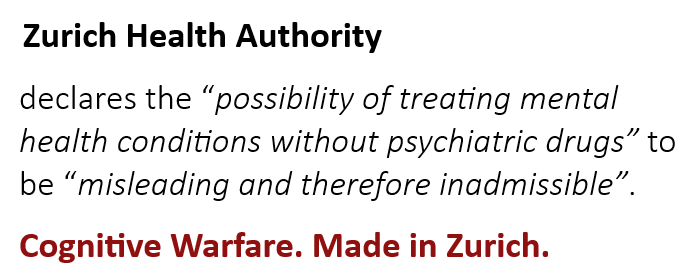
The Association of Swiss Psychotherapists (ASP) combats the international treatment standard of cognitive psychotherapy and receives covering fire from the Health Directorate of Zurich, which officially classifies the “possibility of healing psychological complaints without psychotropic drugs” as “misleading and therefore impermissible.” Cognitive warfare. Made in Zurich.
The Most Serious Objection: Does Thinking Do the Work, or Behavior?
At this point a finding must be put on the table that seriously challenges this article’s thesis—and that is usually missing from texts advocating the cognitive approach.
In 1996 a group around Neil Jacobson took cognitive behavior therapy apart into its components and tested them separately: behavioral activation only, work on the automatic thoughts only, or both together.18 The expectation was that the complete method would win. It did not. Behavioral activation on its own was just as effective as the full package, and remained so at follow-up. A larger replication confirmed the effectiveness of behavioral activation and found it superior in more severely affected patients.19
Anyone concluding from this that thinking plays no part has, however, overlooked the most instructive detail. In the 1996 study all three conditions changed negative thinking and the unfavorable explanatory style to the same degree—including the one in which thoughts were never discussed at all. That is not an argument against the cognitive reading. It is an argument that the change of thinking is the common denominator to which different routes lead.
And it fits exactly what was said above about maintenance. Whoever gets someone to do something he considered pointless supplies him with an experience that contradicts his conviction. Behavioral activation works not because movement makes one happy in itself, but because it refutes a conviction. It is a cognitive experiment, not a health program.
From this follows the practical difference at issue in this article. Whoever instructs a depressed person to go for a walk is prescribing an activity—and she will leave it undone for the same reason she leaves everything undone. Whoever, by contrast, has her write down her prediction - “this will come to nothing” - and then check what actually happened, is working at the same place as behavioral activation, but at the right end: on the self-harming conviction. What the person does in the process is secondary. What gets examined is the thought.
How Long Does It Take?
Considerably less time than common practice suggests. As early as 1994, Klaus Grawe, professor of clinical psychology at the University of Bern, showed with his evaluation of the entire outcome research of the day that the cognitive methods are highly significantly superior to the uncovering long-term methods—at a fraction of the number of sessions.20 Nothing about that ranking has changed in thirty years; what has changed is only how little it impresses the health care system.
A realistic order of magnitude in mild to moderate depression: a concentrated start, in which one’s own thoughts are written down, sorted, and examined, followed by a few appointments for refreshment at intervals of weeks. What happens in that time is not the disappearance of the depression. It is the acquisition of a method. Whether it is then applied is decided by no one but the person concerned—and that is not a hardship but the one piece of good news in this entire situation.
Young Women: The Numbers and the Disputed Explanation
The increase in depressive complaints is not distributed evenly across the population. It is strikingly concentrated among young women.
One of the most precise surveys on this comes from Switzerland. The Swiss Health Survey 2022 records the highest psychological burden of any age group among fifteen- to twenty-four-year-olds; among the young women in that group, 9 percent were severely and a further 20 percent moderately burdened, and 18 percent reported an anxiety disorder in the past year.21 Compared with the 2017 survey, the proportion of psychologically burdened young women rose from 19 to 29 percent.22 Surveys from North America and Britain point the same way.
There is no scientific consensus on the explanation for this rise, and it would be dishonest to feign one here. One side, represented among others by Jean Twenge and Jonathan Haidt, sees a causal connection with the spread of social networks since roughly 2012 and points out that the associations are consistently stronger among girls than among boys.23 The other side, represented among others by Amy Orben and Andrew Przybylski, considers the associations found too small to carry policy conclusions and points to the methodological degrees of freedom in such analyses.24 Both sides work in part with the same data sets and reach different results—a circumstance that counsels caution.
My own view of the causes I have set out elsewhere, in the article “Never Alone Again—and Abandoned All the Same: AI as a Substitute for Attachment”.25
For the purposes of this article, however, the dispute is secondary. Whatever causes the rise: comparing oneself with other people’s lives as they present themselves on a screen generates convictions: “everyone else is further along.” And that conviction belongs to the kind that can be examined—beginning with the question whether anyone has ever counted.
When a Physician Is Needed After All
The boundary runs where thinking itself is affected. In a severe depressive episode the capacity to think is considerably impaired: thoughts falter, circle, freeze. Anyone asked in that state to sort his thoughts is not encouraged but, often enough, overwhelmed. What is needed first is stabilization, and for that medication may under some circumstances be exactly the right means.
The same holds for physical causes: every suspicion of one belongs investigated before anyone talks about errors of reasoning. Thyroid function, blood count, iron and vitamin status, drug side effects—that is quickly done and occasionally answers the whole question. And where there are thoughts of suicide, all self-treatment ends: the situation then belongs without delay in the hands of a physician, a psychiatric emergency service, or the emergency service where one lives.
Core Assessment
Six statements sum up what can be said with confidence from the state of research.
First: a medication changes states, not contents. It can lift mood and increase drive; what a depressive thought asserts, it leaves untouched.
Second: in mild to moderate depression the advantage of antidepressants over a dummy medication is on average minimal to not demonstrable; the effect grows only with severity.
Third: on the risk side there is a warning signal in young people. The recalculation of the FDA data found an increased rate of suicide attempts under antidepressant medication. The methodological question is disputed; the regulator’s warning for those under twenty-five is not.
Fourth: cognitive methods, whose core is work on thoughts and convictions, achieve a medium to large effect in this range, one that survives correction for publication bias—and that appears, in attenuated form, even when no one accompanies the person at all.
Fifth: the real advantage shows after treatment ends. Those who stop medication relapse more than twice as often as those who have completed the cognitive work.
Sixth: which component of treatment carries the effect is not scientifically settled. The best available finding is that all effective routes change the same thing—one’s thinking about oneself.
Anyone wishing to derive advice from this arrives at one that sounds less consoling than it is: the work of changing your cognitions is done by no one but you. But you can do it.
Cognitive Psychotherapy from Dr. Dietmar Luchmann, LLC, works on the thinking errors that cause the suffering — in writing, by video, or in a single-day block. Three paths, one goal.
1. Understand the Method
2. Check Your Suitability
3. Apply for Admission
1 Luchmann, D.: What Is Cognitive Psychotherapy? Psychotherapie. 07/22/2026.
2 Luchmann, D.: “Like the Clap, Doctor?” A Day Against Depression. Psychotherapie. 08/15/2026.
3 Epictetus: Enchiridion, ch. 5. Edition used: Epiktet, Teles, Musonius: Ausgewählte Schriften. Griechisch - Deutsch. Edited and translated by Rainer Nickel. Zurich: Artemis Verlag, 1994, p. 15. [English wording after the public-domain translation by Elizabeth Carter, 1758.]
4 Beck, A.T.; Rush, A.J.; Shaw, B.F.; Emery, G.: Cognitive Therapy of Depression. New York: Guilford Press, 1979. [P. 8: “The philosophical origins of cognitive therapy can be traced back to Stoic philosophers”. The cognitive triad is set out on p. 11.]
5 Luchmann, D.: Cognitive Behavior Therapy and Cognitive Psychotherapy — the Difference. Psychotherapie. 06/04/2026.
6 Cuijpers, P.; Miguel, C.; Harrer, M.; Plessen, C.Y.; Ciharova, M.; Ebert, D.; Karyotaki, E.: Cognitive behavior therapy vs. control conditions, other psychotherapies, pharmacotherapies and combined treatment for depression: a comprehensive meta-analysis including 409 trials with 52,702 patients. World Psychiatry, 2023, 22(1), 105-115. doi.org/10.1002/wps.21069.
7 Cuijpers, P.; Berking, M.; Andersson, G.; Quigley, L.; Kleiboer, A.; Dobson, K.S.: A meta-analysis of cognitive-behavioural therapy for adult depression, alone and in comparison with other treatments. Canadian Journal of Psychiatry, 2013, 58(7), 376-385. doi.org/10.1177/070674371305800702.
8 National Institute for Health and Care Excellence: Depression in adults: treatment and management. NICE guideline NG222, 2022, recommendation 1.5.3 and table 1.
9 Fournier, J.C.; DeRubeis, R.J.; Hollon, S.D.; Dimidjian, S.; Amsterdam, J.D.; Shelton, R.C.; Fawcett, J.: Antidepressant drug effects and depression severity. A patient-level meta-analysis. JAMA, 2010, 303(1), 47-53. doi.org/10.1001/jama.2009.1943.
10 Hengartner, M.P.; Plöderl, M.: Newer-Generation Antidepressants and Suicide Risk in Randomized Controlled Trials: A Re-Analysis of the FDA Database. Psychotherapy and Psychosomatics, 2019, 88(4), 247-248. doi.org/10.1159/000501215. [In the original: “the rate of (attempted) suicide was about 2.5 times higher in antidepressant arms relative to placebo.”]
11 Hayes, J.F.; Lewis, G.; Lewis, G.: Newer-Generation Antidepressants and Suicide Risk. Psychotherapy and Psychosomatics, 2019, 88(6), 371-372, together with the reply by Hengartner and Plöderl, ibid. 373-374.
12 Friedman, R.A.; Leon, A.C.: Expanding the Black Box — Depression, Antidepressants, and the Risk of Suicide. New England Journal of Medicine, 2007, 356(23), 2343-2346. On the underlying analysis: Stone, M.; Laughren, T.; Jones, M.L. et al.: Risk of suicidality in clinical trials of antidepressants in adults. BMJ, 2009, 339, b2880.
13 Davies, J.; Read, J.: A systematic review into the incidence, severity and duration of antidepressant withdrawal effects: Are guidelines evidence-based? Addictive Behaviors, 2019, 97, 111-121. doi.org/10.1016/j.addbeh.2018.08.027.
14 Henssler, J.; Schmidt, Y.; Schmidt, U.; Schwarzer, G.; Bschor, T.; Baethge, C.: Incidence of antidepressant discontinuation symptoms: a systematic review and meta-analysis. The Lancet Psychiatry, 2024, 11(7).
15 Hengartner, M.P.; Angst, J.; Rössler, W.: Antidepressant use prospectively relates to a poorer long-term outcome of depression: results from a prospective community cohort study over 30 years. Psychotherapy and Psychosomatics, 2018, 87(3), 181-183. doi.org/10.1159/000488802.
16 Schulte von Drach, Markus C.: “Die Pharmaindustrie ist schlimmer als die Mafia”. Interview with the Danish specialist and professor at the University of Copenhagen Peter C. Gøtzsche. Süddeutsche Zeitung (Munich). 02/06/2015. [In German. The passage drawn on: Gøtzsche assumes that 95 percent of the money spent on medicines could be saved without patients coming to harm, and that more people would in fact be able to lead longer and happier lives.]
17 Hollon, S.D.; DeRubeis, R.J.; Shelton, R.C. et al.: Prevention of relapse following cognitive therapy vs medications in moderate to severe depression. Archives of General Psychiatry, 2005, 62(4), 417-422. doi.org/10.1001/archpsyc.62.4.417.
18 Jacobson, N.S.; Dobson, K.S.; Truax, P.A.; Addis, M.E.; Koerner, K.; Gollan, J.K.; Gortner, E.; Prince, S.E.: A component analysis of cognitive-behavioral treatment for depression. Journal of Consulting and Clinical Psychology, 1996, 64(2), 295-304. doi.org/10.1037/0022-006X.64.2.295.
19 Dimidjian, S.; Hollon, S.D.; Dobson, K.S.; Schmaling, K.B.; Kohlenberg, R.J.; Addis, M.E.; Gallop, R.; McGlinchey, J.B.; Markley, D.K.; Gollan, J.K.; Atkins, D.C.; Dunner, D.L.; Jacobson, N.S.: Randomized trial of behavioral activation, cognitive therapy, and antidepressant medication in the acute treatment of adults with major depression. Journal of Consulting and Clinical Psychology, 2006, 74(4), 658-670. doi.org/10.1037/0022-006X.74.4.658.
20 Grawe, K.; Donati, R.; Bernauer, F.: Psychotherapie im Wandel. Von der Konfession zur Profession. Göttingen: Hogrefe Verlag, 1994.
21 Swiss Federal Statistical Office: Changes in psychological distress. Swiss Health Survey 2022. Press release of 11/03/2023.
22 Health Promotion Switzerland: Dossier on the mental health of adolescents and young adults, based on the Swiss Health Survey 2022 and the HBSC study 2022.
23 Twenge, J.M.; Haidt, J.; Joiner, T.E.; Campbell, W.K.: Underestimating digital media harm. Nature Human Behaviour, 2020, 4, 346-348. doi.org/10.1038/s41562-020-0839-4.
24 Orben, A.; Przybylski, A.K.: The association between adolescent well-being and digital technology use. Nature Human Behaviour, 2019, 3, 173-182. doi.org/10.1038/s41562-018-0506-1.
25 Luchmann, D.: Never Alone Again — and Abandoned All the Same: AI as a Substitute for Attachment. Psychotherapie. 07/29/2026.
Your Comment
Are you interested in contacting the author? Do you have remarks, suggestions, or additions regarding this article? Do you have personal therapy experiences? We welcome substantial feedback.