A Morning When the Agora Loses Its Terror
The ancient Greeks called the market and assembly place at the heart of their cities the agora. From it agoraphobia takes its name — literally the fear, Greek phóbos, of the agora. It belongs among the finer ironies of intellectual history that at just such an agora, in the bustle of fifth-century-BC Corinth, the first recorded talking cure also had its beginning. The sophist Antiphon, an ancient source reports, “devised, while he was still occupied with poetry, a method of relieving distress [technē alypias], much as the physicians’ treatment relieves the sick. At Corinth he had fitted out a house near the agora and posted upon it that he was able to heal those suffering from grief by words [dia logōn therapeuein].” Whoever named to him merely the cause of his suffering would be prescribed the remedy on the spot.1
The idea that it is not a potion but ordered thinking that frees the tormented is thus no invention of the modern age. It is as old as the square that gave the illness its name. Zurich’s Sechseläutenplatz is today’s agora, and the cognitive psychotherapy of agoraphobia is Antiphon’s craft, to which two and a half millennia of psychological precision have been added. Whoever wishes to understand agoraphobia does well, then, to begin at the beginning — with what this illness actually is.
What Agoraphobia Is: The Fear of Open Spaces and the Phobic Triad
The term was coined in 1872 by the Berlin psychiatrist and neurologist Carl Westphal. He joined the ancient Greek words agorá (marketplace) and phóbos (fear) into “Platzfurcht,” to designate a “fear of crossing open squares or streets” as a disorder in its own right.2 In everyday German the condition is still called Platzangst — a word readily confused with claustrophobia, the fear of enclosed spaces. In truth agoraphobia is its opposite: it is not narrowness that frightens, but expanse.
The classification in force today, the World Health Organization’s ICD-11, binding since 2022, lists agoraphobia as a diagnosis in its own right, 6B02 (ICD-10: F40.0). It is the marked, disproportionate fear of situations in which escape might be difficult or help unavailable: open squares, crowds, pedestrian zones, shops, the restaurant, the lecture hall, public transport, traveling alone and far from home — the train ride, the flight, one’s own drive on the motorway.3 The phobic core is always the same: the fear of losing control over one’s own body once the “safe” house has been left behind and no escape remains.
Agoraphobia rarely comes alone. It regularly joins forces with panic disorder (ICD-11: 6B01, ICD-10: F41.0) and, in time, with generalized anxiety disorder (ICD-11: 6B00, ICD-10: F41.1). For this connected pattern of illness I use the term the “phobic triad.”4 The ICD-11 has since confirmed the clinical observation: it separates agoraphobia and panic disorder cleanly as distinct entities while expressly permitting them as comorbid diagnoses. The phobic triad is thus no psychodiagnostic caprice but a classificatory standard.
The Panic Attack from the Inside
Anyone who has never had a panic attack underestimates it. It is not a discomfort; it is a bodily thunderstorm: racing heart, sweats, dizziness, tunnel vision, nausea, trembling. To these are added the two thoughts that make everything worse — I am about to die, I am about to go mad. The peak of arousal is followed, inevitably, by exhaustion. And here precisely lies the trap: with each attack survived, what spreads is not relief but the worry of when and where the next loss of control will strike. Fear becomes the fear of fear.
The American psychologists Alan Goldstein and Dianne Chambless described this mechanism in 1978 under the name “fear of fear”: the body learns to dread the first harmless heralds of arousal and works itself up on them.5 Remarkably, Westphal had seen the essential point as early as 1872. He noted that his patients did not really fear the squares but the anxiety itself — the historical root of the fear of fear, a full century before its scientific measurement.
Søren Kierkegaard, before psychology could grasp the feeling, cast it in an image that captures agoraphobia more precisely than many a diagnostic checklist: “Anxiety is the dizziness of freedom.”6 The dizziness is both at once — a cardinal symptom of panic and the apt metaphor for the empty square, which suddenly offers a person an excess of possibility and no longer any hold. Where everything is open, there is nothing to hold on to.
Whoever, in this state, reaches for alcohol or for psychopharmacological “anxiolytics” numbs the symptom and only buries the cause deeper. Patients with agoraphobia accordingly bear, more often than average, a second burden — depression, further anxiety disorders, a substance abuse that began as self-medication.7 Today’s sedation is tomorrow’s dependency.
An Error with a History: From Benedikt’s Platzschwindel to Westphal’s Agoraphobia
That the illness arises in the mind and not in the eye was by no means clear from the start. Two years before Westphal, in 1870, the Viennese neurologist Moritz Benedikt described the same type of patient under the title “Über Platzschwindel” (“On the Dizziness of Open Places”) — and misread it: he took the dizziness for the primary phenomenon and the anxiety for its consequence, suspecting a disorder of the eye or of balance.8 It was Westphal who, in 1872, reversed the order and recognized that the anxiety produces the dizziness, not the other way around; almost simultaneously the physician Emil Cordes arrived independently at the same conclusion.9 The dispute over whether the body or the thought comes first is thus as old as the diagnosis itself — and cognitive psychotherapy decided it long ago.
That the expanse of the square can itself make one ill has, moreover, not remained a mere medical theory. When the Sechseläutenplatz was transformed from a wasteland into open urban space, the “Neue Zürcher Zeitung” reported, with fine mockery, on a “spread of the agoraphobia epidemic” in Zurich, which has seemed to rage with particular force ever since.10 At nearly 16’000 square meters11 it is the largest inner-city square in Switzerland12 — and thus, for the agoraphobe, the greatest conceivable challenge in the middle of the city. What urban planning meant as a gift to its citizens, the phobic reads as a threat. Both are right; they merely read the same square differently. And in precisely that lies the key to the cure.
The Cognitive Error at the Center
The decisive finding came in 1986 from the Oxford psychologist David Clark. His cognitive model of panic can be summarized in a single sentence: the panic attack arises from the catastrophic misinterpretation of harmless bodily sensations.13 The heart pounds — and the sufferer reads into it not the ordinary consequence of excitement, coffee, or climbing stairs, but the harbinger of a heart attack. From the misinterpretation grows the fear, from the fear grow further bodily symptoms, and from these grows the next, worse misinterpretation. A closed circle whose engine is not the body but the thinking about it.
From this follows the entire logic of the treatment. If a cognitive error drives the panic, then the panic falls apart as soon as the error is recognized and corrected. It has even been shown that the change in precisely this misinterpretation predicts the treatment’s success — it is not the practicing but the rethinking that carries the cure. Here cognitive psychotherapy and cognitive behavioral therapy part ways, the two being perpetually confused in search engines and self-help guides. Cognitive behavioral therapy rehearses the feared behavior with the patient and sets a cognitive cap upon the exercise. Cognitive psychotherapy, by contrast, corrects the thinking first — and then leaves the practicing of the new behavior to the patient himself, in his own life.
Whoever wishes to know the difference more exactly will find it explained in my article comparing cognitive psychotherapy and cognitive behavioral therapy14. For agoraphobia the essence suffices: what is healed is the thinking about the square; the behavior on the square then follows the behavior-governing thinking.
That the cognitive methods are not only more elegant but also demonstrably more effective than the years-long interpretive labor of psychoanalysis and depth psychology has, since Klaus Grawe’s great Bern meta-analysis, ceased to be a matter of dispute and become the state of research.15 For what most often brings people into psychotherapy - anxiety, panic, phobias - work on thinking is the treatment of choice.
Antiphon, Goethe, and Healing through One’s Own Thinking
From all this follows the two-part structure of cognitive psychotherapy. In the first, cognitive part, the psychotherapist leads the phobic patient to insight into the learning-history origins of his anxiety, lays open the cognitive errors he could not detect on his own, and hands him the mental tools to change his thinking. In the second part, the patient translates this changed thinking into changed behavior on his own — alone, where it counts, and not on the psychotherapist’s arm.
That this second part can be carried out as self-therapy is no assertion but a matter of record in the literature. As a young man, Johann Wolfgang von Goethe suffered from a pronounced fear of heights. In his autobiography of 1812 he described this fear and how he treated it himself:
“A dizziness, above all, [...] distressed me, seizing me each time I looked down from a height.”
Goethe, Johann Wolfgang von: Aus meinem Leben. Dichtung und Wahrheit. Zweyter Theil. Tübingen, 1812, p. 388.16
What Goethe then did stands in every present-day textbook of behavioral therapy, in the chapter on exposure treatment — except that he did it without a textbook and without a psychotherapist, out of the sharpness of his thinking alone. After the independent intellectual penetration and self-recognition of his phobic thinking, for which today cognitive psychotherapists provide help as the indispensable cognitive preparation for the therapeutic exercises, Goethe in Strasbourg resolutely proceeded to the exercise:
“Quite alone I climbed to the highest summit of the minster tower and sat [...] for a good quarter of an hour before I dared to step out again into the open air [...] Such fear and torment I repeated so often, until the impression became wholly indifferent to me.”
Goethe, ibid., pp. 388-389 [text unchanged from the 1812 original; translated from the German].17
Only very few people possess Goethe’s intellectual power to walk this path of insight entirely alone. That is precisely what the cognitive preparation is for: the psychotherapist performs the share of the thinking that the phobic patient cannot perform by himself, and thereby makes him into what Goethe was by nature — his own therapist. That the word here is “therapist” and not “psychotherapist” has its reason: the protected title the client cannot hold, but the thing itself he can certainly realize on his own.
Seven Hours: The Day Block on Zurich’s Sechseläutenplatz
How short an effective psychotherapy can be is shown by the day block, one of the three paths to the self-therapy of anxiety at Psychotherapie.com. It consists, in turn, of three parts and lasts seven hours in all. It is preceded by a written online block of psychodiagnostic assessment of about three hours, in which the client sets out, at leisure and without the pressure of the clock, the learning history of his anxiety and his thinking. There follow three hours of cognitive psychotherapy in conversation at the coffee table of the Brasserie Schiller, in which the cognitive errors are uncovered and the tool for their correction is handed over. And there remains the final hour, in which the psychotherapist stays seated at the window and does nothing but watch as the client crosses the Sechseläutenplatz, again and again, alone, and savors his new sense of life upon the once-feared expanse.
These seven hours are no advertising promise; they lie exactly where the international guideline for effective psychotherapy points. The British National Institute for Health and Care Excellence (NICE) recommends, for panic disorder, cognitive psychotherapy in the optimal range of seven to fourteen hours, expressly holds the briefer variant to be appropriate provided it is interlocked with structured self-help material, and even points, for individual patients, to intensive treatment over a very short period.18 That is precisely the day block: the lower end of the guideline, gathered into a single day on which self-help is carried over into the self-therapy that every cognitive psychotherapy aims at in any case.
At the end the client returns to the café and reports, elated, on Zurich’s agora now mastered. What remains is not a next appointment but the superfluity of one. At the Goethe Bar of the brasserie, with a view of the square to the right and the opera house to the left, the liberation from anxiety winds down at leisure — fittingly, in the very place where, above the bar, stands the name of the man who carried out the thing on himself two hundred years ago.
Why the Psychodiagnostic Assessment Comes First, in Writing
That the first block takes place in writing and online is no concession to technology but part of the method. On paper the beguiling flair of the consulting room evaporates. Every sentence must be thought before it stands; the empty phrase exposes itself, the cognitive error becomes visible in black and white. Thus the correction of thinking begins before the first espresso is served on the Sechseläutenplatz.
When the Cure Is Too Short to Be Permitted
One might suppose that an anxiety disorder that can be dissolved in seven hours and without a single medication would be good news — not least for a health authority. In Zurich the opposite is the case. The cantonal Health Directorate of Zurich supports the cognitive warfare of the Association of Swiss Psychotherapists (ASP)20 against public education about effective psychotherapy, officially classifying the “possibility of healing psychological complaints without psychotropic drugs,” as well as the statement “that anxiety disorders could be healed in eight to ten hours, or that a life could become fully worth living again after a few therapy sessions,” as “misleading and therefore impermissible.”19
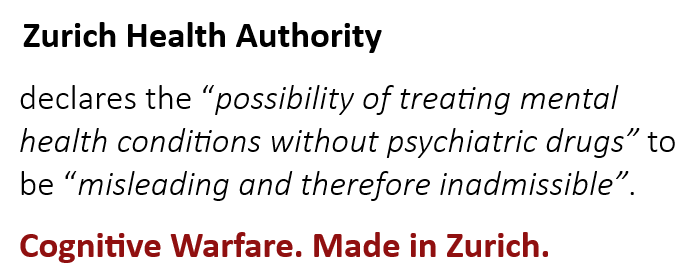
The Association of Swiss Psychotherapists (ASP) combats the international treatment standard of cognitive psychotherapy and receives covering fire from the Health Directorate of Zurich, which officially classifies the “possibility of healing psychological complaints without psychotropic drugs” as “misleading and therefore impermissible.” Cognitive warfare. Made in Zurich.
This is remarkable insofar as the second of these allegedly misleading statements is the international treatment standard. The NICE guideline18, which the seven-hour day block follows, names for panic disorder exactly the range of seven to fourteen hours — and even the eight to ten hours objected to by the authority lie wholly within that range. Whoever declares it “misleading” thereby declares Europe’s leading evidence-based psychotherapy guideline misleading, and places a cantonal legal department above international science.
This official assessment has, to this day, been neither corrected nor withdrawn. It thus still stands, and with it its silent obverse: if the truth that agoraphobia can be overcome in seven hours is “impermissible,” then the “permissible” alternative is the one we all know — the psychotherapy that drags on for years, in the extreme case for two decades, and the chemical sedation that dampens the symptom and not seldom leads into dependency and chronification. It is a peculiar protection of health in Zurich that forbids the efficient psychotherapeutic path and leaves the inefficient one open. Who in Zurich is being protected from whom, the reader may decide for himself.
Frequently Asked Questions about Agoraphobia
Is Agoraphobia the Same as Claustrophobia?
No. In everyday German, agoraphobia is called Platzangst, which is often confused with claustrophobia, the fear of enclosed spaces. Medically, agoraphobia is the opposite: the fear of open squares, crowds, and situations without an escape route.
What Are the Symptoms of Agoraphobia?
At the center stands the panic attack, with racing heart, sweats, dizziness, tunnel vision, nausea, and trembling, accompanied by the fear of dying and the fear of losing control or one’s mind. The dread of a further attack becomes the fear of fear, which draws the radius of movement ever tighter.
Is Agoraphobia Curable — and How Quickly?
Agoraphobia is the most readily and most quickly treatable anxiety disorder. With cognitive psychotherapy it can be overcome in a day block of seven hours — a figure that corresponds exactly to the lower limit of the NICE guideline18.
What Distinguishes Cognitive Psychotherapy from Cognitive Behavioral Therapy?
Cognitive psychotherapy heals solely through the correction of the pathogenic cognitive error; the changed behavior the patient then practices himself. Cognitive behavioral therapy adds a cognitive component to the behavioral exercise — but with agoraphobia it is the correction of the cognitive error that is decisive. The difference is explained in an article comparing cognitive psychotherapy and cognitive behavioral therapy.14
Does Treating Agoraphobia Require Medication?
No. Sedatives and “anxiolytics” numb the symptom and lead into dependency without touching the cause. The NICE guideline18 expressly advises against benzodiazepines for panic disorder. Cognitive psychotherapy manages without medication.
Cognitive Psychotherapy from Dr. Dietmar Luchmann, LLC, works on the thinking errors that cause the suffering — in writing, by video, or in a single-day block. Three paths, one goal.
1. Understand the Method
2. Check Your Suitability
3. Apply for Admission
1 Antiphon der Sophist. In: Diels, H.; Kranz, W. (eds.): Die Fragmente der Vorsokratiker. Vol. 2. Hildesheim: Weidmannsche Verlagsbuchhandlung, 1952 [cited p. 336f. - DK 87 A 6].
2 Westphal, C.: Die Agoraphobie, eine neuropathische Erscheinung. Archiv für Psychiatrie und Nervenkrankheiten (Berlin), February 1872, vol. 3, no. 1, pp. 138-161 [cited p. 138].
3 World Health Organization: ICD-11 for Mortality and Morbidity Statistics, 6B02 Agoraphobia. Geneva, in force since January 1, 2022. [ICD-10: F40.0; panic disorder 6B01/F41.0; generalized anxiety disorder 6B00/F41.1.]
4 Luchmann, D.: The Liberation from the Prison of Fear. Cambridge, UK: TCI, 2010.
5 Goldstein, A.J.; Chambless, D.L.: A reanalysis of agoraphobia. Behavior Therapy (New York), 1978, vol. 9, pp. 47-59 [original p. 51: “‘Fear of fear’ as the most central phobic element.”]
6 Kierkegaard, S. [under the pseudonym Vigilius Haufniensis]: Begrebet Angest [English: The Concept of Anxiety]. Kjøbenhavn: Faaes hos Universitetsboghandler C.A. Reitzel, 1844. [Danish original pp. 61f.: «Saaledes er Angest den Frihedens Svimlen, der opkommer, idet Aanden vil sætte Synthesen, og Friheden nu skuer ned i sin egen Mulighed, og da griber Endeligheden at holde sig ved.»]
7 Telch, M.J.; Cobb, A.R.; Lancaster, C.L.: Agoraphobia. In: Hofmann, S.G. (ed.): The Wiley Handbook of Cognitive Behavioral Therapy. Vol. 3: Smits, J.A.J. (ed.): Part Two: Specific Disorders. Chichester: Wiley-Blackwell, 2014, 941-978. [Original p. 965: “Patients with agoraphobia often present with one or more co-occurring psychiatric conditions such as depression, other anxiety disorders, and substance use disorders.”]
8 Benedikt, M.: Über Platzschwindel. Allgemeine Wiener Medizinische Zeitung, 1870, vol. 15, 488-490.
9 Kohl, F.: “Agoraphobie - Platzangst/Platzfurcht - Platzschwindel.” Die klassischen Beschreibungen der Platzangst von Carl Westphal und Emil Cordes und ihre Bedeutung für die Konzeptgeschichte und aktuelle Diskussion der Angsterkrankungen. Psychiatrische Praxis, 2001, vol. 28, 3-9.
10 Steiner, U.: Keine Angst vor der Leere. Neue Zürcher Zeitung (Zurich), 03.09.2014, no. 203, p. 20.
11 Stadt Zürich: Sechseläutenplatz wird am 22. April 2014 eingeweiht. Media release. 15.01.2014.
12 Sechseläuten-Platz: Jetzt werden die Steine verlegt. Tagesanzeiger (Zurich). 02.04.2013.
13 Clark, D.M.: A cognitive approach to panic. Behaviour Research and Therapy (Oxford), 1986, vol. 24, no. 4, 461-470 [original p. 469: “It has been suggested that panic attacks result from the catastrophic interpretation of certain bodily sensations.”]
14 Luchmann, D.: Cognitive Behavioral Therapy and Cognitive Psychotherapy — The Difference. Psychotherapie. June 4, 2026.
15 Grawe, K.; Donati, R.; Bernauer, F.: Psychotherapie im Wandel. Von der Konfession zur Profession. Göttingen: Hogrefe Verlag, 1994 [German original p. 670: «Kognitiv-behaviorale Therapie ist im Durchschnitt hochsignifikant wirksamer als psychoanalytische Therapie und Gesprächspsychotherapie»].
16 Goethe, J.W.v.: Aus meinem Leben. Dichtung und Wahrheit. Zweyter Theil. Tübingen: J. G. Cottaische Buchhandlung, 1812, p. 388. [Quotation translated from the German original.]
17 Goethe, ibid., pp. 388-389 [text in each case unchanged from the 1812 original; translated from the German].
18 National Institute for Health and Care Excellence (NICE): Generalised anxiety disorder and panic disorder in adults: management. Clinical guideline. 15 June 2020. [Original section 1.3.15: «CBT in the optimal range of duration (7 to 14 hours in total) should be offered.» Section 1.3.20: «Benzodiazepines are associated with a less good outcome in the long term and should not be prescribed for the treatment of individuals with panic disorder.»]
19 Luchmann, D.: Zurich Health Directorate Under Natalie Rickli and the Association of Swiss Psychotherapists (ASP). Psychotherapie. 03.03.2026.
20 Luchmann, D.: Cognitive Warfare by the Association of Swiss Psychotherapists (ASP). Psychotherapie. 16.03.2026.
Your Comment
Are you interested in contacting the author? Do you have remarks, suggestions, or additions regarding this article? Do you have personal therapy experiences? We welcome substantial feedback.