A Woman's Question
Dr. Friedrich Weihenruh stepped up to the lectern without a manuscript, which caused a certain unease in the hall, and said:
"I had prepared a talk on a cognitive case formulation for today. I am not going to give it. Something better has happened to me."
He laid a sheet of paper on the lectern.
"Not long ago a woman asked me about a painting. I did not know it, which put me in a situation that rarely befalls a member of my profession: I had nothing to say. The question was: What do you suppose the two of them are discussing? Is he slightly arrogant, and she a little downcast / turned toward him — or am I mistaken?"
He looked out into the hall.
"I have brought this question with me because it is better than most of the questions I hear at conferences. It contains something that occurs in our profession about as often as snow in August: a doubt about one's own perception. She does not say: The man is arrogant. She asks: Am I mistaken? Please hold on to that for the rest of the afternoon. We shall come back to it, in a manner you will not enjoy."
Then he had the picture thrown up on the wall.
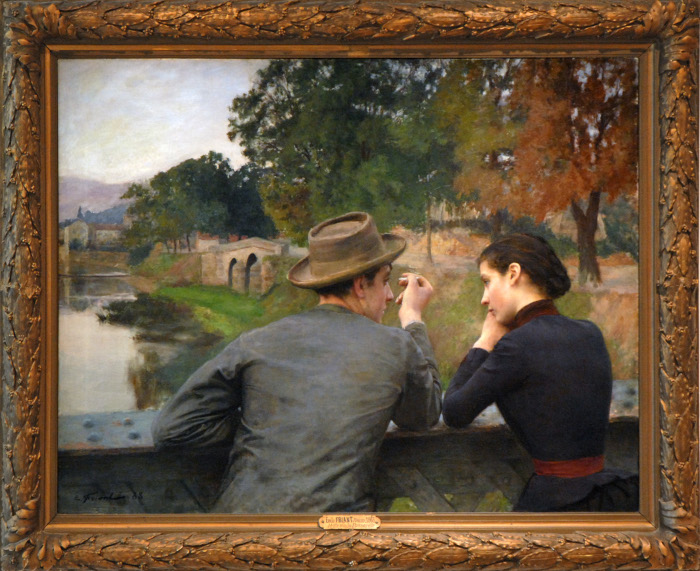
Émile Friant (1863-1932): Les Amoureux, also Soir d'automne and Idylle sur la passerelle, 1888, oil on canvas, Musée des Beaux-Arts de Nancy. Image source: Wikimedia Commons (public domain).
"Émile Friant, Les Amoureux, painted in 1888, signed E. Friant 88. The museum in Nancy also lists it under two further titles: Soir d'automne, autumn evening, and Idylle sur la passerelle, idyll on the footbridge. It has hung there since 1888, because the museum commission bought it in the year it was made. The location is known: the site of the Grands Moulins, the great mills of Nancy, seen from the Passerelle du Pont-Cassé over the Meurthe. That is not a park. That is a place where people work."
He took a step back.
"And now I should like to know from you what you see. Not what you think. What you see."
What You See, and What You Add
The hall held some seventy psychotherapists of various schools, which is to say, people professionally accustomed to being listened to. The answers came accordingly fast.
"He is talking at her."
"She has withdrawn into herself."
"He takes up a great deal of room."
"Those two have nothing left to say to each other."
"Autumn. It is coming to an end."
Weihenruh took notes. After the fifth answer he stopped.
"I have written down five answers and not a single observation. I had asked for observations. You have supplied me with interpretations, at a speed I find, entirely without irony, admirable. You needed about a second and a half to turn paint on canvas into a love story with a beginning, a middle, and a foreseeable end."
Someone called out: "He is wearing a hat."
"Thank you," said Weihenruh. "That was the first observation of the afternoon. It arrived after four minutes. Please continue."
It took a while, but then they came:
Two people are leaning on the railing of an iron bridge.
He stands on the left, she on the right.
Both have their backs to the viewer; his head is turned toward her.
Both are propped on the same railing in the same posture.
In his hand he holds a cigarette.
She rests her head on her hand.
They are not touching.
Behind them lie a river, trees, and buildings.
The foliage has turned.
"That is the entire body of evidence," said Weihenruh. "Nine lines. Everything else that will be said here today is an addition. Note how little stands there. And note how much you made of it a moment ago, without noticing that you were doing it."
He turned to the screen.
"For your reassurance: you are doing no worse than scholarship. If you look up how large this painting is, you will find two figures. The museum's own catalogue entry gives a height of one hundred fourteen centimeters. Other accounts, among them the French-language standard reference work of the internet, give one hundred eleven. We are not dealing here with an interpretation, a mood, or the souls of the people involved. We are dealing with the height of a canvas that has hung on the same wall for one hundred thirty-eight years and could be settled with a tape measure. There is no agreement." He smiled politely. "And you propose to read from a young woman's face whether she is happy."
The Cigarette and the Vandal
A gentleman in the second row raised his hand. He spoke slowly, in the manner of someone accustomed to being waited for.
"You are suppressing the obvious. The cigarette is not a prop. It stands between the two of them, it is in his hand, it is burning down. That is a symbol, and not a particularly well-hidden one."
"A symbol of what?" Weihenruh asked amiably.
"Of running out. Of transience. Possibly also of a masculinity pushing itself between the two of them."
"Very good," said Weihenruh. "I have a counter-question, and I ask it without the slightest mockery: what would have to be visible in this painting for your interpretation to be false?"
The gentleman considered.
"That is not a trick question," said Weihenruh. "It is the whole difference between our two conceptions of this profession. If the cigarette means transience, if a missing kiss means distance, if a kiss that were present could mean desperation and a glance to the side could mean it too — then there is no painting and no human being left on which your interpretation could fail. An assumption that excludes nothing says nothing. It is therefore not false. It is something worse: it is without consequence."
"And so the cigarette means nothing at all?"
"It means, to begin with, that a young man is smoking in the year 1888, which was then about as revealing as a mobile telephone in the hand is today. And it means that a certain amount of time has passed since he lit it. That is all, and it is more than you think: it tells us that this conversation has duration. It is not an exclamation. It is a conversation with length."
He paused.
"There is, however, one cigarette in the history of this painting that genuinely does mean something, and it is not painted. In 1912 a visitor to the museum stubbed out his burning cigarette on the canvas. He chose two places: the young man's eye and the young woman's cheek."
The hall went quiet.
"I find that remarkable for two reasons. First, this person destroyed precisely the two places we have been arguing about all afternoon: the gaze and the expression. He appears to have been the only viewer so far to have delivered a genuinely final interpretation." Weihenruh let that stand for a moment. "Second, Friant afterwards restored the painting himself. The painter was permitted to remove the public's commentary with his own hand. I know of no author to whom that good fortune has ever come."
Seven Conclusions in a Second and a Half
"Let us turn to the craft," said Weihenruh. "I shall write down your earlier answers once more, but this time in two columns. On the left, what is visible. On the right, what you made of it."
He is gesturing. — He is arrogant.
She says nothing. — She is sad.
They are not touching. — The two have become strangers.
She is listening to him. — She is his inferior.
The foliage has turned. — Their love is ending.
He is smoking. — Melancholy.
Behind them lies a factory district. — Pretty backdrop, unimportant.
"Seven lines. On the left, every line holds something I cannot dispute. On the right, every line holds something I cannot test. And between left and right not one single fact has been added. No second painting, no letter from Friant, no word from the people involved. You have travelled from observation to diagnosis and have gained no knowledge whatever along the way."
He tapped the first line.
"Line one is mind reading. From a movement of the hand you infer a character trait. Line two is the inference from your own feeling to reality: the painting makes you melancholy, therefore the woman must be melancholy. Line three is selective perception: you count what is missing and overlook what is there — the two are leaning side by side on the same railing, in exactly the same posture, their elbows so close together that a sheet of paper would not fit between them. Line four is a short circuit to which I shall return at length in a moment. Line five is symbolic overreach: it is autumn because it was autumn. The painting is called Autumn Evening, not The End of a Love. Line six you know from your own consulting rooms: you have a suspicion and then assemble the evidence that suits it. And line seven is the most expensive of them all: you declared half the surface of the painting to be decoration, because it did not fit your story."
A colleague asked: "What has this to do with our work? This is art appreciation."
"It has this to do with it: what you are doing here to a painting, you do every day to a face. To the face of your husband, your wife, your child, your superior. The process is identical: a few visible features, lightning-fast completion into a full story, immediate feeling, corresponding behavior. The only difference is that Friant's canvas does not hit back. Your husband does." He shrugged. "That is why we practice on a painting. On a painting the error is free."
The Hand Beneath the Chin
"Now to the woman who rests her head on her hand," said Weihenruh. "And to my favorite part of the afternoon."
He took a piece of chalk, went to the board, and drew something that could with some indulgence pass for the outline of a seated person, elbow on the knee, chin on the fist.
"You recognize the figure. Auguste Rodin conceived it in roughly the same years. It is called The Thinker. It is not called The Downcast, not The Exhausted, and not The Man Who No Longer Knows What to Do. A man puts his hand beneath his chin, and half of humanity recognizes in it the exertion of thought."
He wiped the chalk from his fingers.
"A woman puts her hand beneath her chin, and what do we hear? We hear: She is downcast. We hear: She has withdrawn into herself. We hear: She is enduring it. The posture is the same. The difference is not on the canvas, ladies and gentlemen. It lies entirely in us."
From the hall: "That is rather a cheap point."
"Cheap it is," said Weihenruh. "It has the disadvantage of being true. Test it on yourselves; it costs you nothing. The next time you see someone with a hand beneath the chin in a session, a meeting, or at a family table: notice which assumption offers itself to you first, and notice whether it depends on who is sitting there."
He went back to the lectern.
"And now insert thinking into the description of the painting, experimentally, without any obligation whatever. What happens? Something unpleasant happens: the entire remainder of the picture stays valid, unchanged. She is silent because one is silent while thinking. She looks at him because she is examining what he says. She does not touch him because one has no use for one's hands while calculating. They do not gaze continuously into each other's eyes because two people considering the same problem do not look at each other, they look at the problem. Not one single observation has to be cleared away. The melancholy interpretation, by contrast, has to explain why the painting is called The Lovers. So far it has not done so."
The Gaze Nobody Asked About
"Now to the man whom you pronounced arrogant a while ago."
Weihenruh had the picture enlarged once more.
"Look at where he is looking."
The hall looked.
"He is looking at her. That is not an interpretation of mine, that is the description you will find in every reference work: his gaze turned toward the young woman. One French description of the painting goes further and calls his gaze so intent that it could make her blush."
He turned around.
"And now I ask you for a moment of logical honesty. What does an arrogant person do while he speaks? He looks past the person in front of him. He treats the agreement as settled before he has finished the sentence. Arrogance is not volume, ladies and gentlemen; arrogance is a lack of interest in the other person's face. That lack of interest is precisely what this painting does not contain. The man looks at her while he speaks, and a man who looks at a person while he speaks is checking something. He is checking how it lands."
He took the sheet from the lectern.
"And that is why the question I began with is so remarkable. The woman who asked it saw the gaze. She was the only one to notice the single circumstance on which the entire interpretation turns. She merely equipped it, as we all do, with the nearest available meaning. Her observation was entirely correct. Her conclusion was premature. And her addition — or am I mistaken? — was the most precise thing in the whole affair. I wish my professional literature contained that half-sentence rather more often."
He put the sheet down.
"For if he is not arrogant, if he looks at her while he speaks, and if she is thinking while she is silent, then exactly one economical explanation remains. He has put something to her. He has not yet carried the point. He is waiting."
The Objection from the Second Row
The gentleman from before raised his hand again, and this time his objection was better.
"You are assigning a woman of 1888 a role that did not exist then. Women were not asked for their judgment. You are turning a genre painting into a parable of present-day partnership because that suits you better. This is retrospective projection."
"Your objection is legitimate, and I accept it in full," said Weihenruh. "I do not know what Friant meant. I have no letter, no note, no witness. What I am putting forward here is not a discovery but an assumption that has less trouble with the visible data than the competing assumptions do. Anyone who turns it into an art-historical fact commits the same error as the colleague who distilled transience out of the cigarette, merely with the sign reversed."
"So you concede the point."
"On the burden of proof: entirely. On the probability: not in the slightest." Weihenruh stepped back up to the lectern. "For your objection contains a silent premise, and that premise I hold to be false. You are assuming that two people can behave toward each other only as the statute book of their time provides. People have never done that. Social orders regulate who may inherit, vote, sign, and study. They do not regulate whose judgment a man treats as authoritative in his own life."
He pointed at the screen.
"And look at where the two of them are standing. Not in a salon, not in a meadow, not in front of a ruin. They are standing on an iron footbridge whose rows of rivets can be counted, in front of the site of a milling industry. Nancy in 1888 was no sleepy provincial town. After the annexation of Alsace-Lorraine by the German Empire, people, capital, and skill had moved into this city, among them a notary from Bitche by the name of Jean Daum, who took over a bankrupt glassworks in 1878; his son Antonin entered the firm in 1887, fresh out of engineering school, and within a few years turned it into a world brand. That is the city in which this couple is standing. One year after a young man there entered his father's business."
He turned back to the hall.
"That proves nothing about these two. But it puts an end to the notion that this background is pretty incidental furniture. Whoever stands at that spot in 1888 and speaks about his own future is speaking about work, money, housing, family, and standing, because he could not leave them out if he tried. They have been painted into his picture."
The Companion
"I should now like to use a word that has gone out of fashion," said Weihenruh. "The word is: companion."
He let it stand in the hall for a moment.
"A companion is not an escort. An escort walks alongside you. A companion, if you take the word literally, is the person with whom you share the bread — and whoever has a share in the loaf has a say in how it is cut. The difference is not sentimental, it is structural. A man with an escort carries alone. A man with a companion carries half and is permitted, in return, to hand over half."
"And you read that out of an oil painting," someone called.
"No. What I read out of the painting is that he is waiting. What the waiting is worth I read out of my professional experience, and on this point it is disagreeably unambiguous. In forty years I have met a great many people who had an admiring partner. Admiration is pleasant, it lasts about as long as a compliment, and it carries not one single difficult decision. And I have met few who had a partner who examined them. Those few were the most durable connections that have come my way."
He took two steps.
"The reason is banal. A man who is admired receives no information. He receives applause, and applause is empty of content, because it sounds the same for good undertakings and for bad ones. A man who is examined receives information. It costs him an evening of his vanity, and then he has a second mind at work on his project, the best one available to him, because it is the only one with just as much to lose as he has. That is why the woman in this painting is not the secondary figure. She is the authority."
He stopped.
"And that is why his gaze is not a gaze of superiority. It is the gaze of a man who knows whom he has beside him. A man who looks like that has not won. A man who looks like that is waiting for a judgment he cannot control, and evidently finds that perfectly acceptable. I am not claiming that you can see happiness. I am claiming that you are looking at a man who would have grounds for it."
Weihenruh took a sip of water.
"About the attraction that emanates from a thinking human being I have written at length elsewhere — about the erotics of thinking and what it has to do with giftedness. I refer you to it because I do not wish to repeat here what is written there. I add only the least romantic version of the same thought: the other person's mind is the one part of them that can get better with the years."
He set the glass down.
"And while we are feeling modern: open any dating site this evening. You will find several thousand people there who would like to enjoy life. About the conditions under which life can be enjoyed there is not a word. Not a word about money, not a word about the division of labor, not a word about how disagreements are to be handled, not a word about who decides when it matters. Two young people from 1888 are standing on an iron bridge discussing precisely that. And we consider them the backward ones."
The Bridge
"Let us stay with the bridge, for it is the most important object in this painting, and it is usually mistaken for a railing."
Weihenruh counted off on his fingers.
"First, it is a date. In 1888 riveted iron was not a building material for lovers but the visible proof that rivers, distances, and travelling times had lately become calculable. Anyone who paints a pair of lovers in front of such a structure has either no feeling for romance or a feeling for something else. Friant certainly had a feeling for people arguing with one another; a year later he painted a picture called, explicitly, The Political Discussion."
"Second, a bridge is not a place but a passage. One does not live on it. One is no longer where one came from and not yet where one is going. These two are standing on the only piece of ground in Nancy on which nobody can settle."
"Third, and this is the point that matters to me: a bridge connects two banks that are different. Were they the same, none would be needed. Two people beginning a life together enter it with unequal conditions: different origins, different money, different experience, different notions of what goes without saying. A partnership does not consist in talking those differences away. It consists in building a structure that carries both. What happens when two people consider that structure superfluous because they are in love has been described elsewhere in this journal, where the subject is infidelity and the question of what actually holds a relationship together. Whoever does not build, incidentally, does not end up with a defective bridge. He ends up with a river and the untested expectation of getting across dry."
"And fourth," said Weihenruh, "you are standing on it yourselves. This afternoon you have travelled from he is arrogant to he is waiting for her judgment without a single brushstroke of the painting having changed. What you crossed was not an insight about Friant. It was the distance between your first interpretation and a tested one. That is exactly the route my patients take, and I assure you: with a painting it is agreeably short."
The Objection from the Back Row
"Let me sum up," said Weihenruh. "No art historian has read this painting in this way before. For decades the interpretations have moved between idyll and separation, that is, between two answers to one and the same question, namely how matters stand with the feelings of these two. To the suggestion that two people here are discussing their economic future, there has —"
"Have you read them all?"
The question came from the back row, from a woman who had said nothing all afternoon.
Weihenruh stopped.
"I beg your pardon?"
"Whether you have read them all. The entire literature on this painting. In French. Since 1888."
The hall fell silent in that particular way that occurs when seventy people notice simultaneously what has just happened.
"No," said Weihenruh. "I have read what I was able to find, and that is something else entirely."
"Then your sentence is not No art historian has written that, but I did not find it."
"Just so. The objection is upheld." Weihenruh looked out into the hall. "Ladies and gentlemen, I have spent an hour and a half explaining overgeneralization to you and have then, in full awareness of my competence, performed it in front of witnesses. I ask you to remember that, for it is the most important piece of information of the afternoon: the error does not disappear because one knows it. It disappears because somebody notices it. Preferably somebody else."
He looked to the back row.
"You have just, without intending to, finished my lecture for me. What you did to me is exactly what the woman in this painting does to the man beside her. You listened, you did not contradict as long as there was nothing to contradict, and then you examined the one sentence that failed the examination. That is not hostility. That is the only service of friendship one thinking person can render another."
Baucis and Philemon
"One last thing, and then I shall release you into the evening."
Weihenruh took his sheet from the lectern.
"Barely a century before Friant's painting, a woman sat in an attic room on the Jaegerstrasse in Berlin and received guests. Her name was Rahel Levin, later Rahel Varnhagen. Between 1790 and 1806 that attic room was frequented by the Humboldt brothers, Friedrich Schlegel, Schleiermacher, Jean Paul, Tieck, a Prussian prince, and a considerable number of people who, under the rules of the society of estates, ought never to have met one another. Rahel Varnhagen founded no university. Neither was she permitted to attend one: in Prussia, women were not regularly admitted to study until 1908, seventy-five years after her death. She merely furnished a room in which thinking took place, and ran it on tea and buttered bread."
He put the sheet down.
"That is the point I owe the colleague in the second row. At no time has the consent of society been required for two people to treat each other as equals. All that has ever been required is two people who did it. Society arrives later in such cases and calls it progress."
He picked up his briefcase.
"And if you want to know what became of the two on the bridge, look it up in Ovid. There you will find the story of an old couple, Baucis and Philemon, poor, inconspicuous, and so closely bound to each other that the two of them wish nothing further from the gods than to die together, so that neither has to bury the other. In the end they become two trees whose crowns grow into each other. Note, please, that in this story nobody permits or forbids anybody anything. Both act, both give, both decide. It is the oldest description of a partnership we possess, and it is at the same time the most modern."
He went to the door and turned around once more.
"Friant paints the beginning. Ovid tells the end. What lies between is the work of the relationship, and it consists for the most part in trusting the other person to think."
The Answer
After the event Weihenruh was asked what he had in fact replied to the woman.
"At the next opportunity I told her that she had been mistaken," he said. "And that she had been mistaken in the only way that is worth anything. She saw the man's gaze, on which everything turns, and she was the only one who asked whether she was mistaken. All the others brought their interpretation along with them and then built the painting around it."
"And what are the two in the painting discussing?"
"That I do not know, and nobody ever will. If you ask me for the most economical explanation: they are discussing what they intend to live on." Weihenruh buttoned his coat. "What I do believe I know with reasonable confidence is the relation between the two of them. He has an idea. She has the last word. And he looks at her while she takes it, as though it had only just occurred to him what good fortune that is."
"And you call that cognitive psychotherapy?"
"I call it the result of it. Cognitive psychotherapy is the boring part beforehand: one separates what one sees from what one thinks about it, and then examines the second part. You will find that the world does not look any more beautiful afterwards." He put on his hat. "It merely looks more precise. That is a great deal more agreeable than it sounds."
* * *
Dr. Dietmar Luchmann, LLC, the publisher of this journal, itself offers cognitive psychotherapy via video — with a written summary of every session, for self-pay patients, in German or English.
1. Understand the Method
2. Check Your Suitability
3. Apply for Admission
Dr. Friedrich Weihenruh is a literary alter ego through which the author gives narrative form to his experiences as a psychotherapist. The stories are based on true events but have been fictionalized: to protect privacy and professional confidentiality, names, locations, and details have been changed. Any resemblance to actual persons is entirely coincidental.
Arendt, Hannah: Rahel Varnhagen. Lebensgeschichte einer deutschen Jüdin aus der Romantik. Munich: R. Piper, 1959.
Musée des Beaux-Arts de Nancy: catalogue entry for Les Amoureux, Émile Friant, 1888, inventory number 771 (dimensions, signature, acquisition in 1888, the act of vandalism in 1912 and the restoration by the painter).
Musée des Beaux-Arts de Nancy: title variants Soir d'automne and Idylle sur la passerelle; setting of the Grands Moulins de Nancy, seen from the Passerelle du Pont-Cassé; execution in the studio with the figures added afterwards, each model sitting separately.
Musée de l'École de Nancy: Auguste et Antonin Daum (acquisition of the Sainte-Catherine glassworks by Jean Daum in 1878, entry of Antonin Daum in 1887).
Ovid: Metamorphoses, Book VIII, lines 611-724 (Baucis and Philemon). [The wish of the two, in summary: to serve as priests and keepers of the temple and, having spent their lives in harmony, to be taken away in the same hour, so that neither has to see the other's grave.]
Villeneuve de Janti, Charles: Émile Friant, 1863-1932: le dernier naturaliste? Somogy éditions d'art / Musée des Beaux-Arts de Nancy, 2016.
Your Comment
Are you interested in contacting the author? Do you have remarks, suggestions, or additions regarding this article? Do you have personal therapy experiences? We welcome substantial feedback.