The professional association dictates, the government agency copies: A documentation of how the Association of Swiss Psychotherapists (Assoziation Schweizer Psychotherapeutinnen und Psychotherapeuten, ASP) instrumentalizes the Zurich Health Directorate under Natalie Rickli to shield the inefficient psychoanalytic, depth-psychological, existential-analytic, bioenergetic, and body-centered methods of its members from scientific progress. A case study in health-policy failure that demonstrates the critical importance of Motion 25.4533: "Remove Psychotherapy From the Catalog of Covered Services,"1,2 introduced in the Swiss Parliament, to drain the swamp of psychotherapeutic inefficiency.
The Hubris of the Association of Swiss Psychotherapists (ASP)
On August 14, 2025, I published an article titled "Switzerland as a Paradise of Psychotherapeutic Inefficiency."3 Swiss online media picked up the piece in the days that followed. Its finding: Scientifically validated psychotherapy methods enable successful treatment of many disorders in a matter of sessions — yet the majority of Swiss psychotherapists employ methods that keep patients in treatment for months, years, or decades without any scientific evidence justifying such duration.
Two weeks later, on September 1, 2025, the Association of Swiss Psychotherapists (ASP)4 filed a "complaint" against me with the Health Directorate of the Canton of Zurich. In it, ASP President Gabriela Rüttimann demanded that the authority investigate websites falsely attributed to me for violations of the Psychology Professions Act. The complaint contained eight specific allegations:
"In particular, we are disturbed above all by the repeated promises of cure and the portrayal of a quick and uncomplicated effectiveness of his therapy offerings. For example, several pages claim that anxiety disorders can be cured in as few as eight to ten sessions, or that a life becomes fully worth living again after just a few hours of therapy. Furthermore, Dr. Luchmann advertises the alleged possibility of curing without the use of psychotropic medication, and presents his written therapy format (KVTS) as an equivalent or even more effective alternative to conventional talk therapy. Such claims lack scientific evidence and could raise false expectations in patients.
The targeted appeal to a wealthy and 'intelligent' clientele, for instance with formulations such as 'suitable for millionaires' or 'sparring partner instead of therapist,' also strikes us as impermissible advertising that does not comply with the restraint requirement of the Psychology Professions Act. Equally problematic are the promises of success tests that purport to determine curability within two minutes, which in our view is neither comprehensible nor scientifically substantiated. These statements appear to violate the professional duties stipulated in Article 27 of the Psychology Professions Act. In our understanding, the PsyG obliges psychotherapists to practice their profession diligently, responsibly, and within the bounds of their professional competence. Misleading advertising and exaggerated promises of cure are therefore impermissible and may harm patients."
On October 22, 2025, the Health Directorate responded — with a letter that, despite the fact that I am manifestly not the owner of the websites in question, demanded a statement from me under threat of revoking my professional practice license. The manner in which this letter came about, and the substance of the allegations it contains, raise questions about the political and professional leadership of the Zurich Health Directorate under Natalie Rickli5 that extend far beyond this individual case.
Copying Instead of Verifying Is "Standard Procedure in Supervisory Proceedings" Under Natalie Rickli
Anyone who places the Health Directorate's letter beside the ASP complaint will observe: The authority did not review the professional association's allegations and restate them in its own words. It copied them.
"Your websites repeatedly contain promises of cure as well as promises regarding the quick and uncomplicated effectiveness of your therapy offerings. It is claimed, for example, that anxiety disorders can be cured in eight to ten hours, or that a life becomes fully worth living again after just a few therapy sessions. Furthermore, you advertise the possibility of curing psychological complaints without psychotropic medication, and present your written therapy format as an equivalent or even more effective alternative to talk therapy. Such claims lack scientific evidence, on the one hand, and, on the other, could raise false expectations in patients regarding rapid therapeutic success. Additionally, the appeal to a predominantly wealthy clientele, as well as the offer of success tests that purport to determine curability within two minutes, are to be considered problematic."
Where the ASP writes of "repeated promises of cure and the portrayal of a quick and uncomplicated effectiveness of his therapy offerings," the authority writes of "repeatedly promises of cure as well as promises regarding the quick and uncomplicated effectiveness of your therapy offerings." Where the ASP claims that it is represented that "anxiety disorders can be cured in as few as eight to ten hours," the authority writes that it is claimed "that anxiety disorders can be cured in eight to ten hours." Where the ASP formulates, "Such claims lack scientific evidence and could raise false expectations in patients," the authority formulates: "Such claims lack scientific evidence, on the one hand, and, on the other, could raise false expectations in patients regarding rapid therapeutic success." The insertion of "on the one hand … on the other" is the only discernible intellectual contribution of the authority in this sentence.
The pattern extends across all eight allegations. They appear in the same order, in the same formulations, and with the same thrust. The alterations are limited to switching from the third person to the second, deleting or substituting individual words, and minimal syntactic rearrangements. At one point, the authority actually sharpened the allegation: Where the ASP still cautiously referred to the "alleged possibility of curing without the use of psychotropic medication," the authority dropped the word "alleged" — turning a cautious assessment by the association into an official finding of fact.
Nowhere does the letter indicate that the Zurich Health Directorate so much as visited a single one of the challenged websites, read a single passage in the original, or independently verified a single one of the asserted facts.
What a Cursory Review of the Facts Would Have Revealed
The wholesale adoption of the allegations would be less egregious if they were factually correct. Yet every single allegation proves baseless upon examination — and for several, common sense alone would have sufficed to recognize the absurdity.
"Promises of cure" The ASP alleges that I make "repeated promises of cure." The authority adopts this as its own finding. In reality, none of the challenged websites contains a promise of cure — that is, a binding assurance of a specific treatment outcome. What they contain are references to scientifically documented treatment durations,6 published therapy reports,7 and linked press coverage.8 The distinction between citing scientific evidence and making a promise of cure in the regulatory sense is elementary. A medical supervisory authority can be expected to know the difference.
"Anxiety disorders in eight to ten hours" The ASP presents the statement that anxiety disorders can be treated in a few sessions as misleading. The authority adopts this verbatim. Yet what the ASP denounces as a promise of cure is the documented state of international science.
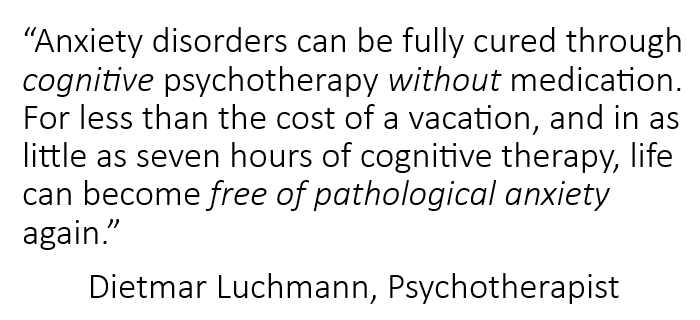
Dietmar Luchmann, Psychotherapist: "Anxiety disorders can be fully cured through cognitive psychotherapy without medication. For less than the cost of a vacation, and in as little as seven hours of cognitive therapy, life can become free of pathological anxiety again." The Zurich Health Directorate "considers" this public education about the scientific standard of psychotherapy to be "misleading and therefore impermissible."
The NICE Guidelines — the authoritative reference work for evidence-based medicine — recommend cognitive behavioral therapy in 7 to 14 sessions as the first-line treatment for anxiety disorders.6 For specific phobias, one to five sessions may suffice.9 The German-language S3 clinical guidelines arrive at the same conclusions. Numerous meta-analyses confirm that evidence-based cognitive psychotherapy regularly achieves success in just a few sessions. Had the Health Directorate examined this allegation even cursorily, it would have recognized it for what it is: an attempt by an association of long-term therapists to redefine the international psychotherapy standard as a regulatory violation.
"Life fully worth living again" That a patient experiences life as worth living again after successful treatment is not a promise of cure. It is the declared goal of every psychotherapy. The question that suggests itself is not why a psychotherapist articulates this goal — but what it reveals about a professional association of psychotherapists that denounces the universal therapeutic objective of its own profession to the supervisory authority as a regulatory violation.
"Cure without psychotropic medication" The ASP objects that I inform the public about the possibility of "curing without the use of psychotropic medication." The authority adopts the allegation — and sharpens it by deleting the ASP's qualifying word "alleged." This allegation betrays a degree of ignorance that should be apparent even to laypeople: Psychotherapy is, by its very nature and legal definition, a non-pharmacological treatment. Licensed psychotherapists in Switzerland may not prescribe medication. They cannot work any other way than without psychotropic drugs. For anxiety disorders, the NICE Guidelines actually warn explicitly against the routine use of benzodiazepines and recommend against psychotropic medication as a first-line treatment. To accuse a psychotherapist of practicing psychotherapy is an absurdity that should have been obvious upon even the most cursory review.
"Written therapy as an alternative" The ASP objects that I present the written form of psychotherapy "as an equivalent or even more effective alternative to conventional talk therapy." The authority adopts this nearly word for word. Yet the psychotherapeutic advantages of writing-based interventions have been scientifically documented for decades — from James Pennebaker's foundational work on expressive writing in the 1980s, through research on cognitive bibliotherapy, to current studies on digital psychotherapeutic writing interventions. That structuring one's thoughts in writing contributes more effectively to the identification and correction of cognitive errors than a conversation whose content is largely forgotten by the next day can, moreover, be grasped without recourse to studies.
"Lack of scientific evidence" The ASP asserts categorically that my psychotherapeutic public education lacks "scientific evidence." The authority adopts this sentence nearly verbatim and elevates it to an official finding of fact — without itself having sought, reviewed, or even requested a single one of the supposedly missing citations. This allegation acquires an additional dimension when one considers who is making it: ASP President Gabriela Rüttimann serves as "academic director" of a training institute accredited by the Zurich Health Directorate whose curriculum, by international scientific standards, does not qualify as a recognized psychotherapy method. A professional association whose own leadership figure heads an institute for body-centered psychotherapy10without a scientifically recognized foundation accuses a psychotherapist of lacking scientific evidence — and the responsible supervisory authority adopts the allegation without noticing the contradiction.
"Targeting a wealthy clientele" The ASP objects to a "targeted appeal to a wealthy and 'intelligent' clientele" and quotes the self-invented phrase "suitable for millionaires." The authority abbreviates the passage but adopts the essence: The "appeal to a predominantly wealthy clientele" is "to be considered problematic."
Fig.: The ASP inverted the statement that cognitive psychotherapy is "affordable not just for millionaires" into its opposite.
Had the authority visited the challenged website, it would have discovered: The actual wording is not "suitable for millionaires" but "not just for millionaires" — a reference to the accessibility of the service. The ASP inverted the statement into its opposite. The authority made this distortion, without verification, the basis of an official threat. Not only would a glance at the website — a matter of seconds — have sufficed, but even a glance at the copies of the website submitted by the ASP. Those, too, read: "Overcoming an anxiety and panic disorder through cognitive psychotherapy by Dietmar Luchmann, requiring as few as eight hours and an investment starting at 2,000 Swiss francs, is affordable not just for millionaires, as the report of a physician demonstrates." That very physician explains in his own therapy report7 how psychoanalytic and depth-psychological psychotherapists damaged his life for ten years.
"Success tests in two minutes" The ASP objects to "promises of success tests that purport to determine curability within two minutes." The authority adopts the wording identically, merely replacing "promises" with "offer" and appending the assessment "to be considered problematic." A glance at the website would have revealed: The challenged "test" is recognizably a screening instrument — a brief diagnostic questionnaire of the kind used routinely in clinical practice. Its purpose is to enable prospective patients to make an initial self-assessment of whether the offered form of psychotherapy suits their needs — as the first step in a multi-stage diagnostic process. Nowhere is it claimed that "curability" can be "determined within two minutes." The ASP distorted the purpose of a standard screening instrument into a diagnostic guarantee of cure in order to be outraged at its own distortion. The authority adopted this distortion, too, without verification.
The Telltale Pattern of Regulatory Capture
What this documentation reveals goes beyond a single instance of negligence.
The Health Directorate of the Canton of Zurich received a complaint from an interest group whose members profit financially from the perpetuation of inefficient long-term treatments. It adopted all eight allegations in near-identical wording without any discernible independent review. On this basis, it threatened a psychotherapist with revocation of his professional practice license. It ignored his statement received on February 9, 2026, in which he characterized the allegations as "absurd" and "contrary to fact" and pointed to the instrumentalization of the authority by the ASP. And it maintained its threat regardless.
The technical term for this failure is "regulatory capture": A supervisory authority that is supposed to independently monitor compliance with professional standards becomes the instrument of the particular interests of those it is meant to supervise.
The episode has a historical precedent. In 1994, the Bern-based psychotherapy researcher Klaus Grawe published his landmark meta-analysis "Psychotherapie im Wandel — Von der Konfession zur Profession" [Psychotherapy in Transition — From Confession to Profession],11 which demonstrated that cognitive psychotherapy is "highly significantly more effective" than person-centered therapy, psychoanalysis, and the other long-term methods. The response of the affected psychotherapist associations consisted not of a substantive engagement but of what Grawe himself described as a "flood of outraged reactions." Thirty-two years later, a successor association employs the same strategy — with the difference that it has now found a supervisory authority willing to make itself serviceable.
The question remains whether the Health Directorate under the leadership of Natalie Rickli — whose management style, according to a report in the Zurich Wochenzeitung,12 is characterized by "micromanagement, compulsive control, chronic overreach, and lack of respect," and from whom experts have been fleeing since she took office in 2019 — still commands personnel capable of preventing such an episode.
The Dangerous Lack of Expertise in Health Oversight
A competent staff member would have known the NICE Guidelines. He would have known that psychotherapy by definition operates without psychotropic medication. He would have read the phrase "not just for millionaires" on the website before making its opposite the basis of a threat. He would have read the footer of every challenged page and discovered that the operator is a company organized under U.S. law with no connection to the Swiss healthcare market.
All of this would have required visiting the websites — and someone who is permitted to look for themselves and think for themselves.
The Health Directorate is required by law to protect the public from misleading and harmful medical practices. These include the "body-centered psychotherapy"10 of ASP President Gabriela Rüttimann, which, for lack of efficacy evidence, is not recognized as psychotherapy in international science.
Yet in this case, the Zurich health authority did not protect citizens from inefficient therapy methods. It did the opposite: It threatened a psychotherapist who provides scientifically grounded public education about efficient psychotherapy — and made itself the instrument of a professional association whose business model depends on patients never learning that they can be cured in hours rather than being supervised for years or decades.
Since the authority not only shirks this duty but makes itself the tool of those whose practices it should be protecting the public from, the last remaining option is to document the episode and make it public. The response letter to the Health Directorate that follows is simultaneously the statement compelled by the authority with a deadline of March 3, 2026.
My Response Letter to Sophie Köhler, the Legal Counsel of the Health Directorate of the Canton of Zurich
Cambridge, March 3, 2026
Gesundheitsdirektion Zürich Amt für Gesundheit Recht Sophie Köhler, MLaw
Dear Ms. Köhler,
First, I would like to thank you for your candor. It is not self-evident that a legal counsel would freely acknowledge that the directives and the "micromanagement" of her Health Director Natalie Rickli, familiar from the press, together with the "standard procedure in supervisory proceedings," do not permit her to independently verify the assertions in a supervisory complaint before threatening someone with a professional ban — even when such verification would consist of nothing more than visiting a publicly accessible website.
I take note of this with understanding. Directives are directives, and I know from more than 40 years of psychotherapeutic experience that it is not always easy to think independently when the institutional framework does not provide for it.
All the more gladly, then, do I make up for the omission on your behalf.
On the facts
Had your directives permitted you to establish the facts ex officio in accordance with the investigative principle (Sections 7 ff. Administrative Procedure Act of the Canton of Zurich, VRG ZH) and the principle of proportionality (Art. 5(2) of the Federal Constitution, BV) — that is, to visit the websites in question — you would have discovered the following:
First, the assertions of the Association of Swiss Psychotherapists (ASP) are demonstrably false, as I informed you in my email of February 9, 2026. In her letter of September 1, 2025, Gabriela Rüttimann, acting as ASP President, turns reality on its head. I clearly and unambiguously characterized the allegations you adopted from the ASP as "absurd" and "contrary to fact."
I am happy to repeat this, and without the slightest impatience, for I understand that your directives evidently did not provide for taking cognizance of my statement of February 9, 2026. My understanding, however, does not alter the fact that your Health Director's directives will expose you to prosecution under Art. 312 of the Swiss Criminal Code (StGB): You were instructed to ignore my statement of February 9, 2026, in which I characterized the ASP's allegations as "absurd" and "contrary to fact" — while simultaneously maintaining your threat to revoke my "trustworthiness under Art. 24 of the Psychology Professions Act (PsyG)" and to strip me of my professional practice license (Art. 27 PsyG).
You have thereby compelled the publication of this statement on the matter.
Second, your letters are addressed to the wrong person. The owner of the challenged websites and provider of the services described therein is Dr. Dietmar Luchmann, LLC, a company organized under U.S. law. It provides psychological consultations in German and English to individuals worldwide — with no connection to the Swiss healthcare market. "A glance at the footer of every page of the referenced websites, or even at the footer of the website copies included in the materials submitted by the Association of Swiss Psychotherapists (ASP), would have sufficed" to recognize this fact as well, as I suggested in my email of February 9, 2026. But that, too, was unfortunately not permitted under your directives.
Accordingly, your office lacks both subject-matter and territorial jurisdiction, and there is no nexus to my cantonal professional practice license, which has been dormant since my retirement. The measures you have threatened under Articles 24 and 27 of the Psychology Professions Act are impermissible for want of statutory prerequisites.
Contact and service of process
These facts simultaneously answer your question "regarding proper service of process." Here, too, all of your assumptions are incorrect. As you are aware, I am no longer practicing in the Canton of Zurich and am not available there. I lack standing as respondent — that is, I am not the proper addressee of any administrative order in this matter. Please take note of this.
I have instructed the kind elderly lady who received your registered letter of January 20, 2026, and scanned it to me, to accept no further deliveries.
You may at any time communicate with the owner of the websites and provider of the services via the email address listed on those websites [...]. Via [...], you can transmit your threats or apologies to Dr. Dietmar Luchmann, LLC, in Dover without the slightest difficulty — with misaddressed "registered mail," you cannot.
Background
The Association of Swiss Psychotherapists (ASP) filed its "complaint" of September 1, 2025, in temporal proximity to my article published on August 14, 2025, under the title "Switzerland as a Paradise of Psychotherapeutic Inefficiency," which was republished or covered by Swiss online media in the days that followed.
I leave it to your own judgment — insofar as the directives of Natalie Rickli permit one — whether it serves the purpose of the Psychology Professions Act and the protection of freedom of expression, freedom of the press, and academic freedom (Articles 16, 17, and 20 of the Federal Constitution) when a professional association deploys your authority as an instrument to sanction an unwelcome publication and you make yourselves serviceable to it.
Request for access to files
By threatening disciplinary measures, you have made me a party to proceedings. Pursuant to Art. 29(2) of the Federal Constitution and Section 8 of the Administrative Procedure Act of the Canton of Zurich (VRG ZH) — subsidiarily, Sections 20 ff. of the Information and Data Protection Act of the Canton of Zurich (IDG ZH, LS 170.4) — I respectfully request that you transmit the complete case file as legible PDF documents by email to [...] within a reasonable period.
This includes:
the ASP complaint in full, including all attachments,
all internal memoranda and orders,
your complete correspondence with the ASP.
Abuse of public authority
I am confident that the matter will be resolved once your directives permit you to examine the websites in question for yourselves. Should a review of the files reveal, however, that your authority made the unverified assertions of a competing professional association the basis of official threats without any independent fact-finding whatsoever, I will have the compatibility of this course of action with Art. 312 of the Swiss Criminal Code (StGB) — infliction of harm through abuse of public authority — reviewed by counsel.
Invoice
To whom may I send the invoice for the costs you have caused because your directives did not permit you to "glance at the footer of every page of the referenced websites" before compelling me to respond to your misaddressed and unsubstantiated threats?
Suggested review
Your directives presumably do not permit you to take note of the fact that the ASP complainant, Gabriela Rüttimann, practices methods that are not accepted by international science and, in her IKP Institute for Body-Centered Psychotherapy, herself trains physicians and licensed psychotherapists in these methods, which are not recognized as psychotherapy by international science because they lack evidence of efficacy. I hereby suggest that you discharge your statutory supervisory duty and investigate why the scientifically unrecognized "body-centered psychotherapy," which is not psychotherapy, is being approved for professional practice licenses.
In closing
Your directives have regrettably prevented you from using my email of February 9, 2026, as a face-saving exit from the farce into which Health Director Natalie Rickli has allowed herself to be drawn by the Association of Swiss Psychotherapists (ASP) and its President, Gabriela Rüttimann. I now hope she finds time to address the matter with the political wisdom it deserves.
I wish you every success in thinking for yourselves, reading for yourselves, and writing for yourselves — and recommend, when the opportunity arises, a visit to the websites. There, please read my review of the standard work of psychotherapy research by Klaus Grawe, which I wrote in 1994 when his book was first published. With the same "flood of outraged reactions" (p. 694, Grawe 1994) with which inefficient psychotherapists attacked the research findings of Klaus Grawe and his team at the University of Bern, the Association of Swiss Psychotherapists (ASP) and Gabriela Rüttimann are attempting, 32 years later, to suppress my modest critique of the still persisting psychotherapeutic inefficiency.
It is truly not difficult to recognize this — and I am confident that the directives will eventually permit the Zurich Health Directorate, albeit 32 years late, to discharge its supervisory duty: not to protect psychotherapists who withhold the state of scientific knowledge from their patients.
6 National Institute for Health and Care Excellence (NICE): Generalised anxiety disorder and panic disorder in adults: management. Clinical guideline. June 15, 2020. [Original text, Section 1.3.15: "CBT in the optimal range of duration (7 to 14 hours in total) should be offered." Section 1.3.20: "Benzodiazepines are associated with a less good outcome in the long term and should not be prescribed for the treatment of individuals with panic disorder."]
9 Öst, L.-G.: One-session treatment for specific phobias. Behaviour Research and Therapy. 1989, Volume 27, Issue 1, 1–7. [Original text, p. 6: "The results for the present group of 20 consecutive cases of specific phobia show that 90% of the patients were much improved or completely recovered after a mean of 2.1 h of therapy."]
12 Beck, R.: Natalie Rickli: Nur das Image zählt [Natalie Rickli: Only Image Matters]. Die Wochenzeitung, Zurich, No. 14/2025. April 3, 2025.
Your Comment
Are you interested in contacting the author? Do you have remarks, suggestions, or additions regarding this article? Do you have personal therapy experiences? We welcome substantial feedback.

Your Comment
Are you interested in contacting the author? Do you have remarks, suggestions, or additions regarding this article? Do you have personal therapy experiences? We welcome substantial feedback.