The answer is uncomfortable in its simplicity: The difference is legal, not professional. Postel held no medical license or professional practice authorization. But the mere existence of a license or authorization does not guarantee that its holder possesses the competence it certifies.
Imposture as an Industry Principle: What Aaron T. Beck Diagnosed From Within
The American psychiatrist and psychotherapist Aaron T. Beck, co-founder of cognitive psychotherapy as the demonstrably most effective form of psychotherapy, articulated the problem as a systematic finding within his own discipline:
"The practice of CBT is not simple. Too many mental health professionals call themselves CBT therapists but lack even the most basic conceptual and treatment skills."
Aaron T. Beck In: Beck, J.S.: Cognitive Behavior Therapy: Basics and Beyond. 3rd edition. New York: Guilford Press, 2021, p. XI.1
Gert Postel demonstrated from outside what Aaron T. Beck diagnosed from within: Where no verifiable competence is required, competence becomes dispensable. The psychiatry that Postel exposed in the 1990s operated on jargon, titles, and the allure of appearances. Anyone who mastered the language needed no substance — a realization that Gert Postel himself put with disarming clarity in 2001:
"For psychiatry you need no foundation whatsoever. You just have to master the language, and then you can prove the opposite or the opposite of the opposite."
A quarter of a century later, nothing about this mechanism has changed.
Klaus Grawe demonstrated in his landmark work on psychotherapy research as early as 1994 that the majority of psychotherapists practice methods whose efficacy is either unproven or — as with psychoanalysis — "highly significantly" inferior to cognitive behavioral therapy and cognitive psychotherapy.2
The Swiss Association of Psychotherapists (ASP), through its president Gabriela Rüttimann, filed a written complaint on September 1, 2025, objecting to the public mention of these scientific therapy standards.3 Psychotherapists trained in "therapy schools" without scientifically recognized evidence of efficacy - such as the IKP Institute for Body-Centered Psychotherapy Zurich4 - continue to receive professional practice licenses as "federally recognized psychotherapists."
In what is plainly an act of legislative self-defense,5 Swiss parliamentarians declared on December 16, 2025, that they would need to "remove psychotherapy from the mandatory insurance catalog"6,7 because "feel-good events"8 are displacing actual medical treatment.
The story of Gert Postel is therefore no historical curiosity. It is the litmus test for an industry that has been resisting, "for a hundred years,"9 being measured by scientific evidence and verifiable outcomes.
1 Beck, A.T.: Foreword. In: Beck, J.S.: Cognitive Behavior Therapy: Basics and Beyond. 3rd edition. New York: Guilford Press, 2021, p. XI.
2 Grawe, K.; Donati, R.; Bernauer, F.: Psychotherapie im Wandel — Von der Konfession zur Profession [Psychotherapy in Transition — From Confession to Profession]. Göttingen: Hogrefe, 1994.
3 Dr. Dietmar Luchmann, LLC: Swiss Association of Psychotherapists (ASP) "Disturbed" by Scientific Psychotherapy Standards. Psychotherapie. Feb. 16, 2026.
4 Dr. Dietmar Luchmann, LLC: IKP Institute for Body-Centered Psychotherapy Zurich. Psychotherapie. Feb. 16, 2026.
5 Luchmann, D.: Cognitive Warfare by the Swiss Association of Psychotherapists (ASP). Psychotherapie. Mar. 16, 2026.
6 Luchmann, D.: Motion 25.4533: "Remove Psychotherapy From the Mandatory Insurance Catalog". Psychotherapie. Feb. 27, 2026.
7 The Swiss Parliament: Remove Psychotherapy From the Mandatory Insurance Catalog. Motion 25.4533, Dec. 16, 2025, introduced by Philippe Nantermod (FDP).
8 The Swiss Parliament: Feel-Good Events Are Not Medical Treatments. Motion 23.4108, Sep. 27, 2023, introduced by Martina Bircher (SVP).
9 Luchmann, D.: Why Cognitive Psychotherapy Is Demonstrably the Most Effective — Yet Helps the Fewest. Psychotherapie. Mar. 31, 2026.
The following book review by Dietmar Luchmann on Gert Postel's impostor autobiography "Doktorspiele — Geständnisse eines Hochstaplers" (Playing Doctor — Confessions of an Impostor) was first published on September 10, 2001 in the journal Psychotherapie.
More Appearance Than Substance: Psychiatry
Impostor Dr. med. Dr. phil. Gert Uwe Postel tears the mask of knowledgeable healers off the faces of psychiatrists and psychotherapists
Book Review
Postel, Gert: Doktorspiele. Geständnisse eines Hochstaplers [Playing Doctor. Confessions of an Impostor]. Frankfurt am Main: Verlag Eichborn, 2001. 191 pp.
May one be permitted to regret that Gert Postel, an impostor of cult status who describes himself as "a nobody," "a former mailman with a secondary school diploma," declined the position of chief physician of the forensic department of the Saxony State Hospital for Psychiatry and Neurology in Arnsdorf — a post that came with a full professorship at the Technical University of Leipzig — when the Saxon Ministry of Social Affairs offered it to him? At any rate, the world was thereby deprived of yet another bitterly amusing exposure of the commodity on which politics and psychiatry thrive to the point of incompetence: the allure of appearances.
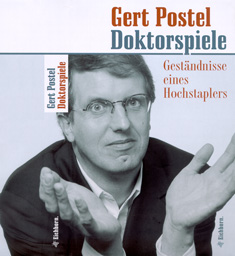
A mere seven months after being hired as a senior physician at the Saxony State Hospital for Psychiatry, Psychotherapy, and Neurology in Zschadraß, the bogus Dr. med. Dr. phil. Gert Uwe Postel, personally endorsed by the Minister of Social Affairs Dr. Hans Geisler (CDU), was nominated for this chief physician position. Postel's professional competence was considered beyond dispute. In July 1996, the Saxon state government approved a cabinet submission recommending the appointment of the swindler who had been notorious nationwide since the 1980s as a self-styled physician. "The conversation with me," Postel recounts in the book about his preceding "audience with the minister," "was conducted almost entirely by the minister himself, even though it lasted an hour and a half. He presented his ideas on deinstitutionalization, which I endorsed — something he was evidently accustomed to. Then he moved on to telling rather pointless anecdotes. One of them went like this: A child molester once escaped from the secure facility in Arnsdorf. Since I live in the area, I drove my private car to the facility and said, I am the minister, I want to have a look at the premises and see how this child molester broke out. Whereupon the people at the gate told me: ‚I am the minister — anyone can say that.‘ They wouldn't let me in."
Gert Postel did not even need a false name to succeed as a psychiatrist and psychotherapist. Yet apparently Postel got cold feet after an uncomfortable conversation with the medical director Hubert Heilemann and withdrew his candidacy of his own accord. The crowning absurdity of this grotesque affair was the reprimand that Heilemann received from the Saxon Ministry of Social Affairs, Health, Youth, and Family: his questions, the ministry charged, had scared off a most promising candidate. The very same minister looked on as a child molester who, according to a report in the "Bild" tabloid, had raped and strangled an eleven-year-old girl, and a convicted double murderess were placed together as a "murderer couple" in a shared cell in the Saxon forensic psychiatric facility, complete with contraceptive pills at the taxpayer's expense, while licensed psychotherapists for non-authorization-required psychotherapy received not a penny for their treatment of primary insurance fund patients at the end of 2000.
Postel, meanwhile, collected over 200,000 deutschmarks in salary during his stint as a senior physician in Saxony. He will, however, be allowed to keep the fees of nearly 44,000 deutschmarks that he earned for psychiatric expert opinions in 23 criminal proceedings, for which he was appointed as a court expert. The Saxon Ministry of Justice reportedly considered demanding repayment but never initiated proceedings, as the only prospect of recovering the money would have required demonstrating that the opinions were flawed. Not a single one of his expert opinions had been rejected or challenged by the courts.
Gert Postel: An Impostor of Cult Status for Twenty Years
As a trained letter carrier, Gert Postel's passion was the medical profession, which he practiced for years without ever attending medical school. From September 1982 to April 1983, Gert Postel operated under the name Dr. Dr. Clemens Bartholdy as deputy public health officer in Flensburg with remarkable success. He reformed psychiatric hospital admission practices, directed the community psychiatric service, and served as the officially appointed port physician and coroner. Under his supervision, the number of involuntary commitments fell by 86 percent. When his decisions were appealed, the district court upheld his findings. He also authored expert opinions and even delivered lectures to professional colleagues. Because the work proved strenuous, however, he applied for a transfer. As a physician, naturally. The deception was uncovered only after Postel lost his wallet, which contained two forms of identification: one in his real name, the other in the name of Clemens Bartholdy. In December 1984, Gert Postel was convicted by the Flensburg District Court of misuse of academic titles, fraud, and forgery, and sentenced to one year's imprisonment, suspended on probation. The sentence was so lenient, the court explained in its opinion, because the health authorities had made it so easy for him and he had caused no harm.
This did nothing to impede his career. Most recently, beginning in 1995, he served for eighteen months as senior psychiatrist at the Saxony State Hospital in Zschadraß — supervising 28 physicians. The newspaper "DIE WELT" quoted his former chief in Zschadraß, Horst Krömker, on January 20, 1999: "The man convinced me immediately. His bearing, his references. I thought, we can't get a better physician than this." This deception, too, was exposed not by any professional inadequacy on the part of mailman Postel, but because a physician at the Zschadraß hospital received a visit from her parents, who happened to come from Flensburg. Somehow the conversation turned to Senior Physician Postel. The parents recognized the name. Shortly afterward, the trained mailman was unmasked. On July 10, 1997, Postel went underground. A Leipzig public prosecutor with whom Postel allegedly had an affair was suspected of having tipped him off before his arrest. For ten months the impostor repeatedly eluded criminal investigators, aided in part by a Stuttgart judge — another affair. Until tactical investigators caught him on May 12, 1998, in a phone booth at Stuttgart Central Station. On January 20, 1999, his trial opened before the Grand Criminal Chamber at the Leipzig District Court, for which "just about everything was marshaled that is fine and expensive." Sentence: four years' imprisonment.
At the beginning of this year he was released early on probation and promptly reappeared with his next coup: the book "Doktorspiele" (Playing Doctor), from which he gave a reading at the Berlin Literary House on Fasanenstraße on September 4, 2001, the day of its release. In his nearly 200-page impostor autobiography, the trained letter carrier describes how easy dignitaries, ministerial officials, and academics made things for him. "I confess and repent in general terms," Postel writes at the beginning of his book. Whether he has been cured of his distorted perception of reality, however, Postel — alias Dr. Gert von Berg — doubts in the preface himself.
There was a time when one needed fine clothes, an elegant carriage, or even liveried servants to bridge the gap between being and appearance. Today, a few coins and an agreeable voice suffice to stage an edifice of lies over the telephone. The requisite measure of cunning, paired with wit, chutzpah, and a dash of insight into human nature, transforms a laborer into an academic, just as the postal worker Postel became Dr. med. Dr. phil. Gert Uwe Postel.
Not without considerable self-irony, Postel recounts in the chapter "How I Saved the State of Saxony From Great Harm" how, at Easter 1996, he "did the right thing and sold it well, too." While his chief — called "Dr. Gutfreund" in the book — "had set out on his well-deserved Easter holiday," Postel, as his senior physician, had "remained behind in Zschadraß, bearing sole responsibility during the feast of the Resurrection — including for the forensic psychiatric ward, that section of the psychiatric hospital in which mentally ill criminal offenders were housed. From there word reached me that several inmates were plotting a mass escape in the interval between the highest Protestant holiday — Good Friday — and the highest Catholic one — Easter Sunday. The havoc that a number of sexual offenders in league with schizophrenic murderers could have wreaked outside the institution was beyond imagining. Swift and decisive action was imperative. I resolved to crush the conspiracy, to separate the ringleaders and place them in isolation. After I had alerted the Ministry of Justice and the Ministry of Social Affairs by fax to the threat situation, my friends at the State Criminal Police Office dispatched a tactical unit that swooped down on the dumbfounded conspirators and distributed them among other, secure facilities across the Free State of Saxony. By the time my patrons at the Ministry of Social Affairs returned to their desks on the Tuesday after Easter, my report was already before them, in which I described, factually but not without a sense for the dramatic, how I had confronted this terrible menace to Saxony during the holidays."
"Now one must understand," Postel begins his analysis of ministerial thinking, "that for those who bear political responsibility, there is nothing more disagreeable than deranged criminals leaving an institution without authorization, whereupon the populace, thrown into terror and alarm, casts about for someone to blame. It therefore requires little imagination to envision the delicious shiver that ran through my ministerial handlers at the thought of having been saved, by my doing, from a calamity that could easily have provoked fearsome eruptions of wrath from their godlike minister, had it not been for the vigilance of this wonderfully energetic senior physician. ‚The state needs men like these,‘ some gentlemen in the ministry must have thought, for nothing else can explain what befell me from that quarter a few days later."
"Three days after Easter I was summoned to a ‚debriefing‘ at the ministry, which I attended unsuspectingly. I assumed they wished to discuss security matters in the forensic ward once more in light of the Easter events. In the ministry, however, my Easter heroics were merely a side topic.
The responsible section chief surprised me with the proposal that I should succeed Prof. Dr. K. as chief physician in Arnsdorf. I was utterly speechless, groping for words. The mere thought of succeeding Prof. Dr. K., the only unbroken disciple of the great Rasch, shook me to the core. For a moment I wondered whether the ministerial officials had perhaps discovered my true educational background in the meantime and simply wanted to make a proper fool of me one more time before handing me over to the public prosecutor.
But I had no time to dwell on such thoughts, for the section chief glanced at his watch and said that we now had to proceed to the conference room. Half unconscious, I trudged along behind him — I, the fraud, the deceiver, the schemer, involuntarily reduced to a helpless object of the machinations of the ministerial bureaucracy."
Thus the Saxon Ministry of Social Affairs induced the impostor, as Postel observes with relish, "very nearly to commit yet another act of fraud" [...]. "Since Landau was positively imploring me to take the Arnsdorf post, my old audacity stirred, and I told him that in that case I would almost rather go straight to the ministry. Landau, the wily bureaucratic fox, parried my presumptuousness with aplomb: ‚You know, Dr. Postel, we had actually envisioned Arnsdorf as a stepping stone toward a position as section chief in the ministry. If you prove yourself there, a subsequent transfer to the ministry would be the natural consequence.‘"
The book by Gert Postel, born on June 18, 1958 in Bremen, traces with consummate irony the labyrinthine life of an impostor who sought to realize his visions of academic honors and social recognition by means of forged credentials, human empathy, and astonishing rhetorical gifts. At the same time, the jacket copy tells us, the book is a "double-edged homage" to his surroundings: to lawyers, politicians, physicians, psychotherapists, judges, girlfriends — in short, to everyone who made the incredible career of Dr. Gert Postel possible in the first place.
Psychiatry and Psychotherapy: Frequently Their Own Brand of Fraud
The bogus senior physician and near-chief of forensic psychiatry tears the mask of knowledgeable healers off the faces of psychiatrists and psychotherapists. Postel's entertaining imposture lets ooze forth once more, from behind the facade of supposed expertise and professed scientific rigor, what psychiatrists and psychotherapists prefer to conceal: that their profession is disproportionately rife with neurotically motivated incompetence, reality-detached sentimentalism, spiritual quackery, pseudoscientific delusions of grandeur, and narcissistic power-seeking.
Postel was "primarily interested in the aspect of power and dominion" that came with his position: "You may gauge the intensity of this interest by the fact that during my time in Zschadraß I lived — with few exceptions — in absolute monastic seclusion, even though I otherwise lead a reasonably healthy sexual life. My celibacy in Zschadraß is an indicator that my existence as a senior physician in this hospital was entirely sufficient to satisfy my every drive.
I occupied a modest physician's room in the hospital, where I prepared my own breakfast and dinner. After completing my morning ablutions, I would throw on my senior physician's white coat, stroll through several wards, observe the hastily assumed activities of the nursing staff, receive their greetings, greet them back with genial condescension, and eventually reach the hospital kiosk, where a specially reserved copy of the Frankfurter Allgemeine Zeitung awaited me. I would then retrace my steps and settle into an armchair in my room with a cup of tea to study my favorite paper at leisure, naturally still in my white coat. Once I had finished the newspaper, a half-hour of Schopenhauer sometimes followed, until I was permitted to present myself for the senior physician's ward round. I say ‚permitted‘ deliberately, for the work in Zschadraß was a pleasure for me, the exercise of authority that came with it a delight."
Anyone who dismisses Gert Postel's nearly incredible account as nothing more than the malicious exaggeration of a narcissist with a personality disorder has never encountered the reality — in parts inhumane — of the German psychiatric and psychotherapy establishment.
An illustrative and entirely interchangeable example of a presumably severely disturbed expert was provided by Michael Gross, a Freiburg-based physician specializing in psychotherapeutic medicine. This psychotherapy physician, whose medical license legally authorizes him to adjudicate the mental health of others, revealed his own distorted worldview in a letter to the editor bearing the self-chosen title "Total Wreck" and the demand that the editors of the journal "PSYCHOTHERAPIE" be placed in permanent preventive detention. The physician and psychotherapist Michael Gross attacked the critically informed and scientifically grounded reporting in "PSYCHOTHERAPIE," along with further verbal assaults, in these words: "Design and content appear [...] to be perpetrated by individuals who, on account of a pronounced mental deficiency, ought to be locked away for good."
Understandably, given this reality, it is not always easy to determine who is actually deranged — the client or the therapist. "Any skilled therapist would have no difficulty producing an expert opinion that qualifies me as being in need of therapy," Ellis Huber told PSYCHOTHERAPIE in an interview on August 21, 2001, criticizing the systematic abuse that psychotherapists and psychiatrists commit in and through their profession. Huber, President of the Berlin Medical Association from 1987 to 1999 and currently chairman of the board of the Securvita health insurance fund, said: "Roughly a third of all physicians are cynical egoists to whom the fate of their patients has become a matter of complete indifference. They think only of themselves and administer therapies whose futility they have known from the outset. A further third consists of frustrated and unprincipled opportunists who swim along in the system and attempt to muddle through, compensating for their guilty conscience with the pleasures of status and prestige."
Diagnosis: "Total Wreck" — but for whom? Against the backdrop of abundantly deranged psychiatrists and psychotherapists, it is hardly surprising that a charming and eloquent mailman stands out as refreshingly normal among the practitioners of the mental health guild and makes a meteoric career in psychiatry.
An Impostor's Autobiography: Succumbing to the Lure of Appearances
Postel quickly found his job as a letter carrier too tedious, too unchallenging. His first boyish prank was a forged secondary school diploma, with which he intended to secure an apprenticeship as a court clerk. Since he had no diploma, he simply forged one, and in 1977 obtained a trainee position as a court clerk in Bremen. The dream collapsed after a few months. Postel then tried his hand at studying Catholic theology in Münster. Later he eagerly shook hands with Pope John Paul II at an audience that Jesuits in Frankfurt am Main had arranged between the head of the Church and the supposed theology student Postel.
The conviction for forgery and unauthorized use of academic titles did not deter the then 19-year-old, by his own account. Over the following years he repeatedly reshaped his curriculum vitae, elevating his father to the rank of theology professor, his mother to that of a fashion model, and himself to assistant physician.
After the suicide of his mother in 1979, he claimed in an earlier trial, he went off the rails. Gert Postel began auditing lectures in psychology and sociology at the University of Bremen. He devoured textbooks and absorbed the professional jargon as if by osmosis: "Anyone who masters dialectics and the psychiatric idiom can formulate any amount of nonsense and dress it up in the garb of the academic," he later wrote in his book "The Adventures of Dr. Dr. Bartholdy."
Postel's first attempt took place in Neuenkirchen near Oldenburg, where he presented himself with a forged medical license — and promptly obtained his first position as a physician. He practiced as a doctor, in part because the hiring of physicians generally does not require a criminal background check. A quarter of a year later, Dr. Postel moved to the position of medical director at the rehabilitation center of the Berufsbildungswerk des Reichsbundes in Bremen. But the deception was exposed after four weeks when a judge recognized the former court clerk trainee.
Thus, as a bogus doctor, he had been bamboozling the authorities since the early 1980s. While Postel was already playing public health officer in Flensburg as Dr. Dr. Clemens Bartholdy, his Bremen "medical practice" was settled in November 1982 with a fine of 600 deutschmarks and placed on file.
His tenure as public health officer was the first pinnacle of a career that made him famous nationwide. Yet the one-year suspended sentence imposed on him by the Flensburg District Court in 1984 did not prevent him from merrily continuing his deception. On the side, in 1985 he brought out a 160-page book recounting his life and his lies.
His fondness for the physician's white coat subsequently led him to work, among other things, as a military medical officer in the Bundeswehr and as an assessment physician producing disability reports at the vocational rehabilitation center in Berlin-Brandenburg. He was also employed by the State Insurance Authority in Stuttgart.
In the midst of his eventful medical career, Postel was afflicted in 1993 by a bout of depression, for which he sought treatment at Berlin's Charité hospital. The apparently successful psychotherapy soon led him back into psychiatry. Six years after the fall of the Berlin Wall, he pulled off his masterpiece as the bogus senior physician of Zschadraß. Postel, who was still studying Catholic theology in Munich in early 1995, assumed the identity of Prof. Gert von Berg of the Münster University Psychiatric Clinic. From a student dormitory, he telephoned the chief of the Saxony State Hospital and told his esteemed colleague about "an exceptionally capable senior physician, a Dr. Postel by name, who is particularly well versed in the field of community psychiatry."
A few months later, in November 1995, Gert Postel, the son of a Bremen car mechanic and a seamstress, became senior physician at what he calls the "Magic Mountain of Leipzig." Despite the handsome salary of around 10,000 deutschmarks, he says he accomplished little, held amiable conversations with his superiors, and did a great deal of scheming. This, he instructs the reader, was his understanding of "rebuilding the East." He negotiated with the Dresden Ministry of Social Affairs about executive positions and authored psychiatric expert opinions for Saxon criminal courts. He hired physicians and dismissed them again when they struck him as professionally or personally unsuitable. "That was no problem," he said. "I simply didn't renew the one-year contracts when I didn't care for someone." Because he generally consulted his colleagues and always drafted court opinions using a template, his nearly two years of activity went undetected.
When a hospital employee from northern Germany unmasked the mailman in the white coat, the cat-and-mouse game began, in which the man with a secondary school diploma led high-ranking officials on a chase for nearly a year. Much like the department store extortionist Arno Funke, alias "Dagobert," he remained tantalizingly close to his pursuers but always one step ahead. When the police investigators stood before the door of his Berlin apartment, he once again led them astray. "Dear Peter, I've gone to Bremen today [...]. Regards, Gert," he wrote on a slip of paper and placed it under the doormat. The officers read the note and did not even bother to ring the bell, although Postel was standing behind the apartment door.
In retrospect, Postel writes: "Instead of thanking God in a quiet prayer for this fortunate deliverance and simply going on my way, I — possessed, it must have been, by the devil — called my public prosecutor in Leipzig from a nearby phone booth and complained that his subordinate officers had been meddling at my front door at so early an hour."
Gert Postel: "Permanently Understimulated" by Psychiatry
Like the property tycoon Jürgen W. Schneider, Gert Postel found it increasingly effortless, over the course of his criminal career, to deceive the great and the good. Once admitted to the circle of academics, no one asks how or why anymore.
On the professional profile of the psychiatrist, Postel remarked dismissively during the discussion following his Berlin reading: "Even a trained goat can practice psychiatry." In psychiatry there had been some "very peculiar" characters among the physicians, the former senior physician recalls: "One of them arrived at a diagnosis for a patient without being able to tell me the symptoms. At that point you lose all respect. I despised every last one of them."
The self-appointed doctor, on the other hand, remembers his time in prison fondly: "It was good. I wouldn't want to have missed it any more than my time as a physician. I would never have managed to work my way through five volumes of Schopenhauer in freedom." For the future, Postel wishes "to grow wiser, to understand more." He plans to write two more books: one about the genesis of Doktorspiele, and a volume of poetry.
Working as a bogus physician at the psychiatric hospital in Zschadraß for the rest of his life, however — that was something Gert Postel could never have envisioned. "That work would have permanently understimulated me intellectually," the former mailman explained at another reading from his book in Leipzig on September 6, 2001. "I wanted the book to distinguish itself from the usual criminal literature of a Dagobert or Dr. Schneider, and I strove for ironic detachment," the author commended himself during the subsequent Q&A session, as the "Leipziger Volkszeitung" reported on September 7, 2001. He would gladly oblige friendly requests for information. "For psychiatry," he reportedly described his method, "you need no foundation whatsoever. You just have to master the language, and then you can prove the opposite or the opposite of the opposite."
His career as a senior physician in Saxony was by no means the only avenue of advancement available to him, Postel elaborated. "I also seriously considered going east as the presiding judge of a court. That would have worked just as well," he declared with conviction. But now, the 43-year-old claimed, he wanted to take walks, smoke his pipe, read Schopenhauer, and live on the right side of the law. The imposture was to end here. "One cannot make oneself into one's own broken record," the "Leipziger Volkszeitung" conveyed his self-portrayal, describing how Postel accepted a rose and beamed as visitors celebrated him as an exposer of psychiatric dysfunction. "I admire you more than I condemn you," the newspaper quoted Wolfgang Ende of the psychiatric hospital in Hochweitzschen (Döbeln), who attended the reading and explained that the impostor's case had given many psychiatrists pause for thought. "I also know that you caused no harm to patients," declared the real senior physician Wolfgang Ende. And Postel retorted caustically: "Well, I'm not a psychiatrist, am I."
Postel has served his sentence, yet his reputation as an impostor remains — and he appears to relish it. Thus the repeat offender finds it easy, in his newly published book, to draft his own psychological profile, signed Dr. Gert von Berg, the pseudonym from his old days of crime. That he now runs a restaurant where the fine society of Leipzig dines, and that he is the principal shareholder of a private psychiatric clinic — that remains, for the time being at least, an unfulfilled dream.
Published September 10, 2001.
Your Comment
Are you interested in contacting the author? Do you have remarks, suggestions, or additions regarding this article? Do you have personal therapy experiences? We welcome substantial feedback.