A moral portrait of Zurich.
On August 14, 2025, the psychotherapist Dietmar Luchmann published an analysis on "Switzerland as a Paradise of Psychotherapeutic Inefficiency."1 The thesis: There is not too little psychotherapy — there is too much psychotherapeutic inefficiency.
The response was considerable. Several Swiss online portals republished the text, including InsideParadeplatz on August 17, 2025, where it alone drew 112 comments.
The second-most popular comment read: "Wow, well put! I can already hear the outcry from this guild: Traitor to the cause…"
Gabriela Rüttimann and the Assoziation Schweizer Psychotherapeutinnen und Psychotherapeuten (ASP) vs. the Scientific Evidence
The outcry came. But not as a counterargument. As a formal complaint.
On September 1, 2025, Gabriela Rüttimann, president of the Assoziation Schweizer Psychotherapeutinnen und Psychotherapeuten (ASP) - the Association of Swiss Psychotherapists - wrote to the Zurich Health Directorate.
The subject line: "Complaint by the ASP regarding […] Dr. Dietmar Luchmann."
The ASP is the professional association of psychoanalytic, depth-psychological, existential-analytic, bioenergetic, and body-centered therapists, based in Zurich.
What had provoked the wrath of the ASP president? A sentence like this one from the article:
"With cognitive psychotherapy methods, most of these disorders can be eliminated in an average of ten sessions."
Dietmar Luchmann, Psychotherapist Switzerland: Paradise of Psychotherapeutic Inefficiency1
This is not a provocation. It is the scientific state of research — and has been for decades.
The British National Institute for Health and Care Excellence (NICE), renowned worldwide for its unflinching commitment to evidence-based medicine, explicitly recommends cognitive psychotherapy for anxiety and panic disorders in a range of "7 to 14 hours in total."2
The use of psychotropic medication is often considered counterproductive in this context, as it functions as a form of chemical safety behavior that impedes cognitive relearning and increases relapse rates.2
Yet Gabriela Rüttimann wrote to the authority — quote:
"We are particularly disturbed by […] [the claim] that anxiety disorders could be cured in as few as eight to ten hours, or that a life could become fully worth living again after just a few hours of therapy. Furthermore, [Ms. Rüttimann and her colleagues object to] the alleged possibility of healing without the use of psychotropic medication […]. Such claims lack scientific evidence and could raise false expectations among patients."
Gabriela Rüttimann, President Assoziation Schweizer Psychotherapeutinnen und Psychotherapeuten (ASP)3
Read that again. Slowly.
The president of a psychotherapy professional association declares the rapid cure of anxiety disorders without medication to be unscientific.
Not a layperson. Not a pharmaceutical lobbyist. A psychotherapist.
So ASP psychotherapists practicing ineffective long-term therapy methods are "disturbed" by the fact that cognitive psychotherapy makes "a life fully worth living again after just a few hours of therapy"?3
Is it not the very purpose of psychotherapists to make "life … fully worth living" again?
Must one not ask ASP psychotherapists whether they remain "trustworthy" under Article 24, paragraph b of the Swiss Psychology Professions Act (PsyG), when they betray their patients by disparaging the reality of a rapidly "fully worth living" life as unserious — solely to justify years of "accompaniment"?
One might mistake this for ignorance. It is something worse: a business model.
IKP Institut für Körperzentrierte Psychotherapie, Zurich: A Business Model Lacking Evidence of Efficacy
Gabriela Rüttimann is not merely ASP president. She also serves as academic director of the "IKP Institut für Körperzentrierte Psychotherapie" (IKP Institute for Body-Centered Psychotherapy) in Zurich.4
The IKP earns its revenue by training physicians and psychotherapists. The Zurich Health Directorate recognizes its training certificates for the issuance of professional practice licenses.
"Body-Centered Psychotherapy IKP […] is based on Gestalt therapy"5 and "looks back on a research tradition spanning more than 40 years,"5 the IKP states on its website.
In the IKP's self-portrayal, the backward-looking gaze is the only credible element. Without scientifically recognized evidence of efficacy, the "scientific rigor"5 claimed by the IKP raises serious questions. The regulatory authority should examine how this is to be assessed - both professionally and legally - within the framework of training accreditation.
Body-centered psychotherapy and Gestalt therapy are methods that, following review by Germany's Scientific Advisory Board on Psychotherapy (Wissenschaftlicher Beirat Psychotherapie), are not recognized as scientifically validated psychotherapy methods due to a lack of evidence of efficacy.6
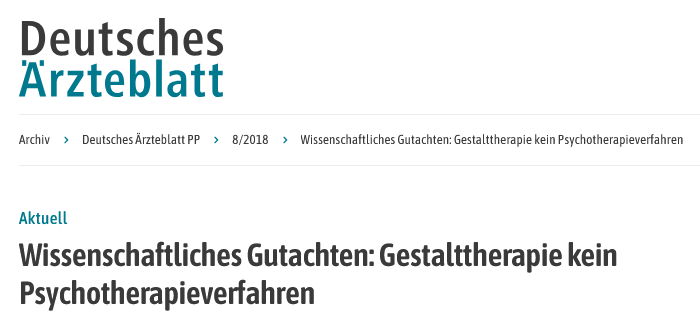
Fig.: The Deutsches Ärzteblatt (German Medical Journal) published the scientific opinion of the Scientific Advisory Board on Psychotherapy (WBP): Gestalt therapy (and body-centered psychotherapy, which is "based on" Gestalt therapy) are not recognized psychotherapy methods.6
Or, less diplomatically: body-centered psychotherapy and Gestalt therapy are methods in which patients talk and feel for years - and Swiss health insurers pay - without any change in the pathogenic thought patterns that sustain their suffering.
That the ASP is "disturbed" by the scientific state of research is therefore entirely understandable. Who would not be disturbed by findings that threaten their own business model?
What happened next is remarkable.
Zurich Health Directorate Declares the Scientific Evidence "Misleading"
The Health Directorate of the Canton of Zurich responded to the ASP complaint. But not as one would expect of a regulatory authority.
Not by examining the ASP's claims. Not by consulting the research literature. Not by asking the obvious question: whether it might in fact be the ASP psychotherapists who lack a scientific basis and the trustworthiness required under Article 24, paragraph b PsyG.
No. The Zurich Health Directorate wrote to the psychotherapist who had published the current state of the research.
The regulators informed him that they "consider" his statements on his websites to be "misleading and therefore impermissible."
Which statements? That anxiety disorders can be overcome with cognitive psychotherapy in approximately ten sessions. That no medication is necessary for this purpose.
In other words, precisely what the NICE guidelines recommend:

Fig.: The statement above represents the scientific standard of psychotherapy. In a letter dated October 22, 2025, the Zurich Health Directorate, headed by Cantonal Councillor Natalie Rickli, adopted the manifestly untenable claims of the Assoziation Schweizer Psychotherapeutinnen und Psychotherapeuten (ASP)3 without independent review and wrote that it "considers" the public information provided by the psychotherapist Dietmar Luchmann to be "misleading and therefore impermissible." The recommendation sent by Dietmar Luchmann via email on February 9, 2026, to the Health Directorate — that before compelling a "statement of position," it first conduct the customary preliminary review of the "absurdity of these allegations" through the standard administrative procedure of "a glance at the incriminated website" — was rejected by the supervising officials.
The Zurich Health Directorate demanded a "formal response" and invoked the "trustworthiness requirement under Art. 24 of the Psychology Professions Act (PsyG)" — the violation of which "results in revocation of the professional practice license (Art. 27 PsyG)."
Let us be clear: A Swiss regulatory authority is threatening a psychotherapist with a professional ban because he made the international state of research public.
Not because he harmed patients. Not because he disseminated misinformation. But because his statements "disturb" the practitioners of ineffective therapy schools.
Other cantons received the ASP complaint as well. None of them took action. Only Zurich.
Regulatory Capture: How Ineffective Therapy Schools Co-opt Oversight in Zurich
The word choice of ASP President Gabriela Rüttimann deserves recognition. "Disturb" is exactly the right word. Because what is being disturbed here is not science. It is a market. A therapy market.
Anyone who understands how this market operates also understands why the Zurich Health Directorate responded as it did.
The ASP represents therapy schools that provide training. The training institutes - such as the IKP - generate revenue through that training. The Health Directorate recognizes their certificates for the issuance of professional practice licenses.
It is a closed loop. The schools train. The authority rubber-stamps. The health insurers pay. The patient notices nothing.
And when someone publicly states that there is a more effective approach? The school writes to the authority. And the authority threatens the one who is effective.
In the financial world, this is called "regulatory capture" — the co-optation of a regulatory authority by the very industry it is supposed to oversee.
Natalie Rickli, Cantonal Councillor (SVP, Swiss People's Party) and head of the Zurich Health Directorate, bears responsibility for this mode of operation within her authority.
The question is inescapable: Does this authority protect patients — or the business models of those ineffective psychotherapy schools whose certificates it recognizes?
The question is not rhetorical. It carries a price.
According to the Swiss Health Observatory, mandatory health insurance (OKP) expenditures on psychotherapy rose from CHF 528 million in 2021 to CHF 922 million in 2024. Annual increase: approximately CHF 130 million. Trajectory: unabated.
These are the visible costs. The invisible ones are greater.
What is the cost of a career abandoned because of untreated panic attacks? What is the cost of a marriage that collapsed under the weight of a partner's chronically mistreated depression?
What is the cost of a decade in which a person does not live their life because no one told them their anxiety could be overcome in ten sessions?
The third-most popular comment on the article about Switzerland as the paradise of psychotherapeutic inefficiency came from someone who had lived through it. It reads like a case study:
"For over 20 years I had been going to therapy, and in the end I was sicker than when I started. One suspected diagnosis after another, pathologized personality traits, 'deficits' here and 'traumas' there. You are quite literally conditioned into a helpless victim. […] I feel like a former cult member."
Affected individual, August 18, 2025, 1:59 PM Comment on Switzerland: Paradise of Psychotherapeutic Inefficiency1
Twenty years. At one session per week at approximately CHF 200, that amounts to more than CHF 200,000. For an outcome that the individual himself describes as deterioration.
For comparison: 7 to 14 sessions of cognitive psychotherapy cost between CHF 1,400 and CHF 2,800.
For readers inclined to account for lost years of life: the return on investment of ineffective psychotherapy is not zero. It is negative.
A market in which the product makes the customer sicker and the provider is paid regardless. In any other industry, this would be a matter for the regulator.
But the regulator here protects the providers. Not the customers.
Motion 25.4533: Paying for Psychotherapy Out of Pocket as the Only Quality Control
This is precisely where the parliamentary motion 25.4533, submitted by National Council Member Philippe Nantermod (FDP, Free Democratic Party) on December 16, 2025, applies. It demands that psychotherapy be removed from the catalog of mandatory health insurance benefits.7
The motion's text argues on the basis of costs. That is correct, but it does not go far enough.
The stronger argument is quality assurance.
There is no functioning quality control for psychotherapy in Switzerland.
The professional associations do not monitor themselves — they protect their members. The health directorates do not monitor — they rubber-stamp certificates. The health insurers do not monitor — they pay whatever is billed.
Who monitors, then? No one.
Unless the patient monitors on their own. And they only do so when they pay out of pocket.
Out-of-pocket payment is not the dismantling of social welfare. It is personal responsibility. It is the only functioning mechanism of quality assurance in a market where providers have successfully fended off every form of external accountability.
Those who pay for their own psychotherapy ask questions. How long will this take? What is the goal? How do I measure success? They do not tolerate twenty years of paid conversations about nothing.
Those who know the health insurer will pay, on the other hand, lean back. They become consumers of a service whose quality they cannot assess — and whose provider has no interest in ending the treatment.
Motion 25.45337 by Nantermod is therefore not an attack on the mentally ill. It is a lever against a system in which providers of ineffective therapies instrumentalize regulatory authorities to silence effective psychotherapists.
Nantermod's motion text cites a cost of "approximately CHF 2,500" for a "complete course of treatment." This corresponds with striking precision to the 7 to 14 sessions that the international evidence base prescribes for cognitive psychotherapy.
The question Gabriela Rüttimann ought to be asking is not: "How can we silence the author?"
It is: "Why do our methods fail to achieve in months or years what cognitive psychotherapy accomplishes in hours?"
She will not ask that question. The answer would call into question the IKP, the ASP, and the entire Zurich training market for long-term therapies.
Instead, she writes to the authority. And the authority writes to the psychotherapist.
Klaus Grawe's Legacy and the Failed Transition to Effective Psychotherapy in Zurich
Klaus Grawe, the eminent psychotherapy researcher at the University of Bern, demonstrated in his landmark work "Psychotherapie im Wandel: Von der Konfession zur Profession" (Psychotherapy in Transition: From Confession to Profession)8 in 1994: Cognitive psychotherapy for anxiety disorders and depression "is, on average, highly significantly more effective than psychoanalytic therapy and client-centered therapy" (p. 670).8
Thirty years later, a Swiss authority threatens a psychotherapist with a professional ban for making precisely this finding public.
The transition "from confession to profession" that Grawe demanded has never taken place in Zurich.
Psychoanalysis, depth psychology, and body-centered therapy occupy the training institutes. The training institutes occupy the professional associations. The professional associations sit alongside the regulatory authority.
And the regulatory authority sits on the lid.
Natalie Rickli could lift that lid. She could direct her authority to review the evidence of efficacy underlying the accredited therapy schools.
The Zurich weekly Die Wochenzeitung (WOZ) reported on April 3, 2025, under the headline "Natalie Rickli: Nur das Image zählt" (Natalie Rickli: Only the Image Matters), "that Rickli engages in micromanagement and concerns herself with the smallest details of day-to-day operations […]. In doing so, she routinely overrides her own experts."9
Natalie Rickli could ask why her administration demands justification from a psychotherapist who cites the state of research — instead of finally reviewing the schools whose methods fail to withstand any serious meta-analysis.
Whether Natalie Rickli, given her penchant for "micromanagement," is aware of this matter remains an open question. If she is not, it raises questions about executive oversight. If she is, it raises other questions. The public has a right to answers.
As long as quality assurance in psychotherapy remains in the hands of those who have no interest in psychotherapeutic quality, nothing will change.
Motion 25.45337 offers a way out. Not the most elegant. But the only one that works.
The patient who pays out of pocket is the only quality controller this system cannot corrupt.
One in three people will experience an anxiety disorder in the course of their lifetime. The question is not whether you will ever need a psychotherapist.
The question is whether you will then find one who helps you in ten sessions — or one who cultivates you as a revenue source for twenty years.
Your Statement, Please, Health Director Natalie Rickli!
Gottfried Keller wrote in the Neue Zürcher Zeitung on January 11, 1879, "that the Canton of Zurich ranks among the states that statistically exhibit the highest rates of mental derangement."10
Has this "blemish,"10 as Gottfried Keller described the state of mind in Zurich, been remedied since? Health Director Natalie Rickli, who has been responsible for mental health in Zurich since 2019, is respectfully requested to answer this and the other questions raised in this article for the benefit of the public.
Those who cite the state of the research are made to justify themselves. Those who deny it are left undisturbed. This is how supervision works in the Canton of Zurich in 2026.
This is the real psychotherapeutic care crisis.
That is why Dietmar Luchmann long ago removed himself and his Angstambulanz am Zürichsee (Anxiety Outpatient Clinic on Lake Zurich) from "the physical reach of the madness"11 in Zurich.
1 Luchmann, D.: Die Schweiz als Paradies der psychotherapeutischen Ineffizienz [Switzerland: Paradise of Psychotherapeutic Inefficiency]. Psychotherapie. August 14, 2025.
2 National Institute for Health and Care Excellence (NICE): Generalised anxiety disorder and panic disorder in adults: management. Clinical guideline. June 15, 2020. [Section 1.3.15: "CBT in the optimal range of duration (7 to 14 hours in total) should be offered." Section 1.3.20: "Benzodiazepines are associated with a less good outcome in the long term and should not be prescribed for the treatment of individuals with panic disorder."]
3 Dr. Dietmar Luchmann, LLC: Assoziation Schweizer Psychotherapeutinnen und Psychotherapeuten (ASP) «stören» wissenschaftliche Psychotherapie-Standards [Association of Swiss Psychotherapists (ASP) "Objects to" Psychotherapy Evidence Standards]. Psychotherapie. February 16, 2026.
4 Dr. Dietmar Luchmann, LLC: IKP Institut für körperzentrierte Psychotherapie Zürich [IKP Institute for Body-Centered Psychotherapy, Zurich]. Psychotherapie. February 16, 2026.
5 Quotes taken from the website of "IKP Institut für Körperzentrierte Psychotherapie Zürich" at the time of publication of this article (psychotherapie-ikp.com).
6 Wissenschaftlicher Beirat Psychotherapie [Scientific Advisory Board on Psychotherapy]: Wissenschaftliches Gutachten: Gestalttherapie kein Psychotherapieverfahren [Scientific Opinion: Gestalt Therapy Is Not a Psychotherapy Method]. Deutsches Ärzteblatt PP, Issue 8/2018, p. 342.
7 The Swiss Parliament: Psychotherapien wieder aus dem Leistungskatalog streichen [Remove Psychotherapy from the Mandatory Health Insurance Benefits Catalog]. Motion 25.4533, December 16, 2025, submitted by Philippe Nantermod (FDP).
8 Dr. Dietmar Luchmann, LLC: Klaus Grawe, Universität Bern: Kognitive Psychotherapie ist «hochsignifikant wirksamer» als Gesprächspsychotherapie und Psychoanalyse [Klaus Grawe, University of Bern: Cognitive Psychotherapy Is "Highly Significantly More Effective" than Client-Centered Therapy and Psychoanalysis]. Psychotherapie. February 16, 2026.
9 Beck, R.: Natalie Rickli: Nur das Image zählt [Natalie Rickli: Only the Image Matters]. Die Wochenzeitung, Zurich, No. 14/2025. April 3, 2025.
10 Keller, G.: Die Weihnachtsfeier im Irrenhaus [The Christmas Celebration in the Asylum]. In: Gottfried Keller's Nachgelassene Schriften und Dichtungen. Berlin: Verlag von Wilhelm Hertz, 1893, p. 75.
11 Luchmann, D.: Angstambulanz am Zürichsee: Als Zürich die kognitive Psychotherapie von Angst und Hysterie verbot [Anxiety Clinic on Lake Zurich: When Zurich Banned the Cognitive Psychotherapy of Anxiety and Hysteria]. Psychotherapie. August 20, 2025.
Your Comment
Are you interested in contacting the author? Do you have remarks, suggestions, or additions regarding this article? Do you have personal therapy experiences? We welcome substantial feedback.