This text answers four questions, in this order: What problems is this psychotherapy meant for? How do you get in? How do the three paths differ? And what do they cost?
What Problems This Psychotherapy Is Meant For
We work with four groups of people: those who suffer from anxiety and panic; those who are depressed; gifted people whose gift stands in their way; and those in a life crisis whose complaints fit none of these boxes.
That a single method should serve such different problems sounds presumptuous at first. The reason, however, is simple, and it fits into one sentence: all of these problems share the same mechanism, because the event itself does not create psychological distress — the appraisal of the event does.
Three examples make this concrete. Someone who has learned to appraise a harmless flutter of the heart as a herald of death has a panic attack. Someone who has learned to appraise a setback as proof of his own worthlessness becomes dejected. Someone who has learned to appraise his own difference as a personal defect suffers from his gift. What differs is the content of these appraisals; what stays the same is the flaw in how they are built. And whatever has been learned can be unlearned — that is the entire founding idea of cognitive psychotherapy.
Anxiety Disorders, Panic Attacks, and Phobias
At the core of every anxiety disorder lies a mistaken appraisal of danger. The body reports something harmless — a racing pulse, a moment of dizziness, a confined space -, and thinking turns it into a catastrophe. The error then confirms itself, and it does so in a treacherous way: because the sufferer avoids the square, the elevator, the presentation, he never finds out that nothing would have happened there. The catastrophe that fails to arrive is credited to the avoidance rather than to the harmlessness of the situation. That is how anxiety keeps itself alive.
Cognitive psychotherapy breaks this circle where it begins: at the appraisal. This is the oldest and best-studied field of work at our clinic. The 7 to 14 therapy hours mentioned above refer to precisely these disorders.
Depression and Burnout
Cognitive psychotherapy was not invented for anxiety. It was invented for depression. Aaron T. Beck developed it with depressed patients and described in the process a pattern that has been known ever since as the cognitive triad — “triad” being simply the word for a set of three.2 The depressed person appraises three things wrongly: himself as worthless, his surroundings as hostile, and his future as hopeless.
These three appraisals produce the dejection — and the dejection then supplies the very proof the three appraisals require: a person who no longer undertakes anything no longer experiences anything that might contradict him. This too is a circle, and this circle too is cut at the same point.
For choosing a path, however, depression has one peculiarity that we state openly: it robs you of drive. At the beginning, speaking comes easier than writing. Anyone who is severely dejected therefore often does better to start in the video session and to switch later, once the drive returns, to the written form. That switch is expressly provided for, and it costs nothing extra.
Giftedness as a Handicap
Giftedness is not an illness, and we do not treat it as one.3 It does carry handicaps, however, and these arise not from the gift itself but from what the gifted person has learned to think about it. Anyone who experiences from childhood that he thinks differently from those around him rarely draws the accurate conclusion — that he simply thinks differently. He usually draws the false one: that something is wrong with him.
From this single false conclusion the familiar patterns grow. The overadaptation that hides the gift. The boredom that gets read as personal failure. The perfectionism that retroactively devalues every achievement. And the loneliness that is understood not as a consequence of rarity but as proof of one’s own inadequacy. These are thinking errors like any others, and they are just as correctable as any others. What is expressly not corrected is the gift itself.
For gifted people the written form holds a particular advantage: as a rule they think faster than a conversation permits, and so in conversation they cut off their own thoughts. In the written word they find a counterpart who keeps up, because he is writing too.
What This Path Is Not Suited For
Honesty includes the limits. This psychotherapy is outpatient work on thinking for people who are responsive, capable of judgment, and able to work. It is not the right path in an acute crisis, with thoughts of suicide, with a psychosis, or with an addiction in its active stage — nor whenever a medical examination has to come first. Anyone in such a situation turns first to a physician where he lives. That is not a refusal but an order of precedence.
In short: we do not treat diagnoses, we treat thinking errors. Which diagnosis appears on paper says less about suitability than the question of whether someone is willing to examine his own thinking.
One Entrance for All Three Paths
Which of our three psychotherapeutic paths you prefer can be chosen when you apply. Whether the path you want is the best one for solving your particular problem is determined only by the psychotherapist, on the strength of the psychodiagnostic assessment; and before the actual start, all three paths alike require acceptance of the terms and conditions and payment in advance.
The entrance itself is the same for every form: the anonymous, cost-free suitability test, the equally cost-free application with an account of how the problem developed and a definition of your goals, and finally the psychodiagnostic assessment and trial phase, which carry a charge at a fixed rate. Two technical terms that appear here deserve an immediate explanation: psychodiagnostic assessment is the professional determination of what someone actually suffers from; the trial phase is the probationary period in which it becomes clear whether method and person fit each other. After that it is settled what the applicant suffers from and what is possible with him — and what is not.
Across all three paths, the psychodiagnostic assessment and trial phase impose one further condition that is not negotiable: every applicant writes down the learning history and life history that went wrong — the history of his anxiety, his dejection, or his difference. Anyone who later speaks in front of a camera or chooses the day block writes it first; no path exempts you from it.
This writing is not a formality but the first psychotherapeutic step of the work; it regularly yields insights before the actual program has even begun. The reason is plain: a thought that only circles inside your head cannot be examined. A thought that stands on the screen can be examined — by both parties. Anyone who is unwilling or unable to do this during the psychodiagnostic assessment is not suited to serious cognitive psychotherapy. That is not a hardship but a saving of time and money for both sides.
Only on the strength of the psychodiagnostic assessment and trial phase can anyone estimate responsibly how much time an applicant will need in total to reach his goals and where his individual total costs are likely to lie — determined by the number of hours required and by the path chosen. The figures and how they are arrived at are given on the costs page.4
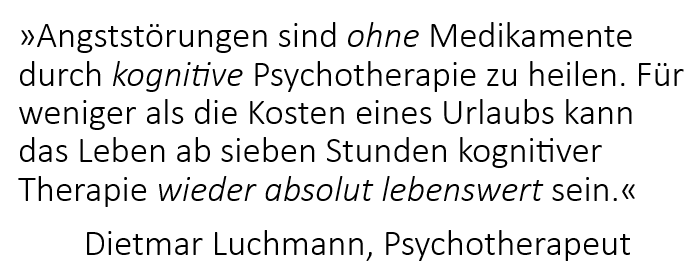
Anxiety disorders can be treated without psychotropic medication: cognitive psychotherapy works on the thinking errors from which the anxiety arises.
The Main Path: Written Cognitive Psychotherapy (WCP)
Written Cognitive Psychotherapy is not the most comfortable form of effective psychotherapy but the most rigorous. The written word cannot be blurred with impunity: it forces both parties into clarity, it remains permanently available, and it can be read as often as it takes to be understood. It demands the greatest mental effort of the client and thereby returns to him the highest thing psychotherapy has to teach: the ability to recognize and correct himself. This form is discreet, independent of place, and reaches the goal in the shortest time. It is our main path and our recommendation, unless there is a reason for another form.
It plays its strengths most fully where much is to be thought and little said: in anxiety disorders without acute escalation, with gifted people, and with those who write for a living in any case.
The Convenient Path: Video-Supported Cognitive Psychotherapy (VCP)
Not everyone who can write wants to write — and not everyone who wants to write is able to at this moment. For those who prefer the spoken word, Video-Supported Cognitive Psychotherapy offers the same path by way of the screen: the same work on the same thinking, spoken instead of written, at a firmly agreed hour and from any place with a camera. It is the more comfortable path — you need neither leave the house nor take up the pen. What that comfort costs is stated bluntly in the section on costs.
It is at the same time the suitable entry point for people whose depression has taken away the drive to write. The spoken hour requires less of a run-up than the written page. Anyone who begins on this path can switch to the written form later, as soon as it comes more easily — and most of them then want to.
The session does not run over the platform of some outside corporation that turns conversations into data — that would be the opposite of what our data privacy aims at. It runs over a dedicated, encrypted instance: without an account, without an app, in the bare browser, and with two participants directly from device to device. Nothing is recorded — on the server side no recording facility is set up in the first place. That a second camera defeats any technical barrier is known to everyone; the contract therefore prohibits recording for both parties equally and bindingly.
The Compact Path: Day-Block of Cognitive Psychotherapy (DCP)
Anyone who would rather put everything into a single day than spread it over weeks chooses the day block: eight concentrated hours in direct, personal conversation with the psychotherapist in Switzerland. The same work on the same thinking, only in one piece and face to face. It is the most demanding of the three paths - a whole day committed, a place, a journey -, and precisely that is reflected in the price; what is bought here, too, is not a greater cure but the condensed form.
The day block comes into its own with phobias and with agoraphobia, the fear of open squares, crowds, and leaving the house. Here what the anxiety claims can be tested on the same day: you go together to the place where the catastrophe is supposed to occur, and it does not occur. What takes weeks of practice in the written form can happen here in a single afternoon.
This form does, however, presuppose what it promises: the ability to sustain concentration through an entire working day, high motivation, and cognitive stamina. Exactly that must already have been demonstrated by the applicant during the psychodiagnostic assessment and trial phase. The day block can therefore be requested but not ordered: it is carried out only if the psychotherapists consider it sensible. How it proceeds is vividly described in the therapy report of a physician5 who overcame his anxiety disorder in a cognitive day block after ten years of going the wrong way, and in an article on the cognitive psychotherapy of agoraphobia in Zurich6.
Which Path Suits Which Problem
All three paths are open for all of the problems named. What follows is therefore not an allocation but a rule of thumb — it says what has served most people with the respective problem well.
With anxiety and panic all three paths work equally well. The written form is the most thorough, the video session the most convenient, the day block the fastest.
With phobias and agoraphobia the day block is often the strongest choice, because the decisive test of your own expectation of catastrophe can take place on the spot.
With depression and burnout the decisive factor is drive. Whoever can still write, writes; whoever cannot at the beginning, speaks, and switches later.
With the handicap of giftedness the written form is almost always the right one, because it can withstand the faster thinking.
And once more with all possible clarity, because it is the most common worry: a change of path is possible at any time, provided it makes professional sense. Nobody commits himself for good by applying.
What the Three Paths Cost — and Why
The three paths do not cost the same, and the reason is plain: they tie up unequal amounts of the psychotherapist’s time and unequal amounts of logistics. The written word can be worked on in pieces, without a fixed appointment and without a place; the video session requires a firmly agreed hour; the day block requires an entire day along with a place and a journey. From this the gradation follows: WCP is the least expensive path, the day block the most expensive, and the video session lies in between.
What this gradation reveals about effectiveness is less than flattering for the more expensive end. The least expensive path is at the same time the most effective: whoever writes thinks most thoroughly and keeps a record he can reread for the rest of his life. Whoever prefers conversation is buying comfort and pays for it twice — with the higher price, and with that measure of effectiveness which fleeting speech forfeits against the permanent word. This is not an objection to the comfortable paths but an honest statement of what they cost.
Measured against the return, even the most expensive path remains a good bargain. On a vacation whose recovery evaporates within weeks, most people spend more than on a psychotherapy whose effect endures. The rational calculation would argue unambiguously for what lasts longer — why most people nevertheless decide otherwise is a question for another time. The actual figures and how they are arrived at are given on the costs page4.

Anxiety, obsessive-compulsive, and depressive disorders according to ICD-11 and ICD-10 — the two international catalogs by which diagnoses are named uniformly worldwide.
Frequently Asked Questions
How Do the Three Paths Differ?
Only in the channel, not in the method: Written Cognitive Psychotherapy works through the written word, Video-Supported Cognitive Psychotherapy through the video session, the day block through conversation in person over one concentrated day. The work on your own thinking remains the same in all three.
Which Path Is the Most Effective?
Written Cognitive Psychotherapy. The written word demands the greatest mental effort and leaves behind a permanent record. The video session and the day block are more convenient and forfeit a measure of effectiveness for it.
Does Cognitive Psychotherapy Also Help with Depression?
It was invented for depression. Aaron T. Beck developed it with depressed patients and described in the process the cognitive triad: the depressed person appraises himself as worthless, his surroundings as hostile, and his future as hopeless. Those three appraisals are precisely what gets corrected. Anyone with very little drive often does better starting in the video session and switching to the written form later.
Giftedness Is Not an Illness — So Why Psychotherapy?
What is treated is not the gift but what the gifted person has learned to think about it. Anyone who reads his own difference as a personal defect produces overadaptation, perfectionism, and loneliness from it. These are thinking errors like any others and just as correctable. The gift itself remains untouched.
Do I Have to Write on the Video Path and in the Day Block as Well?
Yes, once. At the outset every applicant writes down the learning history and life history of his own problem; that is psychodiagnostic assessment and the first psychotherapeutic step, the trial phase, in one. No path exempts you from it.
How Confidential Are the Video Sessions?
The sessions run over a dedicated, encrypted instance without an account and without an app, and with two participants they run directly from device to device. Nothing is recorded on the server side; the contract prohibits recording for both parties.
How Do I Choose My Path, and Can I Change It?
You name the path you want when you apply. Whether it suits you is decided by the psychotherapist after the psychodiagnostic assessment. A change is possible whenever it makes professional sense.
Whom Is This Path Not Suited For?
People in an acute crisis, with thoughts of suicide, with a psychosis, or with an active addiction. In those situations medical help where you live comes first. That is not a refusal but an order of precedence.
One Method, One Goal
However different the three paths look, they lead through the same gate of cognitive psychotherapy and toward the same goal: freedom from a way of thinking that produces suffering. In each of them the client does the work himself, in each of them the relationship ends as soon as he no longer needs it, and in each of them the goal is the same: to become his own psychotherapist.
What we offer in doing so is psychotherapeutic instruction — guidance in correcting your own thinking -, not medical treatment. We therefore do not bill health insurers, and anyone looking for a treatment he merely receives passively is in the wrong place here. That is our contribution to more effective psychotherapy. The first step is the same for all three paths — the suitability test.
Cognitive Psychotherapy from Dr. Dietmar Luchmann, LLC, works on the thinking errors that cause the suffering — in writing, by video, or in a single-day block. Three paths, one goal.
1. Understand the Method
2. Check Your Suitability
3. Apply for Admission
1 National Institute for Health and Care Excellence (NICE): Generalised anxiety disorder and panic disorder in adults: management. Clinical guideline. 15 June 2020. [Recommendation 1.3.15: “CBT in the optimal range of duration (7 to 14 hours in total) should be offered.”]
2 Beck, A. T.; Rush, A. J.; Shaw, B. F.; Emery, G.: Cognitive Therapy of Depression. Guilford Press, New York 1979. [The foundational account of the cognitive triad: a negative view of the self, the world, and the future.]
3 Luchmann, D.: Cognitive Psychotherapy for the Handicap of Giftedness. Psychotherapie. 1 July 2026.
4 Dr. Dietmar Luchmann, LLC: What Does Cognitive Psychotherapy Cost? Psychotherapie. The total costs are derived transparently there from the flat rate for psychodiagnostic assessment and trial phase and from the hourly fee.
5 Nordes, N.: Record of a Misdiagnosis — a Physician Experiences Psychotherapists and Psychotherapy. Psychotherapie. 11 March 2003.
6 Luchmann, D.: Agoraphobia in Zurich — Cognitive Psychotherapy of the Fear of Open Spaces. Psychotherapie. 25 June 2026.
Your Comment
Are you interested in contacting the author? Do you have remarks, suggestions, or additions regarding this article? Do you have personal therapy experiences? We welcome substantial feedback.