Dr. Friedrich Weihenruh, a seasoned psychotherapist whose kindly eyes stood in sharp contrast to his razor-keen intellect, contemplated the bundle of misery cowering in the sinfully expensive leather armchair before him.
He was making a house call to Bodo von und zu Kleingläubig, heir to a tea bag dynasty and collector of anxieties more crippling and exquisite than the rarest orchids.
"He did it over the phone," Kleingläubig whimpered, kneading a handkerchief that presumably cost more than Dr. Weihenruh's monthly rent.
"Just like that. Between the weather forecast and an anecdote about his golf handicap. 'Mr. von und zu Kleingläubig,' he cooed, 'I have a once-in-a-lifetime opportunity here. A currency speculation. US dollars. An absolutely sure thing.'"
Dr. Weihenruh sighed, thinking of the flamingo banker.1 It was a deep, profoundly human sigh — a blend of compassion and a quiet amusement at the absurdities to which greed can drive the human brain.
"And you — a man who pays the pizza delivery driver only through the peephole to avoid eye contact — entrusted over the phone, to a complete stranger, a sum that exceeds the annual revenue of some municipalities?"
"He sounded so… competent!" Kleingläubig protested feebly. "He talked about 'portfolio diversification' and 'hedging against market volatility.' He promised me a return of six percent! Six!"
Dr. Weihenruh smiled indulgently. "Six percent. Before taxes, I presume? Preposterous. A pittance. That is the kind of return one offers a hamster for running in its wheel. And now the money is gone, is it not? Evaporated into the digital ether because the US dollar decided to do something other than what your financial advisor saw in his crystal ball."
Kleingläubig nodded, and a single, expensive little tear rolled down his cheek. "A million. Gone. My portfolio is hemorrhaging."
"A million," Dr. Weihenruh repeated softly, leaning forward. His eyes did not flash with predatory gleam but with the quiet knowledge of just how taxing rational thinking can be.
"Let us talk about your real portfolio, Mr. von und zu Kleingläubig. Money can create meaning, as long as it remains the servant. The moment it becomes the master, it devours both heart and mind. Let us talk about a proper investment. I am offering you a return that will make your financial advisor look like a first-grader trying to buy an ice cream cone with Monopoly money."
Kleingläubig looked up. His greed was visibly wrestling with his apathy. "More than six percent?"
"I am talking about 400 percent in three months. At a minimum."
The tea bag heir froze and stared at him in disbelief. "That is… not serious. A 400 percent return in three months? Are you selling tulip bulbs, Doctor?"
"No, the tulip bubble was a stock market mania," said Dr. Weihenruh, lacing his fingers together. "What I am offering you is something far rarer and far more valuable. I am selling you your life back. It is the safest investment in the world: human capital. More precisely: your human capital. You invest in yourself — the only investment over which you have 100 percent control."
"This investment in cognitive psychotherapy has been available for over three decades."2 From his leather writing case he produced a brochure emblazoned with a large Swiss cross and handed it to Kleingläubig. "Here is a report on health monitoring by the Swiss federal and cantonal governments. Please turn to page 14. I have highlighted in yellow where even the Swiss Health Observatory3 confirms that this is the perfect investment for you."
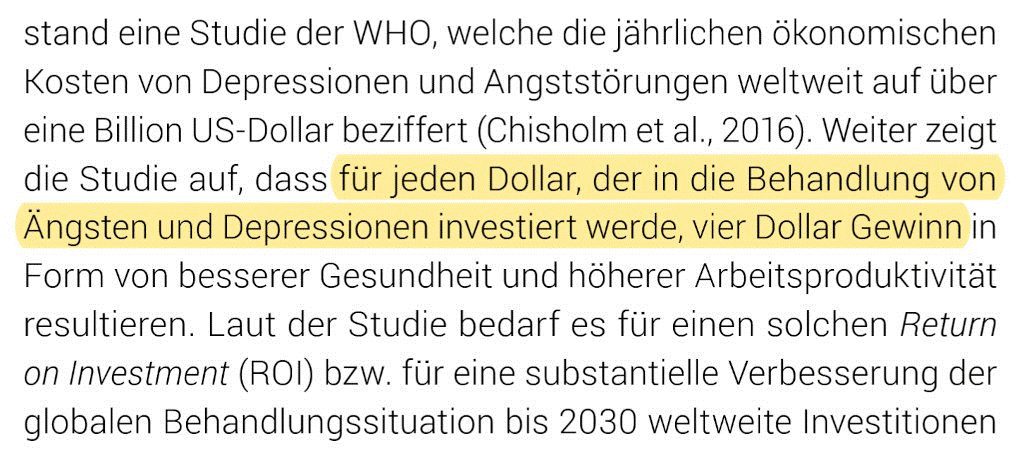
Fig.: Mental Health in Switzerland. Monitoring 2016 (Obsan Report 72). Neuchâtel: Swiss Health Observatory. p. 14.3
With astonished eyes, Kleingläubig read "that for every dollar invested in the treatment of anxiety and depression, four dollars of return result in the form of better health and higher work productivity."
Dr. Weihenruh rose to his feet and began pacing back and forth like an investment banker delivering a pitch. "You see, your financial advisor promises you a paltry six percent on your money. I am offering you 400 percent on the investment in your quality of life. Every franc you invest in yourself to rid yourself of your absurd fear of other people yields, scientifically proven, at least four times its value in productivity and — what matters infinitely more — in pure, unadulterated joy of living."
Kleingläubig stared at him. "Joy of living? Can that be captured in spreadsheets? Is it inflation-adjusted?"
"Oh, absolutely!" Dr. Weihenruh exclaimed with enthusiasm. "Let us run a little return calculation. What is the ROI — the return on investment — of a panic attack in the supermarket?"
"Um… negative?"
"Correct! Catastrophically negative! And what is the dividend you receive if you manage to attend the Christmas party at your own company without fleeing to the restroom after three minutes and spending two hours in there counting tiles?"
"I… um…"
"The CEO position that should rightfully be yours, but which your second cousin occupies because he is capable of shaking people's hands without breaking into a sweat! That is a dividend running into the millions!"
Kleingläubig sank into himself, while Dr. Weihenruh proceeded to draw up a balance sheet of the tea bag heir's life.
"Your current holding in 'Social Isolation Inc.'? Performance: minus 90 percent. You are losing money on it every single day. You order takeout instead of dining at a Michelin-starred restaurant. Cost: forfeited pleasure, value incalculable."
"You admire women only on Instagram instead of speaking to one in person. Cost: a potential marriage, a family, happiness. Let us call those 'forfeited happiness futures.'"
"Your financial advisor sells you slips of paper with numbers on them. I am selling you the ability to walk into a bakery and order a pretzel without feeling as though you are testifying before the Supreme Court!"
Kleingläubig had gone pale. "But… 400 percent… that sounds so… easy."
"Easy?" Dr. Weihenruh laughed. "It is the hardest work of your life! But the return is phenomenal. Imagine: you can fly again without requiring three sedatives and an entire quart of gin. You can sit on a park bench and enjoy the sunshine without analyzing whether the man with the dachshund is a contract killer. That is not six percent, my friend. That is liberation from a maximum-security prison of your own construction. That is a return that is infinite."
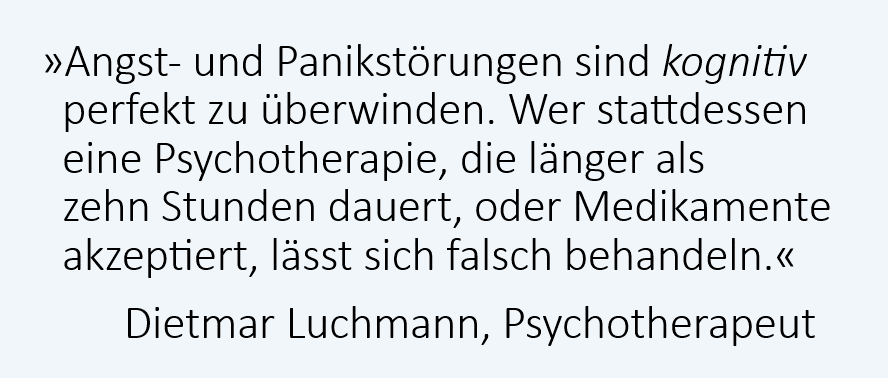
Dietmar Luchmann, Psychotherapist: "Anxiety disorders and panic attacks can be perfectly overcome through cognitive methods. Anyone who instead accepts a psychotherapy lasting longer than ten sessions, or medication, is receiving the wrong treatment."
He paused and looked Kleingläubig directly in the eyes. "Do you know what the ultimate portfolio liquidation is? Death. And do you know that your last shirt has no pockets? You cannot take a single share, a single dollar, or a single gold bar with you. But do you know what you do take? The memory of a laugh. The memory of a good conversation. The memory of not having sat alone in a mansion while entrusting your fortune to faceless voices on the telephone."
The room fell silent. The only sound was the faint hum of the air conditioning, circulating the expensive air.
Kleingläubig looked down at his trembling hands, then at the smiling face of Dr. Weihenruh. He thought of the lost million. It was a number, nothing more. Then he thought of the man with the dachshund, whom he had actually once taken for a spy. He thought of the countless parties he had missed, the trips he had never taken, the people he had never met.
"All right," he whispered. "I'll invest. When do we begin… accumulating this… social capital?"
"Immediately, if you wish," Dr. Weihenruh replied, raising a cautionary finger, "but it is the strangest business model you will ever encounter."
"In what way?" Kleingläubig asked.
"Quite simple. With your financial advisor, you pay, and he is supposed to do the work. A wretched business model, as we have just established. With me, it is the exact reverse: you pay me, and then you do the brutally hard work yourself."
Kleingläubig looked at him in bewilderment. "I am supposed to do the work?"
"Absolutely!" said Dr. Weihenruh. "Think of me as your personal Sherpa for the Mount Everest of your soul. I supply you with the finest equipment — the mental ice axes, the maps of your thought patterns, even the motivational chocolate. But the actual scrambling up that damned mountain? That you must do yourself."
Kleingläubig sank even further into himself. "I don't know if I can do it," he murmured. "I have had this anxiety for decades. It is a part of me."
"Nonsense, a part of you!" Dr. Weihenruh retorted with a laugh, slapping his knee. "You have spent decades practicing being anxious. All that means is that you are an unrecognized world champion of anxiety! Congratulations! Now, how would it be if we harnessed that discipline and energy to make you the champion of something else? The work of relearning is hard, yes. But the return is phenomenal. Just imagine!"
"What if I give up halfway through?" the anxiety whispered out of Kleingläubig again.
"That is allowed to happen," Dr. Weihenruh declared with an encouraging nod. "You will learn to handle setbacks. Giving up is part of the process, the way headwinds are part of cycling. When the wind grows too strong, we dismount and walk for a stretch, then simply get back on. Anxiety is stupid and it destroys the soul: it always brings the same arguments. We, on the other hand, are creative — we write counterarguments, laminate them, and tuck them into your wallet, right next to your Black Card."
Dr. Weihenruh leaned back again, his gaze growing gentler. "Your financial advisor sold you a number on a screen. An abstract promise. I am offering you the pleasure of moving among people and feeling at ease. I am offering you the laughter of a woman you invite for a glass of wine. I am offering you the sunset over the ocean, seen from an actual beach and not on your 8K television. These are the lifelong dividends of the 400 percent investment. This is the compound interest of a life actually lived."
Dr. Dietmar Luchmann, LLC, the publisher of this journal, itself offers cognitive psychotherapy via video — with a written summary of every session, for self-pay patients, in German or English.
1. Understand the Method
2. Check Your Suitability
3. Apply for Admission
Slowly, Kleingläubig raised his head. His eyes were clearer. "All right," he said, his voice firmer now. "What can I do? How do we begin… the work?"
Dr. Weihenruh smiled his broad, honest smile. He extended his hand to Kleingläubig. "By shaking my hand. That is the first small step up the great mountain."
And as Bodo von und zu Kleingläubig hesitantly took the offered hand, Dr. Weihenruh knew: this is how it begins. The slow, arduous, beautiful climb back to life.
1 Luchmann, D.: "It Is Hell, Doctor!": On a banker's attempt to sell an inflatable flamingo. Psychotherapie, June 30, 2025.
2 Luchmann, D.: Heilkunst ohne Gebetbuch — Empirische Psychologische Therapie. Verhaltenstherapie & psychosoziale Praxis 26 (1994) 231–241. [Book review: Grawe, K., Donati, R., Bernauer, F.: Psychotherapie im Wandel. Von der Konfession zur Profession. Göttingen: Hogrefe-Verlag, 1994.]
3 Schuler, D., Tuch, A., Buscher, N. & Camenzind, P.: Psychische Gesundheit in der Schweiz. Monitoring 2016 (Obsan Bericht 72). Neuchâtel: Swiss Health Observatory, 2016.
Dr. Friedrich Weihenruh is a literary alter ego through which the author gives narrative form to his experiences as a psychotherapist. The stories are based on true events but have been fictionalized: to protect privacy and professional confidentiality, names, locations, and details have been changed. Any resemblance to actual persons is entirely coincidental.
Your Comment
Are you interested in contacting the author? Do you have remarks, suggestions, or additions regarding this article? Do you have personal therapy experiences? We welcome substantial feedback.