The Sixth Domain of Warfare — Thinking
In 2020, the French officer François du Cluzel presented a document at the NATO Innovation Hub in Norfolk, Virginia, that expanded the Western security architecture by an additional dimension. Alongside land, sea, air, space, and cyberspace, a sixth domain of warfare emerged: the cognitive.
Cognitive warfare - "Cognitive Warfare" - does not target bridges, servers, or satellites. It targets thinking itself. Du Cluzel's core statement: "The objective of cognitive warfare is to make everyone a weapon."1 Soldiers are not the target. Every single citizen is. The human mind, according to the official doctrine, is not a means to an end — it is the battlefield.
From the NATO analyses on cognitive warfare, three conditions can be distilled under which cognitive attacks are particularly effective1,2:
- They originate from trusted actors.
- They are not recognizable as attacks.
- And they exploit existing cognitive vulnerabilities.
Commit these three conditions to memory. We will need them.
Switzerland has since dutifully debated cyber defense, drone swarms, and the procurement of new fighter jets. About the sixth domain, it is silent. Cognitive warfare? — Never heard of it. Yet the most effective attack on the cognitive resilience of the Swiss population has long been underway — not directed from Moscow, not disseminated through troll farms, but administered in therapy rooms, financed by mandatory health insurance, and defended against all enlightenment by the Association of Swiss Psychotherapists (ASP).
The Health Care System as a Subversion Vector
That the infiltration of the health care system as an instrument of cognitive warfare is not a theoretical construct is attested by a historical source from the Cold War. Yuri Bezmenov, a KGB officer who defected in 1970, described in a book3 published in 1984 and in a documented lecture4 the Soviet strategy of "ideological subversion" in four stages: demoralization, destabilization, crisis, normalization. The first stage - the demoralization of a society - takes fifteen to twenty years according to Bezmenov and proceeds primarily through the manipulation of education, media, and the health care system.
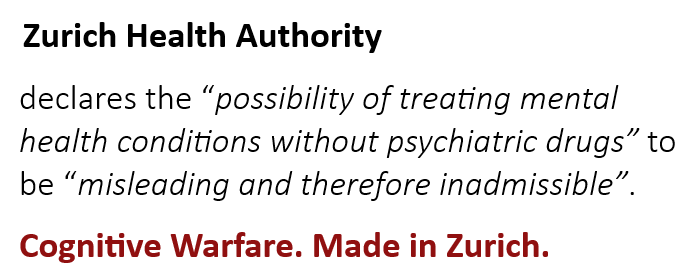
The Association of Swiss Psychotherapists (ASP) is attacking the international standard for cognitive psychotherapy and has received support from the Health Directorate of the Canton of Zurich. Sophie Köhler, MLaw, a lawyer with the Zurich Health Directorate, classifies the “possibility of healing mental health issues without psychotropic drugs” as “misleading and therefore inadmissible.” Cognitive warfare. Made in Zurich.
One need not follow Bezmenov in every detail to find the precision of his description remarkable: a health care system that systematically conditions its patients into learned helplessness accomplishes precisely what Bezmenov identified as the most efficient form of subversion — the erosion of resilience from within, by actors whom the target population considers its helpers.
Paradox: Psychiatry and Psychotherapy in Switzerland
Switzerland has the highest psychiatrist density in the world: approximately 53 psychiatrists per 100,000 inhabitants — nearly triple the OECD average and almost double the rate of the second-ranked country.5,6 Since the introduction of the referral model for psychological psychotherapy on July 1, 2022, the number of psychotherapy practices has more than doubled within two years, from 2,340 to 4,834.7 The costs of mandatory health insurance for psychotherapy rose between 2021 and 2024 from 528 million to 922 million Swiss francs. "This corresponds [...] to an average annual increase of 20.4%."8
The measurable effect of this investment ought to be the most psychologically healthy population in Europe.
The opposite is the case.
The "National Health Report 2025" of the Swiss Health Observatory documents a marked increase in psychological complaints: "Since the 2017 survey, this share rose sharply. This increase was particularly pronounced among young women (from 19% to 28.9%), but there was also an increase among men (from 9.6% to 16.4%)."9 The trend in the prevalence of moderate to severe psychological distress: continuously rising.
Mental disorders are the most common cause of disability. The majority of all new disability pensions, according to the disability insurance statistics for 2024, are "psychologically caused (52% of all disability pensions and 76% of all illness-related disability pensions)."10 Here, too, the trend for years: continuously rising.
An OECD survey of Swiss psychiatrists found "that the average treatment duration is approximately 60 months."5 Five years of treatment for disorders that, according to the international body of research, can be successfully treated in a few sessions of cognitive psychotherapy. Trend in waiting times: continuously rising.
Whoever places these numbers side by side - more psychotherapists, more psychotherapy practices, higher costs, and yet: more illness, more disability, more suffering - confronts a question that the system does not wish to ask, because the answer would destroy its business model:
If psychotherapy works — why do the Swiss become sicker the more psychotherapists they have? On March 2, 2025, even the Neue Zürcher Zeitung (NZZ) noticed: "In the country with the greatest density of psychiatrists, the waiting lists for appointments keep growing longer. What is going wrong?"11
The NZZ did not dare to name the battlefield and the responsible parties in concrete terms.
The Fabrication of Patients
There are logically only two answers to this question.
Either the therapies are ineffective — in which case their expansion is a waste. Or the therapies themselves are iatrogenic, that is, they cause illness — in which case their expansion is a hazard. In both cases, the system produces not health but demand for itself.
The second answer is the more severe. And it has a scientific name.
The psychologist Nick Haslam of the University of Melbourne documented in 2016 what he termed concept creep: the systematic expansion of core psychological concepts such as trauma, abuse, addiction, and mental disorder.12 What thirty years ago was regarded as a normal life experience - grief, nervousness, shyness, disappointment - is today diagnosed, pathologized, and treated. It is not illness that is increasing. It is the definition of what counts as illness that is expanding — and with it the number of those who profit from that definition:
"A possible adverse looping effect of concept creep is therefore a tendency for more and more people to see themselves as victims who are defined by their suffering, vulnerability, and innocence, and who have diminished agency to overcome their plight."
Nick Haslam Concept creep: Psychology's expanding concepts of harm and pathology Psychological Inquiry, 2016.12
On the battlefield of cognitive warfare, these people are cognitively defeated: through years of therapeutic treatment that perpetuates their victim identity rather than overcoming it, they have been systematically demoralized, destabilized in their capacity for judgment, and stripped of their psychological resilience. They were not healed but rendered defenseless — cognitively disarmed, trapped in learned helplessness, and incapable of perceiving themselves as agents capable of action. The ostensible therapeutic care placed them in a state of permanent vulnerability in which they can neither recognize the manipulation nor summon the will to resist it.
The psychiatrist Klaus Dörner, who taught at the University of Witten-Herdecke and directed the Westphalian Clinic for Psychiatry in Gütersloh, wrote in 2002 in the Deutsches Ärzteblatt what Haslam would empirically confirm fourteen years later:
"Competition forces the opening of new markets. The objective must be the conversion of all healthy people into patients — that is, into people who consider themselves to be, for as long as possible, [...] psychologically in need of therapeutic, rehabilitative, and preventive manipulation by experts in order to 'live healthy lives.' This is already working quite well in the domain of physical illnesses, but even better in the domain of mental disorders, especially since there is no shortage of theories according to which almost no one is healthy."
Klaus Dörner Gesundheitssystem: In der Fortschrittsfalle [The Health Care System: Trapped by Progress]. Deutsches Ärzteblatt. September 20, 200213
"The objective must be the conversion of all healthy people into patients" — read that sentence twice. It does not come from a system critic. It comes from a chief psychiatrist describing what he observed from the inside. And it describes not a conspiracy but an economic logic — the same logic revealed by the Swiss numbers.
Yet concept creep and market expansion explain only the proliferation of diagnoses. They do not explain why patients are sicker after years of treatment than they were before. That requires a second mechanism: long-term therapy as cognitive disarmament.
A reader who commented on the public critique of the Swiss psychotherapy industry described his experience in words no researcher could have formulated more trenchantly:
"For over 20 years I had been going to therapy, and at the end I was sicker than at the beginning. Again and again new suspected diagnoses, pathologized personality traits, 'deficits' here and 'traumas' there. You are literally conditioned into a victim full of incapacities. [...] I feel like an ex-cult member."
Affected individual, August 18, 2025, 1:59 PM Comment on Switzerland as a Paradise of Psychotherapeutic Inefficiency14
Twenty years. Sicker than at the beginning. Conditioned into a victim. The word "conditioned" is precisely chosen and correct in clinical terminology: this patient was not treated. He was trained in learned helplessness. His cognitive self-efficacy — the ability to solve his own problems through his own thinking — was not strengthened but systematically dismantled.
This is not the failure of individual psychotherapists. This is the business model. Long-term therapy breeds, in effect, the patients it needs for its own economic sustenance by dismantling cognitive self-efficacy instead of building it. The patient who is cured and discharged after ten sessions has no commercial value. The patient who still comes after ten years is an annuity.
And this is precisely where the arc closes back to the NATO doctrine: what François du Cluzel defined as cognitive warfare - the systematic undermining of the cognitive capabilities of a target population - is functionally indistinguishable from what takes place in psychotherapy practices across Switzerland.
The "Psychotherapy" Schools for Fabrication
The sources of this systematic debilitation of the Swiss population's cognitive capabilities are easy to locate. They include the institutional members of the Association of Swiss Psychotherapists (ASP)15 — training institutes accredited by the Federal Office of Public Health (BAG) that sell inefficient therapeutic methods to young physicians and psychotherapists. The cantonal health authorities then rubber-stamp these training programs for the acquisition of the titles "Federally recognized psychotherapist" and for the training leading to "Specialist physician for psychiatry and psychotherapy."
As of the publication date of this article, the following institutes and associations are listed as members of the Association of Swiss Psychotherapists (ASP):
Accredited Advanced Training Institutes — Depth Psychology
- CGJI C.G. Jung Institute Zurich
- IPA Institute for Process Work
- IRG Istituto Ricerche di Gruppo
- SGBAT Swiss Society for Bioenergetic Analysis and Therapy
Accredited Advanced Training Institutes — Humanistic Psychotherapy
- GES Society for Existential Analysis Switzerland
- GFK Person-Centered and Experiential Psychotherapy - Body-Oriented
- IKP Institute for Body-Centered Psychotherapy Zurich16
Associated Collective Members
- EFAPO École Française d'Analyse Psycho-Organique Paris
- ISAPZURICH International Seminar for Analytical Psychology Zurich
- SIPT Swiss Institute for Psychotraumatology
- VPB Association of Psychotherapists of Both Basels
Cognitive Warfare — Without Uniform
Let us return to the three NATO conditions for successful cognitive attacks.
Cognitive attacks originate from trusted actors. No actor enjoys more intimate trust than a psychotherapist. The patient reveals to the therapist his most vulnerable thoughts, his deepest fears, his most private convictions. The psychotherapeutic relationship is, by design, a setting of maximal cognitive openness — and thus maximal cognitive vulnerability.
The cognitive warfare of the psychotherapists is not recognizable as an attack. No patient enters a psychotherapy practice expecting to emerge sicker. No citizen suspects that a system bearing "mental health" in its name undermines his mental health. The camouflage is perfect because it is not camouflage — it is a self-deception that the psychotherapist shares with the patient.
They exploit existing cognitive vulnerabilities. The patients who walk into the psychotherapy practice are, by definition, already cognitively burdened. A system that does not remedy their vulnerability but cultivates it operates at the most exposed point of society — and holds it open.
One need not attribute military intent to the members of the Association of Swiss Psychotherapists (ASP). The term "cognitive warfare" describes here not an intention but an effect. The question is not whether the psychotherapists of the ASP are planning an attack on Switzerland. The question is whether the effect of their actions is distinguishable from such an attack.
A document17 from the Association of Swiss Psychotherapists (ASP), dating from 2025, permits this question to be answered with a precision that an analyst rarely dares to hope for.
The Confession of ASP President Gabriela Rüttimann
In the summer of 2025, as a psychotherapist, I published an analysis demonstrating that Switzerland is a "paradise of psychotherapeutic inefficiency14" — a system in which the majority of Swiss psychotherapists employ methods that keep patients in treatment for years and decades when scientifically substantiated, effective psychotherapy could cure them in a few sessions. I criticized:
"Psychotherapists perpetually demand more resources. But they provide no quality assurance. They complain about too few treatment slots, yet defend interminable psychotherapies without objectives. They claim interpretive authority over mental health, yet argue like lobbyists serving their own interests."
Dietmar Luchmann Switzerland as a Paradise of Psychotherapeutic Inefficiency14
The response of the Association of Swiss Psychotherapists (ASP) did not consist in a professional rebuttal. It consisted in a formal complaint17 filed with the Health Directorate of the Canton of Zurich, in which ASP President Gabriela Rüttimann called upon the authority to take action against the author.
The documentation18 with the full texts shows how the Association of Swiss Psychotherapists (ASP) successfully instrumentalized the Health Directorate of the Canton of Zurich, led by Natalie Rickli, to shield the inefficient psychoanalytic, depth-psychological, existential-analytic, bioenergetic, and body-centered methods of its members from scientific progress.
What renders this document17 valuable for the present analysis is not the procedure — it is the content. For the ASP President formulated therein, openly and in writing, what must be identified as operational damage objectives for cognitive warfare against the Swiss population — regardless of whether Gabriela Rüttimann intended this effect or merely accepted it as a collateral consequence.
Damage Objective No. 1:
Suppression of information about effective psychotherapy.
The Association of Swiss Psychotherapists (ASP) denounced17 the statement that anxiety disorders can be treated in eight to ten sessions as "misleading." What the ASP characterizes as a violation of professional conduct regulations is the documented state of international science: the NICE guidelines of the British National Institute for Health and Care Excellence (NICE), renowned worldwide for its relentless evidence-based rigor, recommend cognitive behavioral therapy for anxiety disorders in a total of 7 to 14 hours19; for specific phobias, one to five sessions may suffice.20
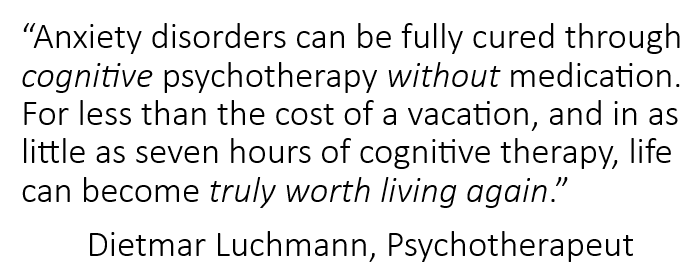
Dietmar Luchmann, psychotherapist: "Anxiety disorders can be fully cured through cognitive psychotherapy without medication. For less than the cost of a vacation, and in as little as seven hours of cognitive therapy, life can become truly worth living again." The Health Directorate of the Canton of Zurich "considers" the dissemination of the international scientific standard for psychotherapy to be "misleading and therefore impermissible," writes its jurist Sophie Köhler, MLaw, and threatens the disseminator with revocation of his professional license.
The psychotherapy researcher Klaus Grawe demonstrated as early as 1994, in the most comprehensive meta-analysis in psychotherapy research at the University of Bern, that cognitive psychotherapy is "on average highly significantly more effective than psychoanalytic therapy and client-centered psychotherapy."21 The reaction of the affected professional associations consisted at the time of what Grawe described as a "torrent of outraged reactions."22 Thirty-two years later, the Association of Swiss Psychotherapists (ASP) employs the same strategy — with the difference that this time it has found in the Health Directorate of the Canton of Zurich, led by Government Councillor Natalie Rickli, a collaborator who does its work for it.18
The damage:
Patients are not to learn that they could be cured in a few hours. They are to remain in treatment for years.
Damage Objective No. 2:
Pathologization of therapeutic success.
The Association of Swiss Psychotherapists (ASP) objected17 to the statement that, following successful psychotherapy, one's "life can be fully worth living again." A professional association of psychotherapists denounces the universal goal of every psychotherapy as a violation of professional conduct regulations. That is as though an association of surgeons were to report the statement that the objective of an operation is the survival of the patient as a "misleading promise of cure."
The damage:
The standard by which therapeutic success is measured is eliminated. If no one may state that psychotherapy makes "life fully worth living again," the absence of this result in interminable long-term therapies becomes invisible.
Damage Objective No. 3:
Discrediting of medication-free psychotherapy.
The Association of Swiss Psychotherapists (ASP) censured17 the dissemination of information that "anxiety disorders [...] can be cured without the use of psychotropic medications." This denunciation, too, turns psychotherapeutic science on its head. Psychotherapy is, by its nature and by its legal definition, a non-pharmacological treatment. Psychological psychotherapists in Switzerland may not prescribe medications. They cannot work any other way than without psychotropic drugs — but they do not need psychotropic drugs either, because cognitive psychotherapy for anxiety disorders requires no medication. The NICE guidelines for anxiety disorders even explicitly warn against the routine use of benzodiazepines and recommend that psychotropic medications not be employed as first-line treatment.19 To accuse a psychotherapist of practicing psychotherapy is an absurdity.
The damage:
The boundary between psychotherapy and pharmacotherapy is blurred — in favor of a system in which patients become medication consumers who "additionally" require interminable talk therapy.
Damage Objective No. 4:
Distortion of meaning as method.
The Association of Swiss Psychotherapists (ASP) cited its own fabricated formulation17 "suitable for millionaires" as a quotation from the attacked psychotherapist and denounced the "targeted solicitation of a wealthy clientele." The actual wording on the contested website reads: "not only for millionaires" — a reference to the low cost and affordability of efficient psychotherapy. The ASP inverted the statement into its opposite. It manufactured from an argument for accessibility an argument for exclusivity. In the terminology of cognitive psychotherapy, this is a cognitive distortion of the type "meaning-distorting abstraction": one tears a detail from its context and reverses its meaning in order to generate indignation over one's own distortion.
It is the cognitive structure of disinformation — executed by people who professionally purport to treat cognitive distortions.
The Captured State as Accomplice — Regulatory Capture as a Security Risk
The Health Directorate of the Canton of Zurich, under the political responsibility of SVP Government Councillor Natalie Rickli,18 adopted all charges of the Association of Swiss Psychotherapists (ASP) in near-identical wording - in the same sequence, in the same formulations, with the same substantive thrust - and threatened the psychotherapist with revocation of his professional license.
At one point, the Health Directorate of the Canton of Zurich even sharpened the charge: where the ASP had still written, in qualifying terms, of the "alleged possibility" of cure without psychotropic medications, the authority struck the word "alleged" and converted a cautious assessment by a professional association into an official finding of fact.
Nowhere does the official response reveal that even a single one of the contested websites was accessed, a single passage was read in the original, or a single one of the asserted facts was independently verified. The Health Directorate of the Canton of Zurich did not even notice that the websites do not belong to the attacked psychotherapist. The psychotherapist's suggestion to verify the charges before compelling a formal response by "taking a look at the incriminated website" was rejected, which leads to the question:
Does Natalie Rickli protect inefficient psychotherapy schools?23
The technical term for this process is regulatory capture: a supervisory authority that is supposed to protect the public from harmful practices becomes the enforcement organ of those whose practices it was meant to oversee. The state becomes the accomplice of those who corrode it from within. Because for the politically leading Natalie Rickli "only the image counts,"24 she is, on the battlefield of cognitive warfare, a leader whose documented disinterest in substantive review systematically undermines whatever expertise remains within the supervisory authority.
Natalie Rickli expanded the "Communications" department by a fifth staff member beginning in March 2026 — while simultaneously maintaining her threat posture in favor of the Association of Swiss Psychotherapists (ASP) and refusing to communicate with me. My email of March 3, 2026,18 containing my formal response to what I assess as increasingly recognizable abuse of office and the resulting request for access to the case files, has to this day remained unanswered by the Health Directorate of the Canton of Zurich. This, too, is cognitive warfare against the dissemination of international treatment standards.
It deserves mention that ASP President Gabriela Rüttimann, who presumes to claim that cognitive psychotherapy "lacks scientific evidence," simultaneously serves as "academic director" of the IKP Institute for Body-Centered Psychotherapy in Zurich, whose method is listed in none of the authoritative international treatment guidelines as evidence-based psychotherapy.16 This personnel conflict of interest - the director of a training institute for a non-evidence-based method simultaneously leading the professional association that mobilizes the supervisory authority against evidence-based competition - is documented and undisputed. The charge of lacking evidence, leveled by a representative of a method without evidence against a representative of a method with evidence, is concept creep as an instrument of power: the redefinition of standards until incompetence passes for the norm and competence counts as a violation.
More Effective Than Any Troll Farm
Let us pose the question that has not yet been asked in Switzerland's security policy debate: who inflicts greater damage on the cognitive resilience of the population — Russian disinformation campaigns or the psychotherapists of the ASP with the compliant Health Directorate of the Canton of Zurich?
Russian disinformation reaches a fraction of the Swiss population, operates indirectly through social media, and can be neutralized through media literacy. Its reach is limited, its effect diffuse, its intent — once recognized — transparent.
The psychotherapists of the ASP reach the most vulnerable population group - people in psychological distress - directly, in a setting of maximal trust, over months and years, financed by the general public. They operate on precisely those citizens who are already cognitively weakened — and hold them in that weakened state rather than remedying it. With an average treatment duration of five years,5 the contact hours of Swiss psychiatrists and psychotherapists with their patients exceed those of most intelligence operations ever documented.
The effect of this system surpasses what a hostile intelligence service could achieve through conventional means of disinformation — not in intent, but in reach, contact duration, and depth of access. A nationwide network of actors who enjoy the intimate trust of the most vulnerable, are paid by health insurance, and have an economic interest in maintaining cognitive debilitation. A system that need not be infiltrated because it operates itself.
The difference between a troll farm and the Association of Swiss Psychotherapists (ASP) is the motive. The troll farm intends to harm. The psychotherapists of the ASP intend to earn. For Switzerland's cognitive resilience, this distinction is without consequence. A commenter on my article "Natalie Rickli and the Psychologists' Lobby"25 wrote:
"Having already experienced several severely drug-addicted tenants, I have come to know a system that operates across cantons to egregiously mistherapize addicts and exploits our health insurance funds and the social welfare systems in need of reform. More than 20,000 per person per month are squandered without the slightest incentive for the addicts to actually be cured."
Schmatz, March 3, 2026, 6:29 PM Comment on "Natalie Rickli and the Psychologists' Lobby." March 3, 202625
National Security Begins in the Mind
What is described here is not a deficiency of the health care system. It is a threat to Switzerland's national security — cognitive warfare in its most perfected form.
The connection is not abstract. It can be read from the operational readiness of the Swiss Armed Forces. The number of recruits classified as unfit for service on psychological grounds at the recruitment assessment has been rising for years. "More and more arrive in the army with pre-existing psychological conditions," warned Blick26 on June 29, 2025. On the occasion of the 2010 popular initiative to abolish compulsory military service, the St. Galler Tagblatt27 reported that the "recruitment potential [...] of the 1964 cohort [...] corresponded to a fitness rate of 80 percent at the time" and that "today's fitness rate [...] based on the applicable fitness criteria [...] the number of recruits constitutes just 64 percent of those liable for military service (year 2008)."
The army is losing a growing share of the military-age population — not to enemy weapons but to diagnoses. "At times, several diagnoses coincide, yet 76 percent of all conscripts found unfit for military service have a primary psychological finding," according to SwissInfo.28 Diagnoses issued by a system that — as the numbers demonstrate — does not reduce mental disorders but produces them. The recruits who are today mustered as psychologically unfit are the patients of yesterday, chronified in a system that profits from their illness.
If NATO has declared the human mind the sixth domain of warfare, then the mental health of the population does not belong under the jurisdiction of the Federal Office of Public Health (BAG) alone. It belongs on the desk of the Federal Intelligence Service (NDB). For what the NDB monitors under "threats to internal security" - terrorism, espionage, violent extremism - are attacks that come from outside or that identify themselves as such. The cognitive debilitation wrought by a system that holds the most vulnerable citizens in learned helplessness comes from within and presents itself as help. By the criteria of NATO doctrine, it is the more perfected threat: invisible, trust-based, self-financing.
Switzerland invests billions in fighter jets that protect its airspace. It invests in cyber defense that protects its digital infrastructure. And it invests one billion annually in a system that undermines the cognitive infrastructure of its population — the ability of its citizens to think clearly, to judge independently, and to act in a crisis. A country whose military-age youth has learned in therapy rooms to regard itself as victims full of incapacities will not produce an army capable of defending Switzerland — not even with new fighter jets.
National security does not begin with the procurement of armaments. It begins with the question of whether the citizens who are supposed to operate those armaments still possess the cognitive resilience that General Guisan recognized in 1940 as Switzerland's true defense resource. The answer that the Swiss numbers provide is alarming. And the system that produces this answer is financed by the general public, defended by the professional associations, and protected by the authorities.
If this is not a case for the Federal Intelligence Service, then the term "internal security" has lost its meaning.
Two Lines of Defense
The diagnosis has been made. But a cognitive psychotherapist worthy of the name never stops at the diagnosis. He shows the path to curing the cognitive sepsis caused by inefficient and harmful forms of therapy.
Line of Defense 1:
The FOPH halts the proliferation of inefficient and harmful "psychotherapy"
Pursuant to Article 34 of the Federal Act on Psychology Professions, the Federal Department of Home Affairs (FDHA) is responsible for the accreditation of advanced training programs that lead to a federal advanced training title, e.g., "Federally recognized psychotherapist" and "Specialist physician for psychiatry and psychotherapy."
The advanced training programs in psychotherapy accredited by the federal government are published by the Federal Office of Public Health (FOPH) in a registry that also lists programs of the ASP expiring on May 1, 2026 — among them advanced training programs for "body psychotherapy" and "bioenergetic analysis": methods listed in none of the authoritative international treatment guidelines as evidence-based psychotherapy. Accreditation runs for a maximum of seven years. After that, it must be renewed.
The FOPH now has the opportunity to refuse reaccreditation. To do so, it need only apply existing law and pose the question it has thus far failed to ask: is there genuine scientific evidence of efficacy for what these training programs teach? No cathedrals of words! In answering this question, the authority must exclude the professional associations that, as members of the responsible decision-making commissions, have hitherto "approved their own accreditation."
In somatic medicine, one calls it antibiotic therapy when one prevents pathogens from spreading. The principle is transferable: halting the dissemination of scientifically unsubstantiated therapy methods through state-accredited training programs is the first measure against the cognitive sepsis corroding the Swiss health care system from within. The pathogens are already in the system. To nourish them through reaccreditation is a dereliction of duty — a failure to mount a defense that the threat to national security demands.
Line of Defense 2:
Parliament cuts the funding of cognitive sepsis with Motion 25.4533
Every defense system has an Achilles' heel: the supply line. No army operates without logistics. No cognitive debilitation on the scale described here functions without funding. The chronification of the Swiss population is not financed with the psychotherapists' own money. It is financed with the money of premium payers — the very people whose cognitive self-efficacy it undermines.
Approximately one billion Swiss francs for outpatient psychotherapy flows annually from mandatory health insurance into a system that produces the illness from which it lives — and has done so for decades. Karl Kraus already mocked psychoanalysis as "that mental illness for which it considers itself the cure."29 The premium payer finances the dismantling of his own cognitive resilience — and has no means to prevent it, because between him and the psychotherapists no corrective exists that is not itself part of the system.
The professional associations define the quality standards. The professional associations accredit the training programs. The professional associations determine what counts as lege artis. And when an outsider cites the international body of research, the professional associations mobilize the state supervisory authority to silence him. It is a self-contained circuit of self-supervision and self-enrichment in which the controller, the controlled, and the beneficiary are the same entity — and the patient is the only party whom no one asks.
There is exactly one authority that this circuit cannot co-opt, cannot corrupt: the individual who spends his own money.
This is the individual to whom FDP National Councillor Philippe Nantermod seeks to restore personal responsibility. The Motion 25.4533, "Remove psychotherapy from the mandatory insurance catalog,"30 introduced by Nantermod in the National Council on December 16, 2025, is, in this light, not an austerity measure. It is the severing of the supply line to a system that devours Switzerland's cognitive substance from within. Whoever continues to feed a system that produces the illness from which it lives does not finance recovery. He finances chronification — cognitive sepsis.
Despite the manifest systemic failure, the Federal Council rejected Motion 25.4533 on February 11, 2026: "The Federal Council considers the existing processes to be expedient and sufficient."31 Let us examine the "existing processes": of the 40 advanced training programs listed in the FOPH registry of accredited psychotherapy training programs, only six (15 percent!) teach the most effective psychotherapy — cognitive behavioral therapy. The Federal Council must answer, in the further parliamentary proceedings on Motion 25.4533, what it means by "expedient": what purpose does it serve, and whom does it serve, to promote cognitive sepsis through training programs in body-centered, Gestalt-therapeutic, person-centered, experiential, bioenergetic, existential-analytic, and psychoanalytic methods?
Only the person who pays 200 Swiss francs per hour out of his own pocket develops a diagnostic acuity that surpasses the consensus blindness of the Federal Council. He does not ask whether his psychotherapist's method is "accredited." He asks whether it works. He does not accept ten years on the couch, because he senses what the Federal Council refuses to see: that every hour that changes nothing is an hour he has paid for himself. This pain is the most precise quality indicator that psychotherapy knows — and the only one that no professional association can define away.
The objection is obvious: and the truly ill? Those who cannot afford therapy? The objection sounds humane. It is not. For it presupposes that the current system cures the truly ill. The opposite is documented: it keeps them ill. Sixty months of average treatment duration. Twenty years, sicker than at the beginning. Conditioned into a victim. The true inhumanity does not consist in requiring people to take personal responsibility. The true inhumanity consists in confining them in a system that has made their helplessness its business model — and calling this confinement "care."
For acute emergencies and individuals without any means, the structures exist that a civilized country maintains: disability insurance, accident insurance, social assistance, psychiatric emergency services. No one will stand before closed doors. But the millions that today flow into structureless, interminable conversations will be redirected to where they produce effect — or they will dry up. Either outcome is preferable to the status quo.
For the status quo has an endgame that no one articulates but that is arithmetically inescapable: if the number of psychological diagnoses continues to rise at the rate at which it has risen for twenty years, and if the number of psychotherapists continues to grow at the rate at which it has grown since the introduction of the referral model, then Switzerland steers toward a condition that can only be described as an open-air psychiatric ward — a country in which one half of the population therapizes the other half, and both halves fall ill from it. One from the diagnoses the system has invented for them. The other from the self-deception that it is contributing to health.
The second line of defense is the severing of funding through Motion 25.4533, "Remove psychotherapy from the mandatory insurance catalog."30 Not as punishment. As self-defense.
Spiritual National Defense 2026
On July 25, 1940, General Henri Guisan assembled the senior officers of the Swiss Army on the Rütli meadow. His purpose was not the discussion of troop deployments. His purpose was to combat defeatism, the readiness to accommodate, the inner capitulation. What Guisan impressed upon those assembled at the Rütli was the recognition that the defense of a country begins not at the border but in the mind — and that the force which erodes inner resilience is more dangerous than the army standing at the frontier. In the language of the Federal Council's cultural message of 1938, which first systematically articulated "spiritual national defense": the independence of Switzerland stands and falls with the mental resilience of its citizens.32
"If the armed defense of the country, whose preparation and organization is exclusively a matter of the state and the primary task of the Confederation, then we would leave spiritual national defense primarily to the citizen, to the individual, to the free development of the mind."
"Message of the Federal Council to the Federal Assembly on the Organization and Tasks of Swiss Cultural Preservation, December 9, 1938"32
What Switzerland then called "spiritual national defense," NATO today calls "cognitive resilience." Switzerland did not import this idea from NATO. It was one of the first European nations to articulate it. And it has forgotten that it still applies in 2026 - with the difference that the corrosion today does not emanate from propaganda at the border but from a system in the interior of the country that dismantles the cognitive self-efficacy of the population instead of building it - operated by psychotherapists who do not know what they are causing, and defended by training institutes and professional associations that know and profit from it.
Cicero warned the Roman Senate two thousand years ago that the threat within the walls - emanating from those who enjoy the trust of the institutions, who speak with the voice of their fellow citizens - is more dangerous than any army before the gates: "here within lurks the ambush, here lies the danger, here is the enemy."33
Aaron T. Beck, who co-founded cognitive behavioral therapy, formulated the clinical variant of the same warning in 2021: "The practice of CBT is not simple. Too many mental health professionals call themselves CBT therapists but lack even the most basic conceptual and treatment skills."34 What Beck diplomatically described as a lack of competence, the Swiss reality reveals in its full severity: it is not merely incompetence. It is an organized professional association that declares incompetence the standard, secures its financing by the general public, and combats anyone who makes visible the difference between healing and exploitation.
Sun Tzu wrote two and a half millennia ago: "The supreme art of war is to subdue the enemy without fighting."35 The outcome produced by the psychotherapists of the ASP matches this description — not from strategic calculation but from the profit motive. Has anyone ever investigated whether this damage to Switzerland's cognitive resilience exceeds that inflicted by terrorism?
Neither the Federal Office of Public Health (BAG) under the direction of Anne Lévy nor the Health Directorate of the Canton of Zurich under the direction of Natalie Rickli gives any indication of defending against the cognitive warfare being waged against Switzerland or of protecting citizens from the ruinous consequences of harmful "psychotherapy." On the contrary, SVP Government Councillor Natalie Rickli has already proven herself a master of cognitive distortion when she "with perfidious cunning [...] inverted the meaning of the concept of 'personal responsibility'"36: "The unvaccinated should really forgo a place in the intensive care unit — that would be personal responsibility."36 Which leads to the question: does Natalie Rickli protect the interests of the Swiss people — or those of a professional association whose members profit economically from the perpetuation of inefficient treatments?
If cognitive sepsis has infected the state, then today as in 1938, "spiritual national defense is left primarily to the citizen [...],32" who cannot be relieved of the personal responsibility to defend himself against the enemies within through "the free development of the mind"32 — through his own intellectual power. Whoever wishes to survive the warfare over thinking in good health has no choice but to think for himself.
Cognitive Psychotherapy from Dr. Dietmar Luchmann, LLC, works on the thinking errors that cause the suffering — in writing, by video, or in a single-day block. Three paths, one goal.
1. Understand the Method
2. Check Your Suitability
3. Apply for Admission
1 Du Cluzel, F.: Cognitive Warfare. Norfolk, VA: NATO Allied Command Transformation (ACT), Innovation Hub, 2020, p. 25. [Original text: "While actions taken in the five domains are executed in order to have an effect on the human domain, cognitive warfare's objective is to make everyone a weapon."]
2 Claverie, B.; Prébot, B.; Buchler, N.; Du Cluzel, F. (Eds.): Cognitive Warfare: The Future of Cognitive Dominance. First NATO scientific meeting on Cognitive Warfare (France) ‒ 21 June 2021. Neuilly-sur-Seine, France: NATO Collaboration Support Office, 2022.
3 Schuman, T.D. [alias Yuri Bezmenov]: Love Letter to America. Los Angeles, CA: W.I.N. Almanac Panorama, 1984.
4 Schuman, T.D. [alias Yuri Bezmenov]: Deception Was My Job: The Testimony of Yuri Bezmenov - Interviewed by G. Edward Griffin. Westlake Village, CA: American Media, 1984.
5 OECD: Psychische Gesundheit und Beschäftigung: Schweiz [Mental Health and Work: Switzerland]. Research Report No. 12/13. Bern: FSIO, 2014, p. 123.
6 Avenir Suisse: Die Schweiz hat dreimal so viele Psychiater wie der OECD-Durchschnitt – 53 gegenüber 19 pro 100'000 Einwohner [Switzerland has three times as many psychiatrists as the OECD average]. Zurich: Avenir Suisse, July 1, 2025.
7 Tuch, A.; Fischer, F.B.; Jörg, R.: Monitoring zur Neuregelung der psychologischen Psychotherapie [Monitoring of the Revised Regulation of Psychological Psychotherapy]. Second report commissioned by the Federal Office of Public Health (FOPH). Obsan Report 07/2025. Neuchâtel: Swiss Health Observatory, 2025, p. 20.
8 Ibid., p. 4.
9 Swiss Health Observatory (Ed.): Psychische Gesundheit in der Schweiz: Entwicklung, Förderung, Prävention und Versorgung [Mental Health in Switzerland: Development, Promotion, Prevention and Care]. National Health Report 2025 (Obsan). Neuchâtel: Federal Statistical Office, 2025, p. 89.
10 Federal Social Insurance Office: Jahresbericht IV-Statistik 2024 [Annual Report Disability Insurance Statistics 2024]. Bern: Federal Social Insurance Office (FSIO), 2024, p. 6.
11 Althaus, N; Messmer, P.: Die Schweiz auf der Couch [Switzerland on the Couch]. Neue Zürcher Zeitung am Sonntag, 9/2025, March 2, 2025, pp. 1 and 18-19.
12 Haslam, N.: Concept creep: Psychology's expanding concepts of harm and pathology. Psychological Inquiry, 27(1), 1–17. [Original text, p. 14: "A possible adverse looping effect of concept creep is therefore a tendency for more and more people to see themselves as victims who are defined by their suffering, vulnerability, and innocence, and who have diminished agency to overcome their plight."]
13 Dörner, K.: Gesundheitssystem: In der Fortschrittsfalle [The Health Care System: Trapped by Progress]. Deutsches Ärzteblatt, September 20, 2002, Vol. 99, No. 38, pp. A2462–A2466. [Citation: Section 11, pp. A2464ff.]
14 Luchmann, D.: Die Schweiz als Paradies der psychotherapeutischen Ineffizienz [Switzerland as a Paradise of Psychotherapeutic Inefficiency]. Psychotherapie. August 14, 2025.
15 Dr. Dietmar Luchmann, LLC: Assoziation Schweizer Psychotherapeutinnen und Psychotherapeuten (ASP) «stören» wissenschaftliche Psychotherapie-Standards [Association of Swiss Psychotherapists (ASP) "Disturbed" by Scientific Psychotherapy Standards]. Psychotherapie. February 16, 2026.
16 Dr. Dietmar Luchmann, LLC: IKP Institut für körperzentrierte Psychotherapie Zürich [IKP Institute for Body-Centered Psychotherapy Zurich]. Psychotherapie. February 16, 2026.
17 Quotations from the letter of the "Association of Swiss Psychotherapists (ASP)," signed by Gabriela Rüttimann as "President," dated September 1, 2025, addressed to the Health Directorate of the Canton of Zurich. The letter is available as a PDF copy. Documentation.
18 Luchmann, D.: Gesundheitsdirektion Zürich unter Natalie Rickli und die Assoziation Schweizer Psychotherapeuten (ASP) [Health Directorate Zurich under Natalie Rickli and the Association of Swiss Psychotherapists (ASP)]. Psychotherapie. March 3, 2026.
19 National Institute for Health and Care Excellence (NICE): Generalised anxiety disorder and panic disorder in adults: management. Clinical guideline. June 15, 2020. [Original text, Section 1.3.15: "CBT in the optimal range of duration (7 to 14 hours in total) should be offered." Section 1.3.20: "Benzodiazepines are associated with a less good outcome in the long term and should not be prescribed for the treatment of individuals with panic disorder."]
20 Öst, L.-G.: One-session treatment for specific phobias. Behaviour Research and Therapy. 1989, Volume 27, Issue 1, 1-7. [Original text, p. 6: "The results for the present group of 20 consecutive cases of specific phobia show that 90% of the patients were much improved or completely recovered after a mean of 2.1 h of therapy."]
21 Grawe, K.; Donati, R.; Bernauer, F.: Psychotherapie im Wandel. Von der Konfession zur Profession [Psychotherapy in Transition: From Confession to Profession]. Göttingen: Hogrefe-Verlag, 1994, p. 670.
22 Ibid., p. 694.
23 Dr. Dietmar Luchmann, LLC: Schützt Natalie Rickli ineffiziente Psychotherapie-Schulen? [Does Natalie Rickli Protect Inefficient Psychotherapy Schools?] Psychotherapie. February 16, 2026.
24 Beck, R.: Natalie Rickli: Nur das Image zählt [Natalie Rickli: Only the Image Counts]. Die Wochenzeitung, Zurich, No. 14/2025. April 3, 2025.
25 Luchmann, D.: Natalie Rickli und die Psychologen-Lobby [Natalie Rickli and the Psychologists' Lobby]. Inside Paradeplatz, Zurich, March 3, 2026.
26 Zahno, C.: «Immer mehr kommen psychisch vorbelastet in die Armee» ["More and more arrive in the army with pre-existing psychological conditions"]. Blick, June 29, 2025.
27 Clavadetscher, R.: Armee schrumpft so oder so [The Army Shrinks Either Way]. St. Galler Tagblatt, July 7, 2010.
28 Keystone-SDA: Beruf und Herkunft haben Einfluss auf Diensttauglichkeit [Profession and Origin Influence Fitness for Service]. SwissInfo, March 24, 2017.
29 Kraus, K.: Nachts [At Night]. In: Die Fackel, Vol. XV, June 1913 issue (double issue 376/377, May 30, 1913), 18-25 [citation p. 21].
30 Luchmann, D.: Motion 25.4533: «Psychotherapie wieder aus dem Leistungskatalog streichen» [Motion 25.4533: "Remove Psychotherapy from the Mandatory Insurance Catalog"]. Psychotherapie. February 27, 2026.
31 The Swiss Parliament: Psychotherapien wieder aus dem Leistungskatalog streichen [Remove psychotherapy from the mandatory insurance catalog]. Motion 25.4533 of December 16, 2025, introduced by Philippe Nantermod (FDP), rejected by the Federal Council on February 11, 2026.
32 «Botschaft des Bundesrates an die Bundesversammlung über die Organisation und die Aufgaben der schweizerischen Kulturwahrung und Kulturwerbung vom 9. Dezember 1938» [Message of the Federal Council to the Federal Assembly on the Organization and Tasks of Swiss Cultural Preservation, December 9, 1938]. Bern: Federal Gazette, 90th year, No. 50, Vol. II, 1938, 985-1035. [Citation p. 1021.]
33 Cicero, M.T.: Die Catilinarischen Reden [The Catilinarian Orations]. Berlin: Akademie-Verlag, 2011. [Original citation: In L. Catilinam II, § 11, p. 50: "domesticum bellum manet, intus insidiae sunt, intus inclusum periculum est, intus est hostis."]
34 Beck, A.T.: Foreword. In: Beck, J.S.: Cognitive Behavior Therapy: Basics and Beyond. 3rd edition. New York: Guilford Press, 2021. [Original text, p. XI: "The practice of CBT is not simple. Too many mental health professionals call themselves CBT therapists but lack even the most basic conceptual and treatment skills."]
35 Sun Tzu. The Art of War. Tokyo: Tuttle Publishing, 2008. [Original text (III.2), p. 10: «不戰而屈人之兵,善之善者也。».]
36 Luchmann, D.: Angstambulanz am Zürichsee: Als Zürich die kognitive Psychotherapie von Angst und Hysterie verbot [Anxiety Outpatient Clinic on Lake Zurich: When Zurich Banned the Cognitive Psychotherapy of Fear and Hysteria]. Psychotherapie, August 20, 2025.
Your Comment
Are you interested in contacting the author? Do you have remarks, suggestions, or additions regarding this article? Do you have personal therapy experiences? We welcome substantial feedback.