The Illusion That Psychotherapists Heal
Psychotherapists do not heal. They never have. Not a single mentally suffering human being on this earth has ever been healed by a psychotherapist. These people healed themselves, without exception — by changing their thinking and, consequently, feeling and acting differently. The psychotherapist was, at best, the guide and instructor who showed them how.
Yet precisely this truth is systematically obscured. Psychotherapists present themselves as healers, the media portray them as healers, professional associations suggest that "psychotherapists heal," Google's automatically generated "AI Overview" claims that "psychotherapists heal," and those seeking help believe they are going to a healer.
This collective delusion has devastating consequences: Anyone convinced that the psychotherapist will heal them waits patiently for the cure. Session after session, year after year. They wait the way one waits at the dentist's — expecting the professional to fix the problem while they simply open their mouth. But the cure does not come, cannot come, because it never originated with the psychotherapist.
No psychotherapist can reprogram erroneously wired neural connections — neither through hypnosis nor through decades of relational acrobatics. The false image of oneself and the surrounding world, the image that produces those psychologically painful collisions with reality, can only be corrected by each person themselves — with clear knowledge and awareness of how to direct their own thinking.
Even as psychotherapy associations fight this truth, the fact remains: «Mental health is not a service delivered by the healthcare system — it is the achievement of the thinking individual, rendered unto oneself.»2, which is why Swiss parliamentarians want to «remove psychotherapy from the catalog of mandatory health insurance benefits»1 and return to people the personal responsibility for their own thinking.
The Remedies of Effective Psychotherapy: Thinking and Personal Responsibility
If people knew from the outset that they can only heal themselves psychologically, and that nothing more may be expected of a psychotherapist than a competent answer to the question "How do I do that?" — they would not return after the very first session in which that answer fails to materialize. And that is precisely the flaw in the ailing healthcare system: The current system and the documented cognitive warfare by the Swiss Association of Psychotherapists (ASP) against public education about effective psychotherapy protect not the patient, but the therapist's caseload.3
The uncomfortable truth has been known for decades: Cognitive psychotherapy is the best-researched and most effective method for the most common mental health conditions such as anxiety disorders and depression — «highly significantly more effective than psychoanalytic therapy and person-centered therapy».4 It can – when the patient is willing to take responsibility and learn to direct their own thinking – lead to substantial, lasting improvement in an average of ten sessions. Sometimes even faster.
| Type of Therapy | Approach | Effectiveness (Evidence) |
|---|---|---|
| Cognitive psychotherapy | Correction of dysfunctional thought patterns through cognitive techniques; empowerment toward self-healing | Highest demonstrated effectiveness |
| Cognitive behavioral therapy | Cognitive psychotherapy plus behavioral rehearsal of changed thinking | Highest demonstrated effectiveness — provided cognitive psychotherapy is the dominant component |
| Classical behavior therapy | Training of behavior without cognitive work on underlying causes | Only very limited effectiveness without a cognitive component |
| Psychoanalytic therapy | Interpretation of purportedly unconscious conflicts, often over years | Significantly lower or no demonstrated effectiveness |
| Person-centered therapy | Empathic listening and mirroring | Significantly lower or no demonstrated effectiveness |
The problem: Cognitive psychotherapy requires something that Professor Ernst Pöppel, neuroscientist and professor of medical psychology at Ludwig Maximilian University of Munich, sorely missed during more than 40 years of teaching: independent thinking. His observation, «Not thinking is unhealthy»5, describes more than an academic problem — it describes the daily reality in psychotherapy practices and psychiatric clinics.
The Ten-Percent Problem — or: Why Most People Would Rather Suffer Than Think
Pöppel observed that «only about ten percent of people think for themselves and take their lives into their own hands.»5 An alarming yet hardly novel insight. The philosopher and Nobel laureate Bertrand Russell put it more bluntly as early as 1925:6
"We all have a tendency to think that the world must conform to our prejudices. The opposite view involves some effort of thought, and most people would die sooner than think — in fact, they do so."
Bertrand Russell The ABC of Relativity. New York: Harper & Brothers, 1925, p. 166.6
Nearly a century later. The same observation. Except that today, as Pöppel notes, «the influence of digital media»5 has been added to the equation: «They increasingly assume the function of thinking on our behalf – even among academics, the very people one might most reasonably expect to want to think for themselves.»5
The ten-percent rule is a provocative simplification, but it points to a fundamental truth:
"Without thinking of one's own, there is no insight of one's own — including no psychotherapeutic self-insight."
To do justice to this truth, we must examine the causes of this refusal to think with appropriate differentiation. Within the large group of the "90 percent," a critical distinction must be drawn: between a psychopathological inability and a habitual unwillingness. We must not overlook that these boundaries are often fluid. Not infrequently, the ultimate cognitive inability at the end of a downward spiral is the tragic result of an initial unwillingness — the failure to actively and timely counteract deteriorating thinking during earlier, milder phases of crisis.
Those trapped in severe depression suffer genuinely impaired cognitive function — their thoughts stall, circle, freeze. What appears from the outside as refusal is in reality incapacity. To speak of "unwillingness to think" here would be cynical and wrong. These individuals first need stabilizing support that prepares the very ground on which actual cognitive change work can take place.
The situation is different with mild to moderate depression: Here, cognitively reversing depressive thinking is demonstrably possible — and inaction sometimes contributes to the entrenchment of the condition. The following analysis is therefore not addressed to those who cannot. It is addressed to the far larger group of those who, out of habit, convenience, or fear of the effort of thinking, will not — and to the system that professionally organizes and finances this avoidance.
What does this have to do with psychotherapy? Everything. Because if only ten percent of people think for themselves — then, in all probability, the same holds true for the psychotherapy profession. And here things turn Kafkaesque:
How Is Someone Who Does Not Think Supposed to Heal Disordered Thinking?
Aaron T. Beck, the co-founder of cognitive psychotherapy, confirmed this inability of many psychotherapists shortly before his death in remarkably plain terms:
"The practice of CBT is not simple. Too many mental health professionals call themselves CBT therapists but lack even the most basic conceptual and treatment skills."
Aaron T. Beck In: Beck, J.S.: Cognitive Behavior Therapy: Basics and Beyond. 3rd edition. New York: Guilford Press, 2021, p. XI.7
Here lies the most exquisite paradox of psychotherapy research: It is precisely those ten percent who still think for themselves whose participation produces the impressive study results credited to cognitive psychotherapy. The research looks overwhelming — effect sizes that would make any pharmaceutical corporation green with envy. What is rarely mentioned: The patients in these studies are not random cross-sections of the population, and the psychotherapists are not overworked insurance-funded providers running on autopilot.
No: In the so-called randomized controlled trials (RCTs), those who are actually capable of and willing to think are meticulously selected in. Only motivated, verbally articulate, cognitively resilient patients are permitted to participate — and only those psychotherapists who think for themselves and have demonstrated this through training, supervision, and methodological fidelity. The result: a mathematically clean but humanly heavily embellished laboratory reality. The joint probability that, in the real world, a thinking-willing ten-percent patient meets a thinking-capable ten-percent psychotherapist is approximately one percent. The remaining combinations yield chat sessions, semantically disguised consolation events, and therapeutic feel-good rhetoric.
This explains why the empirical effectiveness of cognitive psychotherapy glitters like diamond in studies but appears as dull as asphalt in everyday practice: Research shows what is possible when thinking takes place. Practice shows what happens when it doesn't.
The System of Organized Irresponsibility
«The problem begins at the universities – and it can make you ill», Pöppel observed.5 This is corroborated by Daniel Kahneman, psychologist and Nobel laureate in economics, who taught psychology at elite universities for more than 40 years. Kahneman found that even years of studying empirical psychology did not change his students' everyday thinking. His question: «Can psychology be taught?» His answer after decades of empirical research is devastating: «Did students learn from the results … anything that significantly changed their way of thinking? The answer is straightforward: they learned nothing at all.»8
Klaus Grawe, professor at the University of Bern, described the consequences with alarming clarity as early as 1994: «For the patients treated within these university departments, this state of affairs has tangible negative consequences. They have every reason to expect a particularly qualified therapy there, but in practice they are treated systematically worse.»9
Read that again: «systematically worse».9 At the very places regarded as bastions of science and the finest training. It is a systemic failure that raises a decisive question: If the most effective psychotherapeutic method is known but is neither mastered by most psychotherapists nor sought by most patients — what drives the 90 percent? Why do they choose the path of suffering? The answer lies in the seductive psychological mechanisms of self-deception.
"Sapere aude! Have the courage to use your own understanding!" — Immanuel Kant (1784)10
The Sweet Flight Into Suffering: Why We Love the Wrong Remedy
Choosing a years-long, fruitless psychotherapy is not a pathological aberration but a profoundly rational decision, rooted in four psychological mechanisms as seductive as they are fatal.
1. The Illusion of Work: The Therapeutic Hamster Wheel
Interminable psychotherapy is the perfect alibi for stagnation. It generates the comforting illusion that one is working intensely on oneself. One invests heavily – financially, in time, and emotionally. One talks about trauma, analyzes childhood, relives painful memories. This "talking problems to death" feels like work without requiring the consequences of actual change. Real change is uncomfortable and confrontational. Talking about suffering is infinitely more pleasant than the concrete work of ending it. Inefficient psychotherapy is the paid deferral of the actual task.
2. The Comfort of the Victim Role: Identity Through Deficit
A years-long psychotherapy focused on exploring the past sends a subtle yet powerful message: You are not responsible; you are the product of your history. The therapist becomes the professional witness to one's suffering. This constellation cements a victim identity. One becomes an expert in one's own deficit rather than learning self-efficacy. It is often easier to be an interesting case than an unremarkably functioning human being.
3. The Fear of the Void After the Solution
What happens when the problem that has dominated life for years is actually solved? For many, this prospect is not liberating but terrifying. The problem has become a familiar companion; it structures daily life, explains failures. The solution would leave an existential void. One would have to find a new identity beyond suffering. Inefficient psychotherapy provides a shelter from this void; symptom maintenance becomes an unconscious survival strategy.
4. The Seduction of the Master Interpreter: The End of Thinking for Oneself
The classic analytic constellation creates intellectual dependency. The therapist is the all-knowing master who holds the monopoly on interpretation. The answer to the pressing question "What should I actually do?" is, in sad reality, often: "You'll have to figure that out for yourself." This is not a caricature but the program of a method that refuses to instruct in self-help.
Cognitive psychotherapy pursues the opposite. It, too, explores and analyzes a person's life story — not to linger there, but to understand how harmful thought patterns formed and to actively change them. It replaces faith in the master with the demanding but liberating work of thinking for oneself. It is an instruction manual for acquiring autonomy, not an invitation to intellectual capitulation.
The Self-Assessment: Are You Among the Ten Percent Who Think for Themselves?
The following questions are not a moral judgment but a tool for radical honesty. They serve to recognize one's own patterns — and to ask whether one belongs to the group of those who, in principle, can but perhaps, until now, have chosen not to.
- Responsibility or explanation? Do you see yourself as someone who takes responsibility — or as someone who looks for explanations as to why others are to blame?
- Self-help or rescue? Do you truly want to help yourself? Or do you want someone else to save you while you remain passive?
- Willingness to work? Are you prepared to write out your life story analytically, keep thought records, and face what you are afraid of?
- Honesty about failure? Why have you not succeeded so far? Was it your own unwillingness to do the work? Or did you choose psychotherapeutic windbags who could not help you because they cannot think for themselves?
- Truth or reassurance? Are you looking for a psychotherapist who tells you the truth — or one who emotionally coddles you?
- Your investment? What are you willing to invest in your recovery? Time? Effort? Uncomfortable truths? Or do you expect healing to arrive painlessly from the outside?
If these questions make you flinch or feel attacked, you probably do not belong to the ten percent. That is not a verdict. But do not deceive yourself: cognitive psychotherapy will not help you then. Not because it doesn't work — but because you will not do the work.
The Good News: For the Ten Percent, It Happens Faster Than You Think
If, however, you are willing to do the work – if you are fiercely determined to help yourself and are looking for a psychotherapist solely as a competent guide – then you do not need years.
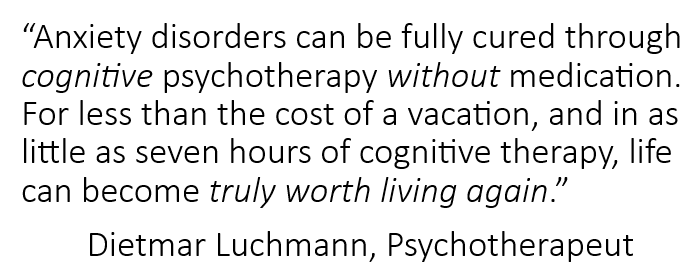
Fig.: The founder of the Anxiety Clinic at Lake Zurich, psychotherapist Dietmar Luchmann, has demonstrated over decades: "Anxiety disorders can be fully cured through cognitive psychotherapy without medication. For less than the cost of a vacation, and in as little as seven hours of cognitive therapy, life can become truly worth living again."
Johann Wolfgang von Goethe articulated the decisive condition with timeless clarity:
«Knowing is not enough, we must apply; willing is not enough, we must do.»11
Cognitive psychotherapy works when you do more work between sessions than during them. When you are willing to challenge your beliefs and conduct behavioral experiments. If you invest the effort of relearning, the neuroplasticity of your brain will reward you with astonishing results.12
That is demanding. But it is also liberating. Because it means: you are not helpless. You do not need years of dependency. You need competence through professional cognitive instruction — and the willingness to apply it.
The Decision Is Yours
Cognitive psychotherapy does not fail because the method doesn't work, but because the tacit alliance between psychotherapists who do not challenge and patients who avoid the effort is more comfortable.
If the self-assessment reveals that you have, so far, tended to choose the comfortable path, that is not a condemnation. It is the decisive first insight — the turning point at which the decision for a new path becomes possible in the first place. There are thousands of psychotherapists who will happily continue accompanying you on the old path. Who willingly serve as cognitive hospice attendants and manage you for years on end. You will feel understood for years. But nothing will change.
If, however, you want to belong to the ten percent who do not shy away from Russell's «effort of thought»6 — then cognitive psychotherapy is probably the best investment of your life. Not because we perform miracles. But because we teach you how to help yourself. Our psychotherapists show you the way. You must walk it yourself.
Are you ready? All you need to do is think for yourself — and follow our instructions.
Cognitive Psychotherapy from Dr. Dietmar Luchmann, LLC, works on the thinking errors that cause the suffering — in writing, by video, or in a single-day block. Three paths, one goal.
1. Understand the Method
2. Check Your Suitability
3. Apply for Admission
1 Luchmann, D.: "Remove Psychotherapy From the Catalog of Mandatory Health Insurance Benefits" — Motion 25.4533. Psychotherapie. 02/27/2026.
2 Luchmann, D.: Switzerland as a Paradise of Psychotherapeutic Inefficiency. Psychotherapie. 08/14/2025.
3 Luchmann, D.: Cognitive Warfare by the Swiss Association of Psychotherapists (ASP). Psychotherapie. 03/16/2026.
4 Grawe, K.; Donati, R.; Bernauer, F.: Psychotherapie im Wandel. Göttingen: Hogrefe Verlag, 1994, p. 670.
5 Lossau, N.: DENKSTE! Deutsche haben verlernt, sich eigene Meinungen zu bilden, sagt Hirnforscher Ernst Pöppel. Das Problem geht an den Unis los – und kann krank machen. Die Welt, 10/26/2016, issue 251/2016, p. 20.
6 Russell, B.: The ABC of Relativity. New York: Harper & Brothers, 1925, p. 166.
7 Beck, A.T.: Foreword. In: Beck, J.S.: Cognitive Behavior Therapy: Basics and Beyond. 3rd edition. New York: Guilford Press, 2021, p. XI.
8 Kahneman, D.: Thinking, Fast and Slow. New York: Farrar, Straus and Giroux, 2011, pp. 170, 173.
9 Grawe, K.; Donati, R.; Bernauer, F.: Psychotherapie im Wandel. Göttingen: Hogrefe Verlag, 1994, p. 693.
10 Kant, I.: Answering the Question: What Is Enlightenment? In: Berlinische Monatsschrift, 1784, vol. 4, no. 12, pp. 481–494 [cited p. 481].
11 Goethe, J.W.: Wilhelm Meister's Journeyman Years, or The Renunciants (1829). In: Sämtliche Werke nach Epochen seines Schaffens, vol. 17. Munich: Carl Hanser Verlag, 1991, p. 698.
12 Nordes, N.: Record of a Misdiagnosis — a Physician Experiences Psychotherapists and Psychotherapy. Psychotherapie. 03/11/2003.
Your Comment
Are you interested in contacting the author? Do you have remarks, suggestions, or additions regarding this article? Do you have personal therapy experiences? We welcome substantial feedback.