The Crisis as Midwife of a New Psychotherapy
What began at the Anxiety Clinic on Lake Zurich as a psychotherapeutic stopgap developed into what may be the most efficient form of work on the psyche: with my strategic decision to switch from psychotherapeutic conversation to written online communication, I created Written Cognitive Psychotherapy — WCP.
WCP proved to be the logical evolution of what lies at the core of cognitive psychotherapy: work on thinking. For if anxiety, depression, and most of the other emotional afflictions for which people seek psychotherapy originate in dysfunctional thought patterns — and after decades of research there is no reasonable doubt about that — then the medium of writing is not a makeshift at all but the ideal tool. Dysfunctional means that these thought patterns harm the person who thinks this way.
In more than three decades of solo practice in cognitive psychotherapy, I have seized every opportunity to work with clients in writing as well, and I have observed the immense benefit of the written form. Written Cognitive Psychotherapy is far more than a digital extension of conversation; it is the emancipation of clients through their own thinking and personal responsibility. This emancipation overcomes the limits of conventional psychotherapy.
This article shows why in six steps. It first describes what ails conventional psychotherapy. It then explains what happens in the mind when we write, and why writing in particular sharpens cognitive restructuring, that is, the targeted correction of thinking errors. Next, it presents the studies demonstrating that cognitive psychotherapy works and that psychotherapy conducted in writing is on a par with conversation, and in some respects even superior to it. It shows why the combination of conversation and writing is the strongest form. It sets out why the psychotherapist in WCP instructs rather than accompanies. And it says frankly for whom this path is right — and for whom it is not.
The Double Failure of Conventional Psychotherapy
Psychotherapy has always suffered from two problems: one logistical, one methodological.
Logistically, it is defined by the administration of scarcity: months-long waits for an opening with a psychotherapist, inflexible appointments in a rigid 50-minute rhythm, the obligation to appear in person at a practice that can often be reached only after a considerable journey — or, in times of crisis, not at all.
Methodologically, it often carries the stigma of the “chitchat hour,” in which a great deal is said but little is changed in any structured way. There, the spoken word fades away, and insights evaporate between two sessions like morning mist. That this picture is no exaggeration but can actually be measured will be shown below.
The introduction of WCP overcame more than physical distance. At the same time, it radically resolved these fundamental design flaws of conventional care. WCP is not “psychotherapy lite,” nor is it a chat with an artificial intelligence. Writing in WCP enables people who are willing to take responsibility for their own healing to put evidence-based cognitive methods to work in helping themselves — and at a far higher standard. Evidence-based means shown to be effective in controlled studies.
Correspondence Instead of Text Messages
Written Cognitive Psychotherapy is not the rapid back-and-forth of short messages billed as “text-based psychotherapy,” as digital “health apps” would have us believe. In WCP there are no chatbots and no staccato of text messages. Communication with the psychotherapist follows the tradition of classic correspondence: asynchronous, deliberate, and profound. Asynchronous means that the two parties do not write at the same time but whenever they have time to reflect. The pause between letter and reply is therefore not a shortcoming but part of the method.
Anyone interested in this path should understand what this form of psychotherapy demands of them and why it is the sharpest instrument of change for one’s own thinking. That is the subject of the following sections.
Writing as a Cognitive Scalpel
Why is the written word often superior to the spoken word in psychotherapy?
The spoken word is fleeting, often impulsive, and clouded by emotion. It leaves the mouth before the thought has been thought through. In conversation, people tend to react emotionally, to digress, or to hide behind empty phrases. Writing, by contrast, forces us to slow down and demands precision. Anyone who writes has to think, order, and refine. Every sentence can be reconsidered, corrected, and sharpened before it is sent. This slowing down is not a drawback — it is the psychotherapeutic process itself.
That writing heals is not speculation but an empirically established fact. The American social psychologist James W. Pennebaker, a professor at the University of Texas, has spent decades studying expressive writing: writing about one’s own feelings and thoughts concerning distressing experiences. His studies demonstrate impressively that putting distressing experiences, traumas, and thoughts into writing not only brings emotional relief but also produces measurable physiological improvements and strengthens the immune system.
Study participants who worked through their worst traumatic experiences in short, intensive writing sessions subsequently made significantly less use of the health care system and also showed measurable physiological improvements. Significant, in statistical terms, means that the difference is so large that chance can hardly explain it. Writing works far beyond mere emotional catharsis, that is, the relief that comes from letting feelings out. It helps to put distressing experiences in order in one’s mind and to fit them into a comprehensible whole. This lowers chronic stress, strengthens immune function, and reduces the symptoms of chronic and psychosomatic illnesses.1
“Writing about upsetting experiences, although painful in the days of writing, produces long-term improvements in mood and indicators of well-being.”
James W. Pennebaker, “Writing About Emotional Experiences as a Therapeutic Process”2
How robust this finding is, and where its limits lie, is shown by a meta-analysis, that is, a study that statistically combines the results of many individual studies. Calculated across all 146 studies included, writing about distressing experiences has a demonstrable effect, though on its own only a modest one.3 Therein lies the key to WCP. Writing alone brings relief. It unfolds its full power only when a psychotherapist reads what has been written, names the thinking errors in it, and guides their correction.
WCP therefore goes far beyond expressive writing as a potent means of fortifying mind and body. It harnesses the specific properties of the written word for cognitive restructuring — the precise work on the thinking errors that sustain anxiety, depression, and personality disorders. Five mechanisms work together here:
- The slowing of thought. Those who write are forced to cast diffuse feelings into concrete sentences. This process alone is already psychotherapeutic: one has to pause, reflect, and formulate. One steps out of immediate experience and becomes an observer of oneself. Brain research has supplied measurable evidence for this. In a study at the University of California, Los Angeles, participants viewed images with negative emotional expressions. When they matched the emotion shown with a fitting word instead of processing the image in some other way, activity fell in the amygdala, the brain region that signals danger and triggers fear.4 Putting a feeling into words turns down the brain’s alarm system.
- The objectification of thought. A thought that merely circles in the head is a phantom. A thought written down on the screen is an object: it can be analyzed like someone else’s text. The American psychiatrist Aaron T. Beck, one of the founders of cognitive psychotherapy, called this step distancing: the ability to examine one’s own thoughts as assumptions instead of mistaking them for facts. It is no accident that, from its beginnings, cognitive psychotherapy has kept its most important tool in written form: the thought record, in which the patient notes the situation, the feeling, and the automatic thought, and then tests that thought for its truth.5 WCP turns this tool into the entire method. The psychotherapist can point to individual formulations, examine their logic, and guide the client in discarding or rebuilding them where necessary.
- Memory on paper. The psychotherapist’s replies and analyses remain permanently available. They can — and should — be read several times, thought through, and internalized. Nothing is lost in the “noise” of a session. How much is otherwise lost there has been measured by memory research: of what physicians and other health care professionals explain to their patients, 40 to 80 percent is forgotten immediately, and almost half of what is remembered is wrong.6 Psychotherapy fares no better. Patients with bipolar disorder, that is, an alternation between depressive and manic phases, who also suffered from insomnia recalled only 20 to 37 percent of what had been worked out in their weekly sessions of cognitive psychotherapy.7 Written information, by contrast, is better retained and more often acted upon.6 Every exchange in WCP is stored. Clients can reread earlier reflections, trace their progress, and, in times of crisis, fall back on insights already gained. A sentence spoken in the consulting room fades away; the written word remains as an anchor of reason. No conversation that is not recorded in writing offers this kind of cumulative learning, in which each step builds on the last.
- Self-directed work as the active ingredient. The Dutch psychologist Pim Cuijpers, a professor at Vrije Universiteit Amsterdam, showed in his meta-analysis of bibliotherapy, that is, treatment with self-help books, that self-guided cognitive interventions achieve significant effects in unipolar depression, meaning depression without manic phases.8 How closely one’s own work between sessions is tied to success is shown by a further meta-analysis of 17 studies with 2,312 patients: the more assignments patients completed between sessions, and the more carefully they completed them, the better the outcome of their cognitive behavioral therapy.9 Written Cognitive Psychotherapy maximizes this principle. Clients do not merely read. They write. They put things into words themselves. They think for themselves. The psychotherapist expects them to work with the analyses they receive, to study them, and to make them the basis of their next reply.
- Candor behind the shield of writing. Those who write see no face scrutinizing them and no gaze before which they feel ashamed. That makes people more honest. Experiments by the British psychologist Adam Joinson showed that in written communication via computer, people spontaneously disclose considerably more about themselves than in face-to-face conversation, and that they open up most when they cannot be seen.10 For psychotherapy, this is not a side effect but a condition of success: a thinking error that no one discloses is one that no one can correct.
In WCP, however, none of this happens haphazardly. The experienced cognitive psychotherapist analyzes the client’s entire life and learning history, as well as the client’s texts, for logical inconsistencies and dysfunctional cognitions, that is, harmful thoughts and beliefs. Through written feedback, the client receives a document to read, think through, and internalize again and again — a cognitive scalpel that cuts precisely where thinking goes astray and thinking errors cause suffering.
Let us take stock: writing slows thinking down, makes thoughts testable, protects what has been worked out from being forgotten, demands one’s own effort, and makes openness easier. Each of these five mechanisms is supported by evidence in its own right. That leaves the decisive question: Does psychotherapy conducted wholly or mainly in writing demonstrably work as well as conversation? The answer has two parts. The first concerns the method, the second the medium.
The Evidence: Why Cognitive Psychotherapy Works
The scientific foundation is unambiguous. In his monumental meta-analysis Psychotherapie im Wandel (“Psychotherapy in Transition”), the German psychologist Klaus Grawe, professor of clinical psychology and psychotherapy at the University of Bern, arrived as early as 1994 at a finding that still stands today:
“Never yet, in any review of the comparative effectiveness of therapies, has any other form of therapy proved superior to the cognitive-behavioral therapies. [...] The actual state of the findings could therefore not be clearer than it is: on average, cognitive-behavioral therapy is highly significantly more effective than psychoanalytic therapy and client-centered psychotherapy.”
Klaus Grawe, Ruth Donati, and Friederike Bernauer, Psychotherapie im Wandel11
This superiority rests on a simple but profound cognitive principle handed down by ancient Greek philosophy for more than 2,000 years: it is not events themselves that cause our suffering but our interpretation of them. Change your patterns of interpretation, your thinking, and you change your emotional experience. WCP carries this demonstrated effectiveness into a medium that takes the cognitive penetration of problems even further.
The Evidence for Writing: On a Par and Often More Efficient
The second part of the answer concerns the medium. Research determines whether a treatment works by means of randomized controlled trials: participants are assigned to the treatments by lot, so that the groups differ — apart from chance — only in the treatment they receive. When two treatments are compared, the effect size measures the difference between them. A value close to zero means that both work equally well. A value of 0.8 or more counts as a large effect. Five lines of research tell a clear story.
Guided self-help works as well as conversation. Pim Cuijpers and his colleagues analyzed 21 studies with 810 participants in which guided self-help for depression and anxiety disorders was compared directly with psychotherapy in conversation. Guided self-help means that patients work with written material while a professional supports them. The effect size of the difference was 0.02, practically zero, and no difference was found up to a year later either. The authors’ conclusion: “It seems safe to conclude that guided self-help and face-to-face treatments can have comparable effects.”12
Psychotherapy over the internet works as well as an office visit. In 2023, a Swedish-Dutch research group pooled, in a meta-analysis, 31 randomized trials that compared professionally guided internet-based cognitive behavioral therapy directly with the same treatment in the consulting room. In this format, patients read the treatment as text on a screen, complete the exercises in writing, and receive feedback on them. The result across all disorders studied: the effect size of the difference was 0.02 — once again, practically no difference.13 Honesty requires one caveat: with standardized internet programs for depression, more patients drop out than in the consulting room. In one analysis, 65 percent completed the guided internet treatment, compared with 85 percent for treatment in conversation.14 That is why WCP is not a program that sends out prefabricated lessons but a personal correspondence: every digital letter from the psychotherapist responds to exactly what this one client has written.
Psychotherapy in typed messages works. In a study published in the medical journal The Lancet, patients with depression received up to ten sessions of cognitive behavioral therapy conducted exclusively through typed messages with their psychotherapist, in real time, without picture or sound. After four months, 38 percent of them had recovered, compared with 24 percent in the control group, which received only usual care from their primary care physician. After eight months, the figures were 42 and 26 percent.15
Writing against trauma: fewer sessions, fewer dropouts. How much the medium of writing can accomplish is shown by the treatment of trauma-related disorders. In written exposure therapy, patients write about their traumatic experience over a small number of sessions. Exposure means deliberately confronting what one fears, here in thought and on paper. In a randomized trial with 126 adults, this five-session writing treatment was noninferior to the established cognitive processing therapy with twelve sessions, meaning that it was not meaningfully worse. Of the patients in the writing treatment, 6.4 percent dropped out; in the comparison treatment, 39.7 percent.16 In 2023, a second study with 178 American veterans confirmed the finding in comparison with prolonged exposure, in which patients recount their trauma aloud again and again over eight to fifteen sessions of 90 minutes each: the writing treatment, with five to seven sessions, was noninferior to this method as well, and 12.5 rather than 35.6 percent dropped out.17 Written exposure therapy is not a cognitive method in the strict sense. But it is hard evidence of what writing can achieve as a medium of psychotherapy.
The relationship forms in letters, too. The most common objection to the written form holds that without a face, no psychotherapeutic relationship can develop. Research refutes it. In a randomized trial with 96 patients suffering from the aftereffects of trauma, Christine Knaevelsrud and Andreas Maercker treated half of them over the internet, with ten writing assignments over five weeks and written feedback; the other half initially waited. The patients rated their relationship with their psychotherapist as exceptionally strong, and compared with the waiting group, the treatment achieved an effect size of 1.40 — a large effect.18
This disposes of the objection that written psychotherapy is a makeshift. Guided by a professional, it works as well as conversation. In the treatment of trauma-related disorders, it achieves the same results with fewer sessions and far fewer dropouts. And the relationship between patient and psychotherapist develops on paper or on screen as well.
Conversation and Writing: The Strongest Combination
Many people would rather talk than write. That is not an argument against writing but a mandate to combine the two. Conversation offers what a letter cannot: the follow-up question and the objection in the very same moment. Writing secures what conversation loses: the result.
That is why, in cognitive psychotherapy by video, every session is followed by a written summary from the psychotherapist. He sets down in black and white the thinking errors identified and how they were corrected. In addition, every treatment begins with a written account of one’s own problem and one’s own learning and life history. In this way, the strengths of both media come together: the liveliness of conversation with the verifiability, permanence, and precision of the written word.
Two findings support the claim that this combination is more efficient than conversation alone. The first comes from the memory research discussed above: much of what is only spoken is forgotten at once; what is written down remains. The second comes from a randomized trial at two American university medical centers with 154 patients with depression. A cognitive behavioral therapy combining about five hours of contact with a psychotherapist and computer-based lessons and exercises was noninferior to conventional treatment with up to twenty sessions of 50 minutes each — even though the latter offered more than eight additional hours with the psychotherapist.19
The interim verdict, then: those who prefer to talk lose nothing through writing; they gain the memory of their psychotherapy. Those who prefer to write can conduct their entire psychotherapy in writing.
What Sets WCP Apart: Instruction Instead of Hand-Holding
The studies in the preceding sections concern the medium. What further distinguishes WCP is the role of the psychotherapist. It is crucial not to equate Written Cognitive Psychotherapy (WCP) with classic cognitive behavioral therapy (CBT). The difference goes far beyond the mere choice of a communication medium.
In traditional CBT, the psychotherapist often acts as a companion: he is there when clients face their fears, sits beside them in the dreaded situation, rides the elevator with them, or walks them across the bridge. This practice is well meant, but it harbors a structural problem that the Canadian-American psychologist Albert Bandura described precisely in his theory of self-efficacy expectations.20 Clients attribute their success not to themselves but to the psychotherapist’s presence:
“I made it — but only because you were there.”
This attribution undermines precisely the self-efficacy expectation that is indispensable for lasting change: the conviction that one can master a feared situation through one’s own strength. Bandura showed that this conviction predicts future behavior more accurately than the performance a person has already achieved in treatment. Anyone who believes the success was owed only to having company has crossed the bridge, to be sure, but has not acquired the conviction of being able to do it alone.
Cognitive psychotherapy — and WCP as its purest form — resolves this dilemma through a change of roles: the psychotherapist goes from companion to instructor.
He replaces accompaniment with cognitive instruction. At first glance this may look like a loss of closeness; in truth it is a gain in self-efficacy.
As a cognitive instructor, the psychotherapist uses precise cognitive preparation to enable clients to carry out the behavioral steps on their own. The confrontation with the feared situation takes place alone. The success is undivided. The self-attribution complete.
This principle also corrects a widespread misconception: that the psychotherapist heals. He does not. He cannot. In psychotherapy, only clients can heal themselves — namely, by changing their self-damaging thinking. The psychotherapist provides the tool. Using it is up to the patient.
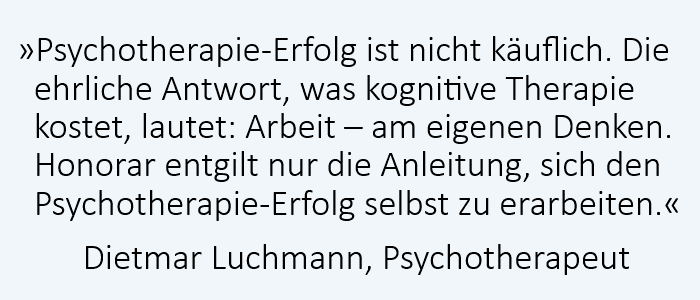
What makes WCP more efficient? It rigorously demands this personal responsibility.
Instead of letting clients squander precious hours of their lives in waiting rooms or on the road, Written Cognitive Psychotherapy makes possible, regardless of place and time, highly efficient
- self-help,
- self-therapy,
- self-healing,
which every single psychotherapist must make a conscious decision to promote as the aim of his work. For this aim of psychotherapeutic efficiency is at odds with the business models of long-term psychotherapists, who take “exception” to effective psychotherapy.21
Ever since my time at the Psychiatric University Hospital in Tübingen, I have championed efficient cognitive psychotherapy. In “an average of ten hours,” as the Berlin daily Der Tagesspiegel reported on August 20, 2004 (p. 25), I enable people with anxiety disorders, panic attacks, phobias, and depression to heal themselves by motivating and teaching them to remove the causes of their suffering on their own.22 This expertise as a cognitive instructor, gained over more than three decades of psychotherapy, went into the development of WCP.
This is psychotherapy for strong personalities who want to regain sovereignty over their own thinking and feeling.
Autonomy Instead of Office Visits and Scheduling Constraints
Beyond its psychotherapeutic mechanisms of action, WCP offers practical advantages that make it an intelligent alternative in a tightly scheduled world:
No wait times. According to a 2018 survey by the German Federal Chamber of Psychotherapists, almost five months passed on average in Germany between the first inquiry and the start of “guideline psychotherapy,” that is, treatment paid for by statutory health insurance.23 WCP begins immediately after the suitability assessment.
No commutes. Whether in the Engadine or in England, in a home office or a hotel room — psychotherapy is wherever the client is.
No fixed appointments. Clients write when they can and when they are ready — at three in the morning, when their thoughts are racing, or on a Sunday morning, when there is quiet for reflection. The psychotherapist’s reply follows promptly, but asynchronously. This allows a density of reflection that is scarcely attainable in 50-minute increments.
Complete discretion. Communication runs through end-to-end encryption at a military-grade security level, which allows only sender and recipient to read the messages. No “walk of shame” into a practice, no chance encounters in the waiting room. No entry in patient records that might one day end up with insurers. No data striptease.
A real psychotherapist. Unlike the currently booming AI-based “mental health apps,” every reply comes from an experienced psychotherapist of flesh and blood — with decades of clinical experience and the ability to read between the lines. Why chatbots as psychotherapists can become accomplices to delusion is the subject of a separate article in this journal.
Who Is WCP For? It Is Psychotherapy for Independent Thinkers
WCP is easily accessible, but it is anything but undemanding. It is aimed at people who bring three abilities and one attitude: They can read. They can write. They can think. And they are willing to take responsibility for themselves.
That sounds more self-evident than it is. WCP is not psychotherapy for those who want to be held, who wait for advice, or who would like to hand responsibility for their well-being to others. It is for people who are prepared to recognize, analyze, and correct their own thinking errors — with expert guidance, but under their own direction. It presupposes abilities that are becoming rarer in our accelerated world. So ask yourself honestly whether you recognize yourself in the following three points, for without these foundations no psychotherapist can help you along this path:
- The capacity for introspection, that is, for looking inward. Are you willing and able to look inside yourself under psychotherapeutic guidance? Your psychotherapist will not only deal with your symptoms but will take apart, analytically, the underlying motives and thinking errors: catastrophizing, for instance, which turns a skipped heartbeat into a heart attack; black-and-white thinking, which knows only “perfect” or “worthless”; or emotional reasoning, which concludes from “I am afraid”: “So it must be dangerous.”
- The ability to read and write. That sounds trivial, but it is not. You must be able to grasp complex relationships in written form and to articulate your inner world intelligibly. The point is not literary beauty but clarity of thought. Anyone who dislikes reading or finds writing difficult will fail at purely written psychotherapy. For such a person, the combination of video sessions and written summaries is the right path.
- The discipline of self-reflection. Because communication does not take place simultaneously, responsibility for the psychotherapeutic process between messages lies with you. Your psychotherapist will send you analyses and cognitive assignments. The real work happens when you read his words, think them over, and formulate your reply. You need the patience to let an answer mature instead of reacting impulsively.
Those who love to think, read, and write will relish this correspondence with their psychotherapist.
The target group consists of discerning independent thinkers and self-pay clients who do not delegate their mental health to a system but regard it as their own project: people who want to take their lives into their own hands rather than waste them on chitchat hours in insurance-funded psychotherapy.
WCP is particularly well suited for:
Anxiety disorders, panic attacks, and phobias — where the cognitive restructuring of catastrophic expectations forms the core of healing. More than three decades of anxiety treatment at my anxiety clinics in Stuttgart and on Lake Zurich have shown that anxiety disorders can be cured in about ten hours — through cognitive psychotherapy and without medication. For less than the cost of a vacation, life after cognitive anxiety treatment is worth living again.
Depression and burnout — where dysfunctional thought patterns about self-worth, the future, and the world must be uncovered and changed.
Personality disorders — here WCP proves to be the premier discipline. Especially with narcissistic problems, the written form offers a decisive advantage: clients do not have to look the psychotherapist in the eye. Shame falls away. Honesty becomes possible. People with a narcissistic personality structure, who often find it hard to open up to a psychotherapist in direct contact or to admit inferiority, can often allow themselves to be honestly analyzed for the first time under the protection of the written word. The absence of physical presence lowers resistance to the necessary cognitive restructuring. What the experiments on openness in written communication mentioned above show in general takes full effect here.
This protected space — one is read, but not seen — paradoxically opens the way to radical openness.
WCP is not suitable for acute psychotic states, for acute suicidality, that is, the immediate danger of taking one’s own life, or for people who cannot or will not meet the demands of written communication. In an acute crisis, local medical help must come first.
What You Can Expect — and What You Cannot
Do not expect a digital shoulder to cry on that merely confirms how unjust the world is. That would not be psychotherapy but aiding and abetting the chronification of your problems, that is, helping them become permanent.
Expect instead an intellectual and emotional challenge. Your psychotherapist will read your texts closely. He will point out contradictions. He will question your logic wherever it causes you pain. He will guide you professionally through the process of self-knowledge through writing.
If you are ready not merely to talk about change but to bring it about with the sharp tool of your own mind and under psychotherapeutic guidance, then this is the most efficient path for you.
Efficiency Instead of Endless Psychotherapy
One last aspect deserves mention: the question of how long psychotherapy should take.
While insurance-funded psychotherapies not infrequently stretch over years — with weekly appointments that at some point become more ritual than treatment — WCP is results-oriented.
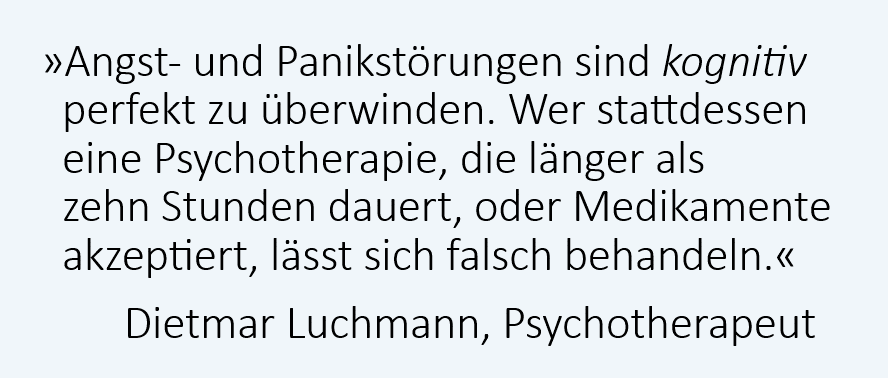
An average of ten sessions. Not because an insurer’s approved quota of sessions prescribes it, but because the method makes it possible. The British National Institute for Health and Care Excellence (NICE) has issued guidelines for the treatment of generalized anxiety disorder and panic disorder in adults. For panic disorder, it recommends: “CBT in the optimal range of duration (7 to 14 hours in total) should be offered.”24 For generalized anxiety disorder, it provides for weekly sessions over roughly three to four months. The measure, then, is hours and months — not years.
NICE also expressly warns against benzodiazepines, the widely used tranquilizers: “Benzodiazepines are associated with a less good outcome in the long term and should not be prescribed for the treatment of individuals with panic disorder.”24 That is logical, for no medication remedies the thinking errors that cause anxiety and panic. Instead, medications prevent the experience of self-efficacy.
Once clients have understood how their thinking works and how they can correct it, they no longer need a psychotherapist. This mental sovereignty is the goal of every serious psychotherapy — and WCP reaches it more consistently than most other methods.
Nevertheless, all clients receive the time they wish for and need. Narcissistic clients often need longer to change their thinking — and they get it. Clients may also ask for advice after the work has been completed.
The Right Psychotherapy for the Right People
What began as a stopgap during the 2020 lockdown is supported by the research of the past two decades. Guided by a professional, writing works as well as conversation. It preserves what is forgotten in conversation. It makes people more honest than a face-to-face gaze allows. And in several studies it reaches the same goal with fewer sessions.
Written Cognitive Psychotherapy is no longer a stopgap. It is the form of psychotherapy for the twenty-first century: maximally efficient, absolutely discreet, and profoundly emancipatory. The National Institute for Health and Care Excellence lists “bibliotherapy” as written psychotherapy under item 1.3.35 of its guidelines on the treatment of anxiety.24
Written Cognitive Psychotherapy is not for everyone. It demands personal responsibility, the capacity for reflection, and the willingness to confront one’s own thought patterns — in writing, precisely, without evasion.
For those who bring this willingness, however, it offers a form of psychotherapy that goes to the heart of what works: changing one’s own thinking. In a format that not only enables this change but compels it. With a psychotherapist who guides but does not patronize. Who does not hold hands but steers thinking in the right direction.
At a time when time is the most precious commodity, WCP offers what modern medicine ought to deliver: maximum effect through maximum personal responsibility.
For those ready to watch themselves think, the path is wide open. It takes only two steps to begin WCP with Dr. Dietmar Luchmann, LLC:
Suitability Assessment
In the first step, determine how well Cognitive Psychotherapy by Dr. Dietmar Luchmann, LLC, aligns with your needs. The anonymous and complimentary suitability assessment provides the answer in less than two minutes.
Goal Definition
In the second step, follow the instructions on the form and describe the situation you wish to improve and the resistances you intend to overcome. Within 24 hours, you will receive a complimentary response from Dr. Dietmar Luchmann, LLC, containing an offer or a recommendation.
Telephone Consultation
Do you prefer a fee-based consultation with one of the psychotherapists at Dr. Dietmar Luchmann, LLC, prior to the complimentary steps 1 and 2? You can book your telephone appointment here.
1 Pennebaker, J.W.; Beall, S.K.: Confronting a Traumatic Event: Toward an Understanding of Inhibition and Disease. Journal of Abnormal Psychology, 1986, Vol. 95, No. 3, 274–281.
2 Pennebaker, J.W.: Writing About Emotional Experiences as a Therapeutic Process. Psychological Science, 1997, Vol. 8, No. 3, 162–166. [Original text, p. 162: “Writing about upsetting experiences, although painful in the days of writing, produces long-term improvements in mood and indicators of well-being.”]
3 Frattaroli, J.: Experimental Disclosure and Its Moderators: A Meta-Analysis. Psychological Bulletin, 2006, Vol. 132, No. 6, 823–865. [146 randomized studies; mean effect size r = 0.075.]
4 Lieberman, M.D.; Eisenberger, N.I.; Crockett, M.J.; Tom, S.M.; Pfeifer, J.H.; Way, B.M.: Putting Feelings Into Words: Affect Labeling Disrupts Amygdala Activity in Response to Affective Stimuli. Psychological Science, 2007, Vol. 18, No. 5, 421–428. [Original text: “affect labeling … diminished the response of the amygdala and other limbic regions to negative emotional images.”]
5 Beck, A.T.; Rush, A.J.; Shaw, B.F.; Emery, G.: Cognitive Therapy of Depression. New York: Guilford Press, 1979. [Foundational account of Beck’s cognitive psychotherapy with the written thought record (Daily Record of Dysfunctional Thoughts).]
6 Kessels, R.P.C.: Patients’ memory for medical information. Journal of the Royal Society of Medicine, 2003, Vol. 96, No. 5, 219–222. [Original text: “40-80% of medical information provided by healthcare practitioners is forgotten immediately” … “almost half of the information that is remembered is incorrect” … “Written information is better remembered and leads to better treatment adherence.”]
7 Dong, L.; Lee, J.Y.; Harvey, A.G.: Memory support strategies and bundles: A pathway to improving cognitive therapy for depression? Journal of Consulting and Clinical Psychology, 2017, Vol. 85, No. 3, 187–199. [Original text: “only recalled 20–37% of the treatment points from weekly cognitive therapy sessions.”]
8 Cuijpers, P.: Bibliotherapy in Unipolar Depression: a Meta-Analysis. Journal of Behavior Therapy and Experimental Psychiatry, 1997, Vol. 28, No. 2, 139–147.
9 Kazantzis, N.; Whittington, C.; Zelencich, L.; Kyrios, M.; Norton, P.J.; Hofmann, S.G.: Quantity and Quality of Homework Compliance: A Meta-Analysis of Relations With Outcome in Cognitive Behavior Therapy. Behavior Therapy, 2016, Vol. 47, No. 5, 755–772. [17 studies with 2,312 patients; the quantity and quality of completed assignments are related to treatment outcome.]
10 Joinson, A.N.: Self-disclosure in computer-mediated communication: The role of self-awareness and visual anonymity. European Journal of Social Psychology, 2001, Vol. 31, No. 2, 177–192.
11 Grawe, K.; Donati, R.; Bernauer, F.: Psychotherapie im Wandel: Von der Konfession zur Profession. Göttingen: Hogrefe Verlag, 1994. Cited: p. 670.
12 Cuijpers, P.; Donker, T.; van Straten, A.; Li, J.; Andersson, G.: Is guided self-help as effective as face-to-face psychotherapy for depression and anxiety disorders? A systematic review and meta-analysis of comparative outcome studies Psychological Medicine, 2010, Vol. 40, No. 12, 1943–1957. [21 studies with 810 participants; difference d = 0.02. Original text: “It seems safe to conclude that guided self-help and face-to-face treatments can have comparable effects.”]
13 Hedman-Lagerlöf, E.; Carlbring, P.; Svärdman, F.; Riper, H.; Cuijpers, P.; Andersson, G.: Therapist-supported Internet-based cognitive behaviour therapy yields similar effects as face-to-face therapy for psychiatric and somatic disorders: an updated systematic review and meta-analysis. World Psychiatry, 2023, Vol. 22, No. 2, 305–314. [31 randomized trials; difference g = 0.02 (95% confidence interval −0.09 to 0.14).]
14 Andersson, G.; Titov, N.; Dear, B.F.; Rozental, A.; Carlbring, P.: Internet-delivered psychological treatments: from innovation to implementation. World Psychiatry, 2019, Vol. 18, No. 1, 20–28. [Completion rates for depression: 84.7 percent in face-to-face treatment, 65.1 percent in guided internet treatment.]
15 Kessler, D.; Lewis, G.; Kaur, S.; Wiles, N.; King, M.; Weich, S.; Sharp, D.J.; Araya, R.; Hollinghurst, S.; Peters, T.J.: Therapist-delivered Internet psychotherapy for depression in primary care: a randomised controlled trial. The Lancet, 2009, Vol. 374, No. 9690, 628–634. [Recovered after 4 months: 38 vs. 24 percent; after 8 months: 42 vs. 26 percent.]
16 Sloan, D.M.; Marx, B.P.; Lee, D.J.; Resick, P.A.: A Brief Exposure-Based Treatment vs Cognitive Processing Therapy for Posttraumatic Stress Disorder: A Randomized Noninferiority Clinical Trial. JAMA Psychiatry, 2018, Vol. 75, No. 3, 233–239. [126 participants; 5 vs. 12 sessions; dropout 6.4 vs. 39.7 percent.]
17 Sloan, D.M.; Marx, B.P.; Acierno, R.; Messina, M.; Muzzy, W.; Gallagher, M.W.; Litwack, S.; Sloan, C.: Written Exposure Therapy vs Prolonged Exposure Therapy in the Treatment of Posttraumatic Stress Disorder: A Randomized Clinical Trial. JAMA Psychiatry, 2023, published online August 23, 2023. [178 veterans; dropout 12.5 vs. 35.6 percent.]
18 Knaevelsrud, C.; Maercker, A.: Internet-based treatment for PTSD reduces distress and facilitates the development of a strong therapeutic alliance: a randomized controlled clinical trial. BMC Psychiatry, 2007, Vol. 7, Article 13. [96 participants; effect size d = 1.40. Original text: “High ratings of the therapeutic alliance and low drop-out rates indicated that a positive and stable therapeutic relationship could be established online.”]
19 Thase, M.E.; Wright, J.H.; Eells, T.D.; Barrett, M.S.; Wisniewski, S.R.; Balasubramani, G.K.; McCrone, P.; Brown, G.K.: Improving the Efficiency of Psychotherapy for Depression: Computer-Assisted Versus Standard CBT. American Journal of Psychiatry, 2018, Vol. 175, No. 3, 242–250. [154 patients; about 5 hours of contact with the psychotherapist plus computer lessons, noninferior to up to 20 sessions of 50 minutes.]
20 Bandura, A.: Self-efficacy: Toward a Unifying Theory of Behavioral Change. Psychological Review, 1977, Vol. 84, No. 2, 191–215.
21 Luchmann, D.: Kognitive Kriegsführung der Assoziation Schweizer Psychotherapeutinnen und Psychotherapeuten (ASP). Psychotherapie, March 16, 2026.
22 Kast, B.: Der Graben ist größer denn je: Psychotherapeuten streiten darüber, welche Methode von der Kasse bezahlt werden soll. Tagesspiegel, Berlin, August 20, 2004, p. 25.
23 Bundespsychotherapeutenkammer (BPtK): Ein Jahr nach der Reform der Psychotherapie-Richtlinie: Wartezeiten 2018. Berlin, April 11, 2018. [Original text: “Eine Richtlinienpsychotherapie beginnt durchschnittlich erst fast fünf Monate (19,9 Wochen) nach der ersten Anfrage.”]
24 National Institute for Health and Care Excellence (NICE): Generalised anxiety disorder and panic disorder in adults: management. Clinical guideline CG113, 2011, last updated June 15, 2020. [Original text, item 1.3.15: “CBT in the optimal range of duration (7 to 14 hours in total) should be offered.” Item 1.3.20: “Benzodiazepines are associated with a less good outcome in the long term and should not be prescribed for the treatment of individuals with panic disorder.”]
Your Comment
Are you interested in contacting the author? Do you have remarks, suggestions, or additions regarding this article? Do you have personal therapy experiences? We welcome substantial feedback.