The psychotherapeutic relationship rests on a promise older than the profession itself: what is said here stays here. The seal of the confessional, the physician’s oath, the criminally protected duty of professional secrecy — they all encode the same sentence. The patient bares his soul because he believes that sentence and has not yet recognized the cognitive warfare of psychotherapists1 waged against him — those psychotherapists who regard him as an object of their exploitation. Without that belief there would be no psychotherapy, only two strangers cautiously maneuvering around each other.
In the digital consulting room, this promise has been quietly transferred to a third party the patient has never met and never trusted: to a server, a cloud provider, the investors of an app company, an advertising network, and, most recently, a language model trained on his words to serve as a digital substitute for psychotherapists2. The confidentiality the patient feels is the confidentiality of his psychotherapist. The confidentiality that actually protects his data is that of the weakest link in a long technical chain. The two have almost nothing to do with each other.
In short, the confessional has been automated — and it has gone unnoticed that the confessor is now a database whose password, as we shall see, was in one real case “root.” Anyone who considers this alarmism should read the following five cases. Not one of them is a thought experiment. All are documented, established by a court or a regulator, and all concern people who had done nothing more than seek help.
Five Ways the Danger Has Already Materialized
It is pointless to debate abstract risks when concrete harms have long since overtaken them and turned them into undeniable reality. The order that follows is not by probability but by mode of access: how exactly does power over a person arise from the digital data of a psychotherapeutic interaction?
1. Extorting the Individual — Psychotherapy at Vastaamo
Finland, a country of five and a half million, operated in Vastaamo one of the largest private providers of psychotherapeutic care: some twenty-five centers, in part as a subcontractor to the public health system. In 2018 and 2019 an attacker broke into the database. The later trial brought to light that the database had been secured with the almost touchingly amateurish combination “root/root.”3 Stolen were the treatment files of roughly 33,000 patients.4 These were not appointment data but the verbatim intimacies of psychotherapy: traumas, addiction histories, family abysses.
In October 2020 the damage became public. An extortionist operating under the name “ransom_man” demanded roughly 450,000 euros in Bitcoin from the company and threatened to publish the files.3 Up to this point the affair resembles any other ransom demand. What is decisive - and, for our subject, the truly instructive part - is what happened when the company refused to pay: the perpetrator turned against the patients themselves. On the dark web he announced that he would publish a hundred patient profiles a day, and at the same time he sent individual victims targeted letters: pay about 500 euros, or your psychotherapy notes go public.3,4
More than 22,000 people reported to the Finnish police that they had received such a personal extortion letter — a record number of injured parties in a single criminal proceeding.3 Many of the victims were children or were in treatment for severe trauma. Several suicides were reported in connection with the leak.3,4 Vastaamo went bankrupt in 2021; its former managing director, who had concealed the breaches, was dismissed and prosecuted. The principal perpetrator, Aleksanteri Kivimäki, was sentenced in April 2024 to six years and three months in prison — and in September 2025, during the appeal, was provisionally released because of the length of his pretrial detention.5
Consider the mechanics: the notes meant to heal became a precise instrument of humiliation. Whoever knows a person’s most secret fears no longer needs force; he needs only an email address and a deadline. That is the difference between a stolen credit-card record and a stolen psychotherapy file. The card can be canceled. The exposed interior of the soul cannot.
2. The Transcript as Evidence — The Talkspace Case
The second danger needs no criminal. A court and a contract suffice. An American woman, heavily pregnant and just laid off, used the app Talkspace - a benefit her former employer offered its staff - to talk about her fears. Later she sued that same employer for discrimination. His attorneys then obtained a court order for the release of her Talkspace data, including the complete verbatim transcript of what she had written to her psychotherapist — and used it against her in court.6
Here a structural difference reveals itself that the convenience of users willfully overlooks. In a classic session the psychotherapist jots down a few sentences; the conversation itself fades. A chat platform, by contrast, produces a verbatim transcript of the exact back-and-forth — a new window into private life that can be turned against the person.6 And what exists as a file can be seized, subpoenaed, demanded.
At this point the first of the great fallacies with which people reassure themselves shatters: “The law protects me.” The U.S. health-data statute (the Health Insurance Portability and Accountability Act - HIPAA) grants psychotherapy notes a special status. But that status helps little when the “note” is in truth a complete transcript owned by a company and subject to a court order. On top of this, the much-invoked anonymization - as data-protection lawyers have warned for years - can often be reversed.6 A protection that fails under real conditions is not protection but a placation.
3. The Soul as an Advertising Record — The BetterHelp Case
The third route is legal, everyday, and precisely for that reason the most disturbing. In 2023 the U.S. consumer regulator, the FTC, ordered the online provider BetterHelp to pay 7.8 million dollars. The charge: that the company had passed sensitive health data - email addresses, IP addresses, and the answers from health questionnaires - to Facebook, Snapchat, Criteo, and Pinterest for advertising purposes, in breach of its own privacy promises.7 Roughly 800,000 people were affected. The fig leaf that the email addresses had been “hashed,” that is, encrypted, did not hold: the recipient could reverse the encryption — and that was precisely the point, since the data served to target the same people with advertising once again.7
The truly revealing sentence, however, came in the defense: the settlement was no admission of guilt, and the conduct complained of was customary in the industry.8 Read that twice. It is not a denial but a confession of greater reach: what was penalized here is not the lapse of a single black sheep but the business model. And it points to the second fallacy — “It’s anonymized, it’s aggregated.” The data set was anonymized enough to reassure the regulator and identifying enough to find the individual again. Both at once. That is not a technical glitch but the commercial logic of the entire industry.
4. The Soul in the Clearance Sale — Data Trading Instead of Data Protection
What becomes of data that do not arise with a psychotherapist at all, but with a meditation app, a symptom search engine, a mood diary? They migrate into a market that operates in the half-shadow. A researcher at Duke University contacted 37 data brokers; eleven of them were willing to sell lists of people sorted by mental diagnosis - depression, anxiety disorder, bipolar disorder, post-traumatic stress - frequently furnished with names, addresses, ethnicity, income, and sometimes even details about their children. Prices started at a few hundred dollars; no serious vetting of the buyer took place.9,10 Because they arise outside the medical sphere, these data are subject to no health-data law.
For the individual this means: somewhere a list exists with the word “depression” next to his name, and he will never learn who bought it or for what — an insurer reassessing the risk; a staffing agency pre-sorting applicants; a landlord’s algorithm; a political campaign that knows who is susceptible to the language of fear. Here the third fallacy appears in its purest form: “I have nothing to hide.” The question is not whether you have something to hide. The question is whether someone else has something to gain by knowing you. And the answer, as the market proves, is yes.
5. The Open Door — The Confidant Health Case
The fifth route is more banal than all the others and, for that very reason, the hardest to forgive: sheer incompetence. In 2024 a security researcher came upon a database belonging to the U.S. provider Confidant Health that stood unprotected - without a password - on the open internet. It comprised 5.3 terabytes: 126,276 files and more than 1.7 million log entries.11,12 Among them were audio and video recordings of sessions, psychiatric histories, medical records, and images of ID cards and insurance cards.11 The company says it secured the database within an hour of being informed.
Note that here no hacker, no ransom, no criminal energy was required. It was enough that someone had forgotten to lock the door. The only barrier that ever protected these data was competence — and competence, as it turns out, is optional. Health data are traded on criminal markets; mental-health data are especially valuable there because they lend themselves especially well to extortion. The circle closes back to the Vastaamo case.
The Escalation: The Soul as Raw Material for the Machine
Up to here one might object that these are mishaps, crimes, and business excesses that could be contained with better technology and stricter laws. But one development changes the statics of the whole problem: artificial intelligence. The transcripts are no longer a by-product to be tolerated at best and lost at worst. They are the raw material.
Talkspace informs its investors that the company holds one of the world’s largest mental-health databases - 140 million messages, eight billion words - and is using it to train a chatbot for “therapy companionship”; a hospital corporation acquires the company for 835 million dollars.6 The most intimate sentences a person ever typed thus become training material. With this the anonymization argument collapses a second time: not only can anonymization be reversed — a model trained on a person’s words can reproduce patterns that point back to him.
It is worth examining the vocabulary the industry operates with. “Anonymized.” “Aggregated.” “Solely for therapeutic purposes.” These are not technical guarantees. They are formulas of reassurance whose function is to end reflection before it has begun. Whoever sells the surveying of the soul as “innovation” and its exploitation as “personalized care” has already built the fallacy into the language. Distrust every sentence that means to spare you the trouble of thinking.
The Logic: Why Systems of Convenience Become Systems of Control
One need invoke no conspiracy to understand the direction of this development. It is enough to consider three sober properties of data that together yield an almost inevitable tendency.
First: data are non-rivalrous and all but immortal. Information once collected can be copied any number of times without being used up, and keeping it costs practically nothing. What costs nothing to keep is kept. And what is kept is eventually used — for the temptation grows with time, while the memory of the promise under which the data were collected fades.
Second: the purpose of a data set is not fixed at its collection but by whoever later owns it. Today’s “to improve our service” is tomorrow’s “acquired by,” “subpoenaed by,” “sold to,” “compromised at.” No one who confides in his psychotherapy app or his chatbot psychotherapist has consented to the hospital corporation that buys the company three years later. Yet the consent travels with the data.
Third: the asymmetry is permanent. The individual surrenders his intimate truth once; the holder of the data accumulates his leverage forever. History - and here sobriety is in order, not pathos - knows the pattern well enough: registers created for administration have repeatedly become instruments of control once the political weather turned. The data of the soul are the most valuable of all, because they record not what a person has done but what he is afraid of.
At this point the enlightened reader objects: but in Switzerland and Europe there are laws. True, and they must be taken seriously. The revised Swiss Data Protection Act, in force since September 1, 2023, counts health data among the especially sensitive personal data; anyone who processes them with a foreseeably high risk - for instance, using artificial intelligence or cloud services - must carry out a data protection impact assessment (Art. 22).13 The Federal Data Protection Commissioner requires, as a rule, secured transmission for health data; unencrypted email is permissible only under narrow conditions.14
That is right and necessary — and it is insufficient. The law binds the law-abiding. It does not bind the hacker with the combination “root/root,” the foreign buyer, the data broker beyond the reach of jurisdiction, or the company that simply rebrands a break-in as an “incident.” Above all, it fights the wrong evil. It tries to make the storage of the soul’s data secure. But the only secure data are the data that were never created.
The Real Question: Why People Look Away
The cases are documented. The mechanics are transparent. And yet almost no one changes his behavior. Here, not in the technology, lies the real cause of the threat to psychotherapeutic data. For the question is not why the systems are built as they are built. The question is why we allow it, though we could know it and could prevent it.
The answer is uncomfortable: recognizing the danger demands precisely what most people instinctively avoid — thinking, and then acting in a way that runs counter to one’s own need for convenience. For this case the mind keeps a whole arsenal of cheap defensive formulas ready, and every one of them is a logical fallacy that feels so good only because it spares one the trouble of thinking.
“I have nothing to hide” — the confusion of privacy with secrecy; in truth it is not about hidden guilt but about the autonomy of a person who does not wish to be seen through. “It won’t happen to me” — the optimism error that subtracts one’s own person from every statistic. “Everybody uses these things” — the appeal to common practice, the very fallacy with which BetterHelp defended itself in court. “The convenience is worth it to me” — the weighing of a diffuse future harm against a small immediate gain, which the mind systematically skews in favor of the immediate. Four sentences, four errors of thought, four conveniences.
The brain researcher Ernst Pöppel has offered the sober estimate that “only about ten percent of people think for themselves and take their lives into their own hands.”15 In the same breath he names the present-day aggravation, in which “the influence of digital media”15 is added: “These increasingly take over a thinking-ahead function — precisely among academics, of whom one would most readily expect that they want to think for themselves.”15 Herein lies the bitter symmetry of our subject: the very devices that siphon off the soul are the same ones to which the human being has outsourced his judgment. Whoever no longer thinks for himself also fails to notice that thinking is being done for him — and that decisions are being made about him.
Bertrand Russell, philosopher and Nobel laureate, put the same thing as early as 1925:
“We all have a tendency to think that the world must conform to our prejudices. The opposite view involves some effort of thought, and most people would die sooner than think — in fact, they do so.”
Bertrand Russell The ABC of Relativity. New York: Harper & Brothers, 1925, p. 166.16
A century has passed, and the observation is the same. The repression is not stupidity; it is a self-harming economy. Thinking costs effort and threatens the comfort of settled conviction. And so the danger persists — not because it is hidden, but because it is unwelcome. It demands a decision, and decisions are strenuous, which is why they are avoided.
The Compromise: Data-Minimal Psychotherapy
This is precisely where cognitive psychotherapy unfolds its potential for self-healing. Its entire aim is to give a person back the capacity to govern his own life in mental sovereignty, drawn from the power of his own thinking.
From this claim follows a practical principle open to any psychotherapist who wants it; it is neither patented nor secret. The fewer data a psychotherapy generates, the less can be used against the patient. Data minimization here is not a setting in a computer program but a therapeutic stance. For data protection17 with “Zero Tracking + Total Privacy” across all the self-help offerings of Psychotherapie.com, this means in concrete terms: no third-party providers, genuine end-to-end encryption between client and psychotherapist, written instruction in files that only the two participants can open — and no one else, not even a server in between.
Yet even this safeguard is, in all honesty, no protection for eternity — and it belongs to the logic of this text to point out the risks posed by the development of quantum computers. The weak point is not the encryption process itself: against strong symmetric encryption such as AES-256 a quantum computer gains only a quadratic speedup, which a sufficiently long password absorbs. What is vulnerable is the moment at which anything at all crosses the open network — for nearly every secured internet transmission rests, at the moment of key exchange, on asymmetric methods such as RSA or elliptic curves, and these a sufficiently large quantum computer will break completely. From this follows a strategy with a name of its own, “harvest now, decrypt later”: today’s encrypted traffic is recorded and stored so that it can be decrypted once the machine exists. That this threat is serious enough to set in motion the global migration of cryptography is shown by the finalization of the first post-quantum standards by the U.S. NIST in August 2024.18
The pace of progress surprises even the experts: a researcher at Google Quantum AI lowered the estimated number of qubits needed to break a 2,048-bit RSA key from twenty million to under one million in May 2025, and recommended phasing out vulnerable methods after 2030;19 in parallel, the same group achieved, with its “Willow” processor, the first demonstration of error correction “below threshold,” in which the error rate falls as more qubits are added.20 For data with a short confidentiality horizon this is immaterial; for psychotherapeutic records, whose confidentiality must hold for a lifetime, it is the opposite. Every line transmitted today thus becomes a wager on the state of cryptanalysis twenty years hence. This does not devalue strong encryption, but it shifts it from a promise to a wager. It sharpens the conclusion of this text rather than softening it: the only data that escape “harvest now, decrypt later” with certainty are those that were never transmitted, never recorded, never created.
The Safe Way Out: Data-Free Psychotherapy
Security-conscious clients can obtain, on request, data-free therapy options through Psychotherapie.com, in which the danger drops to zero because the dangerous data are never created in the first place. Among them is, unsurprisingly, the oldest form of all: the psychotherapeutic forest walk21. A conversation of many hours, on foot, through the forest — nothing is recorded, nothing stored, nothing transmitted. A psychotherapy that has helped and that, digitally speaking, nonetheless never took place. There is no transcript for a court to subpoena, no database for a hacker to empty, no list for a broker to sell, and no words for a language model to feed on.
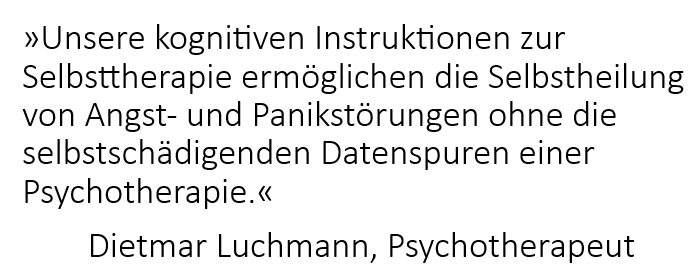
Such a data-free psychotherapeutic full- or half-day block can be organized in many ways — tailored individually to the client’s needs and to what best serves the solution of the problem. For more than three decades the author has instructed clients in the day block on how, through cognitive psychotherapy, they can heal their anxiety and panic disorders themselves. By way of example, in his report22 a physician describes this compact cognitive psychotherapy: after a ten-year ordeal he healed his anxiety disorder in just eight hours through the day block with the author of this article.
In an age that has learned to read the soul, the most radical act of protection is at the same time the simplest: to leave behind nothing that could be read. This is neither romanticism nor hostility to technology. It is the sober consequence of everything that the five cases of this article document and that holds quite generally: “Anyone who bills a psychotherapy through health insurance drags a data trail behind him that can destroy careers.”17 For those ten percent who would rather think for themselves than have others think for them, the data-free forest walk21 is therefore not nostalgia. It is the only completely safe psychotherapy there is.
Dr. Dietmar Luchmann, LLC, the publisher of this journal, itself offers cognitive psychotherapy via video — with a written summary of every session, for self-pay patients, in German or English.
1. Understand the Method
2. Check Your Suitability
3. Apply for Admission
1 Luchmann, D.: Cognitive Warfare of the Association of Swiss Psychotherapists (ASP). Psychotherapie. March 16, 2026.
2 Luchmann, D.: Chatbots as Psychotherapists? Perfect Accomplices for Madness. Psychotherapie. October 10, 2025.
3 Krebs, B.: Man Who Mass-Extorted Psychotherapy Patients Gets Six Years. Krebs on Security. April 30, 2024.
4 Ghanbari, H.; Koskinen, K.: When Data Breach Hits a Psychotherapy Clinic: The Vastaamo Case. Journal of Information Technology Teaching Cases. 2026, 16(1), 20–28.
5 Martin, A.: Hacker Convicted of Extorting 20,000 Psychotherapy Victims Walks Free During Appeal. The Record. September 15, 2025.
6 Gilbertson, A.: Woman’s Talkspace Therapy App Sessions Exposed in Court. Proof News. April 28, 2026.
7 Federal Trade Commission: FTC Gives Final Approval to Order Banning BetterHelp from Sharing Sensitive Health Data for Advertising, Requiring It to Pay $7.8 Million. Federal Trade Commission, Press Releases. July 14, 2023.
8 Bajak, F.; Associated Press: Counseling Service BetterHelp to Return $7.8M to Customers in FTC Settlement After It Shared Private Health Data with Facebook and Snapchat. Fortune. March 3, 2023.
9 Kim, J.: Data Brokers and the Sale of Americans’ Mental Health Data. Duke University, Sanford School of Public Policy. February 2023 (PDF).
10 Collier, K.: A Researcher Tried to Buy Mental Health Data. It Was Surprisingly Easy. NBC News. February 13, 2023.
11 Burgess, M.: Therapy Sessions Exposed by Mental Health Care Firm’s Unsecured Database. Wired. September 6, 2024.
12 Security Staff: Confidant Health Database Exposed 5.3 Terabytes of Patient Information. Security Magazine. September 9, 2024.
13 Swiss Confederation: Federal Act on Data Protection (FADP).
14 Federal Data Protection and Information Commissioner (FDPIC): Notes on Patient Forms for Medical and Therapeutic Consultations. September 30, 2025 (PDF).
15 Lossau, N.: DENKSTE! Deutsche haben verlernt, sich eigene Meinungen zu bilden, sagt Hirnforscher Ernst Pöppel. Das Problem geht an den Unis los – und kann krank machen. Die Welt, October 26, 2016, issue 251/2016, p. 20.
16 Russell, B.: The ABC of Relativity. New York: Harper & Brothers, 1925, p. 166.
17 Luchmann, D.: Data Protection, Psychotherapy, and Psychotherapists. Psychotherapie. January 10, 2025.
18 National Institute of Standards and Technology (NIST): NIST Releases First 3 Finalized Post-Quantum Encryption Standards. August 13, 2024.
19 Gidney, C.: How to Factor 2048 Bit RSA Integers with Less Than a Million Noisy Qubits. arXiv:2505.15917, May 2025.
20 Castelvecchi, D.: ‘A Truly Remarkable Breakthrough’: Google’s New Quantum Chip Achieves Accuracy Milestone. Nature. December 9, 2024.
21 Luchmann, D.: The Forest Walker — Cognitive Psychotherapy of a Physician. Psychotherapie. July 16, 2025.
22 Nordes, N.: Record of a Misdiagnosis — A Physician Experiences Psychotherapists and Psychotherapy. Psychotherapie. March 11, 2003.
Your Comment
Are you interested in contacting the author? Do you have remarks, suggestions, or additions regarding this article? Do you have personal therapy experiences? We welcome substantial feedback.