There are moments when politics must articulate, with painful clarity, what professionals have long known but only whispered: The Swiss healthcare system finances vast quantities of services that may temporarily boost well-being but have nothing to do with healing in the medical sense. The demand in the Swiss Parliament to remove ineffective psychotherapies from the catalog of covered services in order to reduce the premium burden comes not a day too soon.
Quality Assurance in Psychotherapy? Nonexistent.
Switzerland maintains the world's highest density of psychiatrists and psychotherapists—twice as many as Iceland in second place. Yet paradoxically, this "psychiatrist glut" does not correlate with a healthier population, but with exploding costs and ever-longer waiting times, as Sylvia Flückiger-Bäni addressed in Interpellation 14.41783 on December 11, 2014.
The reason is a systemic failure of quality assurance in Switzerland as a paradise of psychotherapeutic inefficiency, as psychotherapist Dietmar Luchmann explained in an article4 on August 14, 2025: As long as "psychotherapy" can be anything that two people do together in a room for an hour, psychotherapeutic inefficiency is rewarded. Switzerland does not have a supply problem. It has an efficiency problem.
This becomes particularly evident in the case of so-called "body-centered methods." A cognitive autopsy of these offerings—conducted here by way of example using the self-presentation of the IKP Institute for Body-Centered Psychotherapy Zurich5—demonstrates why Motion 25.45331 for quality assurance in psychotherapy must be adopted without delay.
Semantic Smoke Screens Instead of Evidence: The Fairy Tale of "Scientific Rigor"
Anyone searching the IKP Institute for Body-Centered Psychotherapy website for evidence of efficacy will find no hard data, no randomized controlled trials (RCTs) meeting the gold standard that demonstrate superiority over placebo or wait-list controls. Instead, the subpage devoted to "scientific rigor"5 offers a fantastical fireworks display of academic-sounding verbiage designed to impress the layperson and exhaust the critic.
The IKP states that its approach is based on "Gestalt therapy"5 and constitutes a "contemporary and holistic form of psychotherapy"5 that has led to a "holistically oriented and multidimensional personality model."5 It invokes a "research tradition spanning over 40 years"5—without scientifically recognized evidence of efficacy. And it points to "explication levels according to von Quekelberghe,"5 which can be "interpreted and compared"5 like a divination oracle—connectable to any reading, yet immune to refutation.
Translated from jargon into plain language, this often means: We do not objectively measure whether symptoms disappear; rather, we interpret the patient's subjective experience until it fits our theory.
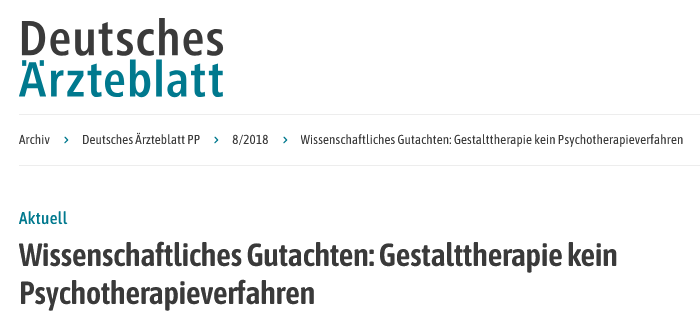
Fig.: The Deutsches Ärzteblatt (German Medical Journal) publishes a scientific expert opinion: Gestalt therapy is not a recognized psychotherapy method.
Particularly revealing is the self-characterization on the IKP website: Body-Centered Psychotherapy, it claims, is "constantly critically reflected upon, further developed, and its efficacy substantiated through scientific studies"5—and "the breadth of therapeutic methods and techniques is likewise impressive."5 Anyone who must praise their own scientific credentials and methodological breadth on their own website to this degree usually has a problem with both.
Real science shows data. Pseudoscience builds cathedrals of words.
For health insurance premiums, this self-description is ruinous: a "research tradition spanning over 40 years,"5 "process and resource orientation, emotion and needs-centeredness, and experiential activation,"5 and a "holistic anthropological personality and thinking model"5— while the IKP continues to "constantly critically reflect,"5 the premium payer continues to pay.
The Illusion of Holism
It sounds seductive: In a fragmented world, people long for the "whole." The IKP delivers promptly: An "anthropological cube model"5 with no fewer than "six dimensions of life"5 is supposed to set things right. Anyone who suffers psychologically, the message goes, does not have a specific cognitive distortion but rather an imbalance in the "multidimensional personality model."5
Viewed cognitively, however, this is a classic logical fallacy (red herring). When a patient suffers from panic attacks because he mistakenly believes his heartbeat is a harbinger of death (a catastrophizing misinterpretation), the solution is not to explore his "life dimension of space"5 or to breathe into his "spiritual-meaning-giving or meditative-transcendent life dimension."5 The solution that is effective by scientific standards is the cognitive falsification of the assumption "heartbeat = death."
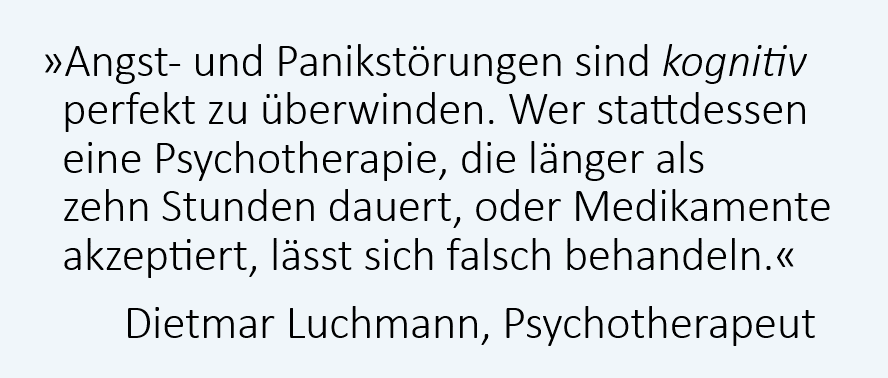
Fig.: This statement represents the scientific standard of psychotherapy. The Zurich Department of Health under Cantonal Councillor Natalie Rickli apparently wishes to withhold the findings of science on effective psychotherapy from its citizens—it calls this statement "misleading and therefore impermissible."6
By inflating the problem across six dimensions—"body, mind, soul, social and ecological environment, as well as time and space"5—offerings like those of the IKP suggest a complexity that is psychotherapeutically counterproductive. The patient does not learn to solve his central problem but loses himself in endless self-contemplation. This is not psychotherapy aimed at cure but a business model designed for perpetual therapeutic attachment—occupational therapy at an elevated verbal level.
The Myth of "Body Memory"
Particularly instructive for the necessity of Motion 25.4533 is a sentence from the IKP's service description: The goal, it states, is to "anchor what has become conscious in the body memory as well"5—"exclusively at the IKP."5
Here, a scientifically long-debunked metaphor is sold as clinical reality. There is no "body memory"5 in the sense of muscles or connective tissue that stores complex psychological content. Memory and emotional learning are the exclusive domain of the central nervous system (the brain). Anyone who claims that insights must be "anchored in the body memory"5 is practicing neurological obscurantism.
The danger of this rhetoric is real: It suggests to the patient that cognitive insight ("I am safe") is not sufficient. It infantilizes the intellect and autonomous thinking in favor of a mystified biology. Instead of showing the patient that he is the master of his thoughts and his appraisals, he is declared the slave of an alleged cellular memory that can be erased only through years of "body work."5 A perfect recipe for perpetual treatment.
Business Model: Massage Instead of Cognitive Mental Work
The offerings further include "active and passive body work"5 as well as "creative action (colored sketches, pictorial representations, sounds, etc.)."5 Translated from jargon into the language of evidence-based medicine, one arrives at the concept of safety behavior.
Modern anxiety research demonstrates unequivocally: Anyone who, at the onset of anxiety, focuses on their breathing, "grounds" themselves, or tries to feel "where the body touches the floor" is cognitively avoiding the anxiety. They do not learn, in accordance with the scientific standard of cognitive psychotherapy, to govern their thinking and overcome the anxiety; rather, they learn to supposedly "breathe it away." The result is short-term relaxation ("feeling better") but long-term stagnation and chronification.
Body-centered therapy functions like a passive massage: It lowers the stress level for the duration of the session. The patient goes home relaxed and perceives the psychotherapist as soothing. This is economically brilliant—the customer gladly returns—but psychotherapeutically fatal. Genuine cognitive change more closely resembles competitive athletics: It is strenuous, often uncomfortable, and intellectually challenges the patient to demolish the pathological construction of reality that is making him sick.
Gabriela Rüttimann's Confession of Inefficiency
The protracted duration of these "psychotherapies" is not coincidence but system, as a glance at the leadership level confirms. The psychotherapist Gabriela Rüttimann, professional director of the IKP and simultaneously president of the Swiss Association of Psychotherapists (ASP), produced, in a letter7 to the Zurich Department of Health dated September 1, 2025, a document of rare, involuntary honesty.
In her "complaint"7 about the public assertion that efficient psychotherapy is possible, she wrote verbatim:
"We are particularly disturbed by [...] [claims that] anxiety disorders could be cured in as few as eight to ten hours, or that a life could be fully worth living again after just a few hours of therapy. Furthermore, [we are disturbed by the] alleged possibility of healing without the use of psychotropic medication [...]. Such claims lack scientific evidence and could raise false expectations among patients."
Gabriela Rüttimann, President Swiss Association of Psychotherapists (ASP)8
With this letter, Gabriela Rüttimann delivers a declaration of insolvency for her profession. She enters into the record that her methods cannot produce these results. Yet her claim that rapid cures in psychotherapy lack a scientific basis is factually false.
As the presidential lobbyist of the Swiss Association of Psychotherapists (ASP)—an organization representing psychoanalytic, depth-psychological, existential-analytical, bioenergetic, and body-centered methods that, in the author's assessment and not only his, fail to meet current efficacy standards—Gabriela Rüttimann disseminates claims that contradict the current scientific state of knowledge in psychotherapy and engages in misleading advertising for the business models of unnecessarily prolonged "therapies" that—judged scientifically—are not psychotherapies at all.
The question arises whether Gabriela Rüttimann, as a psychotherapist with her own practice in Zurich, is thereby violating her professional obligations under Article 27 of the Psychology Professions Act (PsyG).
"Body-Centered Psychotherapy" and "Gestalt Therapy" Are Not Psychotherapy
The Scientific Advisory Board for Psychotherapy (WBP)— the authoritative body for the scientific recognition of psychotherapy methods in Germany—has not classified body psychotherapy as a scientifically recognized method. Likewise, Gestalt therapy, which the IKP identifies as the foundation of its body psychotherapy, cannot, in the judgment of the Scientific Advisory Board for Psychotherapy, be considered a scientifically recognized psychotherapy method due to the absence of efficacy evidence.9
In its expert opinion on the scientific evaluation of Gestalt therapy, the Scientific Advisory Board for Psychotherapy determined on June 11, 2018:
"Gestalt therapy [...] can be recommended neither as a method for the advanced training of psychological psychotherapists pursuant to Section 1(1) of the Training and Examination Regulations for Psychological Psychotherapists, nor as a method for the advanced training of child and adolescent psychotherapists pursuant to Section 1(1) of the Training and Examination Regulations for Child and Adolescent Psychotherapists."
Scientific Advisory Board for Psychotherapy (Wissenschaftlicher Beirat Psychotherapie), Germany Scientific Expert Opinion: Gestalt Therapy Not a Recognized Psychotherapy Method. Deutsches Ärzteblatt PP, Issue 8/2018, p. 342.9
Why Does Natalie Rickli Tolerate Scientifically Unrecognized Methods?
The Zurich Department of Health, headed by Natalie Rickli and responsible for cantonal quality assurance in psychotherapy, allows itself to be influenced, in its accreditation of psychotherapy training at the IKP Zurich, neither by the findings of the psychotherapy efficacy research conducted at the University of Bern by Klaus Grawe10 nor by the determination of the Scientific Advisory Board for Psychotherapy9 that body-centered psychotherapy and Gestalt therapy lack sufficient evidence of efficacy.
One is left at times with the impression that in the Canton of Zurich, professional-political traditions and institutional proximities carry greater weight than transparent, scientifically grounded criteria of quality assurance.
The question presents itself inescapably: Is Natalie Rickli protecting inefficient psychotherapy schools?11
That the Zurich Department of Health under Natalie Rickli neither revokes the professional practice license of the psychotherapist Gabriela Rüttimann for her statements nor withdraws the accreditation of her IKP Institute for Body-Centered Psychotherapy as a psychotherapy training institute illustrates that the dysfunction of psychotherapeutic inefficiency through feel-good events can only be drained by removing psychotherapies from the KVG catalog of covered services and transferring quality assurance to those who pay for it personally.
The Standard of Care for Anxiety Disorders: "7 to 14 Hours"—Without Psychotropic Medication!
Only those who know the scientific state of psychotherapy—and know that they can permanently rid themselves of their panic attacks through eight hours of cognitive psychotherapy—will refuse to carry their money to psychotherapists who will pluck them multidimensionally for years on end like a Christmas goose. And equally refuse to carry it to psychiatrists who, instead of efficient cognitive psychotherapy, sell a lifetime of psychopharmacological dependence.
International guidelines such as those of the British National Institute for Health and Care Excellence (NICE)—renowned worldwide for its ruthless commitment to evidence— explicitly recommend cognitive interventions of only "a total of 7 to 14 hours"12 for anxiety and panic disorders as well as phobias. What is more: The administration of psychotropic medication is regarded in modern anxiety therapy as counterproductive, since it functions as chemical safety behavior that impedes cognitive relearning and increases relapse rates.
"Anyone who wants effective psychotherapy in order to achieve the therapeutic goal in a few hours is forced, in the paradise of psychotherapy inefficiency, to perform the missing quality assurance themselves—only thus does one escape the risk of becoming the financial and mental victim of psychotherapists who, by the standard of science, should never have been granted a professional practice license."
Dietmar Luchmann Klaus Grawe, University of Bern: Cognitive psychotherapy is "significantly more effective" than person-centered psychotherapy and psychoanalysis. Psychotherapie. February 16, 2026.10
When the professional director of a psychotherapy training institute denies the existence of efficient brief therapies, the reason is not a lack of evidence but fear for one's own business model. Those who heal efficiently have empty waiting rooms. Those who claim that healing requires years and medication secure for themselves and their graduates a permanent income at the expense of the premium payer.
The Takeaway: The Golden Goose of Inefficient Psychotherapists Must Be Slaughtered
The "holistic"5 expansion across six dimensions and the focus on "body work"5 serve above all one purpose: They make what is sold as "psychotherapy" interminable. A precise psychological problem can often be solved cognitively in ten hours or fewer. An "Anthropological Cube Model"5 with "six dimensions of life,"5 by contrast, can be calibrated for a lifetime.
The solidarity-based insurance system is not responsible for financing lifelong self-discovery trips or "spiritual-meaning-giving or meditative-transcendent" body work.5 Psychotherapy must work—efficiently, durably, and measurably by symptom, not by subjective well-being during the session. Those who want to "feel" should go for a massage and pay for it themselves. Those who want to get well should start thinking.
Dr. Dietmar Luchmann, LLC, the publisher of this journal, itself offers cognitive psychotherapy via video — with a written summary of every session, for self-pay patients, in German or English.
1. Understand the Method
2. Check Your Suitability
3. Apply for Admission
The Swiss parliamentarians, with Motion 25.4533,1 have drawn the logical conclusion: Removing psychotherapies from the catalog of covered services is the first necessary step toward the rehabilitation of the Swiss healthcare system.
1 The Swiss Parliament: Psychotherapien wieder aus dem Leistungskatalog streichen (Remove Psychotherapies From the List of Covered Services). Motion 25.4533, December 16, 2025, submitted by Philippe Nantermod (FDP).
2 The Swiss Parliament: Wohlfühlveranstaltungen sind keine Krankheitsbehandlungen (Feel-Good Events Are Not Medical Treatments). Motion 23.4108, September 27, 2023, submitted by Martina Bircher (SVP).
3 The Swiss Parliament: Psychiater-Schwemme in der Schweiz (Psychiatrist Glut in Switzerland). Interpellation 14.4178, December 11, 2014, submitted by Sylvia Flückiger-Bäni (SVP).
4 Luchmann, D.: Die Schweiz als Paradies der psychotherapeutischen Ineffizienz (Switzerland as a Paradise of Psychotherapeutic Inefficiency). Psychotherapie. August 14, 2025.
5 Quotations taken from the website of the "IKP Institut für Körperzentrierte Psychotherapie Zürich" (IKP Institute for Body-Centered Psychotherapy Zurich) at the time of this article's publication (psychotherapie-ikp.com).
6 Quotation from the letter of the "Gesundheitsdirektion Zürich" (Zurich Department of Health), signed by Sophie Köhler, MLaw, as "Legal Counsel," dated October 22, 2025, addressed to the author. The letter is available as a PDF copy.
7 Quotation from the letter of the "Assoziation Schweizer Psychotherapeutinnen und Psychotherapeuten (ASP)" (Swiss Association of Psychotherapists), signed by Gabriela Rüttimann as "President," dated September 1, 2025, addressed to the Zurich Department of Health. The letter is available as a PDF copy.
8 Dr. Dietmar Luchmann, LLC: Assoziation Schweizer Psychotherapeutinnen und Psychotherapeuten (ASP) «stören» wissenschaftliche Psychotherapie-Standards (Swiss Association of Psychotherapists (ASP) "Disturbed" by Scientific Psychotherapy Standards). Psychotherapie. February 16, 2026.
9 Wissenschaftlicher Beirat Psychotherapie (Scientific Advisory Board for Psychotherapy): Wissenschaftliches Gutachten: Gestalttherapie kein Psychotherapieverfahren (Scientific Expert Opinion: Gestalt Therapy Not a Recognized Psychotherapy Method). Deutsches Ärzteblatt PP, Issue 8/2018, p. 342.
10 Dr. Dietmar Luchmann, LLC: Klaus Grawe, University of Bern: Cognitive psychotherapy is "significantly more effective" than person-centered psychotherapy and psychoanalysis. Psychotherapie. February 16, 2026.
11 Dr. Dietmar Luchmann, LLC: Is Natalie Rickli protecting inefficient psychotherapy schools? Psychotherapie. February 16, 2026.
12 National Institute for Health and Care Excellence (NICE): Generalised anxiety disorder and panic disorder in adults: management. Clinical guideline. June 15, 2020. [Section 1.3.15: "CBT in the optimal range of duration (7 to 14 hours in total) should be offered." Section 1.3.20: "Benzodiazepines are associated with a less good outcome in the long term and should not be prescribed for the treatment of individuals with panic disorder."]
Your Comment
Are you interested in contacting the author? Do you have remarks, suggestions, or additions regarding this article? Do you have personal therapy experiences? We welcome substantial feedback.