Twenty-One Questions before Every Session
In England, every patient in the state program "NHS Talking Therapies" fills out short questionnaires for every session of his psychotherapy, as a rule beforehand and mostly on a mobile phone. Two of them measure symptoms — the "Patient Health Questionnaire" and the "Generalised Anxiety Disorder scale." The first, called the PHQ-9, uses nine questions to ask about the signs of depression. The other, the GAD-7, uses seven questions to ask about nervousness, restlessness, and the fear that something awful might happen; it was developed for generalized anxiety disorder, and in the program it serves as the standard measure of anxiety. The patient marks how often in the past two weeks he has been bothered by, say, low mood, trouble sleeping, or uncontrollable worry, and each answer counts from zero to three points. This yields two numbers: zero to 27 points for depression, zero to 21 for anxiety. A third questionnaire uses five questions to ask how much the condition impairs work, household, leisure, and relationships. Anyone suffering from a specific anxiety disorder, such as panic disorder or social anxiety disorder, additionally fills out a questionnaire tailored to that disorder.1 Three questionnaires, 21 questions, a few minutes.
At the end of treatment, these numbers become a single piece of information: Has the patient recovered or not? A patient counts as ill if, at the start, he reaches the defined threshold on at least one of the two symptom questionnaires, ten points on the PHQ-9 or eight on the GAD-7. He counts as recovered if, at the end, he is below it on both. For the anxiety disorders that have a questionnaire of their own, that questionnaire takes the place of the GAD-7 in the calculation. Because a score can also fluctuate by chance, there is an additional check of whether the improvement is greater than the measurement error: at least six points on the PHQ-9 or four on the GAD-7; the other score must not have reliably worsened in the process. This is called "reliable improvement"; anyone who both falls below the threshold and achieves this minimum improvement counts as "reliably recovered."1,2
This calculation is carried out separately for each of the regional services and published every month.1 In the reporting year 2025/26, 674,683 courses of treatment were completed, after an average of 8.6 sessions; of those treated who counted as ill at the start, 50.1 percent had recovered by the end.3 An outcome score is available for more than 98 percent of those treated.1,4
Switzerland keeps books too. It knows that psychological psychotherapy cost basic health insurance 991 million Swiss francs in 2025, compared with 528 million in 2021, and that this comes to 106 francs per insured person instead of 60.5 Eight indicators track the development, from gross costs to the age structure of the patients.6 Whether even a single one of these patients has recovered is something none of them records.
This difference is the subject of the article: a system that wants to know what its treatments achieve, and one that only wants to know what they cost. The thesis is this: Outcome measurement in psychotherapy is possible, cheap, and proven. Where it is missing, it is not missing for technical reasons. And as long as it is missing, the public pays for the hour, not for the cure.
Dr. Dietmar Luchmann, LLC, the publisher of this journal, itself offers cognitive psychotherapy via video — in accordance with the guidelines of the National Institute for Health and Care Excellence (NICE), with a written summary of every session, for self-pay patients, in German or English, with no waiting period.
1. Understand the Method
2. Check Your Suitability
3. Apply for Admission
The way there has nine stages. First, I distinguish four levels of control, because the debate constantly confuses what is actually being checked: the method, the outcome, or the bill. Second, I use the English program to show what happens when one measures and publishes, and what the critics object. Third come the countries that have adopted the model. Fourth is the question of duration: What does measurement show about long and short psychotherapy, and what did Klaus Grawe establish as early as 1994? Fifth, I ask where payment actually follows the outcome. Sixth, we look at the countries that do not measure. Seventh, I explain why resistance to measurement is as old as the idea itself. Eighth comes Switzerland, which already had measurement in its draft ordinance. Ninth, I derive why the sequence can only be: measure, publish, and only then pay. Immediately before that, I say what does not follow from the comparison.
Four Levels of Control
Anyone who speaks of "quality assurance" in psychotherapy can mean four different things. Keeping them apart is half the work.
First level: entry control. What is checked is which methods may be billed at all. Germany admits four,7 Austria recognizes 23 methods,8 and England restricts its program to methods recommended by the state guideline institute NICE (National Institute for Health and Care Excellence).1 Entry control checks the label. What happens in the treatment room and what comes of it, it does not check.
Second level: outcome measurement. A validated questionnaire is used to record how the patient is doing before and after treatment, ideally before every session. Only this level answers the question that matters to the patient and to the payer: Did it help?
Third level: publication. The results are disclosed for each provider, so that patients, referring physicians, and insurers can compare. A measurement that stays in the drawer is the private affair of whoever does the measuring.
Fourth level: payment by outcome. Part of the remuneration depends on what was achieved. In technical language this is called "pay for performance."
The levels build on one another. One can publish only what has been measured, and one can pay by outcome only when the outcome is established and verifiable. The countries can be ordered along this grid. The result in advance: Almost all have the first level, only a few the second and the third, and not a single country has the fourth to any appreciable extent.
England: What Happens When One Measures and Publishes
The Program
The English program began in October 2008 under the name "Improving Access to Psychological Therapies"9 and is now called "NHS Talking Therapies." It treats depression and anxiety disorders, and does so in steps: Milder cases first receive guided self-help based on cognitive behavioral therapy; more severe cases, or those that have not improved, receive psychotherapy from a psychotherapist specially trained for the purpose, in the treatment room, by video, or by telephone.1,10 Only methods recommended by NICE are admitted. For depression these include, besides cognitive behavioral therapy, interpersonal psychotherapy, a person-centered form of counseling, and a brief psychodynamic psychotherapy, among others; for the anxiety disorders, NICE recommends specialized forms of cognitive behavioral therapy and, beyond these, only applied relaxation for generalized anxiety disorder and the trauma method EMDR for posttraumatic stress disorder.1
In the reporting year 2025/26, 1.81 million referrals were received. In 1.17 million cases there was a first appointment, which serves mainly for assessment. A total of 674,683 courses of treatment were completed, meaning that at least two sessions took place; in 89.1 percent of these cases, the first appointment came within six weeks of referral.1,3 In March 2026, the monthly figures stood at 51.2 percent recovered, 68.7 percent with reliable improvement, and 48.4 percent reliably recovered.2 The health service's targets for the latter two measures rise step by step: 68 and 50 percent by March 2026, 71 and 53 percent by March 2029.1
The Published Number Changes Practice
What is decisive is not that measurement takes place but what happens with the numbers. They are public, and indeed for every single service. The psychologist David Clark of the University of Oxford, one of the founders of the program, analyzed with colleagues in 2018 why some services discharge far more patients recovered than others. Five organizational characteristics predicted the results, among them the waiting time, the number of sessions, and the proportion of missed appointments.4 These are not secrets of the soul but things management can change once it knows them.
And it did change them. In 2009, the first full year, the recovery rate stood at 37.4 percent. In 2012 it was 45.9 percent, and in 2018 it reached 51.9 percent, while the number of people who attended at least one appointment rose from about 182,000 to more than one million.9 A system that knows and compares its results improved by more than a third in nine years and grew fivefold in the process. A system that does not know its results cannot get better. It can only get more expensive.
The economic benefit can be quantified as well, though more modestly than the proponents once hoped. In 2026, an analysis of linked treatment and earnings data found that completing a course of treatment raised the employment rate by up to 1.5 percentage points and monthly earnings by up to 17 pounds; for job seekers, the figures were 3.1 percentage points and 63 pounds.11
What the Critics Object
The English program has weaknesses, and they belong in this reckoning. First, the denominator: The 50 percent refers to those who completed a course of treatment and were above the clinical threshold at the start. Of the year's 1.81 million referrals, only a good third led to a completed course of treatment.3 Anyone who stays away after the first session appears in no recovery rate.
Second, durability: In a follow-up of 439 patients who counted as recovered after a low-intensity treatment, 53 percent relapsed within a year.12 This concerns the first and shortest level of treatment. But it shows that a score on the last day of treatment is not a score for the life that follows.
Third, the pressure on the number: In a survey of 650 people working in the program, 41 percent said they had been asked to manipulate data.13 Where a performance figure decides contracts, the temptation grows to work on the figure instead of on the patient.
Fourth, the label: In the routine data of 33,243 depressed patients from 103 services, what was recorded as cognitive behavioral therapy did no better than counseling; in both groups, about half did not achieve reliable improvement.14 This does not speak against cognitive behavioral therapy. Its effectiveness has been demonstrated in controlled studies in which specially trained psychotherapists treat under supervision. The routine data show something else: what actually happens under this name in everyday practice. In my clinical experience, there is only one explanation for the finding: What was billed as cognitive behavioral therapy was in many cases nothing of the kind. Aaron T. Beck, the founder of cognitive therapy, said so in the foreword to the textbook by his daughter Judith Beck:
"The practice of CBT is not simple. Too many mental health professionals call themselves CBT therapists but lack even the most basic conceptual and treatment skills."
Aaron T. Beck, foreword to "Cognitive Behavior Therapy: Basics and Beyond," 202115
The English data support this reading. As early as the program's first year, recovery rates were lower where a method not recommended by NICE was used.16 Lack of skill is no objection to a method. Incompetence is first of all just that: incompetence. But it is the best reason to measure, for only measurement shows who has mastered the method whose name he bills.
None of these objections speaks against measurement. Every single one is known only because measurement takes place and is published. About the dropouts, the relapses, and the whitewashing in Swiss, German, or Austrian psychotherapy, nothing of the kind can be said, because no one counts them. The criticism of England is the strongest argument for England.
Interim summary: England shows three things. Measurement is feasible on a mass scale, with more than 670,000 completed courses of treatment a year. Publication improves the results, from 37 to 52 percent recovered. And it makes visible the weaknesses that remain invisible elsewhere.
The Imitators: Norway, Spain, Canada, Australia
One might object that England is a special case: a state health service that can order whatever it wants. The objection can be tested, for the model has been exported.
Norway introduced it in the municipalities under the name "Rask psykisk helsehjelp," prompt mental health care, and tested it in a randomized trial. Randomized means: Chance decided which of the 681 participants received the new service and which received usual care. After six months, 58.5 percent of those newly treated had reliably recovered, compared with 31.9 percent in the comparison group.17 After twelve months, the gap was 59.4 versus 36.6 percent.18
In Spain, 1,061 patients from 22 primary care centers received either usual primary care treatment or, in addition, seven group sessions of cognitive behavioral therapy. Specialists express the difference between two groups as an effect size; 0.2 is considered small, 0.5 medium, 0.8 large. The additional treatment reduced anxiety with an effect size of 0.65 and depression with 0.58, and the advantage persisted, in weakened form, after twelve months.19
The Canadian province of Ontario has rebuilt the English model as "Ontario Structured Psychotherapy," including measurement at every session.20 Since 2017, more than 106,000 people have been enrolled; according to the health authority, nearly half of those who completed the program reported a noticeable improvement in their symptoms.21
Australia is the most instructive case, because it has taken both paths at once. Since 2006, the state health insurance has reimbursed psychological sessions under the "Better Access" program without recording the outcome. In 2022, a comprehensive evaluation recommended changing this and measuring outcomes routinely.22 In a pilot, however, only 12 of 56 enrolled providers collected any outcome data at all; the evaluators suspected a general reluctance among providers behind this.23 In 2024, the government merely noted the recommendation; its response records that there is no precedent for routine outcome measurement in the programs paid for by the state health insurance.24 Alongside this, Australia has operated the nationwide digital service MindSpot since 2013, which has measured from the outset: 121,652 assessments started, 21,745 treatments started, and, comparing before with after, effect sizes of 1.40 for depression and 1.45 for anxiety.25 Finally, on January 1, 2026, a new national service on the English model was launched, funded with 588.5 million Australian dollars over eight years.26 The country that paid for twenty years without measuring is now building, alongside, a service on the pattern of the system that measures.
Interim summary: The model does not depend on the English state health service. It works in Norwegian municipalities, in Spanish primary care, in a Canadian province, and digitally across an entire continent. Where it was tested by random allocation, it was superior to usual care.
Finland and the Question of Duration
The most uncomfortable number in this comparison comes from Helsinki. Since 2018, the hospital district of the Finnish capital has kept a quality register for psychotherapy; anyone who treats on its behalf must enter the results of his patients there. This makes it possible to compare, on routine data, what long and what short psychotherapy achieve. The result of the first analysis: The short psychotherapies achieved effect sizes between 0.75 and 0.91, the long ones 0.65. The long treatment thus did not do better than the short one but worse. The authors add an observation that must be read twice: The Finnish system, they write, seems to assign patients with milder illness to the more intensive, longer, and more expensive treatment, and it achieves smaller effects than the programs on the English model.27
What this costs is shown by the Finnish social insurance institution Kela. It pays for a "rehabilitative psychotherapy" of up to three years and 200 sessions; in 2024, 65,900 people received it, at a cost of 105 million euros.28
The Finnish figures do not stand alone. As early as 1986, an analysis of data from three decades showed that the benefit of each additional session declines: About half of the patients had measurably improved after eight sessions, three quarters after 26.29 In 2020, a systematic review of routinely delivered treatments concluded that the optimal length of treatment in routine care lies between four and 26 sessions.30 In the English data from 102,206 patients, 95 percent of those who responded to treatment at all had done so after seven sessions of the low-intensity treatment and after fourteen sessions of the more intensive one.31 The British guideline institute NICE recommends, for panic disorder, cognitive behavioral therapy totaling seven to fourteen hours.32
For long-term psychoanalytic psychotherapy itself, the state of research is disputed. In 2012, a meta-analysis - that is, a pooled analysis of several studies - found no advantage in recovery over the comparison treatments in eleven randomized trials and called the evidence limited and conflicting.33 Proponents of the method, using a different selection of studies, arrive at more favorable results.34 Who is right could easily be settled: by the very measurement that is already beginning to decide the dispute in Helsinki.
What Klaus Grawe Established in 1994
None of this is new. In 1994, the psychotherapy researcher Klaus Grawe of the University of Bern, together with Ruth Donati and Friederike Bernauer, presented an analysis of 897 controlled psychotherapy studies. On duration he noted that effective psychotherapy unfolds its effect in months, not years, and that precisely the particularly effective cognitive-behavioral methods manage with astonishingly few sessions. He called the assumption that severely disturbed patients need years of treatment refuted. To psychotherapists in whose practice the majority of treatments last longer than 40 sessions, he said that they should rethink their practice.35 In this journal, the work Psychotherapie im Wandel (Psychotherapy in Transition) has been discussed in detail.36
Grawe relied on controlled studies, that is, on treatments under research conditions. In 1994, one could object that in the everyday reality of practices everything is different. That argument has since been used up. The routine data from England, Norway, and Finland come from everyday practice, from hundreds of thousands of ordinary patients, and they show the same thing as Grawe's studies: Whoever responds to psychotherapy responds early. Thirty-two years after "Psychotherapy in Transition," it is not the evidence that is lacking. What is lacking is the willingness to make the transition and apply the findings.
Interim summary: Where measurement takes place, long psychotherapy is not superior to short. Improvement sets in during the first weeks and months. Grawe derived this in 1994 from controlled studies; today the registers confirm it on routine data.
Money Follows the Outcome Only in Traces
The title of this article claims that what is paid for is the hour and not the cure. That holds, with small exceptions, everywhere. Even the countries that measure hardly pay by outcome.
England tried. The national tariff rules for 2017 to 2019 required that the services' remuneration be tied to ten performance measures; the recommended share was no more than five percent of the contract value.37 The documented experience is mixed. In the South Tees region, under a contract with deductions, the recovery rate rose from 37.7 percent in March 2015 to 54 percent in November 2017. In Wakefield, by contrast, where ten percent of the remuneration had depended on the outcome since September 2016, it declined markedly.38
The highest share I found was in the American state of Washington. There, a program for the treatment of depression in community clinics tied a quarter of the remuneration to quality measures. After that, patients improved markedly faster: The likelihood of responding to treatment within a given period was 73 percent higher than before.39 This involved about 8,000 patients in 29 clinics and treatment coordinated by primary care physicians, not classic individual psychotherapy;40 the finding can therefore be transferred only with caution.
In the Netherlands, the insurer Menzis began a program in 2019 with a group of providers for milder anxiety disorders and depression that ties a supplement to a better treatment outcome; the treatment is paid for even when success fails to materialize.41,42
How not to do it was demonstrated by Sweden. From 2008 to 2015, under the "rehabilitation guarantee," the state funded, at a cost of about seven billion kronor, cognitive behavioral therapy for mild and moderate mental disorders, among other things. Payment was made per treatment that bore this name; whether it worked and whether it deserved the name, no one had to demonstrate. In 2015, the Swedish National Audit Office found that none of the evaluations had shown a reliable effect on the return to work, and it titled its report with the call to rethink the program or shut it down.43 In December 2015, the government decided to terminate the agreement.44 The lesson matches Aaron T. Beck's warning: Whoever pays for the name of a method instead of the outcome gets the name. Whether cognitive behavioral therapy took place in Sweden where it was billed, no one checked.
How rare even measurement is, a survey by the OECD shows: In 2018, only five of twelve countries surveyed regularly recorded, in the care of the mentally ill, how patients rate their outcome and their treatment; only Australia, the Netherlands, and England reported both.45
Interim summary: No country pays for psychotherapy predominantly by success. The dividing line therefore does not run between a success fee and an hourly fee. It runs between countries that know the outcome and countries that do not. In the former, the hour is paid for and the cure is counted. In the latter, the hour is paid for, and that is the end of it.
Where No One Measures
Germany: Up to 300 Hours on Application
The statutory health insurers in Germany, by their own account, currently spend about 4.6 billion euros a year on outpatient psychotherapy, twice as much as ten years earlier.46 Payment is per session. The guideline allows up to 300 hours of analytic psychotherapy, up to 100 hours of depth-psychology-based psychotherapy, and up to 80 hours of behavior therapy.7 Control takes place in the so-called expert review procedure (Gutachterverfahren): Before a long-term treatment, the psychotherapist writes an application, which a colleague assesses. What is examined, then, is a text before the treatment, not the outcome after it.
That things could be done differently has been tried in Germany itself. In a model project, the health insurer Techniker Krankenkasse had the outcomes of outpatient psychotherapies measured with questionnaires and fed back to the psychotherapists. The final report of 2011 showed: Measurement was feasible in practice, and the treatments worked with an effect size of about 1.0. The measurement procedure did not, however, do better than the conventional expert review procedure, and in the measurement group even more hours were billed.47 Measurement was not adopted into standard care.
Since 2025, a quality assurance procedure provided for by law, intended to replace the expert review procedure, has been on trial in North Rhine-Westphalia.48 It surveys patients only after the end of treatment and anonymously, and it requires more than a hundred entries per case from the psychotherapist;49,50 consequently, no baseline value with which the condition at the end could be compared is collected from the patients. The Scientific Advisory Board on Psychotherapy considers it unsuitable,49 and on this point the criticism is right: A procedure that does not know the baseline value cannot measure improvement.
What is remarkable is the conclusion drawn from this justified criticism. The German Psychotherapists' Congress (Deutscher Psychotherapeutentag), the assembly of delegates of the Federal Chamber of Psychotherapists, in which all methods are represented, demanded in November 2025 that the trial be suspended and the statutory mandate be deleted.51 In place of the statutory procedure, the Chamber wants an approach developed by the profession itself, with progress monitoring and feedback, for which the law would first have to be changed.48 The professional society of the psychoanalytically based methods had already declared in 2019 that a further simplification of the expert review procedure "massively threatens the quality of guideline treatments,"52 and in 2024 it demanded that the trial be decoupled from the abolition of the "proven" expert review procedure.53
Meanwhile, steering is done with the only tool that remains without outcome data: price. In March 2026, the Extended Evaluation Committee, the arbitration body of statutory health insurance physicians and health insurers, decided to cut the remuneration of sessions across the board by 4.5 percent; a regional social court provisionally suspended the decision in July 2026.54,55 Whoever does not know which treatment helps can only cut all alike, the effective as well as the ineffective.
Austria: 23 Methods and Not a Single Number
Austria recognizes 23 psychotherapeutic methods, from psychoanalysis through behavior therapy to concentrative movement therapy.8 In 2019, the Court of Audit found that data on the effect of the treatments paid for by social insurance are lacking.56 The framework agreement between the insurance funds and psychotherapists, which the law has provided for since 1992, had, according to the Court of Audit's findings, still not been concluded.56 When the report was deliberated in parliament in January 2021, the Court of Audit spoke out in favor of a new statutory regulation of psychotherapy care.57
France: A Report Disappears
In France, the state health research institute INSERM presented a comparison of three psychotherapeutic approaches in 2004. For cognitive behavioral therapy, the report found evidence of effectiveness in most of the disorders examined; for the psychoanalytic approach, only in isolated cases.58 On February 5, 2005, the health minister Philippe Douste-Blazy told an assembly of psychoanalysts that he had had the report removed from his ministry's website.59 It is the only example known to me of a government withdrawing a scientific comparison of psychotherapy methods before the eyes of those who had come off worse.
The Netherlands: Measured, Compared, Deleted
That measurement can also fail is shown by the Netherlands. From 2011 on, mental health care providers had to deliver outcome data to a foundation financed by the insurers, which used them to produce comparisons between providers;60 in 2015, data were available for just under half of the patients.61 In early 2017, the Court of Audit judged the data to be of insufficient quality to serve the insurers as a basis for purchasing, and more than 6,000 people signed a petition against the comparison.62 The dispute was decided by data protection: The supervisory authority classified the information as personal health data that should not have been processed in this way; the patients had not given their consent.63 The foundation was dissolved; its successor destroyed the database in August 2019.60
The lesson is a legal one, not a psychological one. Measurement needs a sound legal basis, and it must first serve the patient and his psychotherapist before it serves the purchaser. Against measurement itself the case proves nothing; in the same dispute, leading Dutch psychotherapy researchers expressly defended it as an instrument of quality improvement.62
United States: A Standard and Few Who Follow It
In the United States, according to a 2019 review, fewer than one in five of those providing treatment regularly measure how their patients are doing, and only about one in twenty do so at every session. As an important obstacle, the authors name the conviction that a questionnaire is not superior to one's own clinical judgment.64 I will return to this conviction shortly.
Interim summary: Where no one measures, what is lacking is not money, questionnaires, or models. Germany tried measurement and let it lie, France withdrew a comparison, the Netherlands destroyed a database, and Austria has been waiting for a contract since 1992. Each time, the possibility was on the table.
An Old Idea and Its Price
Resistance to outcome measurement is not peculiar to psychotherapy, and it is not a conspiracy. It is as old as the idea, and its reasons are human.
London, 1858: The Published Number
Florence Nightingale returned from the Crimean War in 1856 with statistics no one had ordered. She had counted what the British soldiers had died of, and in 1858 she published the result in a diagram (Fig. 1): By far the most had succumbed not to their wounds but to preventable infectious diseases.65 The left half of the diagram shows how mortality fell after sanitary conditions in the military hospitals were improved in the spring of 1855. The number, once published, could no longer be argued away.
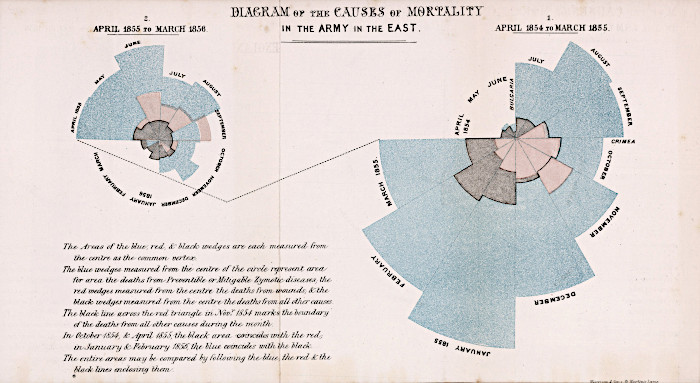
Fig. 1: Florence Nightingale (1820–1910): "Diagram of the Causes of Mortality in the Army in the East," 1858, colored plate from her report on the health and hospital administration of the British Army. Image source: Wikimedia Commons (public domain).
Each wedge stands for one month of the Crimean War, its area for the mortality in that month. Blue marks the deaths from preventable infectious diseases, red those from wounds, black all others. The right-hand diagram shows the period from April 1854 to March 1855, the left-hand one the period from April 1855 to March 1856, after sanitary conditions had been improved.
Nightingale counted what no one wanted to count and published what no one wanted to read. In the same year she became the first woman admitted to the Statistical Society of London. Her diagram is the archetype of what England does today with every psychotherapy: record the outcome, present it for each institution, and lay it before the public.
Boston, 1915: "If Not, Why Not?"
Half a century later, the Boston surgeon Ernest Amory Codman (1869–1940) went a step further. He demanded that every hospital follow every patient long enough to determine whether the treatment had helped, and, in the event of failure, ask: "If not, why not?"66 He called this the End Result Idea. When the administration of Massachusetts General Hospital did not take up his proposals, he gave up his position in 1911 and founded a small hospital of his own. There he kept a card for every patient, recorded 123 errors in 337 patients by 191666 and had the results, errors included, printed at his own expense.67
On January 6, 1915, before the medical society of his district, Codman unveiled a cartoon some six feet wide,68 which the Boston painter Philip Leslie Hale had drawn at his commission (Fig. 2). It shows the paying public as an ostrich that sticks its head in the sand and lays golden eggs over which the doctors scramble. The hospital's trustees wonder whether the bird would go on laying if it were allowed to know the truth about the patients. The outrage was great, and Codman was promptly asked to resign as chairman of the society.66
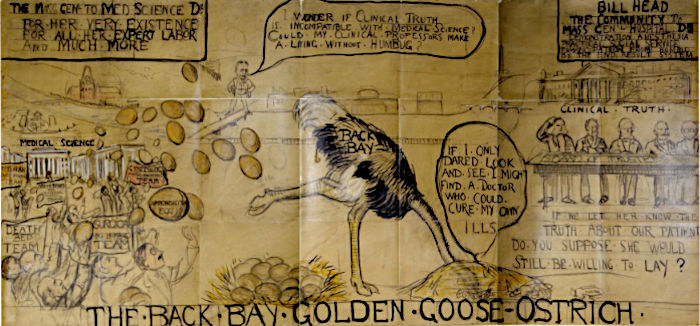
Fig. 2: Philip Leslie Hale (1865–1931): "The Back Bay Golden Goose-Ostrich," 1915, cartoon commissioned by Ernest Amory Codman. Original in the Boston Medical Library, Francis A. Countway Library of Medicine, Boston. Public domain.
The ostrich bears the name of the affluent Boston neighborhood of Back Bay and stands for the paying public. It sticks its head into a mound around which bugs labeled "Humbug" are crawling, and lays golden eggs, for which the doctors on the left are reaching. Its speech balloon says: If I only dared to look, I might find a doctor who could cure my own ills. At the top, the president of Harvard University wonders whether his clinical professors could make a living without humbug. On the right, the hospital's board of trustees sits under the heading "Clinical Truth" and ponders: If we let the bird know the truth about our patients, will it still lay?
The trustees' question is the question of this article. Replace the operation with the session: Would the public go on paying if it knew the results?
Codman had not uncovered a conspiracy but described an incentive: Whoever is paid per operation and does not have to know his result has no reason to want to know it. His idea prevailed nonetheless. He is one of the founders of the institution that today, as the Joint Commission, accredits American hospitals,66 and since 2018 this very institution has required providers of mental health care to measure the course of treatment with standardized instruments.69 It took 103 years. The cartoon now hangs in the library of Harvard Medical School, and the quality and safety department of Massachusetts General Hospital bears Codman's name.66
Why One's Own Judgment Is Not Enough
There remains the conviction that measurement is superfluous because the experienced psychotherapist sees anyway how his patient is doing. It has been tested.
In one study, 129 psychotherapists were asked to compare their own skill with that of their colleagues. On average, they rated themselves such that 80 percent of their colleagues would be worse than they were; one in four saw himself among the top ten percent, and not a single one considered himself below average.70 That is mathematically impossible and humanly normal.
In a second study, 40 psychotherapists were asked to predict which of their 550 patients would deteriorate in the course of treatment. They predicted three deteriorations. In fact, 40 patients deteriorated, and only a single one of the predictions proved correct.71
A third study compared 119 psychotherapists on the basis of 10,786 patients. Depending on the psychotherapist, the proportion of patients who recovered ranged from 23.5 to 95.6 percent.72 On the bill, both ends of this range look the same.
The range is not the outlier of a single study. The psychotherapy researchers Louis Castonguay and Clara Hill summarize the state of research as follows: 15 to 20 percent of psychotherapists achieve consistently and distinctly better results than their colleagues, 15 to 20 percent consistently and distinctly worse ones.73 What this means for a profession that pays the former and the latter alike, I have set out elsewhere.74
Effective, Ineffective, Harmful
At the lower end of this distribution, things do not stop at a lack of improvement. An analysis of 1,841 patients of 91 psychotherapists over two and a half years showed: The patients of the most successful psychotherapists improved ten times as fast as the average; among the patients of the least successful, symptoms increased on average.75 A treatment that can work can also harm. That is true of every drug and every operation, and it is true of psychotherapy. In the prediction study mentioned above, 40 of 550 patients deteriorated, a good seven percent;71 in the English routine data from the program's first year, the figure was 6.6 percent of those treated.16 Not every one of these deteriorations can be blamed on the treatment. But without measurement, one cannot even ask which of them can.
In 2007, the psychologist Scott Lilienfeld presented a provisional list of psychological treatments that can cause harm and reproached his discipline for having long taken hardly any interest in this side of psychotherapy.76 Little has changed since: Even in controlled studies, harms are recorded only incompletely, as has been set out in this journal.77 In the routine care of the countries that do not measure, they are not recorded at all. They are paid for all the same.
Two things follow from these findings. First, the psychotherapists who are worth their money because they treat effectively can be found only through measurement. Neither the title nor the school nor the hourly rate distinguishes them from the rest. Second, it becomes understandable why measurement meets with resistance without anyone having to act in bad faith. Whoever is convinced that he is above average expects no gain from measurement. Whoever does not notice deteriorations does not miss them. And whoever is paid for a hundred approved sessions loses the following eighty-six to a measurement that shows improvement after fourteen. This is a statement about incentives, not about intentions.
The same incentives explain what happens to the one who heals quickly. Remuneration per session rewards managing the patient as a source of revenue, not curing him. Whoever achieves in a few hours what others bill years for endangers this business by his mere existence. As long as no one measures, he cannot prove his success, and he must expect to be not refuted on professional grounds but pursued in disciplinary proceedings; cases are documented in this journal.77
Three objections to measurement have a kernel of truth. Questionnaires do not capture everything. True; they capture the symptoms for which the patient came and for whose treatment the insurance pays. Performance figures can be dressed up. True; that is why money belongs only at the end of the sequence, of which more later. Feedback alone improves little. That too is correct: A meta-analysis of 58 studies with 21,699 patients found, for merely feeding the measured values back to the psychotherapist, a small effect of 0.15 and somewhat fewer dropouts;78 a Cochrane review of 17 studies found no reliable effect.79 Precisely this speaks for the English solution. The number works not because the individual knows it but because everyone sees it.
Switzerland: Measurement Was Already in the Draft
What the Law Requires
On this point the Swiss Health Insurance Act is unambiguous. Benefits under basic health insurance must be "effective, appropriate, and cost-effective"; effectiveness must be demonstrated by scientific methods, and all three properties are to be reviewed periodically.80 For psychotherapy, the benefits ordinance states that payment is made for methods whose effectiveness is scientifically proven.81 Since April 2021, the law has in addition obliged the associations of providers and of insurers to conclude agreements on quality development that regulate measurements, their publication, and sanctions.80
In substance, then, the law requires exactly what this article is about. What is missing is its application.
Proposed in 2019, No Longer Included in 2021
The application already existed, fully worded. In June 2019, the new regulation went out for consultation under which psychological psychotherapists, on a physician's prescription, bill basic health insurance independently, the so-called prescription model. The draft of the benefits ordinance contained a second condition for coverage. Psychotherapy, whether provided by physicians or by psychologists, was to include "an initial, a progress, and an outcome assessment with validated instruments."82 That is, in ten German words, the English model.
A total of 493 submissions were received. In favor of measurement were the Conference of Cantonal Health Directors and the majority of the cantons, as well as the two associations of health insurers existing at the time, one of them with the reservation that the professional associations would first have to define the instruments. It was rejected in principle by the psychological and the psychiatric professional societies, by the Swiss Medical Association FMH, and by the cantonal medical societies; the Social Democratic Party, the hospital association H+, and the majority of the patient organizations joined in the rejection.83 According to the SBAP, the three psychology and psychotherapy associations FSP, ASP, and SBAP submitted a jointly developed position; it demanded that the provision be deleted.84
On March 19, 2021, the final ordinance was issued. It regulates who may prescribe, how many sessions are paid for per prescription, and when a psychiatrist must assess the case. It does not contain the outcome assessment.85 The insurers and the majority of the cantons had wanted measurement; the associations of those providing treatment had not. It is not in the ordinance.
The associations justified their rejection essentially with four arguments.84 They can be tested against the data in this article.
First: The effort is said to be out of all proportion to the benefit. England processes the data on more than 670,000 completed courses of treatment a year and publishes them monthly. The effort for the patient: three short questionnaires with 21 questions.
Second: Data protection is said not to permit data collection per patient. The objection has a serious core, as the Dutch case shows. But it establishes a requirement for the legal basis, not a prohibition. Since July 1, 2012, Switzerland's psychiatric hospitals have recorded the symptom burden of every patient at admission and discharge, once by the treating staff and once by the patient himself, and the results are published for each hospital.86 What is permissible at the hospital bedside cannot be forbidden in outpatient practice.
Third: In routine operation, progress measurement is said to be impracticable and, depending on the disorder, liable to impair the success of treatment. In England, Norway, Ontario, and Helsinki it is routine. Research finds no harm from feeding back the measured values but a small benefit.78 Above all, however, Switzerland already requires this measurement, namely of those in training. The ordinance on the accreditation of postgraduate training programs prescribes that every prospective psychotherapist complete at least ten treatments under supervision and document and evaluate their course and outcome "with scientifically validated instruments."87 What is expected of the beginner is supposed to be unreasonable for the master.
Fourth: Measurement only for mental and not for physical illnesses is said to be discrimination. The reverse is true. No physician treats high blood pressure without measuring blood pressure, and no diabetologist does without the blood glucose value. The exception to the rule is psychotherapy, and ending it would be equal treatment.
That the humanistic and the depth-psychological schools can measure too, they have proven themselves: In the "Praxisstudie ambulante Psychotherapie Schweiz" (Practice Study of Outpatient Psychotherapy in Switzerland), institutes of the Swiss Charter for Psychotherapy had the treatments of 362 patients assessed with questionnaires before and after psychotherapy.88,89 Ability is not what is lacking.
In 2019, the associations proposed first testing measurement in a pilot project and then introducing it on a sample basis.84 In the monitoring with which the federal government accompanies the new regulation, there is to this day no indicator of treatment outcome.6
What Switzerland Measures Instead
What is measured is the costs, and they are impressive. From 528 million francs in the last year of the old model, basic health insurance spending on psychological psychotherapy rose to 991 million in 2025. The Federal Office of Public Health attributes about 30 percent of the increase to the higher tariff and a good six percent to the development of the number of insured persons; almost two thirds cannot be broken down further.5 The evaluation that the Federal Council took note of in June 2026 appears under the headline that the new regulation has become established.90 That is correct. What has become established is an expenditure of soon one billion francs a year, about whose effect the federal government records nothing. I have commented on the figures elsewhere.91
What Entry Control Lets Through
That leaves the first level, the control of methods. In Switzerland, it takes the form of the accreditation of postgraduate training programs by the federal government. Whoever completes one of them receives the federal postgraduate title and, as soon as he meets the other requirements for authorization, can bill basic health insurance on a physician's prescription.92 After that, no one checks what the individual method achieves in patients.
A comparison across borders shows how wide the mesh of this sieve is. Among the accredited postgraduate training programs is "Körperzentrierte Psychotherapie" (body-centered psychotherapy) of the Zurich institute IKP,93 which traces its approach back to Gestalt therapy and describes it as a holistic form of psychotherapy.94 In Germany, the Scientific Advisory Board on Psychotherapy, a statutory body of the German Medical Association and the Federal Chamber of Psychotherapists, examined humanistic psychotherapy, comprising ten approaches, among them Gestalt therapy and body psychotherapy.95 In 2017, it did not classify it as a scientifically recognized psychotherapy method;96,97 for Gestalt therapy, it confirmed this in a separate expert opinion in 2018.98 In Germany, the statutory health insurers pay for four methods, and none of them belongs to this group.7 In the English program, body psychotherapy does not appear among the methods recommended by NICE.1 In 2010, the Netherlands removed classical psychoanalysis from the benefits package of its basic health insurance.99 Austria, by contrast, recognizes a body-oriented method as well: concentrative movement therapy.8
What is paid for as psychotherapy is today decided by the national border: What Switzerland accredits is not reimbursed in Germany, and what Austria recognizes is not offered in the English program. An entry control that yields opposite results from country to country measures, in my judgment, not so much effectiveness as tradition and bargaining power. Only the second level can end the dispute. A method that demonstrably helps its patients has nothing to fear from measurement, whatever school it belongs to. This journal has dealt elsewhere with the IKP Institute for Body-Centered Psychotherapy in Zurich, whose "professional direction" lies with ASP president Gabriela Rüttimann;94 here it suffices to note that the federal government has accredited its postgraduate training program and that no one records with what result the IKP method is applied, a method that in Germany is not95-98 regarded as a scientifically recognized psychotherapy and is not1 admitted in the English program.
The punch line to this is supplied by the hubris of the Association of Swiss Psychotherapists (ASP), whose president, Gabriela Rüttimann, denounced the healing of anxiety disorders within "eight to ten hours" as misleading and in breach of professional law in a 2025 complaint filed by the association: Such information about effective psychotherapy, the professional association fears, "could raise false expectations among patients,"100 for the NICE guideline recommends cognitive behavioral therapy of "7–14 hours in total" for panic disorder.32
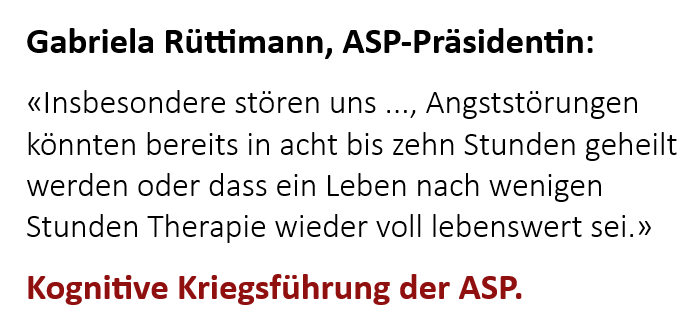
Fig. 3: Gabriela Rüttimann, president of the Association of Swiss Psychotherapists (ASP), declared on behalf of the professional association: "We are particularly annoyed by […] the claim that anxiety disorders can be cured in as little as eight to ten hours, or that life can be fully worth living again after just a few hours of therapy." This is cognitive warfare by the Association of Swiss Psychotherapists (ASP) against effective psychotherapy.101
This journal has documented for Switzerland, with two examples, that professional associations tend to respond to criticism of treatment duration and effectiveness with disciplinary action rather than on the merits, because they are defending what their members live on: the cognitive warfare by the Association of Swiss Psychotherapists (ASP)101 against informing the public about effective psychotherapy, and the psychotherapy inflation77 in treatment figures.
The interest of these professional associations of psychotherapists evidently lies not in promoting rapid healing but in having any mention of it prohibited. It is the logical consequence, then, that Swiss parliamentarians are demanding: "Remove psychotherapies from the benefits catalog again in order to lower premiums."102,103
Interim summary: Switzerland requires effectiveness by law. It requires those in training and the hospitals to measure. It had measurement for outpatient practices in the draft and, after a consultation in which the professional societies rejected it, did not adopt it into the ordinance. Since then, it has been measuring the costs.
What Does Not Follow from the Comparison
Before I draw the conclusion, I set out what this article does not claim.
First, it does not follow that a questionnaire captures the human being. It captures symptoms. That is little, but it is exactly what health insurance pays for.
Second, it does not follow that England is a flawless model. The dropouts, the relapses, and the pressure on the performance figure are documented; they are documented because measurement takes place.
Third, it does not follow that long psychotherapy helps no one. It follows only that its superiority has not been demonstrated where measurement takes place, and that the burden of proof lies with whoever claims more time and more money.
Fourth, no verdict on cognitive behavioral therapy follows from the English routine data. They show only that its name on the bill does not guarantee that it takes place in the treatment room.
Fifth, it does not follow that any particular method or any particular institute is ineffective. Ineffective and unmeasured are two different things. Only the second is claimed.
Sixth, it does not follow that psychotherapists act against their better knowledge. The overestimation of one's own abilities that research describes is not the vice of one profession but a human trait. That is precisely why one measures.
Seventh, it does not follow that remuneration should immediately depend on the outcome. The experience of England and Sweden speaks against it.
Eighth, it does not follow that anything should be taken away from the mentally ill. Whoever measures finds out which treatment helps, and that benefits first of all those who today are treated for a long time without getting well.
Measure, Publish, Only Then Pay
A sequence can be derived from the comparison, and it is not arbitrary. I go through it step by step so that every inference can be checked.
First step: Insurance buys not time but improvement. That is not an opinion but the content of the law: What is effective is paid for, and effectiveness is to be reviewed periodically.80 The session is the means. The purpose is that the patient is doing better afterward.
Second step: Only those who measure before and after know whether a treatment has worked. The practitioner's own judgment does not replace measurement; the studies on self-assessment show this. Nor does the name of the method replace it; Beck's warning, the range from 23.5 to 95.6 percent recovered within the same profession, and the Swedish example show this. And the approval of an application replaces it least of all, for it examines an intention before the treatment. Without measurement, then, one can neither establish whether the condition of the first step is met nor notice when a treatment does harm. Therefore: measure.
Third step: A measurement that no one sees changes almost nothing. Merely feeding the results back to the individual psychotherapist improves outcomes only slightly. Since results in England have been published for each service, the recovery rate has risen from 37 to 52 percent, because the comparison shows what is possible and because patients, physicians, and payers can choose. Therefore: publish.
Fourth step: Money tied to a number too early spoils the number. The English reports of manipulated data and the Wakefield contract show this. Only once measurement has become routine and verifiable through publication can remuneration follow. Its first form is not a bonus but a condition: Only what is measured is paid for, and whoever wants to continue a treatment beyond a fixed number of sessions documents the improvement achieved so far with data instead of an application. Therefore: only then pay.
The sequence cannot be rearranged. One cannot publish what one has not measured. One cannot pay by outcome for what is not publicly verifiable, at least not without inviting whitewashing. And paying without measuring is not a fourth way but the present state of affairs.
Switzerland's Choice and the Nantermod Motion
For Switzerland, this leaves a choice between exactly two options. Either outcome measurement is introduced. The text for it has existed since 2019, and the hospitals and the postgraduate training institutes already use the instruments. Or the public goes on paying for a service of which no one can say whether, in the individual case, it meets the statutory condition of effectiveness.
Motion 25.4533 by Philippe Nantermod, a member of the National Council, draws the consequence from the second option: It demands that psychotherapies be removed again from the benefits catalog of basic health insurance. The Federal Council recommends rejecting it and lists what, in its view, ensures quality: the restriction of the authority to prescribe, the limit on sessions per prescription, cost approval with a psychiatric case assessment after 30 sessions, the statutory criteria of effectiveness, appropriateness, and cost-effectiveness, the review of disputed benefits, and the evaluation of the new regulation. It considers the existing processes "expedient and sufficient."101
Read the list a second time. Every one of its items checks an authorization, an application, or a bill. Not a single one measures the outcome of a treatment. The Federal Council defends the obligation to pay with precisely those forms of control that, by everything this comparison shows, cannot answer the question of whether a treatment works. As long as this remains so, the motion has logic on its side: A social insurance system that does not want to know what it is buying will find it hard to justify why everyone must pay for it. Whoever wants to reject the motion has an honest way of making it superfluous: measure and publish. I have discussed the motion and its justification elsewhere.102
Incidentally, there is one form of outcome measurement that needs no ordinance. Whoever pays for his psychotherapy himself checks after every session whether it was worth the money, and he stops when it is not. This is no objection to solidarity. It is a reminder of what solidarity must replace when it takes the bill off the patient's hands: his control.
What Cognitive Psychotherapy Stands to Gain
Measurement does not check the name of a method but its outcome. It makes visible two things that are decisive for the choice of a treatment: how few sessions an effective treatment usually needs, and how large the differences between practitioners are. For methods designed to last for years, that is an imposition. For a method that counts its success in hours, it is the best recommendation imaginable.
In the systems that measure, what is offered is overwhelmingly cognitive behavioral therapy, which combines work on thinking with behavioral exercises. Cognitive psychotherapy confines itself to the former: It corrects the thinking errors and trusts the patient to change his behavior himself afterward; I have set out in detail how cognitive behavioral therapy and cognitive psychotherapy differ.104 Whether this shorter path keeps its promise is an empirical question, and there is exactly one procedure for answering it: measure before, measure after, publish. Whoever is convinced of his own method could wish for nothing better.
In 1994, Klaus Grawe showed that effective psychotherapy takes months, not years, and he gave his book the subtitle that describes the program to this day: from confession to profession.35 A confession can be recognized by the fact that it rests on mere faith. A profession can be recognized by the fact that it proves its effectiveness with results. England, Norway, and Finland have taken the step. Switzerland had it on paper in 2019.
"Whoever measures knows which psychotherapy heals. Whoever does not measure pays for ineffective and harmful psychotherapy as well."
Twenty-one questions before every session would be enough to change this. They cost the patient a few minutes and the insurer almost nothing. The only expensive thing is not to ask them — for every insured person who, year after year, has a higher premium wrung from him and, with it, psychotherapy care of uncertain or deficient quality forced upon him.
1 NHS England: NHS Talking Therapies for anxiety and depression Manual (formerly known as Improving Access to Psychological Therapies). Version 8, updated October 2026. [Table 2: methods recommended by NICE; Tables 8 and 9: questionnaires and thresholds; Appendix F: wording of the questionnaires.]
2 NHS England: NHS Talking Therapies Monthly Statistics Including Employment Advisors, Performance March 2026 and Quarter 4 2025/26 data. Chapter "Outcomes," May 14, 2026.
3 NHS England: NHS Talking Therapies, for anxiety and depression, Annual reports, 2025-26. September 2026.
4 Clark, D.M.; Canvin, L.; Green, J.; Layard, R.; Pilling, S.; Janecka, M.: Transparency about the outcomes of mental health services (IAPT approach): an analysis of public data. The Lancet, 2018, 391(10121), 679-686.
5 Bundesamt für Gesundheit: Dritter Monitoringbericht zur Neuregelung der psychologischen Psychotherapie: Kostenanstieg hat sich verlangsamt. Press release, November 2, 2026.
6 Schweizerisches Gesundheitsobservatorium (Obsan): Indikatorensystem zur Neuregelung der psychologischen Psychotherapie. As of November 2026.
7 Gemeinsamer Bundesausschuss: Richtlinie über die Durchführung der Psychotherapie (Psychotherapie-Richtlinie). Entered into force on June 19, 2024.
8 Bundesministerium für Soziales, Gesundheit, Pflege und Konsumentenschutz: Patientinnen/Patienten-Information über die in Österreich anerkannten psychotherapeutischen Verfahren. Vienna, as of April 29, 2020.
9 Clark, D.M.: IAPT at 10: Achievements and challenges. NHS England, 2019. [With the annual recovery rates and treatment numbers from 2009 to 2018.]
10 Clark, D.M.: Realizing the Mass Public Benefit of Evidence-Based Psychological Therapies: The IAPT Program. Annual Review of Clinical Psychology, 2018, 14, 159-183.
11 Rzepnicka, K.; Sharland, E.; Rossa, M.; Dolby, T.; Oparina, E.; Saunders, R.; et al.: The effect of adult psychological therapies on employment and earnings: evidence from England. Psychological Medicine, 2026.
12 Ali, S.; Rhodes, L.; Moreea, O.; McMillan, D.; Gilbody, S.; Leach, C.; et al.: How durable is the effect of low intensity CBT for depression and anxiety? Remission and relapse in a longitudinal cohort study. Behaviour Research and Therapy, 2017, 94, 1-8.
13 British Sociological Association: NHS therapists are pressured to exaggerate success, research says. August 26, 2021. [Report on a survey by E. Cotton.]
14 Pybis, J.; Saxon, D.; Hill, A.; Barkham, M.: The comparative effectiveness and efficiency of cognitive behaviour therapy and generic counselling in the treatment of depression: evidence from the 2nd UK National Audit of psychological therapies. BMC Psychiatry, 2017, 17, 215.
15 Beck, A.T.: Foreword. In: Beck, J.S.: Cognitive Behavior Therapy: Basics and Beyond. 3rd edition. New York: Guilford Press, 2021. [In the original, p. XI: "The practice of CBT is not simple. Too many mental health professionals call themselves CBT therapists but lack even the most basic conceptual and treatment skills."]
16 Gyani, A.; Shafran, R.; Layard, R.; Clark, D.M.: Enhancing recovery rates: Lessons from year one of IAPT. Behaviour Research and Therapy, 2013, 51(9), 597-606.
17 Knapstad, M.; Lervik, L.V.; Sæther, S.M.M.; Aarø, L.E.; Smith, O.R.F.: Effectiveness of Prompt Mental Health Care, the Norwegian Version of Improving Access to Psychological Therapies: A Randomized Controlled Trial. Psychotherapy and Psychosomatics, 2020, 89(2), 90-105.
18 Norges forskningsråd: Project 260659: Results of the randomized trial of "Rask psykisk helsehjelp" after twelve months.
19 Cano-Vindel, A.; Muñoz-Navarro, R.; Moriana, J.A.; Ruiz-Rodríguez, P.; Medrano, L.A.; González-Blanch, C.: Transdiagnostic group cognitive behavioural therapy for emotional disorders in primary care: the results of the PsicAP randomized controlled trial. Psychological Medicine, 2021, online February 8, 2021.
20 Government of Ontario: Roadmap to wellness: a plan to build Ontario's mental health and addictions system.
21 Ontario Health: Ontario Structured Psychotherapy: Flexible Mental Health Supports That Work.
22 Pirkis, J.; Harris, M.; Mihalopoulos, C.; Currier, D.; et al.: Evaluation of Australia's Better Access initiative: An overview. Australian & New Zealand Journal of Psychiatry, 2026, 60(1 Suppl), 3-10.
23 Pirkis, J.; et al.: Evaluation of Better Access. Main Report. Melbourne: University of Melbourne, December 8, 2022.
24 Australian Government: Australian Government response to the Better Access evaluation. August 2024.
25 Titov, N.; Dear, B.F.; Nielssen, O.; et al.: User characteristics and outcomes from a national digital mental health service: an observational study of registrants of the Australian MindSpot Clinic. The Lancet Digital Health, 2020, 2(11), e582-e593.
26 Australian Government, Minister for Health and Aged Care: Provider identified to deliver National Early Intervention Service. Press release.
27 Saarni, S.E.; Rosenström, T.H.; Stenberg, J.-H.; et al.: Finnish Psychotherapy Quality Register: rationale, development, and baseline results. Nordic Journal of Psychiatry, 2023, 77(5), 455-466.
28 Kela: Kuntoutuspsykoterapiaa sai lähes 66 000 henkilöä vuonna 2024. Press release.
29 Howard, K.I.; Kopta, S.M.; Krause, M.S.; Orlinsky, D.E.: The dose-effect relationship in psychotherapy. American Psychologist, 1986, 41(2), 159-164.
30 Robinson, L.; Delgadillo, J.; Kellett, S.: The dose-response effect in routinely delivered psychological therapies: A systematic review. Psychotherapy Research, 2020, 30(1), 79-96.
31 Robinson, L.; Kellett, S.; Delgadillo, J.: Dose-response patterns in low and high intensity cognitive behavioral therapy for common mental health problems. Depression and Anxiety, 2020, 37(3), 285-294.
32 National Institute for Health and Care Excellence (NICE): Generalised anxiety disorder and panic disorder in adults: management. Clinical guideline CG113. London: NICE, 2011.
33 Smit, Y.; Huibers, M.J.H.; Ioannidis, J.P.A.; van Dyck, R.; van Tilburg, W.; Arntz, A.: The effectiveness of long-term psychoanalytic psychotherapy - A meta-analysis of randomized controlled trials. Clinical Psychology Review, 2012, 32(2), 81-92.
34 Leichsenring, F.; Abbass, A.; Luyten, P.; Hilsenroth, M.; Rabung, S.: The emerging evidence for long-term psychodynamic therapy. Psychodynamic Psychiatry, 2013, 41(3), 361-384.
35 Grawe, K.; Donati, R.; Bernauer, F.: Psychotherapie im Wandel. Von der Konfession zur Profession. Göttingen: Hogrefe, 1994, pp. 696-703.
36 Dr. Dietmar Luchmann, LLC: Klaus Grawe: Cognitive Psychotherapy Is 'Highly Significantly More Effective' than Person-Centered Psychotherapy and Psychoanalysis. Psychotherapie, February 16, 2026.
37 NHS England: IAPT Outcomes-Based Payment Approach. Slide set, November 2017.
38 NHS England: Paying for quality and outcomes: IAPT case studies. April 10, 2018.
39 Unützer, J.; Chan, Y.-F.; Hafer, E.; Knaster, J.; Shields, A.; Powers, D.; Veith, R.C.: Quality improvement with pay-for-performance incentives in integrated behavioral health care. American Journal of Public Health, 2012, 102(6), e41-e45.
40 University of Washington: Payment innovation cuts depression time in half. April 20, 2012.
41 Menzis: Zorginkoopbeleid GGZ 2020.
42 Tweede Kamer der Staten-Generaal: Aanhangsel van de Handelingen, vergaderjaar 2017–2018, nr. 3096. Answer by State Secretary Blokhuis of September 5, 2018, to questions on the outcome-dependent remuneration of depression treatment by Menzis.
43 Riksrevisionen: Rehabiliteringsgarantin fungerar inte - tänk om eller lägg ner. Granskningsrapport RiR 2015:19.
44 Regeringskansliet: Godkännande av en överenskommelse om en kvalitetssäker och effektiv sjukskrivnings- och rehabiliteringsprocess 2016.
45 de Bienassis, K.; et al.: Patient-reported indicators in mental health care: towards international standards among members of the OECD. International Journal for Quality in Health Care, 2022, 34(Suppl. 1), ii7-ii12.
46 GKV-Spitzenverband: Die Vergütung psychotherapeutischer Leistungen in der ambulanten Versorgung. Fact sheet, February 11, 2026.
47 Wittmann, W.W.; Lutz, W.; Steffanowski, A.; Kriz, D.; Ruprecht, T.M.; et al.: Qualitätsmonitoring in der ambulanten Psychotherapie: Modellprojekt der Techniker Krankenkasse - Abschlussbericht. Hamburg: Techniker Krankenkasse, 2011.
48 Bundespsychotherapeutenkammer: Qualitätssicherung der Zukunft - nützlich, effizient, bürokratiearm.
49 Wissenschaftlicher Beirat Psychotherapie: Positionspapier zum QS-Verfahren Ambulante Psychotherapie.
50 Bundespsychotherapeutenkammer: BPtK: geplantes QS-Verfahren ambulante Psychotherapie nachteilig für Patientenversorgung. Press release.
51 Deutscher Psychotherapeutentag: Resolution "Unnütze Bürokratie jetzt stoppen!". 47th Deutscher Psychotherapeutentag, Berlin, November 14–15, 2025.
52 Deutsche Gesellschaft für Psychoanalyse, Psychotherapie, Psychosomatik und Tiefenpsychologie (DGPT): Stellungnahme zum Gesetzentwurf der Bundesregierung "Entwurf eines Gesetzes zur Reform der Psychotherapeutenausbildung" (Drucksache 19/9770). Committee paper 19(14)0077(11), 2019.
53 Deutsche Psychoanalytische Gesellschaft: Stellungnahme der DGPT.
54 Deutscher Bundestag, Heute im Bundestag: Kritik an geplanter Honorarkürzung für Psychotherapeuten.
55 DGVT-Berufsverband: FAQ: Die Situation in der ambulanten Psychotherapie.
56 Rechnungshof Österreich: Versorgung psychisch Erkrankter durch die Sozialversicherung. Report of the Court of Audit, Vienna 2019.
57 Parlament Österreich: Rechnungshofausschuss diskutiert Präventions- und Behandlungsangebot bei psychischen Erkrankungen und Diabetes. Parliamentary Correspondence No. 13, January 12, 2021.
58 Institut national de la santé et de la recherche médicale (INSERM): Psychothérapie: Trois approches évaluées. Expertise collective. Paris: Les éditions Inserm, 2004.
59 Association française pour l'information scientifique (AFIS): Le pouvoir (pas le moins du monde occulte) des psychanalystes.
60 Skipr: Akwa GGZ vernietigt betwiste oude ROM-data. August 9, 2019.
61 Tweede Kamer der Staten-Generaal: Aanhangsel van de Handelingen 2016-2017, Nr. 1477. Answer by Minister Schippers, March 24, 2017.
62 de Jong, K.; Tiemens, B.; Verbraak, M.J.P.M.; et al.: Red ROM als kwaliteitsinstrument. Tijdschrift voor Psychiatrie, 2017, 59(4), 242-244.
63 Skipr: Privacywaakhond tikt kwaliteitsinstituut ggz op de vingers.
64 Lewis, C.C.; Boyd, M.; Puspitasari, A.; et al.: Implementing Measurement-Based Care in Behavioral Health: A Review. JAMA Psychiatry, 2019, 76(3), 324-335.
65 Nightingale, F.: Notes on Matters Affecting the Health, Efficiency, and Hospital Administration of the British Army. London: Harrison and Sons, 1858.
66 Hicks, C.W.; Makary, M.A.: A prophet to modern medicine: Ernest Amory Codman. BMJ, 2013, 347, f7368.
67 Codman, E.A.: A Study in Hospital Efficiency. As Demonstrated by the Case Report of the First Five Years of a Private Hospital. Boston: Thomas Todd, 1918.
68 Paul S. Russell, MD Museum of Medical History and Innovation, Massachusetts General Hospital: Cartoon "The Back Bay Golden Goose-Ostrich" (1915), object description.
69 The Joint Commission: R3 Report Issue 13: Revised Outcome Measures Standard for Behavioral Health Care. Standard CTS.03.01.09, effective January 1, 2018.
70 Walfish, S.; McAlister, B.; O'Donnell, P.; Lambert, M.J.: An investigation of self-assessment bias in mental health providers. Psychological Reports, 2012, 110(2), 639-644.
71 Hannan, C.; Lambert, M.J.; Harmon, C.; Nielsen, S.L.; Smart, D.W.; Shimokawa, K.; Sutton, S.W.: A lab test and algorithms for identifying clients at risk for treatment failure. Journal of Clinical Psychology, 2005, 61(2), 155-163.
72 Saxon, D.; Barkham, M.: Patterns of therapist variability: Therapist effects and the contribution of patient severity and risk. Journal of Consulting and Clinical Psychology, 2012, 80(4), 535-546.
73 Castonguay, L.G.; Hill, C.E. (eds.): How and Why Are Some Therapists Better Than Others? Understanding Therapist Effects. Washington, DC: American Psychological Association, 2017, p. 328. [Summary table 17.1 in the concluding chapter by Hill and Castonguay: "15% to 20% appear to be consistently and distinctively more effective, whereas 15% to 20% appear to be consistently and distinctively less effective than other therapists."]
74 Luchmann, D.: The Institutionalized Hubris of Psychotherapy: Why Being a Psychotherapist Is an Impossible Profession. Psychotherapie, October 31, 2026.
75 Okiishi, J.; Lambert, M.J.; Nielsen, S.L.; Ogles, B.M.: Waiting for supershrink: An empirical analysis of therapist effects. Clinical Psychology & Psychotherapy, 2003, 10(6), 361-373.
76 Lilienfeld, S.O.: Psychological treatments that cause harm. Perspectives on Psychological Science, 2007, 2(1), 53-70.
77 Luchmann, D.: Psychotherapy Inflation: We Have Not Grown Sicker, We Only Think We Need Treatment. Psychotherapie, September 2, 2026.
78 de Jong, K.; Conijn, J.M.; Gallagher, R.A.V.; Reshetnikova, A.S.; Heij, M.; Lutz, M.C.: Using progress feedback to improve outcomes and reduce drop-out, treatment duration, and deterioration: A multilevel meta-analysis. Clinical Psychology Review, 2021, 85, 102002.
79 Kendrick, T.; El-Gohary, M.; Stuart, B.; et al.: Routine use of patient reported outcome measures (PROMs) for improving treatment of common mental health disorders in adults. Cochrane Database of Systematic Reviews, 2016, (7), CD011119.
80 Bundesgesetz über die Krankenversicherung (KVG). SR 832.10, Art. 32 (effectiveness, appropriateness, cost-effectiveness) and Art. 58a (quality agreements).
81 Verordnung des EDI über Leistungen in der obligatorischen Krankenpflegeversicherung (Krankenpflege-Leistungsverordnung, KLV). SR 832.112.31, Art. 2 and Art. 11b.
82 Eidgenössisches Departement des Innern: Krankenpflege-Leistungsverordnung (KLV), Änderung: Entwurf für die Vernehmlassung. June 2019, Art. 2 para. 1 let. b.
83 Eidgenössisches Departement des Innern, Bundesamt für Gesundheit: Änderung der Verordnung über die Krankenversicherung (KVV) und der Krankenpflege-Leistungsverordnung (KLV) betreffend Neuregelung der psychologischen Psychotherapie und der Zulassungsvoraussetzungen nicht-ärztlicher Leistungserbringer. Bericht über die Ergebnisse der Vernehmlassung. Bern, March 19, 2021, section 4.5.
84 Schweizerischer Berufsverband für Angewandte Psychologie (SBAP): Stellungnahme zur Änderung der KVV und der KLV betreffend Neuregelung der psychologischen Psychotherapie. September 9, 2019.
85 Krankenpflege-Leistungsverordnung (KLV), Änderung vom 19. März 2021. AS 2021 189.
86 Nationaler Verein für Qualitätsentwicklung in Spitälern und Kliniken (ANQ): Messmanual Stationäre Erwachsenenpsychiatrie. From measurement year 2024, version 8.0.
87 Verordnung des EDI über Umfang und Akkreditierung der Weiterbildungsgänge der Psychologieberufe (AkkredV-PsyG), Änderung. SR 935.811.1, AS 2020 5167, Annex 1.
88 Zürcher Hochschule für Angewandte Wissenschaften (ZHAW): PAP-S: Praxisstudie ambulante Psychotherapie.
89 von Wyl, A.; Crameri, A.; Koemeda, M.; Tschuschke, V.; Schulthess, P.: Praxisstudie ambulante Psychotherapie Schweiz (PAP-S): Studiendesign und Machbarkeit. Psychotherapie-Wissenschaft, 2013, 3(1).
90 Der Bundesrat: Neuregelung der psychologischen Psychotherapie hat sich etabliert. Press release, June 24, 2026.
91 Luchmann, D.: Psychotherapie: England misst Erfolg, die Schweiz Kosten. Infosperber, November 13, 2026.
92 Verordnung über die Krankenversicherung (KVV). SR 832.102, Art. 50c.
93 Bundesamt für Gesundheit: Liste der akkreditierten Weiterbildungsgänge. Register under Art. 34 para. 2 PsyG. [Section "Akkreditierte Weiterbildungsgänge in Psychotherapie": "Körperzentrierte Psychotherapie IKP," Institut für Körperzentrierte Psychotherapie IKP, Zurich.]
94 Dr. Dietmar Luchmann, LLC: IKP Institute for Body-Centered Psychotherapy Zurich — An Expensive Illusion of Holism. Psychotherapie, February 16, 2026.
95 Heuft, G.: Gutachten zur wissenschaftlichen Anerkennung der Humanistischen Psychotherapie. Presentation at the Round Table of the Bundespsychotherapeutenkammer, September 27, 2018.
96 Wissenschaftlicher Beirat Psychotherapie: Gutachten zur wissenschaftlichen Anerkennung der Humanistischen Psychotherapie. Adopted on December 11, 2017. Deutsches Ärzteblatt, March 9, 2018.
97 Deutsches Ärzteblatt: Wissenschaftlicher Beirat Psychotherapie lehnt Humanistische Psychotherapie ab. January 22, 2018.
98 Wissenschaftlicher Beirat Psychotherapie: Wissenschaftliches Gutachten: Gestalttherapie kein Psychotherapieverfahren. Deutsches Ärzteblatt PP, 2018, issue 8, p. 342.
99 College voor zorgverzekeringen (now Zorginstituut Nederland): Standpunt psychoanalyse en langdurige psychoanalytische psychotherapie. March 23, 2010.
100 Dr. Dietmar Luchmann, LLC: Association of Swiss Psychotherapists (ASP) "Disturbs" Scientific Psychotherapy Standards. Psychotherapie, February 16, 2026.
101 Luchmann, D.: Cognitive Warfare by the Association of Swiss Psychotherapists (ASP). Psychotherapie, March 16, 2026.
102 Das Schweizer Parlament: KVG. Psychotherapien wieder aus dem Leistungskatalog streichen, um die Prämien zu senken. Motion 25.4533 of December 16, 2025, Philippe Nantermod (FDP), with the statement of the Federal Council of February 11, 2026.
103 Luchmann, D.: Motion 25.4533: "Remove Psychotherapy from the Benefits Catalog Again". Psychotherapie, February 27, 2026.
104 Luchmann, D.: Cognitive Behavioral Therapy and Cognitive Psychotherapy — The Difference. Psychotherapie, June 4, 2026.
Your Comment
Are you interested in contacting the author? Do you have remarks, suggestions, or additions regarding this article? Do you have personal therapy experiences? We welcome substantial feedback.