Two Letters and a Misunderstanding
The first letter is short, and it leaves no question open. Its sender knows what he suffers from, where it comes from, and how it is to be treated:
"Hello, I need an in-depth, long psychotherapy to work through traumas from my childhood. I would like it to start as talk therapy."
Request for a psychotherapy slot
Requests of this kind reach every psychotherapy practice; this one is typical. The second letter comes from someone looking back after five hours of cognitive psychotherapy:
"Thank you very much […] for your support with regard to my thinking. […] What helped me most in the end is the realization that nothing is broken, either physically or psychologically, but that there is only a thinking error in me. Until our therapy, I had given the whole thing too much importance and worked myself up enormously. As a result, I could no longer freely decide what I do and what I don't. I have since changed my thinking so much […] now even feel a slight euphoria that I have regained this freedom and no longer have to worry about a thousand things […]"
Feedback after five hours of cognitive psychotherapy
Both letters deal with the same matter, and they could hardly be more opposed. Before anyone has made a diagnosis, the first already settles four things: the duration ("long"), the depth ("in-depth"), the cause ("traumas from my childhood"), and the method ("talk therapy"). That is roughly as if someone wrote to his surgeon: "I need a long, in-depth operation on my appendix." No one wishes for a long operation. One wishes for the right one, and one is glad if it is short. In psychotherapy, by contrast, length counts for many as a mark of quality.
The second letter describes the opposite: no psychoanalytic or depth-psychological excavation, no support lasting years and relational acrobatics, but an insight - "that nothing is broken, either physically or psychologically, but that there is only a thinking error in me" - and its consequence, the regained freedom to decide for oneself what one does and does not do. Anyone reading this letter for the first time may think it too good to be true. This article sets out to show that it describes not a lucky exception but something that follows from the nature of mental disorders.
Between the two letters lies a misunderstanding that this article aims to clear up: the assumption that only an in-depth, long psychotherapy is a good psychotherapy. It is so widespread that it is no longer recognized as an assumption but passes for a fact. In its strongest form it reads: the earlier a disorder arose and the more serious it is - a trauma, a personality disorder, a so-called early disorder - the longer and more intensive the psychotherapy must be, and the more it must rest on a relationship that grows over years.
This assumption is itself a thinking error, and precisely of the kind this article is about: an inference that sounds plausible, whose premises have never been tested, and that has consequences — for the duration of suffering, for the costs, and for the hope of those affected. The sender of the first letter did not think wrongly. Others did his thinking for him, and they did it wrongly. The previous article in this journal described how that happens: if you do not think for yourself, others will think for you.1
Dr. Dietmar Luchmann, LLC, the publisher of this journal, itself offers cognitive psychotherapy via video — in accordance with the guidelines of the National Institute for Health and Care Excellence (NICE), with a written summary of every session, for self-pay patients, in German or English, with no waiting period.
1. Understand the Method
2. Check Your Suitability
3. Apply for Admission
The path by which I intend to show this has eight stages. First, I clarify what a thinking error is and why we do not notice it. Then I formulate the thesis and delimit the disorders to which it applies. Third, I ask what such a thesis would have to prove and who bears the burden of proof. Fourth come the findings showing that what keeps a disorder alive is not what a person has lived through but its cognitive processing. Fifth, I explain what cognitive psychotherapy does with the past and why the charge that it treats only symptoms rests on a misunderstanding. Sixth, I tell the history of an old insight, from Cicero by way of a Bern physician to a psychoanalyst who refuted his own theory. Seventh, we look at what research shows about effectiveness, duration, and the role of the relationship, and eighth, at why the myth of the necessary length persists nonetheless. At the end stands what is expressly not being claimed.
What a Thinking Error Is — and Why We Do Not Notice It
A Two-Second Experiment
Before we speak of disorders, a small experiment. Read the following scene and pay attention to what happens inside you in the two seconds afterward.
It is Friday evening, shortly before seven. Your family doctor calls. "Your lab results are in," he says. "Please come in to the office on Monday at eight." Then he hangs up.
Most readers now feel something: a small pang, a tightening in the stomach, perhaps a quicker pulse. Asked what triggered this feeling, almost all would answer: the call. Yet the call contained not a single piece of information about an illness. It contained an appointment. What triggered the feeling was something else, something that ran so fast it went unnoticed: a chain of inferences. Why is he calling on a Friday evening? Why does he say nothing on the phone? If it were harmless, he would have said so. So it is not harmless. So it is something bad.
A medical assistant who knows that her family doctor makes a point of discussing every lab result in person reads the same scene and feels nothing. The same event, a different inference, a different feeling. The difference lies not in the telephone but in the head that interprets the call.
Three things can be read from this experiment. First, between the event and the feeling stands a thought. Second, this thought is so fast that it is experienced not as a thought but as a perception: one believes one sees the danger, not that one infers it. Aaron T. Beck, the founder of cognitive therapy, called such thoughts "automatic thoughts."2 Third, a thought one does not notice is not examined either. It holds until someone asks what it rests on.
Herein lies the explanation for an observation every psychotherapist knows: people do not notice their own thinking. This is not a lack of intelligence. It happens because thinking disguises itself as reality. Someone who is afraid does not experience "I think that it is dangerous," but "It is dangerous." One has to show him the thought before he can examine it.
A Definition That Can Fail
A thinking error in the sense of this article is therefore not just any mistake but something specific. I define it as an assumption, inference, or habit of attention that can be put into words and tested against evidence, and whose change predicts improvement. Each part of this definition has a job to do.
Put into words: A thinking error is not some dark something that only an initiate can divine. It can be spoken: "When my heart races, I'm going to have a heart attack." "If I make a mistake, I'm worthless." "Anyone who really knows me will leave me." Because it runs automatically, one often has to search for it first. But it can be found, with precise questions, and usually faster than those affected expect.
Tested against evidence: What has been spoken can be tested. Doesn't the heart also race when one climbs stairs, without a heart attack following? Did the last mistake really destroy all worth, or merely spoil an afternoon? In this way a certainty becomes a conjecture, and a conjecture can turn out to be false.
The change predicts improvement: This part makes the definition testable and thus risky. If any thought whatsoever were a thinking error, the thesis would be an empty claim that is always true. But it claims something that could turn out to be false: when the thinking error changes, the suffering must change, and do so afterward and not by chance. That can be measured, and it has been measured; more on this later.
The method that tracks down and corrects thinking errors is called cognitive psychotherapy, from the Latin cognoscere, to recognize.3 It helps the patient recognize his thinking errors, examine them, and replace them with more accurate beliefs, and it enables him to practice on his own the new behavior that follows from them.
The Right Way to Think Wrong: Rumination, Worry, Suppression
Thinking errors include not only false contents but also false ways of thinking. Rumination turns the same questions over and over - "Why me? Why always me?" - without ever arriving at an answer. Worry rehearses every conceivable catastrophe in advance. And the attempt to suppress unwanted thoughts is meant to silence them. Behind each of these habits there is, in turn, an assumption: that rumination leads to solutions, that worry protects against nasty surprises, that a thought is dangerous and must therefore go.
How well the last of these works you can test right now. For the next minute, do not think of a white bear. In 1987 the American social psychologist Daniel Wegner gave exactly this instruction to research participants. They thought of the bear again and again anyway, and when the ban was lifted, they thought of it more often than participants on whom it had never been imposed.4 Whoever fights a thought feeds it. For someone who takes a sudden memory of an accident as a sign that he is going crazy, this is no laboratory curiosity but the mechanism of his suffering.
"I Know It in My Head"
An objection that almost every patient raises sooner or later runs: "In my head I know it's harmless, but in my gut I feel differently." It seems to prove that feeling is independent of thinking. On closer inspection it proves the opposite. Someone who, in the moment of anxiety, feels his heart racing and thinks "This is it" does not, in that moment, believe that it is harmless; he believes it only in quiet hours, when nothing is at stake. So-called head knowledge is an opinion for Sundays. The conviction that holds when it really counts is a different one. The work of cognitive psychotherapy consists in finding this second conviction and testing it where it operates. The gut does not think; it obeys the thought that holds at the decisive moment.
Unconscious Does Not Mean Unthought
A second objection holds that much in the psyche is unconscious, and that reflection cannot reach the unconscious. It confuses two things. Unconscious does not mean unthought. Most of the brain's information processing runs unnoticed; in 1987, in the journal Science, the American psychologist John Kihlstrom popularized the term "cognitive unconscious" for it.5 The inference in the telephone experiment was unconscious, too. It became conscious within seconds, through a question, not through an excavation.
Even where one would most expect mere reflexes, in learning by association, so-called conditioning, much speaks for thinking. A widely noted review concluded in 2009 that people, as a rule, learn even such associations as propositions - "This tone is followed by pain" - that they hold to be true and that can be changed by new information.6 Merely telling participants that the tone will no longer be followed by pain often weakens their response. A reflex would not be impressed by an announcement.
Interim summary: A thinking error is an assumption, inference, or habit of attention that can be spoken and tested and whose correction must predict improvement. This includes the habits of rumination, worry, and suppression, together with the assumptions that drive them. We do not notice thinking errors because they disguise themselves as perception; being unconscious does not make them unreachable, only unnoticed. With this concept, the thesis can now be formulated.
The Thesis — and What "Psychologically Based" Means
"What maintains a psychologically based disorder is not the past event but its present cognitive processing: appraisals, expectations, inferences, and the strategies that follow from them. Every such disorder is therefore accessible to the correction of thinking. For none has it been shown that it requires years of relationship work. In disorders with an organic component, such as schizophrenia and bipolar disorder, cognitive psychotherapy does not cure the illness, but it demonstrably improves self-regulation."
Thesis of this article
Four terms in this thesis deserve explanation, because the entire argument hinges on them.
Maintenance Is Not Origin
The thesis does not say where a disorder comes from, but what keeps it alive. That makes all the difference. A forest fire sparked by lightning does not keep burning because there was lightning, but because it finds fuel. Anyone who wants to put it out must deal with the fuel, not with yesterday's thunderstorm. The thunderstorm explains how the fire started; it can be put out only where it is burning today.
Applied to mental disorders: an assault, a loveless childhood, a humiliation can stand at the beginning of a disorder. What keeps it alive is what the person concerned concludes and does about it today — the conviction that the world is thoroughly dangerous, the avoidance of every place that recalls the assault, the nightly rumination over why it had to happen to him of all people.
Strategies That Protect the Error
The strategies the thesis speaks of deserve special attention, for they are the reason thinking errors persist so stubbornly. Someone convinced that he will faint in the supermarket avoids the supermarket. Because he never goes, he never learns that he would not faint. Avoidance does not confirm the conviction, but it shields it from every refutation. And if he does go once and, as a precaution, holds on to the shopping cart, his conclusion is: luckily I held on. The safety measure robs the experience of its power as evidence.
Accessible Does Not Mean Guaranteed
The thesis says that every psychologically based disorder is "accessible" to the correction of thinking. The word was chosen with care. Accessible means: there is a path by which the disorder can be reached. It does not mean that everyone walks this path in the same time or with the same success. No method in medicine helps everyone, and whoever promises otherwise promises too much.
Psychologically Based, Organically Based — and a Third Group
That leaves the term "psychologically based." The question of what to call this group of disorders is older than modern psychotherapy. German-language psychiatry long distinguished between disorders with a demonstrable physical cause, endogenous disorders, and psychogenic disorders. In 1994 American psychiatry removed the category of "organic" mental disorders from its diagnostic manual, the DSM-IV, because the term implied that all the others had no biological basis.7 The objection is justified: every thought is a process in the brain.
When I speak here of psychologically based disorders, I therefore do not mean disorders "without a brain." I mean disorders that are maintained by the way a person processes information — by something that was learned and can therefore be relearned. That the brain changes in the process is documented: in depressed patients treated with cognitive behavioral therapy, the activity of certain brain regions changed measurably, and it did so in a different pattern than in patients who had received an antidepressant.8 Thinking changes the brain, by a route of its own.
To be distinguished from these are organically based disorders. In them, a physical process produces the symptoms, regardless of what the person concerned thinks: dementia, delirium, a brain injury, poisoning, a thyroid gone haywire. Against these causes no correction of thinking helps; here medicine is needed.
In between lies a third group, and here precision is called for. In schizophrenia and in bipolar disorder, formerly called manic-depressive illness, the biological share is large. Both are highly heritable, and in acute phases medication is, as a rule, indispensable. But how a person deals with his symptoms considerably influences the course: whether he takes a voice he hears for a message or for a symptom; whether he recognizes the early warning signs of mania before it sweeps him away; whether, after a setback, he concludes that there is no point anyway. Here cognitive psychotherapy does not cure the illness. It improves self-regulation.
That a disorder is highly heritable, incidentally, says nothing about whether it can be influenced. Nearsightedness is highly heritable, and yet glasses help.
A Philosopher and His Chest
What self-regulation looks like in the face of a physical cause was described by a philosopher, from his own experience, more than two hundred years ago. Immanuel Kant had a flat and narrow chest that, as he wrote, left the heart and lungs little room. To this he attributed a constant tightness in the chest and his tendency toward hypochondria, the tormenting fear of being ill. In 1798 he wrote:
"The tightness has remained with me, for its cause lies in my physical build. But over its influence on my thoughts and actions I have become master by turning my attention away from this feeling, as if it did not concern me at all."
Immanuel Kant, Von der Macht des Gemüths (On the Power of the Mind), 17989
Note the order that Kant describes immediately before this. First came a consideration: the cause of the tightness might be merely mechanical and beyond remedy. Only from this did it follow that he no longer concerned himself with the feeling. That is not thought suppression, which takes a thought to be dangerous and therefore wants to lock it away, but its opposite: Kant had stripped the feeling of its significance, and a feeling without significance no longer attracts attention. The physical cause remained; he became master of its influence on his thinking and acting. That is exactly what self-regulation means.
Interim summary: The thesis concerns the maintenance, not the origin, of mental disorders. It applies to psychologically based disorders, that is, to those kept alive by learned cognitive processing, and it promises accessibility, not a guarantee. It does not apply to organically based disorders, and for schizophrenia and bipolar disorder it applies in a more modest form: as an improvement in self-regulation, not as a cure. Whether it is true has not yet been settled. First it must be clarified what it would have to prove.
The Logic: Who Has to Prove What?
White Swans and a Black One
The thesis of this article is a universal statement: it applies to every psychologically based disorder. The philosopher Karl Popper showed why such statements can never be conclusively proved but can be refuted. No number of white swans proves that all swans are white; a single black one refutes it.10 The Europeans did, incidentally, find one, in Australia. For our thesis this means: it cannot be proved, only corroborated, by passing tests it could have failed. And it must state what a black swan would be. More on that shortly.
Whoever Says "Needs" Must Prove It
The opposing position holds that early disorders, traumas, and personality disorders need years of relationship work. The decisive word is "need." It does not claim that a long psychotherapy can also help; no one disputes that. It claims that it cannot be done without one. That is a claim of necessity, and whoever makes it bears the burden of proof. He would have to show that shorter treatments aimed at thinking fail in these disorders, while long relationship work succeeds. No such proof exists; what exists instead is shown in the section on research.
The claim of necessity usually rests on three fallacies worth knowing, because they sound so plausible.
First fallacy: What lies far back takes long. Nothing follows from the age of a disorder about the duration of its treatment; logic calls such an inference a non sequitur, Latin for "it does not follow." How long a treatment lasts depends on what maintains a disorder today, not on when it began. An error one has believed for twenty years is not twenty times harder to correct than one from yesterday; it has merely had more opportunity to appear to confirm itself. That can require more practice, for instance in personality disorders, whose beliefs pervade an entire life. But more practice in rethinking is something other than years of relationship work.
Second fallacy: What is complex needs a complex, long treatment. A person with a personality disorder has many problems: at work, in the partnership, with himself. These many problems, however, often follow from a few beliefs, for instance from the belief "I am worthless, and anyone who notices will leave me." Working on the few beliefs means working on the many problems along with them. A single mistake in the first line of a calculation makes every result below it wrong. Even so, it is corrected only there, and anyone who then recalculates gets the right result in every line. The number of wrong results says nothing about the number of mistakes and nothing about how long it takes to correct them.
Third fallacy: What is early needs long. The expression "early disorder" sounds like a diagnosis but is not one; it appears in neither of the two authoritative diagnostic systems, the World Health Organization's ICD and the American DSM. It comes from psychoanalytic and depth-psychological theory and denotes disorders whose origin that theory locates in the first years of life. But how does one recognize that a disorder arose so early? Evidence that a present-day disorder began in those years is rare, and hardly anyone remembers the first years of life. The early origin is therefore usually inferred from what it is supposed to explain: from the present severity and persistence of the disorder. With that, the argument goes in a circle. The severity is explained by the early origin, and the early origin is proved by the severity. Logic calls this a petitio principii, a circular argument: what is to be proved is already presupposed. Whoever calls a disorder "early" has already put the long treatment into the word from which he then derives it. And if a short treatment does help after all, the word is withdrawn, as the next section shows.
Heads I Win, Tails You Lose
A claim that nothing can refute is not especially strong but especially empty. The philosopher Hans Albert called the procedure of securing a theory against every possible refutation "immunization."11 Psychoanalysis has known it from the beginning, and its founder knew the charge himself. In 1937 Sigmund Freud reported on a critic who reproached analysts for proceeding with their interpretations on the principle of "Heads I win, tails you lose." If the patient agreed with an interpretation, it was right; if he disagreed, that was resistance and confirmed it as well. Freud replied that neither the patient's yes nor his no was to be taken at face value; the further course of the analysis had to decide.12 That course, to be sure, is interpreted in turn by the analyst.
Karl Popper experienced immunization at close range in 1919, as a young man in the Viennese child guidance clinics of the physician Alfred Adler. He described to Adler a case that did not strike him as particularly typical of Adler's doctrine. Adler interpreted it effortlessly with his theory of inferiority feelings, without ever having seen the child. When Popper asked how he could be so sure, Adler answered: because of his thousandfold experience. Popper could not resist the remark: "And with this new case, I suppose, your experience has become thousand-and-one-fold."13
The most convenient form of immunization appears today in another guise. If a short psychotherapy helps with a supposedly early disorder, the response is: then the disorder was not early after all, not deep, not a real trauma. The British philosopher Antony Flew gave this maneuver a name. A Scotsman reads in his newspaper about a heinous crime in Brighton and says: "No Scotsman would do such a thing." The next day he reads about an even more heinous crime in Aberdeen. He says: "No true Scotsman would do such a thing."14 Anyone who retroactively declares every successful short treatment to have been the treatment of a "not really deep" disorder has made his claim irrefutable and thereby stripped it of its content. For him, the second letter at the beginning of this article would be no counterexample, but proof that nothing serious was wrong.
What Would Make This Thesis Fail
A thesis worth anything must say what would refute it. This one would fail if it turned out
(a) that a psychologically based disorder continues its course unaffected even though the beliefs of those affected have demonstrably changed;
(b) that patients whose thinking errors were demonstrably corrected remain just as ill as those in whom this did not succeed;
(c) that long relationship psychotherapy is systematically superior in fair comparisons. Fair means: compared with a cognitive treatment that receives the same number of sessions, and without the researchers being one-sidedly committed to one of the methods compared.
The last condition needs a brief explanation. That a treatment with a hundred sessions sometimes does better than one with ten proves not the value of the relationship but at most the value of ninety additional sessions. To show that the years-long relationship is what matters, one must pit it against an equally long treatment that does something else.
Interim summary: The thesis cannot be proved, but it can be tested, and it names the conditions under which it would fail. As a claim of necessity, the opposing position bears the burden of proof. It relies on three fallacies - from the age of a disorder to the duration of its treatment, from the multitude of problems to the length of the solution, and in a circle from the severity of a disorder to its early origin and back again - and, where it comes under pressure, protects itself through immunization. Whether the thesis passes the tests is shown by the data.
Not the Event but Its Cognitive Processing
Trauma as the Touchstone
If the thesis were bound to fail anywhere, it would be with trauma. An assault, a severe accident, a rape, a war: here, it seems, the event is so overwhelming that it explains the disorder by itself. But then everyone who experiences such an event would have to fall ill. That is not the case. In a large American population survey, 61 percent of men and 51 percent of women reported having experienced at least one traumatic event; just under 8 percent developed posttraumatic stress disorder in the course of their lives.15 The most common reaction to loss and violence is not the disorder but resilience, the psychological capacity to withstand such blows.16
From this it follows inescapably: the event alone is not sufficient for the disorder. Something else must be added that decides who falls ill and who does not. What that is has been investigated for decades by the London and Oxford research group around the psychologists Anke Ehlers and David M. Clark.
In a study of assault victims, the severity of the assault explained 22 percent of the differences in later symptoms. When one added how those affected had processed the event and how they appraised it and its consequences, this share rose to 71 percent.17 In statistics, "explaining differences" means being able to predict who will suffer more and who less. Knowing the severity of the assault alone makes this prediction possible to a small extent; knowing the cognitive processing makes it possible to the greatest extent.
A larger follow-up study of 828 people who had been treated in a London emergency department after an assault or a traffic accident confirmed the pattern. The model's cognitive factors explained more than half of the differences six months later. More remarkable still: differences that at first glance seemed to stem from sex or from the type of event disappeared as soon as the cognitive factors were taken into account. Sex and event thus acted not directly but through thinking.18
Among almost a thousand people injured in traffic accidents, it became clear who was still suffering from the consequences a year later: above all those who interpreted their suddenly surfacing memory images as a sign that something was wrong with them, and those who ruminated about the accident again and again.19 The mechanism is easy to follow. Whoever takes a sudden memory as a sign of losing his mind is frightened. Whoever is frightened tries to suppress the memory. Whoever suppresses it remembers more often; that is the white bear. And every new memory confirms the interpretation. Thus it is not the accident that keeps the disorder alive but a cycle of appraisal and strategy that takes place months after the accident — and that, for precisely this reason, can be interrupted today.
Depression: The Thinking Came First
Against all these findings there is a clever objection: perhaps negative thinking is not the cause of the disorder but its consequence. The sick, after all, simply think gloomily. This can be tested only if thinking is measured before the illness breaks out, in a so-called prospective study. That is exactly what an American long-term study did. It examined 347 students who were not depressed at the outset and classified them by their thinking style: by whether they habitually interpreted setbacks as permanent, pervasive, and proof of their own inadequacy. In the following two and a half years, the students with this thinking style developed depression many times more often than those without it; depending on the analysis, their statistical odds of falling ill were 3.5 to 6.8 times as high. They did not, by contrast, develop pure anxiety disorders more often.20
Two things are thereby settled. First, the order: the thinking came first, the illness afterward. Second, the specificity: the thinking style predicted depression, not just any disorder. A general tendency toward unhappiness would have favored all disorders equally.
Personality Disorders: Beliefs with a Life History
Personality disorders are considered the epitome of the early disorder. They are enduring patterns of experience and behavior that begin in childhood or adolescence and pervade many areas of life. For precisely this reason, it is said, they need years of relationship work. Yet they, too, have a cognitive core. In 2001 Beck and his colleagues showed in psychiatric patients that five different personality disorders can each be distinguished by a group of beliefs of their own.21 Someone with avoidant personality disorder, for example, is convinced that others will reject him as soon as they get to know him better; someone with a dependent personality believes he cannot cope without others; someone with an obsessive-compulsive personality considers mistakes unforgivable.
This means nothing less than that the supposedly deepest of all disorders can be described in beliefs that can be spoken and tested. That such beliefs are deeply anchored because they were learned early and seemingly confirmed a thousand times over is true. It follows that their correction needs more repetition. It does not follow that it needs years of a relationship.
What Brain Research Actually Says
A popular objection appeals to brain research. Fear, it says, arises in the amygdala, an almond-shaped cluster of nuclei deep in the temporal lobe, faster than any thought, and thinking cannot prevail against it. The objection relies above all on the work of the New York neuroscientist Joseph LeDoux. It was LeDoux himself, of all people, who in 2016, together with the psychiatrist Daniel Pine, made clear what the division of labor looks like: the amygdala detects threats and triggers physical defense reactions without our noticing. The conscious feeling of fear, however, arises only in networks of the cerebral cortex that also support thinking, where the brain interprets the signals.22 The anxiety from which people suffer is therefore not the reflex but its interpretation.
Exposure treatment, in which anxiety patients confront what they fear, also works, according to current understanding, through thinking. What matters is that an expectation is disappointed - for instance, "If I get into the elevator, I'll suffocate" - and that the patient learns something new from it.23
The most direct evidence for the causal role of thinking comes from experiments in which a habit of thought is deliberately produced. In an Australian study, healthy participants were trained at the computer to direct their attention preferentially toward threatening words or away from them. Afterward, all of them had to solve a stressful task. Those who had been trained toward threat responded to it with a stronger negative mood.24 A habit of attention, produced in the laboratory, thus produced an emotional reaction. Therein lies the difference between a mere association and a cause: whoever changes the cause changes the effect.
Does the Body Keep the Score?
The idea that a trauma is stored in the body and can hardly be reached with words was popularized by a bestseller: The Body Keeps the Score, by the American psychiatrist Bessel van der Kolk.25 From this it is often concluded that working on thoughts falls short in trauma and that what is needed is a path through the body. Memory research does not support the premise of this conclusion. The Harvard psychologist Richard McNally has reviewed the findings: traumatic experiences are, as a rule, remembered not too poorly but too well. The problem of those affected is not that they have forgotten but that they cannot forget.26
Alongside this finding there is a second test, and it is stricter still, because it measures the doctrine by its own consequences. One asks: what would have to happen if the doctrine of body memory were true? And then one checks whether it happens. Logic calls this way of reasoning modus tollens, Latin for roughly "the mode that takes away." Its rule is: if a claim is true, a certain consequence must occur. If this consequence fails to occur, the claim cannot be true.
An everyday example makes the rule concrete. Suppose someone assures you that it rained hard outside ten minutes ago. If that is true, the street in front of your house must now be wet, for no street dries within ten minutes after a heavy rain. You look out the window and see: the street is dry. Then you know, without having been there yourself, that the claim is false; it did not rain. The conclusion is compelling because precisely the consequence that would inevitably have occurred had it rained has failed to occur. It is the same logic as with Popper's black swan: a claim is refuted as soon as a consequence it necessarily entails fails to occur.
Now the application to trauma, step by step. The claim is: a trauma is stored primarily in a wordless body memory that thoughts cannot reach. If that is true, it follows inevitably: a treatment that works exclusively with thoughts must fail. For it works only on thinking, and it would never reach the place where, according to this doctrine, the trauma resides. The failure of a purely cognitive treatment is thus the wet street one would have to find if the doctrine were true.
Whether the street is wet can be checked, for such a purely cognitive treatment exists, and it has been tested in a controlled study. Cognitive Processing Therapy, developed by the American psychologist Patricia Resick, comes in two versions. In the full version, patients additionally write a detailed account of the trauma and read it aloud in the session. In the purely cognitive version, this account is omitted; only the appraisals of the trauma are worked on: beliefs that produce guilt and shame, such as "I should have prevented it," and beliefs about the world, such as "No one can be trusted." There are no body exercises and no reliving of the event, and even the written account, which would come closest to reviving the memory, is dropped. If any treatment were bound to fail against a wordless body memory, it would be this one.
The result: in a study of women who had suffered interpersonal violence, the purely cognitive version worked as well as the full one. Symptoms even declined faster, and fewer patients dropped out of treatment prematurely.27 The street is therefore dry: the failure that the doctrine of wordless body memory inevitably predicts did not occur. By modus tollens, the doctrine therefore cannot be true in this form: a trauma can be reached by thoughts. The developers of the treatment drew the practical consequence; since 2017, the version without the account has been the standard form in the treatment manual.28
None of this disputes that a trauma takes hold of the body: racing heart, jumpiness, tension, sleeplessness. What is disputed is only that these reactions elude the correction of thinking. Treatment through thinking is no detour around the body but the direct route to what keeps it on alert.
Interim summary: The event alone does not decide; most of those affected do not fall ill. Who does fall ill can best be predicted from cognitive processing: from appraisals, rumination, and suppression. In depression, thinking precedes the illness. Personality disorders have a cognitive core that can be put into words. Where a habit of thought is produced in the laboratory, the feelings are produced along with it. And a purely cognitive trauma treatment works, which according to the doctrine of wordless body memory should not be possible. No candidate has been found for the first refutation condition: wherever one looked, the course depended on cognitive processing.
What Cognitive Psychotherapy Does with the Past
The Charge of Treating Symptoms
The most common objection to cognitive psychotherapy is that it treats only the symptoms, not the causes. It presupposes that the cause lies in the past and that the symptom is merely its surface. For whoever thinks this way, every treatment that does not dig through childhood for years is mere cosmetics.
The objection rests on a misunderstanding of what happens in cognitive psychotherapy. It treats neither the symptom nor the past, but what mediates between the two: the thinking error. And in order to understand it, it reconstructs its entire learning history.
The Learning History of a Thinking Error
An example of the kind that occurs in many variations: a woman suffers from test anxiety and works to the point of exhaustion because she is convinced that a single mistake would prove her worthlessness. The cognitive analysis asks not only what she thinks today, but also since when and from what she learned it. Perhaps there was a father who acknowledged good grades without a word and punished bad ones with contempt. The child drew the conclusion that is logical for a child: "I am worth something only if I am flawless." She developed the matching strategies - perfectionism, procrastination out of fear of failure, avoidance of every evaluation - and each of these strategies prevented the belief from ever being tested. At thirty, the woman hardly has anything to do with her father anymore, but she deals with his lesson every day.
This reconstruction accomplishes three things. It explains why the thinking error arose: it was once a reasonable conclusion drawn from incomplete information. It shows why it persisted: the strategies shielded it from every test. And it makes its repetitions recognizable: anyone who knows how he learned his thinking error recognizes it when it appears in the guise of a new situation - with a boss, in a partnership, with one's own children - and can prevent it before it does harm again. In her standard work, the American psychologist Judith Beck describes how the case conceptualization of cognitive psychotherapy specifically captures the biographical experiences from which a person's core beliefs emerged.29
In cognitive psychotherapy, then, the past is a piece of evidence, not a treatment target. Investigators who analyze the flight recorder after a near crash do not want to experience the flight again, but to find the error so that it does not recur. The difference from the so-called working through of psychoanalytic and psychodynamic psychotherapy therefore does not lie in the fact that one attends to the past and the other does not. It lies in the purpose. Cognitive psychotherapy examines the past in order to understand and correct an error that is at work today. Working through assumes that the past itself is still at work and must be relived and worked through until it loses its power. To stay with the image of the forest fire: cognitive psychotherapy puts out the fire and explains how the lightning struck. The working through of psychoanalysis and depth psychology tries to put out yesterday's thunderstorm.
This insight is not new. Alfred Adler, whose handling of cases Popper described so mockingly, was right on the substance. He wrote in 1931 that we are not determined by our experiences; we are "self-determined by the meaning we give to our experiences," and it is probably always a mistake to make individual experiences the foundation of one's future life.30 A thinker can be wrong in his method and right in an insight.
When Working Through Does Harm
That working through the past can be not only unnecessary but harmful is documented. In an English study, some of those injured in a traffic accident received a so-called debriefing shortly afterward: a session in which they described what they had experienced in detail and expressed their feelings. Three years later they were doing worse than the accident victims without this session.31 In 2007 the American psychologist Scott Lilienfeld counted debriefing after stressful events among the psychological treatments that can cause harm, together with techniques that supposedly recover repressed memories and can create false ones in the process.32
The idea that pathogenic experiences are repressed and must be brought to light through long work has found no convincing confirmation in sixty years of laboratory research, as the American psychologist David Holmes concluded in 1990.33
Early childhood is a different matter. That early experiences can have long-lasting effects is well documented, most impressively by the English and Romanian Adoptees study. It followed, into adulthood, children who after the fall of the communist regime had been adopted by families in Great Britain from Romanian institutions marked by extreme neglect. Those who had spent more than six months in an institution showed autism-like features, attention problems, and disinhibited behavior toward strangers more often even when they were over twenty, and as adults they suffered from emotional problems three to four times as often. Those adopted before the age of six months, by contrast, hardly differed from British adoptees who had not experienced neglect. And even among those neglected for a long time, one in five remained free of impairment in all assessments from the age of six onward.34 Some of these consequences concern the development of the nervous system; they belong to the third of the groups distinguished here, the disorders with an organic component.
What research does not support is something else: the idea that the first years of life irrevocably determine the further course of life. The Harvard developmental psychologist Jerome Kagan called this doctrine "infant determinism" and counted it among the three "seductive ideas" of his field. His reasoning: the idea is plausible and therefore seductive; but it overrates the early years, because later experiences frequently still alter the path that the early ones have laid down.35 The adoption study confirms both at once: early experiences can have long-lasting effects, but they do not irrevocably determine the course of a life.
But how do early experiences continue to have an effect where the nervous system itself has not been damaged? The answer came, of all people, from the founder of attachment research, the British psychiatrist and psychoanalyst John Bowlby. He described how the child forms "internal working models" from its early experiences: expectations about whether others are there when one needs them, and about "how acceptable or unacceptable" one is oneself in their eyes.36 Such a working model is at its core an early-learned belief, for instance "When I need someone, no one is there" or "The way I am, I am not loved." Such a belief continues to have an effect as long as it is believed, and it can be tested as soon as it is spoken. Early childhood thus continues to have an effect not as fate but as a learning history — and that is exactly where cognitive psychotherapy comes in.
Interim summary: Cognitive psychotherapy is not symptom treatment. It treats the cause that is at work today, the thinking error, and it reconstructs its learning history so that the patient understands where it comes from and recognizes and prevents its repetitions. The past serves it as evidence. Those who instead declare the past the treatment target rely on assumptions - repression, wordless body memory, early childhood imprinting as fate - that research does not bear out, and in the unfavorable case they risk causing harm.
A Brief History of an Old Insight
Cicero: Philosophy as the Healing Art of the Soul
The insight that the soul can fall ill from its judgments and recover through better judgments is older than any psychotherapy. The previous article traced it through Zhuangzi, the Buddha, the Stoics, and Marcus Aurelius.1 Here a single witness suffices, one who framed the matter in explicitly medical terms. Marcus Tullius Cicero wrote around 45 BC:
"There truly is a medicine for the soul: philosophy. Its help need not be sought outside ourselves, as in diseases of the body; we must strive with all our means and strength to become able to heal ourselves."
Cicero, Tusculan Disputations 3.637
The last part is remarkable. Cicero promises no physician of the soul who accompanies the sufferer for years, but a method with which one can help oneself. That is, two thousand years earlier, the program of cognitive psychotherapy: to make the patient an expert in his own thinking, so that he can do without the psychotherapist as soon as possible.
Bern, 1904: A Forgotten Pioneer
As psychotherapy in the modern sense, it all began in Switzerland. Around 1900 the Bern physician Paul Dubois treated patients with "nervous" ailments, as they were called at the time, through medical conversation. He explained, argued, and refuted; he called his method "persuasion." In 1904 his textbook appeared, and a year later it was published in German under the title Die Psychoneurosen und ihre psychische Behandlung.38 Before the First World War, Dubois was a famous physician to whom patients traveled from far away.39 His biographer Christian Müller later called him a "forgotten pioneer of psychotherapy."40 How such a famous physician could be forgotten is shown by the story of a patient who never arrived in Bern.
Sergei Pankejeff, the son of a wealthy Russian family, suffered from severe depression. His Russian physician was at his wits' end and sent him to the famous Dubois. Pankejeff, however, got stuck in Vienna and ended up with Sigmund Freud.39 Freud made him, as the "Wolf Man," the most famous case in psychoanalysis and presented the treatment as a success. Pankejeff remained in psychoanalytic treatment and care until his death in 1979, for almost seventy years. In the 1970s he told the journalist Karin Obholzer that he was in the same state as when he had come to Freud.41 He never made it to Bern.
Freud himself never met Dubois, but he knew him well enough to mock him.39 When the Zurich psychiatrists around Carl Gustav Jung turned away from him, he wrote in 1914:
"It is astonishing that the Zurich school needed the long detour via Vienna in order finally to reach Bern, so close at hand, where Dubois cures neuroses through ethical encouragement in a gentler manner."
Sigmund Freud, Zur Geschichte der psychoanalytischen Bewegung (On the History of the Psychoanalytic Movement), 191442
What Freud missed in this kind of treatment was the analysis of the past and of transference, that is, of the feelings the patient directs toward the psychotherapist. With that, the front was opened along which the battle continues to this day: on one side present beliefs and their correction, on the other the past and the relationship. At a distance of a good hundred years, Freud's mockery reads like a recommendation. Bern was closer, and things were gentler there.
Paris, 1887: A Painting and Two Doctrines
A related insight was ripening at the same time in Paris, and a famous painting records its prehistory. Jean-Martin Charcot, the most famous neurologist of his time, presented female patients suffering from "hysteria" in public clinical lessons at the Salpêtrière: from paralyses, convulsions, and seizures without any recognizable physical cause. In 1887 André Brouillet painted one such demonstration (Fig. 1). Charcot regarded hysteria as a disease of the nervous system. His former assistant Joseph Babinski, in the painting the man supporting the patient, came to a different conclusion after Charcot's death. In 1901 he proposed renaming hysteria "pithiatism," from the Greek peithō, persuasion, and iatos, curable. What he meant were disorders that can be produced by suggestion and removed by persuasion alone.43 What looked like a disease of the nerves on the stage of the Salpêtrière was, accordingly, to a good extent a disease of beliefs, nourished by the expectations of the physicians, of the spectators, and of the patients themselves.
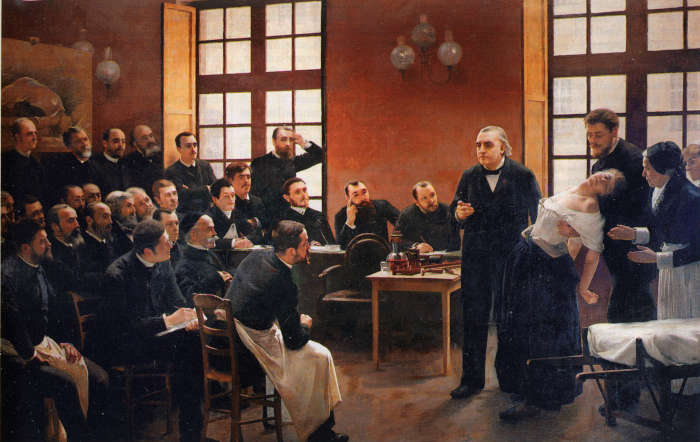
Fig. 1: André Brouillet (1857–1914): "A Clinical Lesson at the Salpêtrière," in French "Une leçon clinique à la Salpêtrière," 1887, oil on canvas, 290 × 430 cm, Paris, Musée d'Histoire de la Médecine. Image source: Wikimedia Commons (public domain).
Jean-Martin Charcot, the most famous neurologist of his time, presents to physicians and students at the Paris Salpêtrière a patient regarded as a hysteric: Blanche Wittmann, who was called the "queen of hysterics." She is caught by Charcot's assistant Joseph Babinski.
The man supporting the patient was later to overturn his master's doctrine. After Charcot's death, Babinski declared a large part of hysterical phenomena to be the work of suggestion: what arises through persuasion can also be removed through persuasion. Sigmund Freud, who had trained under Charcot in 1885–86, hung a lithograph of the painting in his consulting room and drew the opposite conclusion from hysteria: it arises from repressed memories that must be dug up. So in the consulting room of the founder of psychoanalysis hung the picture of the very man who would explain hysteria as a disease of beliefs.
The founding case of Freud's doctrine had been supplied by his older colleague Josef Breuer. Breuer's patient Bertha Pappenheim, who went down in history as "Anna O.," called the telling of her memories, in English, the "talking cure." In the Studies on Hysteria of 1895 she appears as cured.44 In fact, a few weeks after the end of treatment in June 1882, she was admitted to the Bellevue Sanatorium in Kreuzlingen, in the canton of Thurgau, where she stayed until the end of October, among other things because of a morphine addiction; the attempt at withdrawal failed. The psychiatric historian Henri Ellenberger discovered the case record from Kreuzlingen and published it in 1972;45 his colleague Albrecht Hirschmüller later evaluated the documents comprehensively.46 Bertha Pappenheim regained her health only years later, by paths of her own; she became an important social reformer. The history of psychoanalysis thus begins with a cure that was no cure.
Philadelphia, around 1960: A Psychoanalyst Tests His Theory
The turning point came from someone who wanted to prove psychoanalysis right. Aaron T. Beck, a psychiatrist in Philadelphia, had completed his psychoanalytic training and set out to substantiate one of its core assumptions: that depression is hostility turned inward. He examined the dreams of depressed patients and expected more hostility. He found less. Instead, the dreams, like the patients' conscious thoughts, dealt with loss, failure, and rejection.47 Beck did what Freud had avoided in 1937: he let his theory fail against the data. Out of this defeat, cognitive therapy was born. In 1977 the first controlled study showed that it helped depressed patients at least as well as an antidepressant, in at most twenty sessions over twelve weeks.48
Independently of Beck, the psychologist Albert Ellis in New York, likewise a former psychoanalyst, had arrived at the same result; his doctrine of irrational beliefs was described in the previous article.49 And in 1977 the psychologist Albert Bandura showed that the success of very different treatments hinges on the same variable: the patient's expectation of being able to cope with a situation, known as self-efficacy expectation.50
Bern, 1994: The Confirmation
Ninety years after Dubois, confirmation came from Bern once again. With his team at the University of Bern, the psychotherapy researcher Klaus Grawe reviewed the controlled studies then available and arrived at a result that has already been presented in detail in this journal:51 the cognitive-behavioral methods were by far the best supported. The subtitle of his book sums up the history of this section: "From Confession to Profession."52
At the margins of the profession, where thinking, as everyone knows, is freest, a few outsiders early on named what the guild did not like to hear. In 1986 the Hamburg science journalist Dieter E. Zimmer gave his reckoning with psychoanalysis the title Tiefenschwindel, "Depth Swindle."53 In 1994 the American psychologist Robyn Dawes showed that neither the training nor the professional experience of psychotherapists reliably predicts treatment success, and called his book House of Cards.54
Interim summary: The insight that disorders hinge on beliefs and can be improved through better beliefs has been gained several times: by Cicero, by Kant in his own case, by Dubois, by Babinski, by Adler, by Beck and Ellis. Just as often it was overlaid by a doctrine that declared the past and the relationship decisive and asserted its successes rather than testing them. Where testing was done - with Anna O., with the Wolf Man, in Beck's dream studies - the claim did not hold.
What Research Shows about Effectiveness and Duration
The findings so far show that thinking maintains mental disorders. Now to the practical question: does it help to correct thinking, and how long does that take? For what follows, three terms are needed. A randomized controlled trial assigns patients to different treatments by lot; because the lot takes no sides, differences in outcome can be attributed to the treatment. A meta-analysis statistically combines many such studies. And the effect size indicates how large a difference is, measured against the natural spread of the values; a value of 0.8 or more counts as large.
Most of the following studies examined cognitive therapy or cognitive behavioral therapy. Both target appraisals and expectations; cognitive behavioral therapy combines this with behavioral exercises. Cognitive psychotherapy, as I understand it, changes thinking alone and leaves it to the patient to practice the new behavior himself as a consequence of his new thinking; the difference is set out elsewhere.55 For the question of this article - correction of thinking or years of relationship work - both stand on the same side.
Anxiety and Panic
How short an effective treatment can be is already shown by the British health authority NICE, the National Institute for Health and Care Excellence, whose guidelines are heeded far beyond Great Britain. For panic disorder it recommends cognitive behavioral therapy totaling seven to fourteen hours, in weekly sessions, completed within a maximum of four months.56 For social anxiety disorder, a British study compared cognitive therapy with an exposure treatment combined with relaxation training; cognitive therapy was clearly superior.57 For obsessive-compulsive disorder, a cognitive treatment that targets beliefs - for instance, the belief that merely thinking of a misfortune makes it more likely - worked just as well in a Canadian study as the established exposure treatment.58
Obsessive-compulsive disorder is considered particularly stubborn. How short its treatment can nonetheless be is shown by a Norwegian method, the Bergen 4-day treatment: a concentrated exposure treatment on four consecutive days. Of 90 patients who had been on the waiting list of an Oslo university hospital, 72 percent were considered in remission after treatment, that is, their symptoms had largely subsided, and 68 percent three months later; no one dropped out.59 The study had no control group and comes from the developers of the method; it therefore does not prove that this treatment is superior to others. It does, however, refute the claim that such a disorder necessarily needs a long treatment. For that, a single black swan is enough.
Depression
Cognitive therapy works in moderate to severe depression, and its effect endures. In an American study, patients who had completed cognitive therapy relapsed less often in the following year (31 percent) than patients whose antidepressant had been replaced by a placebo (76 percent), and not more often than those who continued taking their medication (47 percent).60 What one has corrected in one's head, one takes along.
How improvement unfolds is just as revealing. In many patients it occurs not steadily but in sudden leaps from one session to the next. These leaps were preceded, in the session before, by measurable changes in thinking, and those who experienced such leaps also did better in the long run.61 That is exactly what the definition of the thinking error demands: the change in thinking predicts improvement. The second refutation condition - corrected thinking errors without improvement - is thus not met; the data show the opposite.
And the early disorder? A meta-analysis of 54 studies with 6,830 depressed patients, 62 percent of whom had had traumatic experiences in childhood, concluded in 2022: although the patients with childhood trauma began treatment with more severe symptoms, they benefited from psychotherapy and from medication similarly to the others.62 Childhood trauma did not render the usual treatment ineffective.
Trauma
For posttraumatic stress disorder, the group around Anke Ehlers compared cognitive therapy in two forms: spread over three months, and as an intensive treatment with about eighteen hours within seven days. Afterward, 73 percent of those treated intensively and 77 percent of those treated weekly were considered recovered. After an equally long supportive psychotherapy that relied on feelings and attentive care, the figure was 43 percent; on the waiting list, 7 percent.63 For the same duration, then, work on thinking did clearly better than work on feeling and relationship.
The pattern also holds for people whose posttraumatic stress disorder goes back to abuse in childhood - the classic early disorder. A Dutch study compared three forms of exposure treatment, including one preceded by a phase of "stabilization," as many consider indispensable. All three worked very strongly, with effect sizes above 1.6, that is, more than double what counts as large; the preceding stabilization brought no additional benefit.64 According to the theory of Edna Foa, who developed this form of exposure treatment, exposure, too, works through new information: it refutes the expectation that the memory is dangerous or unbearable.65
That a phase of stabilization before the actual trauma treatment is indispensable has not been demonstrated for so-called complex posttraumatic stress disorder either, which can arise after prolonged or repeated traumatization, for instance after ongoing abuse in childhood. In 2016, twenty-one trauma researchers, among them Patricia Resick and Edna Foa, examined the studies on which this demand rests. They found no methodologically rigorous research showing that adults with complex posttraumatic stress disorder need a preceding stabilization, that trauma-focused treatments pose unacceptable risks for them, or that they benefit more from such treatments when a stabilization phase precedes them. The current guidelines, they wrote, might therefore be overly cautious and risk depriving patients of effective treatments or offering them only after a delay.66
Nor does the relationship have to grow over years. This is shown by a Dutch intensive program for people with severe posttraumatic stress disorder. The 347 patients had experienced multiple traumas, three quarters of them sexual abuse; almost nine in ten also suffered from depression or another affective disorder, almost three quarters from suicidal thoughts. The program comprised eight treatment days with two sessions each, which turned directly to the traumatic memories: in the morning with an exposure treatment, in the afternoon with EMDR, another trauma-focused method, supplemented by physical activity and education about the disorder. There was no stabilization phase. And the psychotherapists rotated according to plan, so that each patient dealt with about twelve to sixteen different psychotherapists. After the eight treatment days, 83 percent showed a clinically significant improvement, 55 percent no longer met the criteria for the disorder, and only just over 2 percent had dropped out of treatment.67
Like the Norwegian study, this one had no control group, and it comes from the research department of the treatment center itself. It therefore does not prove that this particular program is superior to other treatments. For the question of this article it nonetheless suffices, for here modus tollens applies: if a severe trauma-related disorder could not be improved without a relationship with a single psychotherapist grown over years, this program would have had to fail. It did not fail.
Personality Disorders
In borderline personality disorder, which many regard as the earliest and most difficult of all disorders, dialectical behavior therapy is the best-studied method; it combines cognitive and behavioral elements with mindfulness exercises. A treatment of one year used to be standard. A Canadian study of 240 patients showed in 2022 that six months worked no worse than twelve; symptoms even declined faster.68
The assumption that personality disorders are lifelong does not withstand scrutiny either. In a ten-year follow-up study, 93 percent of borderline patients attained a phase of at least two years in which they no longer met the diagnostic criteria. Half achieved a comprehensive recovery, which also includes a viable social and occupational life.69 This second part is the more difficult one, and here the cognitive work is longer and more intensive than in panic disorder. But longer does not mean years of relationship work.
Long versus Short: The Comparisons
That leaves the third refutation condition: is long relationship psychotherapy superior in fair comparisons? The most revealing study comes from Copenhagen. Patients with bulimia, an eating disorder, received either two years of psychoanalytic psychotherapy with weekly sessions, about ninety in total, or five months of cognitive behavioral therapy with about twenty sessions. After five months, 42 percent of those treated cognitively were free of the typical symptoms, compared with 6 percent of those treated psychoanalytically. After two years, when the psychoanalytic treatment had also been completed, the figures stood at 44 versus 15 percent.70 It is remarkable who conducted the study: the psychoanalytic treatment had been developed by the two first authors themselves. The obvious objection that opponents of psychoanalysis had carried it out poorly therefore falls away.
A meta-analysis in which the Stanford research methodologist John Ioannidis also took part reviewed the controlled studies of long-term psychoanalytic psychotherapy in 2012. In recovery rates, it was not superior to other treatments; the authors called the evidence for its effectiveness "limited and at best conflicting." It was superior only to control treatments that were not tailored to the respective disorder, and possibly only because of the greater number of sessions.71
Even a study co-funded by psychoanalytic professional societies, the German LAC study of chronically depressed patients, found in the end no significant difference between psychoanalytic and cognitive-behavioral long-term treatment. Yet in the first year, those treated psychoanalytically had received an average of 80 sessions, those treated cognitive-behaviorally 33.72 Anyone who needs nearly two and a half times as many sessions to achieve the same result has proved not that depth works but that it costs more.
And the relationship itself? If the intensive relationship grown over years were the actual active ingredient, a treatment conducted largely over the internet - lessons, exercises, written feedback from a psychotherapist - would have to do markedly worse than a treatment in the consulting room. A meta-analysis of 31 head-to-head comparison studies found no difference in 2023.73 Once again modus tollens applies: the markedly worse performance one would have to expect if the intensive relationship were the actual active ingredient did not occur. Therefore the intensive relationship is not the actual active ingredient. Here, too, the street is dry.
The Relationship: Cause or Consequence of Improvement?
The most important evidence that advocates of relationship work invoke is an association. A meta-analysis of 295 studies with more than 30,000 patients, presented in 2018 by the psychotherapy researcher Christoph Flückiger at the University of Zurich with colleagues, found: the better the working relationship between patient and psychotherapist, the better, on average, the outcome. The correlation, a statistical measure of the strength of an association in which 0 means none and 1 a perfect association, was 0.28.74 From this it is readily concluded that the relationship is the actual active ingredient of psychotherapy. The conclusion skips two questions: how large the association is and in which direction it runs.
First, the size. A correlation of 0.28 means that the quality of the relationship statistically explains just under eight percent of the differences in treatment outcome, "explains" in the same sense as above with the assault victims. More than nine tenths of the differences it does not explain. Moreover, the association was just as strong in treatments over the internet as in the consulting room.74 A working relationship that is linked to success thus arises even where patient and psychotherapist hardly or never sit across from each other.
Second, the direction. An association does not say what is cause and what is effect. It may be that the good relationship brings about the improvement. It may just as well be that the improvement brings about the good relationship: anyone who notices that he is getting better appreciates the person who is helping him. If both are measured at the end of treatment, the two directions look the same. They can be told apart only by their temporal order, according to the same rule as in depression: whatever claims to be the cause must be there first.
That is precisely what the American psychologists Robert DeRubeis and Michael Feeley tested in 1990 in depressed patients receiving cognitive therapy. Early in treatment they measured two things: the quality of the relationship, and how consistently the psychotherapist applied concrete, symptom-focused methods of cognitive therapy. The quality of the relationship did not predict further improvement; the concrete cognitive methods did. Later in treatment the reverse direction appeared: the quality of the relationship could be predicted from the preceding improvement.75 A follow-up study of 60 patients confirmed the pattern in 2010: once again, the application of cognitive methods predicted improvement from session to session, while the relationship did not; rather, the relationship could be predicted from the preceding improvement.76 And after the sudden leaps in improvement mentioned above, the relationship also improved in the following session.61 In cognitive psychotherapy of depression, the good relationship followed improvement, not improvement the good relationship.
Not all studies arrive at this result. An analysis of the individual data of 5,350 patients from 17 studies in nine countries found in 2020, for the first seven sessions, both directions at once: a better relationship preceded fewer symptoms in the next session, and fewer symptoms preceded a better relationship. The authors around Flückiger speak of an upward spiral.77 This finding, too, speaks not for the necessity of years of relationship work but against it: the relationship that predicted success was already measurable in the first sessions, and it worked in interplay with improvement, not in its place.
Even where the relationship precedes improvement, it remains open whether it heals by itself or whether it enables the work that heals. A patient who trusts his psychotherapist voices what he fears and has it tested. And where the relationship itself changes something, for instance in a person convinced that no one can be relied on, it acts as evidence against this belief, that is, once again through thinking. The relationship is to psychotherapy what anesthesia is to surgery: indispensable, but not what removes the appendix. And no one concludes from this that anesthesia must last for years for the operation to succeed.
Schizophrenia and Bipolar Disorder
For the third group, the disorders with an organic component, expectations are more modest from the outset, and the data confirm this. A 2014 meta-analysis found only a small effect of cognitive behavioral therapy on the symptoms of schizophrenia themselves, and it was smaller still in methodologically more rigorous studies.78 That speaks not against the thesis but confirms its delimitation: against the organic side of the illness, thinking accomplishes little.
Self-regulation is a different matter. A study by Beck's group treated patients with schizophrenia who could hardly cope with everyday life for eighteen months with a cognitive therapy that targeted their defeatist beliefs, for instance the belief "If I try something, I'll fail anyway." Their overall level of functioning improved markedly more than under standard treatment alone, and lack of drive as well as delusions and hallucinations also declined.79 Such defeatist beliefs explain part of the lack of drive that was long attributed to the illness alone.80
In bipolar disorder, a comprehensive network meta-analysis of 39 studies with 3,863 patients showed in 2021 that psychoeducation reduces the number of relapses when those affected are not merely told how to deal with their illness but practice it: recognizing early warning signs, stabilizing their daily rhythm, acting in time. Cognitive restructuring, that is, the correction of thinking errors, proved to be an effective component.81 For individual psychodynamic psychotherapy in schizophrenia, by contrast, a review by the Cochrane Collaboration, the most important institution for systematic reviews in medicine, found no evidence of a positive effect.82
Interim summary: Effective cognitive treatments last weeks to months, not years. In personality disorders they last longer, but even there half a year worked no worse than a full one. In concentrated form, the majority of patients with obsessive-compulsive disorder improved markedly in four days; in severe posttraumatic stress disorder, this was achieved in eight treatment days, without preceding stabilization and with rotating psychotherapists. The change in thinking precedes improvement. For the same duration, cognitive psychotherapy did better than a supportive psychotherapy focused on feeling and relationship; long-term psychoanalytic psychotherapy was not superior in the comparisons; a treatment over the internet works as well as one in the consulting room. The association between relationship and success explains just under eight percent of the differences in outcome and does not identify the relationship as the active ingredient: in cognitive psychotherapy of depression, the good relationship followed improvement, and where it preceded improvement, it was already measurable in the first sessions. In schizophrenia and bipolar disorder, the picture is the one the thesis predicts: little effect on the illness itself, a marked effect on self-regulation. None of the three refutation conditions has been met.
Why the Myth of the Deep Disorder Persists
If the evidence is so clear, why does anyone write: "I need an in-depth, long psychotherapy"? Cognitive psychotherapy itself supplies the answer. The belief in the necessary length is a thinking error, and it persists for the same reasons as any other: because it is plausible, because it seems to confirm itself, and because no one tests it. Five mechanisms work together here.
What Takes Long Must Be Good
People like to judge the quality of a thing by how much work has gone into it. In experiments, participants rated the same poem and the same painting as better when they were told that its creator had worked on it longer.83 Psychologists call this the effort heuristic: a rule of thumb that mistakes effort for quality. Applied to psychotherapy, it reads: whoever was treated for years must have been treated thoroughly.
What One Has Paid For, One Values More
Added to this is what one has already invested in a thing. In a classic experiment, female students had to pass either an embarrassing or a harmless initiation test in order to join a discussion group. The subsequent discussion was deliberately boring. Those who had gone through the embarrassing test found it more interesting.84 Those who have suffered for something value it more, so that the suffering was not in vain. Related to this is the sunk cost fallacy: one continues a thing because one has already put so much into it, not because it is worthwhile.85 After three years and many thousands of francs, the thought that it could also have been done in three months is hard to accept. This applies to patients as much as to psychotherapists who have themselves invested years in their training.
The Metaphor of Depth
The third mechanism is linguistic in nature. We speak of deep problems and superficial solutions, and this spatial metaphor carries an unspoken judgment within it: below lies the true, above the illusory, and whoever wants to reach the true must dig for a long time. A metaphor, however, is not an argument. The name "depth psychology" therefore works like a seal of quality; who would want to be treated superficially? Cognitive psychotherapy has a harder time with its name. Thinking sounds like the head, and the head sits on top. Yet a thinking error that has dominated a person since childhood is exactly what the word "deep" ought to mean: that which carries everything else. The second letter writer at the beginning of this article found the depth the first was looking for, in five hours and in his own thinking.
When Every Slight Is Called Trauma
The fourth mechanism concerns the concepts themselves. The Australian psychologist Nick Haslam has described how psychology's concepts of harm and pathology have expanded over decades; he calls this "concept creep."86 The word trauma once denoted events such as war, torture, rape, or severe accidents. Today it is also used for rejection, slights, and difficult childhoods. Anyone who has learned to call his own childhood traumatic easily concludes that he needs a psychotherapy that works through his trauma, and a long one at that. This is no disparagement of real traumas, on the contrary: when every slight is called trauma, the word loses its force for those who have lived through something terrible.
Clysterium donare: The Same Answer to Every Question
The fifth mechanism is as old as the healing arts: the same answer to every question. Molière mocked it in 1673 in his last comedy, The Imaginary Invalid. At the end, the hypochondriac Argan is himself made a physician in a ceremony conducted in dog Latin. The examiners ask him what is to be done for dropsy, what for asthma and lung ailments, and each time Argan's answer is the same: "Clysterium donare, postea seignare, ensuitta purgare" — administer an enema, then bleed, then purge. Each time the chorus rejoices over the good answer.87 Molière played Argan himself. During the fourth performance he collapsed and died a few hours later.
The analogy is not entirely fair, for a long psychotherapy does no physical harm the way bloodletting does. Its principle, however, resembles that of the ceremony: panic, depression, compulsions, trauma, personality disorder, and each time the answer is: long, deep, relationship. An answer that fits every question answers none.
Even before the questions about dropsy and asthma, Argan had explained in the same ceremony why opium puts people to sleep: because it contains a "virtus dormitiva," a dormitive power whose nature it is to lull the senses to sleep. For this, too, the chorus rejoices.87 It is the circular argument from the section on logic, in dog Latin: the explanation merely repeats what it is supposed to explain. The two answers of the ceremony belong together. Whoever explains the persistence of a disorder by its early origin, which he has inferred from its persistence, knows no more about it afterward than before. And whoever knows nothing new about a disorder can do nothing specific against it; all that remains for him is the one-size-fits-all answer: long, deep, relationship.
The Dodo and the Thimble
That leaves a last rescue attempt, one that likes to invoke science. In 1936 the American psychologist Saul Rosenzweig asserted that all psychotherapies are ultimately equally effective because they share common factors, above all the relationship. As his motto he chose the Dodo's verdict from Alice in Wonderland: "Everybody has won, and all must have prizes."88 Since a much-cited review of 1975, the claim has been known as the "Dodo bird verdict."89 To this day it is cited whenever a method does poorly in comparisons.
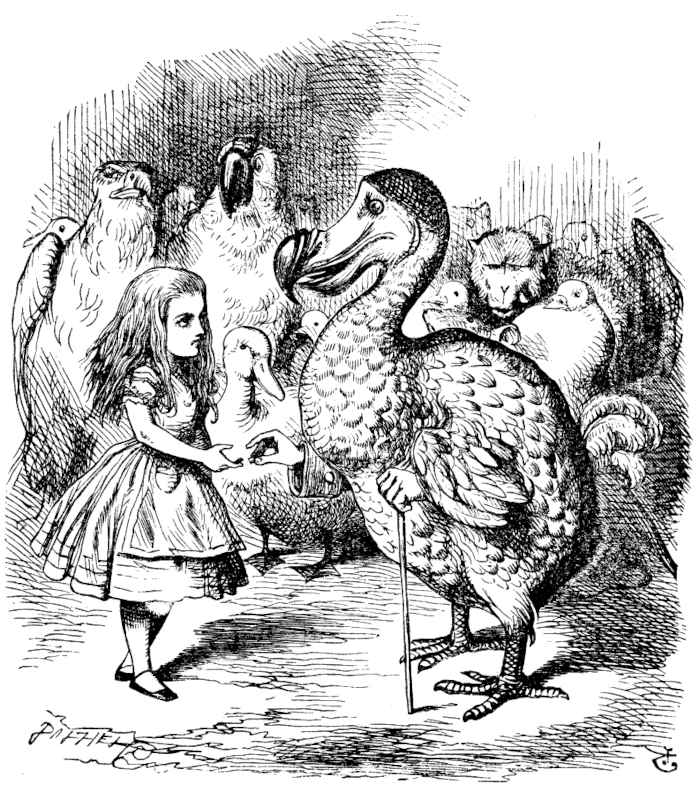
Fig. 2: John Tenniel (1820–1914): The Dodo presents Alice with the thimble, wood engraving after Tenniel's drawing, from: Lewis Carroll, "Alice's Adventures in Wonderland," London: Macmillan, 1865, chapter 3. Image source: Wikimedia Commons (public domain).
After a race without rules, without a start and without a finish - everyone begins and stops whenever he likes - the Dodo announces: "Everybody has won, and all must have prizes." Alice has to pay for the prizes out of her own pocket. When she, too, is to receive a prize, the Dodo asks what else she has in her pocket and solemnly presents her with the only thing left: her own thimble. In 1936 the American psychologist Saul Rosenzweig made the Dodo's verdict the motto of the claim that all psychotherapies are equally effective.
Anyone who invokes the Dodo to defend years of psychotherapy should read the chapter to the end. In the race without rules and without a finish, Alice pays for all the prizes herself and at the end is solemnly handed her own thimble (Fig. 2).90 The image is more precise than Rosenzweig could have suspected: in the race without a finish, the patient pays for all the prizes and in the end receives back what already belonged to him.
Above all, however, the verdict refutes long-term psychotherapy instead of supporting it. If all psychotherapies are equally effective, then the best is the one that finishes fastest and costs least. Whoever claims that all psychotherapies are equally effective has just proved that the shortest is the best. Incidentally, the dodo has been extinct since the seventeenth century, and the comparisons in this article, from London, Oxford, and Copenhagen, show that not all participants in the race deserve a prize.
That professional associations and societies champion the methods in which their members are trained is humanly understandable and irrelevant to the question of what works. How this plays out in Switzerland I have described elsewhere: in the case of a professional association91 and in the case of treatment figures.92
Interim summary: The myth of the necessary length persists not because of the evidence but because of five habits of thought. Effort counts as quality; what one has paid for and suffered for, one values more; the metaphor of depth takes the place of the argument; expanded concepts turn slights into traumas; and a one-size-fits-all answer seems to fit every question. The Dodo bird verdict, finally, when thought through to the end, recommends the shortest treatment.
What Is Not Being Claimed Here
A thesis is only as good as its limits. Hence what this article expressly does not claim.
First, it is not claimed that all suffering is a thinking error. Grief after a loss, fear in real danger, anger at injustice are appropriate reactions to real events, not disorders. A disorder begins where a reaction goes beyond what the situation justifies, or persists when the situation is long past.
Second, it is not claimed that everyone recovers in five hours. The duration depends on the disorder, on the number and interconnection of the thinking errors, and on the patient's cooperation; in personality disorders, the cognitive work is longer and more intensive. What is claimed is only that the duration depends on what has to be corrected, not on the age of the injury.
Third, it is not claimed that cognitive psychotherapy always helps. No method helps everyone. What is claimed is that every psychologically based disorder is accessible to it, not that every attempt at access succeeds.
Fourth, it is not claimed that the past is irrelevant. It is the piece of evidence from which the learning history of a thinking error can be reconstructed.
Fifth, it is not claimed that the relationship is meaningless. Without trust and cooperation, no psychotherapy succeeds. The relationship is merely the precondition of treatment, not its active ingredient.
Sixth, it is not claimed that those affected are to blame for their suffering. Thinking errors are learned, usually early and without choice. No one is to blame for the conclusions he drew as a child. But every adult can examine whether he wants to keep them, and no one can do this examining for him.
Seventh, it is not claimed that organically based disorders can be thought away or that medication is superfluous in them. In schizophrenia and bipolar disorder, medication is part of standard treatment; cognitive psychotherapy supplements it, it does not replace it. Whether cognitive psychotherapy is indicated in an individual case is clarified by a professional assessment, not by a journal article.
Back to the Two Letters
The first letter asked for an in-depth, long psychotherapy to work through traumas from childhood. One cannot reproach its sender. He believed what a doctrine more than a century old, a plausible metaphor, and a culture of working through, fostered by psychoanalytic and psychodynamic psychotherapy, had taught him. He did not think wrongly; others did his thinking for him, and they did it wrongly.
The second letter describes what depth actually means. Its writer did not dig for years. He found a thinking error that had dominated him so completely that he "could no longer freely decide," and he corrected it. What he feels in the process he calls "a slight euphoria that I have regained this freedom." It is not merely a symptom that has disappeared. It is a freedom that has returned.
"A psychotherapy is thorough not when it lasts long, but when it finds the error that causes the suffering. Deep is what goes to the root, not what digs the longest."
Two thousand years ago, Cicero demanded that we strive to become able to heal ourselves. The condition for this has remained the same: one must notice one's own thinking before one can examine it, and one must examine it before one can change it. A psychotherapist can show one both. One has to do it oneself. If you do not think for yourself, others will think for you — including about how long you must suffer.
Ancient and classical texts are cited by the standard passage reference that is identical across all editions (Cicero by book and section, Kant by the Academy edition, Molière by the interlude). Translations without a named translator are by the author.
1 Luchmann, D.: If You Do Not Think for Yourself, Others Will Think for You: How Your Own Thinking Helps Decide Your Happiness and Health. Psychotherapie, November 11, 2026.
2 Beck, A.T.: Cognitive Therapy and the Emotional Disorders. New York: International Universities Press, 1976.
3 Luchmann, D.: What is Cognitive Psychotherapy? Psychotherapie, July 22, 2026.
4 Wegner, D.M.; Schneider, D.J.; Carter, S.R.; White, T.L.: Paradoxical effects of thought suppression. Journal of Personality and Social Psychology, 1987, 53(1), 5-13.
5 Kihlstrom, J.F.: The cognitive unconscious. Science, 1987, 237(4821), 1445-1452.
6 Mitchell, C.J.; De Houwer, J.; Lovibond, P.F.: The propositional nature of human associative learning. Behavioral and Brain Sciences, 2009, 32(2), 183-198.
7 American Psychiatric Association: Diagnostic and Statistical Manual of Mental Disorders. 4th edition (DSM-IV). Washington, DC: American Psychiatric Association, 1994.
8 Goldapple, K.; Segal, Z.; Garson, C.; Lau, M.; Bieling, P.; Kennedy, S.; Mayberg, H.: Modulation of cortical-limbic pathways in major depression: Treatment-specific effects of cognitive behavior therapy. Archives of General Psychiatry, 2004, 61(1), 34-41.
9 Kant, I.: Der Streit der Facultäten. Königsberg: Friedrich Nicolovius, 1798, Part Three: Von der Macht des Gemüths durch den bloßen Vorsatz seiner krankhaften Gefühle Meister zu sein [Academy edition, vol. VII, p. 104].
10 Popper, K.R.: Logik der Forschung. Vienna: Julius Springer, 1935.
11 Albert, H.: Traktat über kritische Vernunft. Tübingen: J.C.B. Mohr (Paul Siebeck), 1968.
12 Freud, S.: Konstruktionen in der Analyse. Internationale Zeitschrift für Psychoanalyse, 1937, 23(4), 459-469 [Gesammelte Werke, vol. XVI, pp. 43-56].
13 Popper, K.R.: Conjectures and Refutations. The Growth of Scientific Knowledge. London: Routledge & Kegan Paul, 1963, p. 35. [In the original: "And with this new case, I suppose, your experience has become thousand-and-one-fold."]
14 Flew, A.: Thinking about Thinking. London: Fontana, 1975.
15 Kessler, R.C.; Sonnega, A.; Bromet, E.; Hughes, M.; Nelson, C.B.: Posttraumatic stress disorder in the National Comorbidity Survey. Archives of General Psychiatry, 1995, 52(12), 1048-1060.
16 Bonanno, G.A.: Loss, trauma, and human resilience: Have we underestimated the human capacity to thrive after extremely aversive events? American Psychologist, 2004, 59(1), 20-28.
17 Halligan, S.L.; Michael, T.; Clark, D.M.; Ehlers, A.: Posttraumatic stress disorder following assault: The role of cognitive processing, trauma memory, and appraisals. Journal of Consulting and Clinical Psychology, 2003, 71(3), 419-431.
18 Beierl, E.T.; Böllinghaus, I.; Clark, D.M.; Glucksman, E.; Ehlers, A.: Cognitive paths from trauma to posttraumatic stress disorder: A prospective study of Ehlers and Clark's model in survivors of assaults or road traffic collisions. Psychological Medicine, 2020, 50(13), 2172-2181.
19 Ehlers, A.; Mayou, R.A.; Bryant, B.: Psychological predictors of chronic posttraumatic stress disorder after motor vehicle accidents. Journal of Abnormal Psychology, 1998, 107(3), 508-519.
20 Alloy, L.B.; Abramson, L.Y.; Whitehouse, W.G.; Hogan, M.E.; Panzarella, C.; Rose, D.T.: Prospective incidence of first onsets and recurrences of depression in individuals at high and low cognitive risk for depression. Journal of Abnormal Psychology, 2006, 115(1), 145-156.
21 Beck, A.T.; Butler, A.C.; Brown, G.K.; Dahlsgaard, K.K.; Newman, C.F.; Beck, J.S.: Dysfunctional beliefs discriminate personality disorders. Behaviour Research and Therapy, 2001, 39(10), 1213-1225.
22 LeDoux, J.E.; Pine, D.S.: Using neuroscience to help understand fear and anxiety: A two-system framework. American Journal of Psychiatry, 2016, 173(11), 1083-1093.
23 Craske, M.G.; Treanor, M.; Conway, C.C.; Zbozinek, T.; Vervliet, B.: Maximizing exposure therapy: An inhibitory learning approach. Behaviour Research and Therapy, 2014, 58, 10-23.
24 MacLeod, C.; Rutherford, E.; Campbell, L.; Ebsworthy, G.; Holker, L.: Selective attention and emotional vulnerability: Assessing the causal basis of their association through the experimental manipulation of attentional bias. Journal of Abnormal Psychology, 2002, 111(1), 107-123.
25 van der Kolk, B.: The Body Keeps the Score. Brain, Mind, and Body in the Healing of Trauma. New York: Viking, 2014.
26 McNally, R.J.: Remembering Trauma. Cambridge, MA: Belknap Press of Harvard University Press, 2003.
27 Resick, P.A.; Galovski, T.E.; Uhlmansiek, M.O.; Scher, C.D.; Clum, G.A.; Young-Xu, Y.: A randomized clinical trial to dismantle components of cognitive processing therapy for posttraumatic stress disorder in female victims of interpersonal violence. Journal of Consulting and Clinical Psychology, 2008, 76(2), 243-258.
28 Resick, P.A.; Monson, C.M.; Chard, K.M.: Cognitive Processing Therapy for PTSD. A Comprehensive Manual. New York: Guilford Press, 2017.
29 Beck, J.S.: Cognitive Behavior Therapy. Basics and Beyond. 3rd edition. New York: Guilford Press, 2021.
30 Adler, A.: What Life Should Mean to You. Boston: Little, Brown and Company, 1931. [In the original: "We are self-determined by the meaning we give to our experiences."]
31 Mayou, R.A.; Ehlers, A.; Hobbs, M.: Psychological debriefing for road traffic accident victims: Three-year follow-up of a randomised controlled trial. British Journal of Psychiatry, 2000, 176(6), 589-593.
32 Lilienfeld, S.O.: Psychological treatments that cause harm. Perspectives on Psychological Science, 2007, 2(1), 53-70.
33 Holmes, D.S.: The evidence for repression: An examination of sixty years of research. In: Singer, J.L. (ed.): Repression and Dissociation. Chicago: University of Chicago Press, 1990.
34 Sonuga-Barke, E.J.S.; Kennedy, M.; Kumsta, R.; Knights, N.; Golm, D.; Rutter, M.; et al.: Child-to-adult neurodevelopmental and mental health trajectories after early life deprivation: the young adult follow-up of the longitudinal English and Romanian Adoptees study. The Lancet, 2017, 389(10078), 1539-1548.
35 Kagan, J.: Three Seductive Ideas. Cambridge, MA: Harvard University Press, 1998.
36 Bowlby, J.: Attachment and Loss. Vol. 2: Separation. Anxiety and Anger. London: Hogarth Press, 1973, p. 203. [In the original: "…in the working model of the self that anyone builds a key feature is his notion of how acceptable or unacceptable he himself is in the eyes of his attachment figures."]
37 Cicero, M.T.: Tusculan Disputations (Tusculanae disputationes) 3.6. [In the original: "Est profecto animi medicina, philosophia; cuius auxilium non ut in corporis morbis petendum est foris, omnibusque opibus viribus, ut nosmet ipsi nobis mederi possimus, elaborandum est."]
38 Dubois, P.: Les psychonévroses et leur traitement moral. Leçons faites à l'Université de Berne. Paris: Masson, 1904 [German edition: Die Psychoneurosen und ihre psychische Behandlung. Vorlesungen gehalten an der Universität Bern. Bern: A. Francke, 1905].
39 Amrein, J.: "Auf vertrautes Reden mit dem Kranken kommt es an". Psychiatrie & Neurologie, 2006, 1, 53-55.
40 Müller, C.: "Sie müssen an Ihre Heilung glauben!" Paul Dubois (1848-1918), ein vergessener Pionier der Psychotherapie. Basel: Schwabe, 2001.
41 Obholzer, K.: Gespräche mit dem Wolfsmann. Eine Psychoanalyse und die Folgen. Reinbek bei Hamburg: Rowohlt, 1980.
42 Freud, S.: Zur Geschichte der psychoanalytischen Bewegung. Jahrbuch der Psychoanalyse, 1914, 6, 207-260 [Gesammelte Werke, vol. X, pp. 43-113].
43 Babinski, J.: Définition de l'hystérie. Revue neurologique, 1901, 9, 1074-1080.
44 Breuer, J.; Freud, S.: Studien über Hysterie. Leipzig, Vienna: Franz Deuticke, 1895.
45 Ellenberger, H.F.: The story of "Anna O.": A critical review with new data. Journal of the History of the Behavioral Sciences, 1972, 8(3), 267-279.
46 Hirschmüller, A.: Physiologie und Psychoanalyse in Leben und Werk Josef Breuers. Bern: Hans Huber, 1978.
47 Beck, A.T.: How an anomalous finding led to a new system of psychotherapy. Nature Medicine, 2006, 12(10), 1139-1141.
48 Rush, A.J.; Beck, A.T.; Kovacs, M.; Hollon, S.: Comparative efficacy of cognitive therapy and pharmacotherapy in the treatment of depressed outpatients. Cognitive Therapy and Research, 1977, 1(1), 17-37.
49 Ellis, A.: Reason and Emotion in Psychotherapy. New York: Lyle Stuart, 1962.
50 Bandura, A.: Self-efficacy: Toward a unifying theory of behavioral change. Psychological Review, 1977, 84(2), 191-215.
51 Dr. Dietmar Luchmann, LLC: Klaus Grawe: Cognitive Psychotherapy Is 'Highly Significantly More Effective' than Person-Centered Psychotherapy and Psychoanalysis. Psychotherapie, February 16, 2026.
52 Grawe, K.; Donati, R.; Bernauer, F.: Psychotherapie im Wandel. Von der Konfession zur Profession. Göttingen: Hogrefe, 1994.
53 Zimmer, D.E.: Tiefenschwindel. Die endlose und die beendbare Psychoanalyse. Reinbek bei Hamburg: Rowohlt, 1986.
54 Dawes, R.M.: House of Cards. Psychology and Psychotherapy Built on Myth. New York: Free Press, 1994.
55 Luchmann, D.: Cognitive Behavioral Therapy and Cognitive Psychotherapy — The Difference. Psychotherapie, June 4, 2026.
56 National Institute for Health and Care Excellence (NICE): Generalised anxiety disorder and panic disorder in adults: management. Clinical guideline CG113. London: NICE, 2011. [Recommendation for panic disorder: cognitive behavioral therapy totaling seven to fourteen hours, weekly sessions of one to two hours, completed within a maximum of four months.]
57 Clark, D.M.; Ehlers, A.; Hackmann, A.; McManus, F.; Fennell, M.; Grey, N.; Waddington, L.; Wild, J.: Cognitive therapy versus exposure and applied relaxation in social phobia: A randomized controlled trial. Journal of Consulting and Clinical Psychology, 2006, 74(3), 568-578.
58 Whittal, M.L.; Thordarson, D.S.; McLean, P.D.: Treatment of obsessive-compulsive disorder: Cognitive behavior therapy vs. exposure and response prevention. Behaviour Research and Therapy, 2005, 43(12), 1559-1576.
59 Kvale, G.; Hansen, B.; Björgvinsson, T.; Børtveit, T.; Hagen, K.; Haseth, S.; et al.: Successfully treating 90 patients with obsessive compulsive disorder in eight days: The Bergen 4-day treatment. BMC Psychiatry, 2018, 18(1), 323.
60 Hollon, S.D.; DeRubeis, R.J.; Shelton, R.C.; et al.: Prevention of relapse following cognitive therapy vs medications in moderate to severe depression. Archives of General Psychiatry, 2005, 62(4), 417-422.
61 Tang, T.Z.; DeRubeis, R.J.: Sudden gains and critical sessions in cognitive-behavioral therapy for depression. Journal of Consulting and Clinical Psychology, 1999, 67(6), 894-904.
62 Kuzminskaite, E.; Gathier, A.W.; Cuijpers, P.; Penninx, B.W.J.H.; et al.: Treatment efficacy and effectiveness in adults with major depressive disorder and childhood trauma history: A systematic review and meta-analysis. Lancet Psychiatry, 2022, 9(11), 860-873.
63 Ehlers, A.; Hackmann, A.; Grey, N.; Wild, J.; Liness, S.; Albert, I.; Deale, A.; Stott, R.; Clark, D.M.: A randomized controlled trial of 7-day intensive and standard weekly cognitive therapy for PTSD and emotion-focused supportive therapy. American Journal of Psychiatry, 2014, 171(3), 294-304.
64 Oprel, D.A.C.; Hoeboer, C.M.; Schoorl, M.; de Kleine, R.A.; Cloitre, M.; Wigard, I.G.; van Minnen, A.; van der Does, W.: Effect of Prolonged Exposure, intensified Prolonged Exposure and STAIR+Prolonged Exposure in patients with PTSD related to childhood abuse: A randomized controlled trial. European Journal of Psychotraumatology, 2021, 12(1), 1851511.
65 Foa, E.B.; Kozak, M.J.: Emotional processing of fear: Exposure to corrective information. Psychological Bulletin, 1986, 99(1), 20-35.
66 De Jongh, A.; Resick, P.A.; Zoellner, L.A.; van Minnen, A.; Lee, C.W.; Monson, C.M.; Foa, E.B.; et al.: Critical analysis of the current treatment guidelines for complex PTSD in adults. Depression and Anxiety, 2016, 33(5), 359-369.
67 Van Woudenberg, C.; Voorendonk, E.M.; Bongaerts, H.; Zoet, H.A.; Verhagen, M.; Lee, C.W.; van Minnen, A.; De Jongh, A.: Effectiveness of an intensive treatment programme combining prolonged exposure and eye movement desensitization and reprocessing for severe post-traumatic stress disorder. European Journal of Psychotraumatology, 2018, 9(1), 1487225.
68 McMain, S.F.; Chapman, A.L.; Kuo, J.R.; Dixon-Gordon, K.L.; Guimond, T.H.; Labrish, C.; Isaranuwatchai, W.; Streiner, D.L.: The effectiveness of 6 versus 12 months of dialectical behavior therapy for borderline personality disorder: The Feasibility of a Shorter Treatment and Evaluating Responses (FASTER) trial. Psychotherapy and Psychosomatics, 2022, 91(6), 382-397.
69 Zanarini, M.C.; Frankenburg, F.R.; Reich, D.B.; Fitzmaurice, G.: Time to attainment of recovery from borderline personality disorder and stability of recovery: A 10-year prospective follow-up study. American Journal of Psychiatry, 2010, 167(6), 663-667.
70 Poulsen, S.; Lunn, S.; Daniel, S.I.F.; Folke, S.; Mathiesen, B.B.; Katznelson, H.; Fairburn, C.G.: A randomized controlled trial of psychoanalytic psychotherapy or cognitive-behavioral therapy for bulimia nervosa. American Journal of Psychiatry, 2014, 171(1), 109-116.
71 Smit, Y.; Huibers, M.J.H.; Ioannidis, J.P.A.; van Dyck, R.; van Tilburg, W.; Arntz, A.: The effectiveness of long-term psychoanalytic psychotherapy - A meta-analysis of randomized controlled trials. Clinical Psychology Review, 2012, 32(2), 81-92. [In the original: "limited and at best conflicting"]
72 Leuzinger-Bohleber, M.; Hautzinger, M.; Fiedler, G.; et al.: Outcome of psychoanalytic and cognitive-behavioural long-term therapy with chronically depressed patients: A controlled trial with preferential and randomized allocation. Canadian Journal of Psychiatry, 2019, 64(1), 47-58.
73 Hedman-Lagerlöf, E.; Carlbring, P.; Svärdman, F.; Riper, H.; Cuijpers, P.; Andersson, G.: Therapist-supported Internet-based cognitive behaviour therapy yields similar effects as face-to-face therapy for psychiatric and somatic disorders: An updated systematic review and meta-analysis. World Psychiatry, 2023, 22(2), 305-314.
74 Flückiger, C.; Del Re, A.C.; Wampold, B.E.; Horvath, A.O.: The alliance in adult psychotherapy: A meta-analytic synthesis. Psychotherapy, 2018, 55(4), 316-340.
75 DeRubeis, R.J.; Feeley, M.: Determinants of change in cognitive therapy for depression. Cognitive Therapy and Research, 1990, 14(5), 469-482.
76 Strunk, D.R.; Brotman, M.A.; DeRubeis, R.J.: The process of change in cognitive therapy for depression: Predictors of early inter-session symptom gains. Behaviour Research and Therapy, 2010, 48(7), 599-606.
77 Flückiger, C.; Rubel, J.A.; Del Re, A.C.; Horvath, A.O.; Wampold, B.E.; Crits-Christoph, P.; et al.: The reciprocal relationship between alliance and early treatment symptoms: A two-stage individual participant data meta-analysis. Journal of Consulting and Clinical Psychology, 2020, 88(9), 829-843.
78 Jauhar, S.; McKenna, P.J.; Radua, J.; Fung, E.; Salvador, R.; Laws, K.R.: Cognitive-behavioural therapy for the symptoms of schizophrenia: Systematic review and meta-analysis with examination of potential bias. British Journal of Psychiatry, 2014, 204(1), 20-29.
79 Grant, P.M.; Huh, G.A.; Perivoliotis, D.; Stolar, N.M.; Beck, A.T.: Randomized trial to evaluate the efficacy of cognitive therapy for low-functioning patients with schizophrenia. Archives of General Psychiatry, 2012, 69(2), 121-127.
80 Grant, P.M.; Beck, A.T.: Defeatist beliefs as a mediator of cognitive impairment, negative symptoms, and functioning in schizophrenia. Schizophrenia Bulletin, 2009, 35(4), 798-806.
81 Miklowitz, D.J.; Efthimiou, O.; Furukawa, T.A.; Scott, J.; McLaren, R.; Geddes, J.R.; Cipriani, A.: Adjunctive psychotherapy for bipolar disorder: A systematic review and component network meta-analysis. JAMA Psychiatry, 2021, 78(2), 141-150.
82 Malmberg, L.; Fenton, M.: Individual psychodynamic psychotherapy and psychoanalysis for schizophrenia and severe mental illness. Cochrane Database of Systematic Reviews, 2001, (3), CD001360.
83 Kruger, J.; Wirtz, D.; Van Boven, L.; Altermatt, T.W.: The effort heuristic. Journal of Experimental Social Psychology, 2004, 40(1), 91-98.
84 Aronson, E.; Mills, J.: The effect of severity of initiation on liking for a group. Journal of Abnormal and Social Psychology, 1959, 59(2), 177-181.
85 Arkes, H.R.; Blumer, C.: The psychology of sunk cost. Organizational Behavior and Human Decision Processes, 1985, 35(1), 124-140.
86 Haslam, N.: Concept creep: Psychology's expanding concepts of harm and pathology. Psychological Inquiry, 2016, 27(1), 1-17.
87 Molière: Le Malade imaginaire. Comédie mêlée de musique et de danses. First performed in Paris, Théâtre du Palais-Royal, February 10, 1673, Troisième intermède. [In the original: "Clysterium donare, / Postea seignare, / Ensuitta purgare." and "Quia est in eo / Virtus dormitiva, / Cujus est natura / Sensus assoupire."]
88 Rosenzweig, S.: Some implicit common factors in diverse methods of psychotherapy. American Journal of Orthopsychiatry, 1936, 6(3), 412-415.
89 Luborsky, L.; Singer, B.; Luborsky, L.: Comparative studies of psychotherapies: Is it true that "everyone has won and all must have prizes"? Archives of General Psychiatry, 1975, 32(8), 995-1008.
90 Carroll, L.: Alice's Adventures in Wonderland. London: Macmillan, 1865, chapter 3 ("A Caucus-Race and a Long Tale"). [In the original: "Everybody has won, and all must have prizes."]
91 Luchmann, D.: Cognitive Warfare by the Association of Swiss Psychotherapists (ASP). Psychotherapie, March 16, 2026.
92 Luchmann, D.: Psychotherapy Inflation: We Have Not Grown Sicker, We Only Think We Need Treatment. Psychotherapie, September 2, 2026.
Your Comment
Are you interested in contacting the author? Do you have remarks, suggestions, or additions regarding this article? Do you have personal therapy experiences? We welcome substantial feedback.