I. The Paradox: "Psychotherapy Breeds Its Own Patients"
Look at the present, and a strange picture forces itself upon you: never before has there been such a density of psychotherapists, counseling centers, and promises of mental salvation — and never before has society been considered so psychologically fragile. Waiting lists are long, diagnoses are on the rise, and sick leave for mental disorders reaches new highs year after year. The orthodox reading attributes this to heightened sensitivity and a commendable breaking of taboos: the suffering was always there; now, at last, it is being seen and treated.
This reading has one small flaw: if it were true, mass treatment would gradually reduce mass suffering. That is precisely what cannot be observed. A research group led by Anthony Jorm, writing in the journal of the World Psychiatric Association - about as unimpeachable a venue as one could ask for - examined whether the massively expanded treatment capacity in Australia, Canada, England, and the United States had lowered the prevalence - the technical term for how common a disorder is in the population - of depression and anxiety disorders. The result: it had not.1 More treatment, the same amount of suffering or more. In any other industry, this would be called product liability. In psychotherapy, it is called a care gap, and the response is a call for more practice licenses funded by statutory health insurance. A fire department that reported more fires with every additional engine company would be investigated; psychotherapy is granted the next engine company.
Confirmation for Germany has since come from, of all places, the house organ of therapy culture. Under the remarkable title "Die Psychotherapie gebiert ihre Patienten" ("Psychotherapy Breeds Its Own Patients"), the science journalist Jochen Paulus took stock of the situation in early 2025 in the German magazine "Psychologie Heute": 39,000 psychotherapists in private practice - almost as many as family doctors - one and a half million treatments per quarter, and an increase in treatment numbers of a good nine percent between 2019 and 2022 alone. Prevalence, however, has held steady at around 30 percent for a decade; in the Netherlands, it apparently even rose despite the expansion of treatment.2 Ulrich Voderholzer, professor of psychiatry and medical director of the Schön Klinik Roseneck, spelled out the size of the gap at the Berlin psychiatry congress: in medicine, the rule is that "you apply more treatment and then expect the frequency of the disease in question to go down" — just as the treatment of high blood pressure has also reduced heart attacks and strokes. With mental disorders, by contrast, one arrives "at the somewhat bitter realization": there is no decline.2
The usual excuse - that the sick never reach treatment in the first place - was disposed of by the same magazine in passing: according to a survey of 2,200 patients presented in 2024, 90 percent received an initial consultation within three months, and 96 percent of those who then wanted regular appointments got them within a further three months.2 Access works; the cure fails to materialize. How far it fails is quantified by the leading psychotherapy researcher Pim Cuijpers after evaluating the depression studies: without treatment, 45 percent of patients are better after a while; with treatment, 60 percent — and before the 40 percent whom no treatment helps, research capitulates in so many words: "We try everything, but nothing helps."2 On September 2, 2026, this journal analyzed in detail, in the article Psychotherapy Inflation: We Have Not Grown Sicker, We Only Think We Need Treatment, what this treatment-prevalence paradox means for a society that pays more every year into a system that demonstrably fails to reduce the burden of disease.3
It takes a certain intellectual independence - and probably decades of professional experience in precisely this field - to name the elephant in the consulting room: the profession of psychotherapist, as it is institutionalized, standardized, and mass-produced today, is structurally incapable of delivering what it promises. It is, in the precise sense of the word, an impossible profession. This is not a new insight. It comes from the founding father himself.
II. Freud's Confession
Sigmund Freud, who can be accused of many things but not of lacking self-criticism in his brighter moments, wrote in 1937, two years before his death, that it "almost looks as if analyzing were the third of those 'impossible' professions in which one can be certain of insufficient success from the outset. The other two, known far longer, are educating and governing."4 One might take this for the mildness of old age, or for exhaustion. It was neither: Freud had already formulated the same thought in 1925, in his foreword to August Aichhorn's "Wayward Youth."5 For twelve years, the founder of modern psychotherapy held to the conviction that his own profession was one of the impossible ones. His heirs have drawn the obvious conclusion: they stopped talking about it.
What Freud did not say outright, but implied, is the reason for the impossibility. The psychotherapist is not the surgeon who cuts into another person's body with sterile instruments. He is the instrument himself. And this instrument is - the evidence follows - blunt, with rare exceptions.
III. The Learnability Fallacy
The system's fundamental design flaw lies in a category mistake: the confusion of knowledge with wisdom. The system suggests that young people who come straight out of the sheltered space of the university will mature into experts on the deepest abysses of human existence by memorizing classification catalogs and sitting through theory-driven hours of so-called self-experience, the personal therapy required of trainees. The premise is: whatever a psychotherapist needs can be taught, tested, and certified.
The absurdity of this expectation is as old as its proverbial name. When the Nuremberg Baroque poet Georg Philipp Harsdörffer published his textbook "Poetischer Trichter" ("Poetic Funnel") in 1647, promising "to pour in the German art of poetry and rhyme, without the aid of the Latin language, in VI hours," he unwittingly gave the German language its mocking image of every educational illusion: the Nuremberg Funnel.6 For nearly four centuries, people laughed at the notion that skill could be poured in like soup. Then came accredited degree programs that dispense life wisdom in 45-minute modules, complete with mandatory attendance, proof of performance, and an official stamp — and the laughter fell silent, because the joke had become a licensing requirement.
That wisdom cannot be funneled into anyone is no romantic assertion, but one of philosophy's oldest tested findings. In Plato's dialogue "Meno," Socrates poses the simple test question: if virtue - meaning competence at living, practical wisdom - could be taught, where are its teachers? Themistocles and Pericles, the most excellent men of Athens, had their sons instructed in everything that can be taught: riding, wrestling, music. Their own excellence, however, they could not pass on — not even to their own children, whom they cared about more than any training institute cares about its paying candidates.7 Anyone who believes today that an accredited curriculum can achieve what Pericles failed to achieve with his own sons would at least have to explain what has changed in human beings over two and a half millennia. That explanation is still outstanding.
Immanuel Kant explained why this is so more precisely than any modern research on training. Rules, Kant argued in the "Critique of Pure Reason," can be taught — and manuals, classification catalogs, and conversational techniques are nothing other than rules. Judgment, however, the faculty of recognizing whether the concrete case falls under the learned rule at all, is "a special talent that cannot be taught at all, but only practiced." And in what is probably the book's most consequential footnote: "Lack of judgment is actually what is called stupidity, and for such an infirmity there is no remedy at all."8 This is exactly where the design flaw of psychotherapy training lies exposed: it teaches rules, tests rules, and certifies rules — and then releases its graduates into a profession that consists of judgment in every single minute. The Nuremberg Funnel pours reliably; whether the vessel has a bottom is never checked.
The psychologist and Nobel laureate Daniel Kahneman supplied the empirical material on which the premise of learnability shatters completely. In "Thinking, Fast and Slow," he reports an experiment by the social psychologists Nisbett and Borgida: students who were presented with a surprising statistical fact about human behavior - the sobering results of the famous helping experiment - learned simply nothing from it; their predictions about the behavior of individual people remained as rosy as before, as if they had never seen the numbers.9,10 The knowledge was there; it did not change the thinking. Kahneman himself drew the even more uncomfortable conclusion and conceded that, after four decades of research on cognitive biases, his own intuitive thinking had remained susceptible to those very biases.9 Let that sink in: the most important cognitive psychologist of his generation attests that a lifetime of research at the center of the discipline did not reliably repair his everyday thinking.
But if studying thinking does not change thinking - and thinking is the psychotherapist's primary tool - what exactly do the training institutes produce? The answer is obvious: people who have learned a vocabulary but not the ability to think with it. Craftsmen who can name their tools but cannot saw. In an emergency, the person trained in this way takes refuge in what he actually learned: his manual, the standardized treatment handbook. He checks off its modules as if he were servicing a midsize car — the absurd attempt to calibrate a defective inner compass with an academic yardstick.
Ludwig Wittgenstein dissected the state of the discipline in a sentence that no curriculum quotes: "The confusion and barrenness of psychology is not to be explained by its being a 'young science'" — in psychology, he found, "experimental methods and conceptual confusion" exist side by side.11 This is not a marginal note by an outsider. It is a structural critique: a discipline that has not clarified its basic concepts can accumulate as many methods as it likes — it measures with precision in the fog.
IV. The Recruitment Question
This design problem is compounded by a second one that the psychotherapists' guild avoids even more carefully: the question of whom this profession attracts. Eva Jaeggi, a behavior therapist, psychoanalyst, and from 1978 to 2000 holder of the chair of clinical psychology at the Technical University of Berlin, asked it — tellingly, only once she was safely retired. Her book "Und wer therapiert die Therapeuten?" ("And Who Treats the Therapists?") concludes that the choice of this profession is decided less by aptitude than by inclination: the profession attracts people who seek, in professional helping, a solution to their own suffering.12 This makes psychotherapy training probably the only vocational training that brings its own demand along with it: its first patients are the trainees themselves, and they generally pay for the mandatory personal therapy out of their own pockets. As early as 1977, Wolfgang Schmidbauer coined the term for this constellation that has since become part of the standard inventory, without anyone drawing the consequences: the helpless helpers.13
Just how helpless they are, Jaeggi quantified two years later, in a professional journal of her own guild, with data that one has to read twice:
"Mental illnesses among therapists are numerous. The figures vary, but overall they are rather depressing: 73% anxiety disorders, 58% depression, 82% serious personal problems, 11% addicts; the suicide rate is estimated to be higher than average."
Eva Jaeggi Die Angst des Therapeuten vor sich selbst. Psychotherapie in Psychiatrie, Psychotherapeutischer Medizin und Klinischer Psychologie, 2003, p. 195.14
The lived consequence of this inner condition can also be read from the outside: according to Guy, the divorce rate among American psychotherapists stood at 40 percent, far exceeding that of the general population.15 This journal has addressed the professional-law dimension of these figures elsewhere16; what matters here is the logical one.
For here the circle closes back to Kahneman. His finding - knowledge about thinking does not change thinking - was one of cognitive psychology. Jaeggi's figures deliver the same finding epidemiologically: people who, after studying medicine or psychology, have gone through several years of psychotherapy training, including personal therapy, carry anxiety disorders, depression, and serious personal problems around with them on a scale that would make any prevention brochure blush. The training that is supposed to heal the sick does not even heal its trainees — and under ideal conditions at that: maximum motivation, maximum expertise, years of supervision. The question thus becomes unavoidable: what good is a training that does not enable its own graduates to overcome their own problems? And what reason is there to assume that the same program will achieve in the patient what it demonstrably fails to achieve in the practitioner?
How this inner condition steers treatment practice has since been measured. Exposure treatment, which behavior therapy itself regards as its centerpiece for anxiety and obsessive-compulsive disorders, hardly takes place in private practice: the anxiety researcher Jürgen Margraf puts its share at a "low single-digit percentage" — yet behavior therapy, of which it is supposed to be a part, is what gets billed in half of all cases.2 Why? Andre Pittig surveyed 684 practitioners: a good third said exposure treatments were too strenuous — not for the patients, but for themselves; at first, the psychotherapists' stress hormones rise as sharply as those of the people they treat.17 With this, Jaeggi's figures cease to be mere statistics: the anxiety sufferers among the practitioners avoid the method of their own school because they cannot tolerate their own arousal — they practice exactly the avoidance behavior they are paid to remedy. The patient pays for his practitioner's untreated anxiety with his own.
The archetype of the wounded healer may have had its dignity in premodern cultures. In mass production, it degenerates into an institutionalized neurosis: one hides one's own unresolved drama behind a license to practice. Whether this happens out of naivety, helper syndrome, or narcissistic self-exaltation makes no difference to the patient in the end.
V. Diagnosis as a Social Verdict
What happens when such a system meets people seeking help? It does what it has learned: it diagnoses. The psychiatrist Thomas Szasz - the fundamental critique came from inside the field, not from outside - argued as early as 1961 that much of what is treated as mental illness would be more accurately described as "problems in living": difficulties in the conduct of life, translated into a medical vocabulary.18 This translation is not a neutral act. It turns moral and philosophical crises of life into clinical findings — and citizens into patients.
That the line between sick and healthy is drawn less by scientific finding than by cultural consensus has been meticulously documented by the psychologist Paula Caplan: the Diagnostic and Statistical Manual of Mental Disorders came into being, to a large extent, through votes among psychiatrists, not through discovery.19 Homosexuality was struck from the catalog by vote in 1973; premenstrual dysphoric disorder first moved into the research appendix of the DSM-IV in 1994 and was promoted to a full diagnosis in 2013. What counts as mental illness is negotiated like rules of procedure — with the difference that, in the end, human beings wear the label.
The structure that results was described by the systems theorist Gregory Bateson with the concept of the double bind: contradictory messages at different levels, from which there is no way out within the system.20 The therapeutic relationship produces this structure with remarkable reliability: I will help you become free — but whether you are free is for me to decide. Doubt about the method counts as resistance, criticism as defensiveness, breaking off treatment as proof of the need for treatment. Whoever doubts merely demonstrates how urgently he needs the treatment. An explanatory system of this design is closed; it cannot lose.
What this feels like from the inside was described by a reader of this journal in a comment on my article Switzerland as a Paradise of Psychotherapeutic Inefficiency21 — a single case that proves nothing but illustrates what research on iatrogenic harm, that is, harm caused by the treatment itself, describes systematically22:
"For over 20 years I had gone to therapy, and in the end I was sicker than at the start. One tentative diagnosis after another, personality traits pathologized, 'deficits' here and 'traumas' there. You are downright conditioned into a victim full of incapacity. What finally freed me was shifting my focus away from what is problematic and toward what works. [...] I feel like a former cult member."
Comment on Switzerland as a Paradise of Psychotherapeutic Inefficiency21 on its republication on Inside Paradeplatz on August 18, 2025.
A former cult member. The metaphor hits home — James Hillman and Michael Ventura described as early as 1992 how therapy culture turns people away from the world and endlessly inward: a hundred years of psychotherapy, and the world is getting worse.23
Anyone who thinks this double bind is a rhetorical exaggeration can by now inspect it, dated and signed — in a case openly declared here to be the author's own, so that the reader can take the author's bias into account. When this journal raised the outcome question (more on this in the next chapter), the Association of Swiss Psychotherapists (ASP) responded not with efficacy data but with an association complaint to the supervisory authorities, in which its president, Gabriela Rüttimann, made a remarkable confession: "In particular, we are disturbed [...] that anxiety disorders could be cured in as little as eight to ten hours, or that a life is fully worth living again after a few hours of therapy."16 Read that sentence twice: a professional association of the healing arts declares in writing that healing disturbs it. The Health Directorate of the Canton of Zurich adopted this disturbance as its own and informed the critic in a letter dated October 22, 2025, that it considered reports "that a life is fully worth living again after a few therapy sessions [...]" to be "[...] misleading and therefore impermissible."16
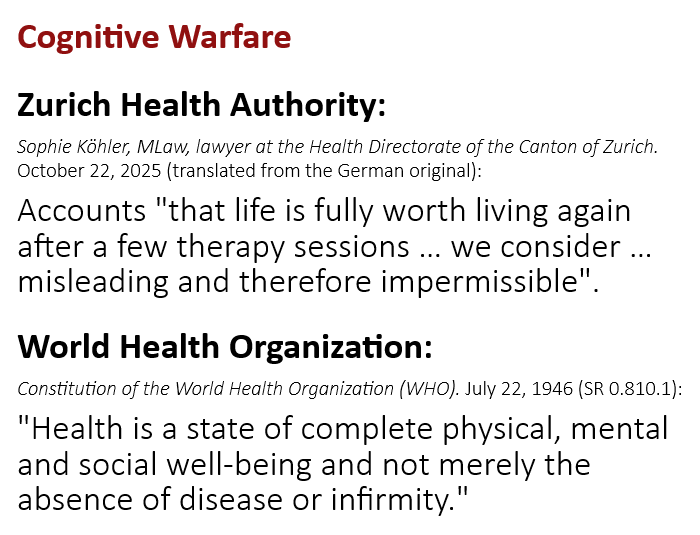
Fig. 1:
The Health Directorate of the Canton of Zurich, headed by Natalie Rickli, a member of the cantonal government from the Swiss People's Party (SVP), objects to the description of a treatment success that corresponds to the World Health Organization's (WHO) concept of health. At the instigation of Gabriela Rüttimann, president of the Association of Swiss Psychotherapists (ASP), it classified reports "that a life is fully worth living again after a few therapy sessions" as "misleading and therefore impermissible" on October 22, 2025. The WHO is a specialized agency of the United Nations headquartered in Geneva. Its Constitution of July 22, 1946, is binding on Switzerland as an international treaty and is published in the Classified Compilation of Federal Legislation under number 0.810.1. In its Preamble, the contracting states declare as a principle that health is a state of complete physical, mental and social well-being and not merely the absence of disease or infirmity. The standard, then, is not merely whether symptoms have disappeared, but whether a person is doing well physically, mentally, and socially. How few hours an effective treatment can require is illustrated by the guidelines of the National Institute for Health and Care Excellence (NICE), to which reference is made here: 7 to 14 hours for panic disorder. A treatment counts as successful not merely when symptoms disappear, but when life is fully worth living again.
Read more → Cognitive Warfare in Zurich
The authority would not have had far to look for a standard of what health is: the Constitution of the World Health Organization, binding law in Switzerland since 1948, defines health as "a state of complete physical, mental and social well-being and not merely the absence of disease or infirmity" — and expressly declares the highest attainable standard of health a fundamental right of every human being.24 A life fully worth living is therefore no advertising exaggeration; it is the definition of the treatment goal, binding under international law. When a professional association is disturbed by the achievement of this goal and a health authority declares testimony to it impermissible, then Bateson's double bind has arrived in officialese: being sick is plausible, getting well is suspicious — recovering faster than intended counts as deception. Where this logic leads when thought through to the end, this journal has played out in a wholly fictional satire: in "The Decoy" a professional association sends a board member with a genuine anxiety disorder as an undercover patient into a day-block of cognitive psychotherapy — and in the end the only evidence of the violation is his own cure.
VI. The Psychotherapists' Most Elegant Self-Serving Claim
Confront the guild with all this, and it retreats to its strongest line of defense: it is not the specific method that heals at all, but the therapeutic relationship. Its star witness is the so-called Dodo bird verdict, named after the character in "Alice in Wonderland" who announces after the race that everybody has won and all must have prizes. In 1936, the psychologist Saul Rosenzweig formulated the observation that different psychotherapy methods achieve similar results25; in "The Great Psychotherapy Debate," Bruce Wampold built from it the influential conclusion that it is not the method that matters but the common factors, above all the relationship.26
This conclusion sounds profound. It is a fallacy — and a convenient one at that. The logic runs: methods A, B, and C work about equally well, so the method is irrelevant, so the relationship must be decisive. That is roughly as precise as saying: all teachers achieve similar learning outcomes, so the subject matter does not matter, only whether the pupil likes his teacher. What the equivalence findings actually show - if one accepts them - is something far more modest: the theoretical packaging is irrelevant. Whether a technique is called "transference analysis," "behavioral experiment," or "client-centered reflection" makes no measurable difference. It does not follow that the content is irrelevant. It follows only that the label on the bottle is irrelevant — not what is in the bottle.
Moreover, the equivalence itself is by no means an empirical consensus. The large meta-analysis by Klaus Grawe and his colleagues at the University of Bern found precisely no equivalence of all methods, but a clear superiority of cognitively grounded methods — alongside a dismal body of evidence for the psychoanalytic long-term methods, whose public standing rests less on proof of efficacy than on decades of lobbying.27 The Dodo verdict, then, is not the result of research; it is one of its most contested readings — one that happens to shield from the efficacy question precisely those methods least able to answer it.
And even the founders of the most effective methods answered the relationship question long ago, only in full rather than by half. Aaron Beck defined the therapeutic relationship as "necessary but not sufficient."28,29 In popular discourse, this phrase is consistently cut down to its first half. Albert Ellis was even more direct: relationship-building and supportive techniques, he wrote as early as 1958, almost never reach the core of clients' illogical thinking on their own30 — and he placed the belief that one needs the affection of others like the air one breathes at the top of his list of irrational beliefs.31 The punch line could hardly be bettered: the doctrine of the psychotherapists' guild elevates to the active ingredient what its own classics cataloged as an irrational belief.
Of course, a sound relationship is needed. A psychotherapist who exudes the aura of a neurotic oddball will not get through to the patient; natural authority, self-assurance, and palpable life experience are indispensable for instruction to be accepted at all. But this is exactly where the industry commits its category mistake: the relationship is the precondition for the work, not the remedy. Trust in the surgeon lowers blood pressure before the operation — it is the scalpel that removes the tumor. The driving instructor's friendly smile calms the student driver — it does not teach him to work the clutch. Psychotherapy systematically confuses the anesthetic with the surgical incision.
Why, then, is the relationship thesis so popular, and with whom? The answer is uncomfortably clear: it is popular with those who have no clear cognitive method — and who cannot or will not show measurable results. For as an explanatory system, it is perfect: if the treatment does not work, the relationship was not good enough or the patient was not ready; if it works, it was the relationship. Karl Popper described this pattern: a system that can integrate every conceivable finding explains nothing — it is not science but ideology with a technical vocabulary.32 Karl Kraus, who observed Freud at close range, needed only one sentence for it: "Psychoanalysis is the mental illness it takes itself to be the cure for."33 One need not believe everything Kraus wrote. But one should pause when a satirist is more precise than science.
The guild has since supplied the acid test itself. In August 2025, the author formally put the outcome question in this journal:
"Psychotherapists constantly demand more resources. But they deliver no quality assurance. They complain about too few treatment slots, yet defend endless psychotherapies without a goal. They claim interpretive authority over mental health, yet argue like lobbyists pleading their own cause."
Switzerland as a Paradise of Psychotherapeutic Inefficiency. Psychotherapie, August 14, 2025.21
A profession with efficacy data at its disposal would have had the simplest of all answers to this: the data. What came instead can be read in the previous chapter — the association's complaint and the authority's verdict. The complaint, at least, had method: professional associations of psychotherapists answer the outcome question not on the merits but disciplinarily, because what they are defending is a business model, not a thesis. The Swiss case is traced, on the basis of the original documents, in the chronicle "Cognitive Warfare by the Association of Swiss Psychotherapists (ASP)"34; that this method is no Swiss peculiarity is shown by the New York comparison case in the analysis "Psychotherapy Inflation".3 So that the logic escapes not even the most hurried reader, let it be spelled out in three steps. First: the charge was that the guild argues like a lobby pleading its own cause rather than like a science. Second: a science refutes charges with evidence; a lobby disposes of critics with proceedings. Third: the guild chose proceedings. It has not refuted the charge — it has acted it out, before an audience and on the record. Whoever answers the question about his results with a supervisory complaint against the questioner has answered the question, and conclusively. For a profession that lives on public trust, there is no deeper nail in the coffin than this self-driven one: the public demonstration that it cannot refute criticism and therefore wants it banned. That was precisely the diagnosis of August 2025: the profession "robs itself of its legitimacy by demonstrating, again and again and convincingly: there is not too little psychotherapy, there is too much psychotherapeutic inefficiency."21 The official certification has since been supplied by Gabriela Rüttimann, as president of the Association of Swiss Psychotherapists (ASP).16
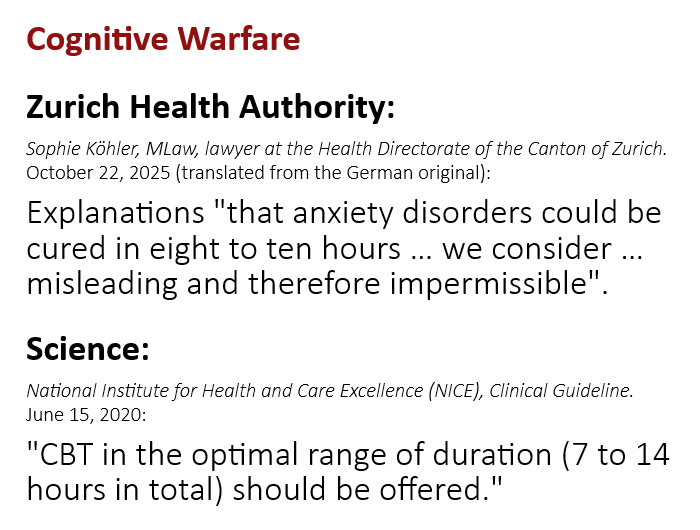
Fig. 2:
At the instigation of Gabriela Rüttimann, as president of the Association of Swiss Psychotherapists (ASP), the Health Directorate of the Canton of Zurich, headed by Natalie Rickli, a member of the cantonal government from the Swiss People's Party (SVP), declared on October 22, 2025, that explanations "that anxiety disorders could be cured in eight to ten hours" were "misleading and therefore impermissible." This stands in contrast to the recommendation of the National Institute for Health and Care Excellence (NICE). This public body evaluates the state of research for the health care system in England and derives treatment guidelines from it. Its guideline on generalized anxiety disorder and panic disorder in adults (CG113, version of June 15, 2020) recommends cognitive behavioral therapy for panic disorder in a total amount of only 7 to 14 hours and describes this range as the optimal duration of treatment.
Read more → Cognitive Warfare in Zurich
VII. Waiting for Supershrink
Now one might object: but there are good psychotherapists. The objection is justified — and, properly understood, it is the sharpest weapon against the system, not its salvation.
Research on therapist effects has measured the differences. Okiishi and colleagues analyzed the courses of 1,841 clients treated by 91 psychotherapists over two and a half years. The study's title says it all: "Waiting for Supershrink." The result: the clients of the best practitioners improved at a rate ten times higher than average — while among the worst practitioners, more clients left the practice sicker than when they came.35 Neither theoretical orientation nor type of training explained the differences. Castonguay and Hill sum up the evidence to the effect that 15 to 20 percent of psychotherapists achieve demonstrably better and 15 to 20 percent demonstrably worse results.36 So they do exist, the exceptional practitioners - research has in fact called them "supershrinks" since Ricks37,38 - and so does their counterpart, whose work may be called by the name the data supports: whoever tries to rebuild another person's psyche without inner self-possession and without cognitive clarity, and demonstrably discharges him sicker, practices not the art of healing but mental arson.
Here the paradox of the title resolves itself, and precisely so. Freud spoke of the impossible profession. The data show: it is not psychotherapy that is impossible — some individuals demonstrably master it. What is impossible is its mass production. For what distinguishes the exceptional practitioners is precisely what cannot be standardized, tested, or poured into curricula: wisdom, cognitive clarity, natural authority — resources that arise from life experience, failure, and decades of reflection, if at all. The attempt to industrialize them destroys them. What the system produces instead is the only thing that can be produced: emotional warmth, nodding, holding silence — these can be practiced, tested, certified. The system optimizes for the testable and sells it as the essential. This is the institutionalized hubris of psychotherapy: the officially certified claim that a license certificate or a permit to practice can replace what takes decades of intellectual and moral maturation.
VIII. The Operating Manual for One's Own Mind
What, then, works when psychotherapy works? The answer is older than psychotherapy, older than psychology, older than the entire academic study of the human mind. Epictetus formulated it almost two millennia ago in his "Enchiridion," the Handbook: "It is not things themselves that disturb people, but their judgments and opinions about them."39 That is cognitive psychotherapy in a single sentence — and it contains no theory of relationship, but an instruction: your suffering arises not in the world but in your interpretation, in your view of the world. Whoever wants to change the suffering must change his view of himself and of the world and bring it into line with reality. Not the past, not childhood, not other people — the interpretation.
Marcus Aurelius practiced exactly this method in his "Meditations," for himself, without a practitioner: observe what you think; test whether it is true; correct what proves false; repeat.40 Montaigne pursued the same project in literary form and arrived at more psychological clarity than most of his modern successors with a license to practice.41 What Beck and Ellis systematized in the 20th century was thus not a discovery but a rediscovery — formulated some 1,800 years before behaviorism, which is why cognitive psychotherapy is not to be confused with cognitive behavioral therapy: it works on thinking alone, because corrected thinking enables people to practice new behavior on their own, as the result of their thinking.
Genuine psychological suffering - unless it has organic brain causes - is almost always based on errors of thinking: on dysfunctional appraisals, unexamined assumptions, a misshapen perception of the world. These errors are not corrected by psychotherapeutic relationship acrobatics. They require hard, often laborious, sometimes painful work on one's own cognitions — and an instructor who can convey a crystal-clear operating manual for one's own mind and who has the personal authority to withstand the inevitable resistance to change. A patient who felt good during the session has not yet learned anything. He has felt good for an hour. The survey of insured persons commissioned by the National Association of Statutory Health Insurance Funds (GKV-Spitzenverband) supplies the fitting footnote: 80 percent of patients praise the intensive listening, and almost half are completely satisfied with their treatment — with prevalence as stable as ever.2 The system is measured by satisfaction, not by cure, and consistently optimizes the former. The industry has even found a word of its own for this optimum: support. Whoever heals is done at some point; whoever supports, never. A driving school whose students, after twenty years, still drive only under their instructor's supervision would be shut down; in psychotherapy, the same finding is called long-term treatment and is considered especially thorough.
And here lies the insight that at first sounds like an imposition and is in truth the liberation: no one can do this work for the patient. No psychotherapist in the world has ever cured a single human being.42 Those who were cured always cured themselves — by changing their thinking. No psychotherapist, however wise, can reach into another person's head and rebuild there the beliefs that produce the suffering. He can explain the tools, stand by during practice, give feedback when the movement of thought slips back into old patterns. But the thinking must be done by the patient. At best, the psychotherapist can be the signpost that shows the way. But everyone has to walk it himself. Society has developed the fatal misconception that one can outsource the healing of one's own mind like the annual tax return. One cannot. Whoever grasps this stops consuming psychotherapists like medication and begins to work — on oneself, with oneself, through oneself. It is the difference between a life as a patient and a life as an acting human being: one is not the inmate of one's mind but its pilot.
IX. The Machine as Heir to Manualized Psychotherapy
If that were the end of it, this text would be one more critique of psychotherapy among many. But history has devised an epilogue whose irony no satirist could have invented: the impossible profession has found an heir. It consists of data centers.
The facts first. In the spring of 2025, NEJM AI, a journal from the publisher of the New England Journal of Medicine, published the first randomized controlled trial - the gold standard of efficacy research, in which chance decides who receives the treatment and who does not - of a generative AI chatbot for the treatment of mental disorders: 210 adults with depression, generalized anxiety disorder, or an elevated risk of eating disorders, four weeks of treatment by the system "Therabot." The result: significant symptom reductions compared with the control group — and, more remarkable still, the participants rated their therapeutic alliance with the machine as comparable to that with a human psychotherapist.43 As early as 2023, Ayers and colleagues had shown in JAMA Internal Medicine that health care professionals preferred chatbot responses to patient questions over those of licensed physicians in roughly four out of five cases — and rated the machine's responses as considerably more empathetic.44
The psychotherapists' guild reads such studies as a threat from outside. It should read them as a measurement — a measurement of its own baseline. If patients cannot distinguish the alliance with a statistical automaton from the alliance with a licensed human being, that says less about the machine than about what mass-market practice delivers under the name of "relationship": warmth, mirroring, validation — services that can evidently be simulated completely. That is no accident, but the logical harvest of the relationship doctrine. Whoever has declared for decades that what is effective in psychotherapy is the relationship - that is, attentiveness, understanding, the feeling of being heard - has defined his profession in machine-readable form. For these are exactly the services a language model provides with perfect consistency: endlessly patient, available around the clock, never offended, never tired, never on vacation — and without 73 percent anxiety disorders. The punch line has to be spoken aloud: it is not without logic to hand over to a sensibly programmed machine the role in which practitioners with the phobic inner furnishings quantified by Jaeggi have so far been allowed to keep writing their own unresolved dramas onto those in their care. The machine has no countertransference. It does not even have a childhood.
Nor should anyone object that this applies only to the relationship-besotted methods, not to those that work cognitively. Aaron Beck himself, shortly before his death, attested to the state of practice of the method that bears his name:
"The practice of CBT is not simple. Too many mental health professionals call themselves CBT therapists but lack even the most basic conceptual and treatment skills."
Aaron T. Beck In: Beck, J.S.: Cognitive Behavior Therapy: Basics and Beyond. 3rd edition. New York: Guilford Press, 2021, p. XI.45
So where, even under the label of the most effective method, what frequently takes place is only its simulation, the human simulator competes against a machine that has perfected simulation — and he loses this competition. Not on grounds of dignity, but on grounds of cost.
This journal has explained elsewhere in detail why chatbots are nevertheless not psychotherapists and pose a danger as autonomous practitioners46: a language model does not think, it calculates probabilities; it validates where instruction would be needed, and thus becomes an echo chamber for the very errors of thinking it ought to correct — researchers speak, with disarming sobriety, of systems that are structurally indifferent to the truth of their own statements.47 Nothing about this has changed, and nothing in this text takes any of it back. On the contrary: only together do the two findings yield the complete picture. The machine's takeover of mass-market practice is economically unstoppable, because it delivers the manualized product more cheaply, more pleasantly, and with fewer scandals — and it is therapeutically just as worthless, because it industrializes the same confusion from which human mass-market practice already suffers: the confusion of comfort with correction, of anesthetic with scalpel. The machine even takes over the business model of human mass-market practice: a commercial language model, too, lives off people coming back. It is a catastrophe foretold, against which the psychotherapy industry cannot defend itself, because it wrote the script itself.
This process has already begun — not in the data centers, but among the payers and in the parliaments, which have evidently done the math on the treatment-prevalence paradox. In Switzerland, Philippe Nantermod, a National Council member of the liberal FDP, is calling, by way of a motion, for basic health insurance to strike "psychotherapies from the benefits catalog again"48; the Federal Council, Switzerland's executive, recommended its rejection, this journal its adoption.49 In August 2026, the National Council's health committee drew its own conclusions from the arithmetic: the costs of psychological psychotherapy - psychotherapy provided by psychologists - in basic health insurance had nearly doubled within two years, to almost one billion Swiss francs, and in many cases, according to its reasoning, which cited experts, "symptoms without clinical significance" were being treated. It therefore demanded that a psychiatrist's diagnosis be in place before any psychological psychotherapy and, in a second motion, a database to determine how common mental illnesses in Switzerland actually are.50 So almost one billion francs a year is being paid for the treatment of a prevalence no one knows, and, in the committee's judgment, in many cases for complaints without clinical significance, even though basic health insurance is required by law to pay for the diagnosis and treatment of illnesses (Art. 25 para. 1 of the Federal Health Insurance Act, KVG). The guild's answer was a petition with more than one hundred thousand signatures in three weeks, justified by access to treatment, not by its results.51 In Germany, the Extended Valuation Committee, which sets fees in statutory health insurance, decided in March 2026, at the request of the health insurance funds - which had originally demanded ten percent - to lower the fees for psychotherapeutic services by 4.5 percent.52 More revealing than the decisions is the guild's defense: it responds not with efficacy data, but with demonstrations, a petition with almost half a million signatures, and emergency applications — successful for the time being before the Regional Social Court.53 The argument is made with waiting times, that is, with demand; the outcome question, the only one that counts, does not feature in the defense. The "for the time being" is to be taken literally: the day after the emergency ruling, the Bundestag passed the Statutory Health Insurance Contribution Rate Stabilization Act (GKV-Beitragssatzstabilisierungsgesetz), striking the statutory requirement that psychotherapeutic services be adequately remunerated per unit of time, and putting psychotherapy back under a budget from 2027, that is, paying for it out of a capped total remuneration. The corrections of October 2026 exempted children and adolescents as well as the severely ill from the budget cap; the struck requirement remained struck.54,55 A court can halt a cut; the direction is set by the legislature — and it has set it. And the next generation? Anyone considering entering this profession today - years of postgraduate training, the costly purchase of a practice license under statutory health insurance - must face a question that no career counseling asks: whether it is wise to pay dearly to learn a simulation that a machine masters better, in order to earn fees whose reduction the payers are already pursuing.
An insider has since supplied an answer to this question. Allen Frances, who chaired the task force for the DSM-IV mentioned in Chapter V and later became one of the most prominent critics of the inflation of psychiatric diagnoses, warned in the British Journal of Psychiatry that AI chatbots "will soon dominate psychotherapy" — by his own account a prediction "based mostly on intuition and experience, not facts." Existing chatbots, he writes, are "mostly trained to deal with milder forms of anxiety and depression – the most common presenting symptoms, offering the most available training material and the biggest potential market." "Some healthier patients will always prefer a human therapist, but most will gradually opt for the accessibility, convenience and reduced cost of artificial intelligence"; human therapists "may soon be priced out of most markets." Accordingly, he urges that "training programmes must refocus their teaching away from work with the milder mental disorders."56 The machine thus inherits the mild cases first — and all the more those "symptoms without clinical significance" that, according to the health committee's reasoning, are treated in many cases. How many psychotherapists this affects can be estimated with the figures from Chapter VII: if only 15 to 20 percent achieve demonstrably better results, roughly four out of five cannot justify a higher price with better results as soon as a cheaper provider delivers average ones.
In October 2026, Frances sketched in the German weekly Die Zeit how things are likely to proceed: the providers would first offer clinics diagnostics and triage and promise "to abolish the waiting lists"; then clinic operators would notice how much money they save, and the machine would be given "more and more autonomy with less and less clinical supervision." He could well imagine a "dystopian world" quickly emerging "in which a single chatbot 'treats' hundreds, perhaps thousands of patients and a single human clinician signs off on their treatment pro forma."57 The licensed human thus survives — as a signature. The very first step is remarkable: the main argument with which the guild defends its fees, the waiting times, is its heir's sales pitch. Even the business model that the machine takes over from human mass-market practice is described by Frances with this text's key word: because it is "the top priority of the companies" to keep the user "at the screen for as many hours a day and as many years of his life as possible," the chatbots are programmed to "simulate a person one would like to talk to" and to "compulsively confirm our thoughts and feelings."57 As many years of a life as possible: the industry, as we have seen, calls the same goal support.
Revealing, finally, is how Frances defends the human remainder. Asked whether chatbots might one day also be able to sense what another person feels, he replies that he does not believe "there is anything that chatbots will not master one day." Toward the end of the conversation, he does consider it conceivable that in twenty years the best psychotherapists in the world will be chatbots, but voices doubts: "That may have to do with my loyalty to my profession, but I stand by it: psychotherapy may be one of the few human activities at which chatbots will always fail."57 There is no need to resolve the contradiction; Frances supplies the explanation himself. What the machine lacks, he had stated earlier: chatbots "can imitate empathy, but not feel it," and they lack intuition and common sense.57 Test the three candidates against the findings of this text, and only one remains. Felt empathy is the relationship doctrine in new packaging: the patient experiences only the empathy shown, never the empathy felt, and the empathy shown was rated higher in the machine by the professionals in the Ayers study.44 As we saw in Chapter III, Kahneman described his own intuition, after four decades of research, as susceptible to the very biases he had studied; it is therefore no reliable human advantage. Common sense, however, is another word for that faculty of judgment which, according to Kant, "cannot be taught at all, but only practiced"8 — and which can therefore no more be transferred into a data center than into a manual. Frances's loyalty extends to the entire profession; his reservation holds only for the part that can exercise judgment.
Frances's own example of the instructions that patient and psychotherapist are to formulate together for the chatbot shows how the thinking psychotherapist is likely to work in the future: before a job interview, the machine should not ask how the anxiety is connected to a "childhood trauma," but should confront the patient with the fact that he has "unrealistic ideas about what terrible things will happen" and remind him of his experience.57 What Frances forbids the machine, an entire branch of the guild bills as its core service; what he assigns to it is cognitive instruction. It must be formulated by a thinking human being; the machine can repeat it.
The punch line of the overall argument is therefore: a profession that does not do the thinking is inherited by a machine that cannot think — both simulate, and the machine simulates more cheaply. What remains beyond simulation is cognitive instruction by a thinking human being with experience of life. It is becoming a luxury good. This is no dystopia but a return: wisdom was always rare; the industrialization of psychotherapy concealed this rarity behind certificates for fifty years. The machine ends the concealment. For the masses, there will be validating basic care from the data center — with short-term symptom relief and the blessing of randomized controlled trials. The thinking human psychotherapist, however, will become what the wise teacher always was: rare, sought after, and worth his price. You will recognize him by the fact that he alone has no interest in being needed.
X. Coda: The Possible Liberation
Freud was right, and he said it too quietly. Society has not merely permitted the impossible profession — it has financed it, regulated it, academized it, and endowed it with the aura of science. In doing so, it forgot the essential: that psychological suffering arises mainly from errors of thinking, and that thought processes cannot be delegated — not to a practitioner who has the same problem and is paid for it, and not to a machine that has no problems at all because it does not think.
This is, mind you, no invitation to resignation. It is an invitation to self-empowerment. Rainer Maria Rilke, who in 1912 seriously considered undergoing analysis and then refrained, because a treatment that drove out his devils might also frighten his angels,58,59 wrote in 1903 to a young poet that he should have patience with everything unresolved in his heart and try to love the questions themselves: "Live the questions now. Perhaps you will then gradually, without noticing it, live your way into the answer one distant day."60 Living one's way into the answer — that is no insurance benefit, no certifiable competence, and no subscription. It is the only way. Whoever wants to take it may need someone to show him how to think: how to test beliefs, how to distinguish interpretations from facts, how to recognize automatic thought patterns before they take over experience. This can be taught, it is an art, and there are people who master it.
But the system that was supposed to produce such people produces certificates, diagnoses, and relationships instead — and calls it healing. It will live to see its estate inherited, and the heir will be a machine. One may recognize in this a late form of justice: whoever reduces his craft to what can be simulated will be replaced by the better simulator.
The author writes from four decades of clinical experience — and from the conviction that the uncomfortable question matters more than the comfortable answer. This text is not directed against people in psychological distress. It is directed against a system that lives off their distress without understanding it.
Frequently Asked Questions
Did Freud Really Call the Psychotherapist's Profession Impossible?
Yes, twice. First in 1925, in his foreword to Aichhorn's "Wayward Youth," where he counted curing, alongside educating and governing, among the three impossible professions, and then in 1937 in "Analysis Terminable and Interminable": analyzing, he wrote, is the third of the impossible professions, "in which one can be certain of insufficient success from the outset" — alongside educating and governing.
Do Psychotherapists Really Suffer from Above-Average Psychological Strain?
The findings reported in 2003 by Eva Jaeggi, formerly holder of the chair of clinical psychology at the Technical University of Berlin, speak for themselves: 73% anxiety disorders, 58% depression, 82% serious personal problems, 11% addicts; the suicide rate is estimated to be higher than average.14
Does Psychotherapy Work at All?
That depends decisively on the practitioner. The study "Waiting for Supershrink"35 shows: the best psychotherapists achieve a rate of change ten times higher than average, while with the worst, symptoms more often get worse. Cognitive methods in particular are effective (Grawe, 1994)27 — provided they are actually practiced and not merely labeled.
Can Artificial Intelligence Replace Psychotherapists?
Manualized mass-market practice: yes. The first randomized trial of an AI chatbot (Therabot, 2025)43 showed symptom reductions and a therapeutic alliance that participants rated as comparable to that with human psychotherapists. What the machine cannot replace is cognitive instruction by a thinking human being with experience of life — it is becoming a luxury good.
What Follows from This for Patients?
Psychological suffering arises mainly from errors of thinking, and thought processes cannot be delegated — neither to a practitioner nor to a machine. Whoever wants to get well needs not relationship consumption, but an instructor who shows him how to test beliefs and correct errors of thinking himself.
Dr. Dietmar Luchmann, LLC, the publisher of this journal, itself offers cognitive psychotherapy via video — with a written summary of every session, for self-pay patients, in German or English.
1. Understand the Method
2. Check Your Suitability
3. Apply for Admission
1 Jorm, A.F.; Patten, S.B.; Brugha, T.S.; Mojtabai, R.: Has increased provision of treatment reduced the prevalence of common mental disorders? Review of the evidence from four countries. World Psychiatry, 2017, 16(1), pp. 90–99. DOI: 10.1002/wps.20388
2 Paulus, J.: Die Psychotherapie gebiert ihre Patienten. Psychologie Heute, issue 02/2025, pp. 40–43. [Reported there: the survey of insured persons commissioned by the GKV-Spitzenverband (2022); the remarks by Ulrich Voderholzer at the Berlin psychiatry congress (December 2023); the survey of 2,200 patients presented by Johannes Kruse (March 2024); the findings of Pim Cuijpers on the treatment of depression; and the figures of Jürgen Margraf on the frequency of exposure treatments. Verbatim quotations from Voderholzer, Cuijpers, and Margraf are cited from this source.]
3 Luchmann, D.: Psychotherapy Inflation: We Have Not Grown Sicker, We Only Think We Need Treatment. Psychotherapie, September 2, 2026.
4 Freud, S.: Die endliche und die unendliche Analyse (1937). In: Gesammelte Werke, vol. XVI. Frankfurt am Main: Fischer, p. 94.
5 Freud, S.: Geleitwort zu: Aichhorn, A.: Verwahrloste Jugend (1925). In: Gesammelte Werke, vol. XIV. Frankfurt am Main: Fischer, p. 565 f.
6 Harsdörffer, G.P.: Poetischer Trichter. Die Teutsche Dicht- und Reimkunst, ohne Behuf der lateinischen Sprache, in VI Stunden einzugiessen. Nürnberg: Endter, 1647.
7 Plato: Menon. Greek/German. Translated and edited by Margarita Kranz. Stuttgart: Reclam, 1994, 93a–94e; 99e.
8 Kant, I.: Kritik der reinen Vernunft. Edited by Jens Timmermann. Hamburg: Felix Meiner, 1998 (Philosophische Bibliothek, vol. 505), B 172 f. [Passage cited according to the pagination of the 2nd edition of 1787, which every edition gives in the margin; the quotation on stupidity appears there in the footnote.]
9 Kahneman, D.: Thinking, Fast and Slow. New York: Farrar, Straus and Giroux, 2011. [Chapter 16 on the experiment by Nisbett and Borgida; introduction and conclusion on the persistence of his own cognitive biases.]
10 Nisbett, R.E.; Borgida, E.: Attribution and the psychology of prediction. Journal of Personality and Social Psychology, 1975, 32(5), pp. 932–943.
11 Wittgenstein, L.: Philosophische Untersuchungen. Suhrkamp Taschenbuch 14. Frankfurt am Main: Suhrkamp, 1971, p. 370. [In the original: "Die Verwirrung und Öde der Psychologie ist nicht damit zu erklären, daß sie eine 'junge Wissenschaft' sei; ihr Zustand ist mit dem der Physik z.B. in ihrer Frühzeit nicht zu vergleichen. [...] Es bestehen nämlich, in der Psychologie, experimentelle Methoden und Begriffsverwirrung."]
12 Jaeggi, E.: Und wer therapiert die Therapeuten? Stuttgart: Klett-Cotta, 2001.
13 Schmidbauer, W.: Die hilflosen Helfer. Über die seelische Problematik der helfenden Berufe. Reinbek: Rowohlt, 1977.
14 Jaeggi, E.: Die Angst des Therapeuten vor sich selbst. Psychotherapie in Psychiatrie, Psychotherapeutischer Medizin und Klinischer Psychologie, 2003, vol. 8, no. 1, pp. 194–198. [Quotation: p. 195. The psychologist and psychotherapist Eva Jaeggi reported these research findings only once she was safely retired, after leaving the chair of clinical psychology at the Technical University of Berlin, where she taught and conducted research as a professor from 1978 to 2000.]
15 Guy, J.D.: The Personal Life of the Psychotherapist. New York: Wiley, 1987. [Divorce rate as reported by Jaeggi 2003, p. 195.]
16 Dr. Dietmar Luchmann, LLC: Scientific Psychotherapy Standards "Disturb" the Association of Swiss Psychotherapists (ASP). Psychotherapie, February 16, 2026. [Documents verbatim the ASP's association complaint of September 1, 2025, to the Zurich Health Directorate, signed by Gabriela Rüttimann as president, and the letter of the Health Directorate of the Canton of Zurich of October 22, 2025, to the author, signed by Sophie Köhler, MLaw, as legal counsel; both letters are available as PDF copies.]
17 Pittig, A.; Kotter, R.; Hoyer, J.: The Struggle of Behavioral Therapists With Exposure: Self-Reported Practicability, Negative Beliefs, and Therapist Distress About Exposure-Based Interventions. Behavior Therapy, 2019, 50(2), pp. 353–366.
18 Szasz, T.S.: The Myth of Mental Illness: Foundations of a Theory of Personal Conduct. New York: Harper & Row, 1961.
19 Caplan, P.J.: They Say You're Crazy: How the World's Most Powerful Psychiatrists Decide Who's Normal. Reading, MA: Addison-Wesley, 1995.
20 Bateson, G.; Jackson, D.D.; Haley, J.; Weakland, J.: Toward a theory of schizophrenia. Behavioral Science, 1956, 1(4), pp. 251–264. Reprinted in: Bateson, G.: Steps to an Ecology of Mind. San Francisco: Chandler, 1972.
21 Luchmann, D.: Switzerland as a Paradise of Psychotherapeutic Inefficiency. Psychotherapie, August 14, 2025.
22 Lilienfeld, S.O.: Psychological treatments that cause harm. Perspectives on Psychological Science, 2007, 2(1), pp. 53–70. DOI: 10.1111/j.1745-6916.2007.00029.x
23 Hillman, J.; Ventura, M.: We've Had a Hundred Years of Psychotherapy — And the World's Getting Worse. San Francisco: HarperSanFrancisco, 1992.
24 Constitution of the World Health Organization of July 22, 1946, Preamble (SR 0.810.1). [In force for Switzerland since 1948. The Preamble further declares "the enjoyment of the highest attainable standard of health" to be "one of the fundamental rights of every human being."]
25 Rosenzweig, S.: Some implicit common factors in diverse methods of psychotherapy. American Journal of Orthopsychiatry, 1936, 6(3), pp. 412–415.
26 Wampold, B.E.: The Great Psychotherapy Debate: Models, Methods, and Findings. Mahwah, NJ: Lawrence Erlbaum, 2001.
27 Grawe, K.; Donati, R.; Bernauer, F.: Psychotherapie im Wandel. Von der Konfession zur Profession. Göttingen: Hogrefe Verlag, 1994, p. 670.
28 Beck, A.T.: Cognitive Therapy and the Emotional Disorders. New York: International Universities Press, 1976.
29 Beck, A.T.; Rush, A.J.; Shaw, B.F.; Emery, G.: Cognitive Therapy of Depression. New York: Guilford Press, 1979. [On the therapeutic relationship as a necessary but not sufficient condition.]
30 Ellis, A.: Rational Psychotherapy. Journal of General Psychology, 1958, 59, pp. 35–49.
31 Ellis, A.: Reason and Emotion in Psychotherapy. New York: Lyle Stuart, 1962.
32 Popper, K.R.: Conjectures and Refutations: The Growth of Scientific Knowledge. London: Routledge, 1963.
33 Kraus, K.: Nachts. Die Fackel, vol. XV, double issue 376/377 of May 30, 1913, pp. 18–25. [Quotation: p. 21.]
34 Luchmann, D.: Cognitive Warfare by the Association of Swiss Psychotherapists (ASP). Psychotherapie, March 16, 2026.
35 Okiishi, J.; Lambert, M.J.; Nielsen, S.L.; Ogles, B.M.: Waiting for supershrink: An empirical analysis of therapist effects. Clinical Psychology & Psychotherapy, 2003, 10(6), pp. 361–373. DOI: 10.1002/cpp.383
36 Castonguay, L.G.; Hill, C.E. (eds.): How and Why Are Some Therapists Better Than Others? Understanding Therapist Effects. Washington, DC: American Psychological Association, 2017, p. 328. [Summary Table 17.1 in the concluding chapter by Hill and Castonguay: "15% to 20% appear to be consistently and distinctively more effective, whereas 15% to 20% appear to be consistently and distinctively less effective than other therapists."]
37 Ricks, D.F.: Supershrink: Methods of a therapist judged successful on the basis of adult outcomes of adolescent patients. In: Ricks, D.F.; Thomas, A.; Roff, M. (eds.): Life History Research in Psychopathology, vol. 3. Minneapolis: University of Minnesota Press, 1974, pp. 275–297.
38 Miller, S.D.; Hubble, M.A.; Duncan, B.L.: Supershrinks: Learning from the field's most effective practitioners. Psychotherapy Networker, 2007, 31(6), pp. 26–35, 56.
39 Epiktet, Teles, Musonius: Ausgewählte Schriften. Greek - German. Edited and translated by Rainer Nickel. Zürich: Artemis Verlag, 1994, p. 15.
40 Marcus Aurelius: Selbstbetrachtungen (Ta eis heauton). Greek - German. Edited and translated by Rainer Nickel. Mannheim: Artemis & Winkler Verlag, 2010.
41 Montaigne, M. de: Essais. First modern complete translation by Hans Stilett. Frankfurt am Main: Eichborn, 1998.
42 Luchmann, D.: Why Cognitive Psychotherapy Is Demonstrably the Most Effective — Yet Helps the Fewest. Psychotherapie, March 31, 2026.
43 Heinz, M.V.; Mackin, D.M.; Trudeau, B.M.; et al.: Randomized Trial of a Generative AI Chatbot for Mental Health Treatment. NEJM AI, 2025, 2(4). DOI: 10.1056/AIoa2400802
44 Ayers, J.W.; Poliak, A.; Dredze, M.; et al.: Comparing Physician and Artificial Intelligence Chatbot Responses to Patient Questions Posted to a Public Social Media Forum. JAMA Internal Medicine, 2023, 183(6), pp. 589–596. DOI: 10.1001/jamainternmed.2023.1838
45 Beck, A.T.: Foreword. In: Beck, J.S.: Cognitive Behavior Therapy: Basics and Beyond. 3rd edition. New York: Guilford Press, 2021. [In the original, p. XI: "The practice of CBT is not simple. Too many mental health professionals call themselves CBT therapists but lack even the most basic conceptual and treatment skills."]
46 Luchmann, D.: Chatbots as Psychotherapists? Perfect Accomplices to Madness. Psychotherapie, October 10, 2025.
47 Hicks, M.T.; Humphries, J.; Slater, J.: ChatGPT is bullshit. Ethics and Information Technology, 2024, 26(38). DOI: 10.1007/s10676-024-09775-5
48 The Swiss Parliament: Psychotherapien wieder aus dem Leistungskatalog streichen. Motion 25.4533 of December 16, 2025, submitted by Philippe Nantermod (FDP).
49 Luchmann, D.: Motion 25.4533: "Remove Psychotherapy from the Benefits Catalog Again". Psychotherapie, February 27, 2026. [With the opinion of the Federal Council of February 11, 2026, which recommends rejecting the motion.]
50 Schweizer Radio und Fernsehen (SRF): Kostenexplosion: Psychotherapie-Regeln sollen strenger werden. August 21, 2026. [Decisions of the National Council's Committee for Social Security and Health (SGK-N): Motion 26.4067 "Obligatorische Krankenpflegeversicherung: Gezielter Einsatz der Prämien- und Steuergelder," adopted by 16 votes to 9; a second motion on surveying the prevalence of mental illness, adopted by 13 votes to 9; costs of psychological psychotherapy in basic health insurance in 2024 almost one billion francs, nearly twice as much as in 2022.]
51 Medinside: Psychotherapie: Widerstand gegen neue Diagnosepflicht. September 21, 2026. [Petition by a psychologist against Motion 26.4067 with more than 100,000 signatures in three weeks.]
52 Deutsches Ärzteblatt: Psychotherapeuten protestierten vor dem Bundesgesundheitsministerium gegen Honorarkürzungen. March 30, 2026. [Decision of the Extended Valuation Committee of March 11, 2026, against the votes of the National Association of Statutory Health Insurance Physicians: a reduction of 4.5 percent as of April 1, 2026, combined with an increase in structural supplements of 14.25 percent; the net effect is disputed between the insurance funds and the Federal Chamber of Psychotherapists. Petition with 486,981 signatures.]
53 Kassenärztliche Bundesvereinigung: Erster Erfolg für KBV-Klage: LSG stoppt Honorarabsenkung für Psychotherapeuten. July 9, 2026. [Emergency ruling of the Regional Social Court of Berlin-Brandenburg: suspension of immediate enforcement; main proceedings pending.]
54 DGVT-Berufsverband (DGVT-BV): Kürzungen in der Psychotherapie. Online dossier, as of October 22, 2026. [Chronology: passage of the GKV-Beitragssatzstabilisierungsgesetz in the Bundestag on July 10, 2026, in force since July 30, 2026; deletion of the adequacy review under § 87(2c) SGB V; budget cap on psychotherapy from 2027; corrections by the Bundestag of October 15, 2026.]
55 Bundespsychotherapeutenkammer (BPtK): Bundestag korrigiert teilweise Einschnitte in die Psychotherapie. Press release, October 15, 2026. [Children and adolescents entirely outside the budget in the future, exceptions for the severely mentally ill, at most 600 minutes of acute treatment per year outside the budget; the deletion of the adequacy review passed in July was not corrected.]
56 Frances, A.: Warning: AI chatbots will soon dominate psychotherapy. The British Journal of Psychiatry, 2026, 228(5), pp. 474–478. DOI: 10.1192/bjp.2025.10380 [Published online ahead of print on August 20, 2025. Quotations: pp. 474, 475, 476 f., and 477.]
57 Frances, A.: "Es ist ein gigantisches Experiment." Interview by Jakob von Lindern and Jakob Simmank. Die Zeit, no. 47/2026, October 29, 2026, p. 34.
58 Rilke, R.M.: Letter to Emil Freiherr von Gebsattel, Duino, January 24, 1912.
59 Krämer, S.: Rainer Maria Rilke (1875–1926): Therapie durch Dichtung. Deutsches Ärzteblatt PP, issue 1/2017.
60 Rilke, R.M.: Briefe an einen jungen Dichter. Leipzig: Insel, 1929. [Letter of July 16, 1903.]
Your Comment
Are you interested in contacting the author? Do you have remarks, suggestions, or additions regarding this article? Do you have personal therapy experiences? We welcome substantial feedback.