Two Books, Twenty-One Years—and a Question Neither of Them Answers
In 2005 a book appeared in New York under the title “One Nation Under Therapy.” Its authors, the philosopher Christina Hoff Sommers and the psychiatrist Sally Satel, described a culture that was in the process of translating ordinary difficulties of living into conditions requiring treatment.1 They coined a term for it: therapism. What they meant was a bundle of three convictions: that human beings are fragile at the core; that they must talk about their feelings in order to master them; and that they need professional guidance to do so. The book was written as a warning. It described a development that, in the authors’ view, could still be halted.
Twenty-one years later, in January 2026, Jonathan Alpert published “Therapy Nation.” Alpert is a New York psychotherapist with more than two decades in private practice.2 His book is no longer a warning but a report from inside the profession: never have so many people been in psychotherapeutic treatment, and never has the population been more anxious, more fragile, and more divided. Alpert says what his guild does not care to hear: as the supply of care expanded, so did the numbers of the sick.
A generation lies between the two books. And between them lies a question that neither one answers, because both consider it long since settled: what has actually happened to mental health in these twenty-one years?
This article answers that question in five steps, each building on the last. First: the contradiction at issue is found not in a polemic but in an official Swiss report. Second: it has a name in the professional literature, and that name comes not from critics of psychotherapy but from its leading researchers. Third: the numbers show something other than what the two books claim—something more uncomfortable. Fourth: there is a mechanism that explains this something else, and it requires no ill intent whatsoever. Fifth: there is a finding that weighs more heavily than any of the numbers—namely, that the decisive numbers are never gathered in the first place.
Two Figures from the Same Official Report on Mental Health
The Swiss Health Observatory, the monitoring body maintained jointly by the federal government and the cantons, published its National Health Report in September 2025. The report is devoted entirely to mental health, and it contains two statements that at first glance rule each other out.
The first: in 2022, more than ninety percent of the population reported a high quality of life, and roughly seventy percent described themselves as happy. The second: one person in two is affected by a mental disorder at some point in life, and the share of people reporting medium to high psychological distress has risen sharply since the 2017 survey—among young women from 19 to 28.9 percent, among men from 9.6 to 16.4 percent.3
A country in which nine out of ten people live well and at the same time every second person falls mentally ill: this is not a contradiction in reality. It is a contradiction between three measuring instruments that measure three different things and whose results are nonetheless placed side by side. Because everything that follows depends on this distinction, it is worth stating precisely.
Quality of life is established by asking people to judge their life as a whole. It therefore measures an overall balance. Distress scores are collected with standardized questionnaires that ask about complaints over the past two weeks: how often someone lacked drive, slept badly, worried. They therefore measure a snapshot—and one the respondent takes of himself. Lifetime prevalence, finally—prevalence being the technical term for the frequency of a disorder within a population—is a projection: the estimated share of people who will meet the criteria for a diagnosis at some point in their entire lives.
Three instruments, three answers. The decisive question is therefore not which of the three figures is correct; all three are. The question is: which of them measures illness—and which measures the willingness to describe one’s own experience as illness?
The Paradox Has a Name, and It Comes from Within the Field
Anyone who takes this question for a provocation from outside is mistaken. It has been raised in the leading journals for years, and there it carries a name: the treatment-prevalence paradox. It states that the expansion of treatment has not reduced the frequency of the illness.
It was formulated by Johan Ormel, Steven Hollon, Ronald Kessler, Pim Cuijpers, and Scott Monroe in 2022 in “Clinical Psychology Review.”4 Their finding: treatment options for depression have improved since the 1980s and their availability has grown enormously—and the frequency of depression in the general population has nonetheless not declined.
One has to know who is writing this in order to gauge the standing of the statement. Ronald Kessler is the epidemiologist behind the large international surveys of the frequency of mental disorders; without his data, nobody would know how widespread depression is in the first place. Pim Cuijpers is the most-cited meta-analyst in psychotherapy research anywhere in the world—a meta-analysis being the arithmetical combination of many individual studies into a single overall result, and Cuijpers being the man who has performed that calculation for the effectiveness of psychotherapy again and again. These are not the opponents of the field. These are its accountants.
Anthony Jorm and colleagues had reached the same conclusion as early as 2017 in “World Psychiatry”: for Australia, Canada, England, and the United States, no decline in depression and anxiety disorders could be demonstrated between 1990 and 2015, although treatment had been massively expanded in all four countries over that period.5
Interim conclusion: that the expansion of treatment has not lowered the frequency of illness is no longer a matter of dispute; it is the published state of the field. What remains disputed is the explanation, and nothing else.
Seven Explanations—and Not One of Them Is Comfortable
Ormel and his colleagues examine seven possible explanations.4 Intellectual honesty requires naming all of them before taking an interest in any single one—for whoever names only the explanation that suits him has not argued but selected.
Two explanations assume that treatment did in fact work but that its success was consumed elsewhere:
- More and more people are counted as depressed who are not depressed by strict standards—the cures achieved therefore disappear into a growing volume of false diagnoses.
- The number of new cases has genuinely risen, for instance through changed living conditions—in which case treatment would merely have prevented a steeper increase.
Five further explanations assume that treatment has accomplished less than is credited to it:
- The treatments are less effective than the published literature suggests—among other reasons because unsuccessful studies are published less often than successful ones.
- Their effect is less durable: what is measured after ten sessions is frequently no longer present after two years.
- Results from studies cannot be transferred to everyday care, because in studies selected patients are treated by specially trained clinicians.
- Care reaches too few people at sufficient quality.
- A portion of the treatments does harm.
An eighth explanation, absent from Ormel, is supplied by the French sociologist Alain Ehrenberg—and it is the most elegant of them, because it requires no reproach against psychotherapy at all.6 Ehrenberg describes how depression displaced neurosis as the signature illness of Western societies. A society that demands above all obedience produces guilt and inner conflict; that was the world in which psychoanalysis arose. A society that demands of every individual initiative, self-realization, and perpetual choice produces instead exhaustion and the sense of not being enough. On this reading, the rise in psychological complaints would be no failure of treatment but the price of freedom.
This explanation deserves to be taken seriously, and it is not refuted here. It does not, however, explain why massively expanded treatment failed to exert at least a dampening effect.
That leaves the seventh explanation: that a portion of the treatments does harm. The medical term for this is iatrogenic, literally “produced by the physician.” It denotes any harm that arises not from the illness but from its treatment. In the summary by Ormel and colleagues, this point stands expressly among the open questions requiring further investigation.4 It has stood there since 2022. It is not being investigated.
What Has Risen—and What Has Not
Now comes the finding that corrects the books by Sommers and Satel and by Alpert, and in a more uncomfortable direction than either of them suspects.
How this would turn out was described by a psychiatrist a quarter of a century ago. Klaus Dörner, who headed the Westphalian Clinic for Psychiatry in Gütersloh from 1980 to 1996, set out in the “Deutsches Ärzteblatt” where a health care system under competitive pressure must inevitably steer: because a growing market needs new customers and the number of the sick is finite, the development runs toward “the conversion of all the healthy into the sick”—toward people, that is, who consider themselves in lifelong need of professional treatment in order to be able to live healthily at all.7
Note who acts in this analysis: not the physician, not the psychotherapist, not a professional association, but competition itself. Dörner is not describing an intention but an objective function—the quantity a system maximizes even when nobody wants it maximized. In 2002 this was a prediction. The figures that follow test it.
Dirk Richter, of the University Psychiatric Services Bern and the Bern University of Applied Sciences, examined in 2019 in the journal “Acta Psychiatrica Scandinavica” whether the frequency of mental disorders is in fact rising.8 His method is what matters: he compared only those studies that had surveyed the same population repeatedly with the same instrument. This is the only way to make a genuine comparison over time; whoever compares different instruments is measuring not the illness but the questionnaire. The result: frequency is barely rising, the observed increase is small and possibly attributable to the changing age structure of the population alone. Where large increases are reported, they almost always rest on something else—on suicide rates, or on the number of people seeking help.
Nick Haslam of the University of Melbourne put this contradiction plainly in May 2026: prescriptions, outpatient psychotherapy, and the share of disability pensions granted for mental illness are rising steeply in many countries, while epidemiological studies show stable or only slightly elevated frequencies for the major disorders.9
Switzerland displays precisely this pattern, and in unusually sharp relief. Since July 1, 2022, the country has operated under the so-called prescription model (Anordnungsmodell): psychological psychotherapy is since then paid for by mandatory basic health insurance—the coverage every resident of Switzerland is required to carry—as soon as a physician prescribes it. Previously this was possible only if the treatment took place in a physician’s own practice. The consequences of this opening have been measured:
| Indicator | Change | Period |
|---|---|---|
| Psychotherapy practices in Switzerland | 2,340 → 4,834 (more than doubled) | 2022–202410 |
| Basic insurance spending on psychological psychotherapy | CHF 528 million → CHF 922 million (+20.4% per year) | 2021–202410 |
| Share of new disability pensions granted for psychiatric causes | 52% of all new pensions, 76% of all illness-related ones | 202411 |
| Self-reported psychological distress among young women | 19% → 28.9% | 2017–20223 |
| Frequency of mental disorders measured with an unchanged instrument | virtually unchanged | international, several decades8,9 |
The last row is the decisive one, and it stands deliberately at the end: everything that rises steeply in this table is a figure about the system of care—practices, francs, pensions, self-reports. The one figure that says anything about the illness itself barely moves. From this follows a thesis harder than Alpert’s and at the same time better supported:
“The number of the sick has barely risen. What has risen are the diagnoses, the treatments, the costs, and the pensions. The therapeutic society has not produced more sick people but more people who understand themselves as sick—and a system that lives off that self-interpretation.”
This is the actual dystopia, and it is more modest and therefore more probable than any tale of collapse. It does not consist in a population falling ill. It consists in a population learning to consider itself ill—and in that self-interpretation generating institutions, professions, pensions, and billion-franc budgets without a gain in health being demonstrable at any point.
How Distress Becomes Illness
How does this happen without anyone intending it? The answer is supplied by three lines of research, all of them from within psychology itself.
The first is prevalence inflation. Lucy Foulkes and Jack Andrews proposed in 2023, and expressly submitted for testing, the hypothesis that public awareness campaigns about mental health themselves contribute to the reported rise in mental health problems.12 They distinguish two pathways, and this distinction is the heart of the matter. The first pathway is desirable: people recognize complaints they would previously have overlooked or concealed. The second is not: people reinterpret ordinary difficulties as a disorder. And whoever understands himself as disordered behaves accordingly—he spares himself, avoids strain, observes himself. The interpretation thereby fulfills itself.
The second line is concept creep, the expression coined by Nick Haslam: core psychological concepts such as trauma, addiction, abuse, or disorder expand steadily over the decades until they encompass what previously counted as ordinary experience. Michael P. Hengartner, professor of clinical psychology at Kalaidos University of Applied Sciences and a co-author of the National Health Report 2025, examined this process empirically together with Haslam in April 2026.13 Two of their findings belong in every debate about mental health. First: whoever holds a broader concept of illness perceives more sick people around him—the number of the sick therefore depends measurably on how broadly the concept is drawn. Second: whoever has studied psychology uses narrower concepts than the layman. The more someone understands of the field, the less illness he sees.
The third line is the oldest and philosophically the deepest. The philosopher of science Ian Hacking showed that classifications of people work differently from classifications of things.14 A quark does not change because physics calls it a quark. A human being very much does change when he is called traumatized: he understands himself anew, behaves anew—and because his behavior changes, the description that fits him changes in turn. Hacking calls this the looping effect. It is the reason why in psychology the measuring instrument and the object measured bring each other into being.
Interim conclusion: nobody has to want anything evil for this to occur. It suffices that everyone means well—raising awareness, creating access, reducing stigma, looking where people once looked away. The mechanism requires no plan. It requires only enough well-meaning participants and a payment system that never asks about the result.
Grief Is Given a Deadline
What such a widening of concepts looks like in practice can be shown with an example every reader knows from his own life.
On January 1, 2022, the eleventh revision of the International Classification of Diseases (ICD-11) came into force—the register issued by the World Health Organization according to which diagnoses are made and billed worldwide. Under code 6B42 it introduces, for the first time, a diagnosis of its own for grief: prolonged grief disorder.15 The American diagnostic manual, the DSM, followed a few weeks later.16
People have died in every age, and they have grieved in every age. What is new, then, is not grief, nor is it new that grief can last a long time. What is new is that it now has a deadline.
Under the World Health Organization’s definition, the diagnosis comes into consideration when the grief reaction persists for at least six months and exceeds what the mourner’s cultural norms would lead one to expect. The American manual requires at least twelve months for the same diagnosis.
This difference is the real finding. Two international classification systems, the same name, the same disorder—and the boundary between normal grief and mental illness lies twice as far from the day of the death in the one as in the other. A boundary that can be moved by a factor of two without anything whatever changing in the object is not a discovery about reality. It is a convention. And it takes effect: in a representative German survey of the bereaved, the broader definition of the World Health Organization produced markedly more cases than the narrower American one.17 The same people, the same suffering, two frequencies.
A first step had preceded it, one less well known and more revealing. Until 2013 the American diagnostic manual contained a rule known as the bereavement exclusion: a person who had recently lost someone close could not be diagnosed as depressed on the strength of ordinary grief symptoms alone. Psychiatry had therefore not overlooked the possibility of construing grief as illness. It had expressly erected a barrier against it. In 2013 that barrier was removed.
The Psychiatrization of Society
Here too the objection came from within the field. The psychiatrist Allen Frances, who had chaired the fourth edition of the American diagnostic manual, called the move the medicalization of a normal emotion: it stigmatizes the pain, interrupts its processing, devalues the cultural forms of consolation, and delivers the bereaved to a medication they do not need.18 As early as 2007 the sociologist Allan Horwitz and the psychologist Jerome Wakefield had traced, in a widely noted study, how psychiatry had step by step turned normal sadness into a depressive disorder.19 The Harvard psychiatrist and anthropologist Arthur Kleinman described in “The Lancet” his own grief for his late wife and asked by what standard one proposes to assign it a permissible duration.20
One might now object: if some of the bereaved genuinely never find their way out of grief, a diagnosis is useful because it makes targeted help possible. The objection is legitimate, and it is expressly not disputed here. Roughly one bereaved person in ten develops a persistent, severely disabling grief, and for this group effective treatments exist.21 What is disputed is not the existence of that minority. What is disputed is the deadline that applies to everyone.
For what happens to the other nine has been investigated. The most comprehensive meta-analysis of psychotherapeutic offerings for the bereaved evaluated 61 controlled studies. The result: a small effect immediately after treatment, and at follow-up no statistically meaningful advantage at all.22 Whoever grieves normally gains nothing lasting from treatment. He would have covered the same ground without it—George Bonanno’s resilience research has shown that recovery under one’s own power after a loss is not the exception but the rule.23
And with that, what is at stake becomes visible. What the diagnosis changes is not the grief. It is the self-observation. A person who lost someone used to grieve for as long as he grieved; when it had been enough was for him to decide, and those around him gave him time. Today he grieves against a deadline. After half a year the question arises whether this is still normal—and he can no longer answer that question himself, because the answer stands in a register he does not know and whose authority he cannot contest.
The cultural forms that societies developed over millennia for dealing with death—periods of mourning, rituals, dress codes, days of remembrance—were nothing other than collectively organized grief work, and they had deadlines of their own. They have largely disappeared. A diagnostic code has taken their place. This is no gain in knowledge. It is a transfer of jurisdiction—from the mourner and those around him to a body of experts, and to one that nobody applied for.
That Psychotherapy Can Do Harm Is Not a Thesis but a Finding
At this point comes the objection that all of this is speculation: psychotherapy helps, after all, and whoever suspects otherwise must prove it. The proof that well-meant psychological help can do harm has been available for thirty years.
“As we have seen, the popular psychological imperatives to ‘get it all out’ and ‘feel it to heal it’ do not always work. Cancer patients who talk about their ordeal in therapy groups do not live longer. Mourners do not have to go through five stages of grieving, and healthy grieving does not require wrenching sadness. Expressing anger does not invariably alleviate it; on the contrary, it can make one angrier. And when people are distraught, ruminating about their pain may only intensify the pain.”
Sommers, C.H.; Satel, S.: One Nation Under Therapy. How the Helping Culture Is Eroding Self-Reliance. New York: St. Martin’s Press, 2005, p. 140.1
Sommers and Satel set out at length how ostensible psychotherapeutic help does harm.1 The subject is psychological debriefing, also known as critical incident stress debriefing: a structured session shortly after a distressing event in which those affected are meant to recount their experience in order to forestall the development of post-traumatic stress disorder. From the 1980s onward the procedure was in use worldwide—among fire departments, emergency services, police forces, airlines, and after disasters.
The randomized studies—trials in which a draw decides who is treated and who is not, so that the two groups differ in the treatment alone—showed first of all that those treated recovered no better than people who received no intervention whatever. Two investigations showed more than that. In a study of burn victims, those treated developed post-traumatic stress disorder three times as often after one year as the control group.24 In a three-year follow-up of road accident victims, those treated recovered more slowly in anxiety, functioning, and pain than the untreated.25 The review by the Cochrane Collaboration—the international network that systematically evaluates the evidence on medical procedures—confirmed the picture,26 as did a meta-analysis in “The Lancet.”27 The British National Health Service, NATO, and the World Health Organization thereupon warned against the procedure.1
Alongside all this, a certification industry flourished. Sommers and Satel describe how, after the Oklahoma City bombing in 1995, established trauma specialists from a leading American university were turned away from the site because they lacked the certificate of a private foundation—a certificate anyone received who paid the course fee and showed up.1
The case is not an isolated one. Crime prevention offers the counterpart: programs in which delinquent juveniles visited prisons in order to be deterred. The Cochrane review found that the participants subsequently committed more offenses than the control group.28 And in the schools the pattern is repeating itself today: Foulkes and Andrews point to a meta-analysis and a randomized trial in which teaching cognitive behavioral principles to adolescents increased their internalizing symptoms relative to control groups, and to a large study in which mindfulness instruction intensified depressive symptoms among adolescents already under strain.12
Why do these programs fail? The answer stands in the preceding section: the most common response to a severe loss is recovery under one’s own power. Whoever relieves people of a coping they would have accomplished themselves is not helping. He is interrupting. And whatever is offered to everyone inevitably reaches, above all, those who do not need it.
The Real Finding Is What Is Missing
With that we arrive at the core. What is known about the frequency of harm caused by psychotherapy?
Robert Klatte, Bernhard Strauss, Christoph Flückiger, and Jenny Rosendahl evaluated in 2023 every randomized psychotherapy trial whose study protocol could be located: 85 studies with 14,420 participants.29 The study protocol is the plan laid down before a trial begins; whoever compares it with the published result sees what was supposed to be measured and what was ultimately reported. The result comes in two parts, and the second weighs more heavily than the first.
The first part: adverse events are to be expected in more than one participant in ten, and serious adverse events occurred in more than one participant in twenty-one.
The second part: harmful events were expressly reported in only 60 percent of the studies at all. Their recording, definition, and presentation were so inconsistent that the results could be compared only to a limited degree. And for most of the events reported, it remained open whether they had anything to do with the treatment.
To cite that figure alone would be dishonest. For there is a counter-figure, and it belongs immediately beside it: a meta-analysis by Pim Cuijpers and colleagues from 2018 found that patients in psychotherapy deteriorated 61 percent less often than patients in control groups.30 Psychotherapy therefore lowers the risk of deterioration considerably as against no treatment at all. Whoever suppresses this is not arguing but agitating.
The apparent contradiction dissolves as soon as one keeps the two standards of comparison apart. Cuijpers compares treatment with non-treatment: there, treatment wins. Klatte asks what happens inside the treatment: there, in four studies out of ten, nobody knows. The two findings do not contradict each other—they answer different questions. From “better than nothing” there follows neither “harmless” nor “sensible in this quantity.” It is precisely this confusion that has carried the rhetoric of professional politics for decades.
And with that the question stands in the room against which there is no argument, only silence:
“In no other medical discipline would a procedure be applied millions of times over decades while the recording of its harms was left to chance. With a drug one asks about benefit, side effect, frequency, and severity before licensing it. With psychotherapy one does not ask at all in four studies out of ten—and nobody has ever been made to explain why.”
The question can be answered, and the answer is more uncomfortable than any accusation. It runs: because nobody involved in the treatment has any interest in that measurement.
A payment scheme that pays by the session and never asks about the result rewards duration. And a patient who goes home relieved after every hour experiences that relief as evidence that the treatment is working—even when nothing in his situation has changed for years. Relief and change, however, are not the same thing: the one lasts until evening, the other a lifetime. Where both parties take the relief for the success, a stable arrangement arises in which nobody is defrauded and nothing nonetheless happens. That it is precisely this constellation that stands in the way of the most effective treatment has been set out elsewhere in this journal.31
This explanation imputes bad intentions to no one. It presupposes only that people do what they are paid for and believe what they feel. It does, however, explain why research into harm, recommended since 2022, finds no natural sponsor: the professions of psychotherapy and psychiatry have nothing to gain from it, the patient does not wish to hear that the familiar hour changes nothing, and the payer is paying anyway.
“Thou Shalt Be Afraid.” 32
What this feels like for the citizen was described long before this research by someone who knew nothing of it. Isabel Villalon, an engineer from Zurich, published an opinion piece in 2019 on the financial portal “Inside Paradeplatz” in which she interpreted the spread of depression in Switzerland in socioeconomic terms. She compressed her verdict into a sentence meant as an indictment:
“Swiss citizen, thou shalt be afraid. For fear makes thee tame, compliant, and meek.”
Isabel Villalon32
This is not a scientific statement, and it is not adduced here as one; whether anyone intends this effect is thereby neither demonstrated nor claimed. The sentence is of interest for another reason: out of sheer everyday observation it names a consequence that no statistic captures—that a person who understands himself as threatened and in need of treatment becomes more accommodating. The engineer formulated this as a political observation; psychologically it can be stated more precisely.
What a person loses in the process has a name that is missing from the debate: confidence in his own perception. Whoever has learned that his exhaustion is a syndrome, his sorrow a disorder, and his doubt a symptom has at the same time learned something else—namely that judging his own inner life is a specialist question for which he is not trained. Nobody prevents him from thinking about himself. He simply no longer does it, because he no longer regards himself as the competent authority on the matter. The question “What is actually the matter with me?” he no longer addresses to himself but to a specialist. And he does not check the specialist’s answer. He has been declared incapable of doing so—and at some point he consented to his own cognitive incapacitation.
This is precisely where cognitive psychotherapy parts company with the rest of the field: it gives a person back the examination of his own thoughts instead of taking it off his hands.
What Happens When Someone Asks About the Effectiveness of Psychotherapy
There is an empirical way to test a system’s willingness to examine itself: one looks at what happens to those who demand that examination.
Jonathan Alpert published an opinion piece in “The New York Times” in 2012 about psychotherapies without end. He reports what followed: hostile letters from colleagues, a meeting convened specially by colleagues in the same office building, a petition to the licensing board seeking to strip him of his license to practice, expulsion from an alumni network, and a personal attack from the podium at a university ceremony.2 What is remarkable is not the vehemence. What is remarkable is that not one of these reactions was a professional rebuttal.
The Swiss counterpart resembles the American one down to the sequence of steps. In August 2025 the author of this text published in this journal a critique of the duration and the effectiveness of the psychotherapeutic procedures prevalent in Switzerland.33 The reply is dated September 1, 2025, and here too it consisted not in a professional rebuttal but in a submission to the supervisory authority: the Association of Swiss Psychotherapists approached the Health Directorate of the Canton of Zurich with the request that professional-conduct proceedings be taken against the critic. The authority adopted the allegations and held out the prospect of revoking his license to practice. The submission itself moreover confronted the critic with a formulation presented as a quotation that had been turned into its opposite on the website complained of, and derived a further allegation from it. The proceeding is documented elsewhere in this journal together with the original papers.34
This pattern has already been documented in detail in this journal in a Swiss case35:
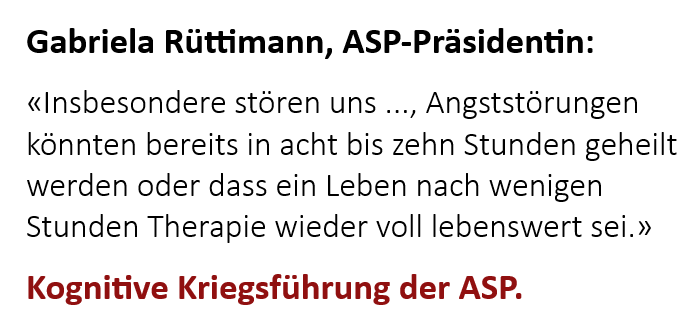
Gabriela Rüttimann, president of the ASP: “What disturbs us in particular [are claims] that anxiety disorders can be cured in as little as eight to ten hours, or that a life can be fully worth living again after a few hours of therapy.”34 Cognitive warfare of the Association of Swiss Psychotherapists (ASP).35
Two continents, one sequence: a psychotherapist publicly raises the question of the duration and effectiveness of treatment. He receives no study by way of answer, but a proceeding—in New York the petition to the licensing board and the personal attack from the podium, in Zurich the association’s complaint and the authority’s threat of a ban on practicing. In both cases the defense is directed not against the evidence presented but against the licensing of the man who presents it.

The Association of Swiss Psychotherapists (ASP) combats the international treatment standard of cognitive psychotherapy and receives covering fire from the Health Directorate of Zurich, which officially classifies the “possibility of healing psychological complaints without psychotropic drugs” as “misleading and therefore impermissible.” Cognitive warfare. Made in Zurich.
This demonstrates no intent, and certainly no arrangement across the Atlantic. It demonstrates something plainer and harder: professional systems treat the question of their own effectiveness not as an empirical question but as a disciplinary one. A system that reacts in this way will not pursue research into its own harms of its own accord.
What Is Not Being Claimed Here
Four clarifications, because in a politically charged debate they must not be left to the reader’s goodwill.
First, it is not claimed that psychotherapy does harm as such. The evidence says the opposite: as against no treatment, it lowers the risk of deterioration considerably.30 What is claimed is that a portion of treatments does harm, that nobody knows which portion that is or how large it is, and that this ignorance is no accident but the product of research left undone.
Second, it is not insinuated that this system was created for this purpose. A distinction is needed here, and it is the one that separates substantive criticism from conspiracy narrative. The emergence of the state of affairs described requires no intent: concept creep, prevalence inflation, and the looping effect operate exclusively through well-meaning participants, and nobody had to resolve upon anything. It suffices that nobody has an interest in measuring the result. Its defense, by contrast, does require decisions, and these are dated and on the record—a submission to a supervisory authority does not write itself. Whoever defends a system has not therefore built it. To claim both at once would be the error this text avoids: intent in the emergence is not demonstrable, while the intent behind the defense is documented.35
Third, this text is no recommendation to forgo treatment. Whoever is in a crisis needs help and should seek it. The question raised here concerns not the individual case but the extension of a system across an entire population. These are two different questions, and they are nonetheless played off against each other with great regularity.
Fourth, the author discloses that he works in this field himself as a cognitive psychotherapist and has an economic interest in short, targeted treatments. Whoever writes about the interests of a system in which he works has no right to conceal his own. The evidence presented is verifiable independently of that fact; all of it comes from peer-reviewed journals and official reports.
The Loss at Issue: Thinking for Oneself
In 1975, in “Medical Nemesis,” Ivan Illich distinguished three levels of physician-generated harm.36 The first is clinical: the harm done to the individual patient. The second is social: a population’s dependence on medical services. The third he called cultural—and it is the only one that cannot be undone. Cultural iatrogenesis means that a society loses the capacity to deal with pain, loss, and mortality because it has ceded that task entirely to a body of experts.
Philip Rieff had described the same process as early as 1966, when he declared “psychological man” the successor to religious man and economic man: a creature whose only binding content is his own well-being.37 What Sommers and Satel described in 2005 as an American phenomenon of the day was by then already forty years old.
The political form of this development was anticipated by Alexis de Tocqueville in 1840, long before psychotherapy existed. He foresaw a new kind of power that appears not tyrannical but solicitous: a force absolute, provident, and mild, which sees to the happiness of its citizens, keeps them in perpetual childhood, and spares them the trouble of thinking and the burden of living. “Thus it every day renders the exercise of the free agency of man less useful and less frequent; it circumscribes the will within a narrower range and gradually robs a man of all the uses of himself. The principle of equality has prepared men for these things; it has predisposed men to endure them and often to look on them as benefits.”38 Tocqueville held this form of rule to be more dangerous than open oppression, and for a single reason: its subjects do not recognize it as rule. They mistake it for help.
Psychotherapy as Cognitive Hospice Care?
With that the dystopia is named. It does not consist in every human being one day having a psychotherapist. It consists in the killing off of one’s own judgment; in the fact that it no longer occurs to anyone that a person might overcome his suffering without institutional psychotherapy—that he might think for himself.
This process is no mere suspicion. It has a name in the professional literature and by now a measure as well. The name comes from epistemology and reads epistemic injustice—an injustice done to a person not as a person but as a knower: he is denied the capacity to judge his own experience. Anna Drożdżowicz and Jan Grodniewicz were the first to examine systematically, in 2025 in the journal “Philosophical Psychology,” how this occurs in psychotherapy. They distinguish three forms: the patient is granted less credibility than his account deserves; interpretive patterns are imposed on him that do not fit his experience; and he is not included in the process of inquiry at all. The harm the two authors describe is exactly the one at issue here: the person loses the capacity to understand himself.39
The measure is supplied by a Dutch research group led by Nadia Geurtzen. They developed a questionnaire that captures dependence on treatment and tested it on 742 outpatients. The starting point of the investigation is already remarkable: that patients can become dependent on their psychotherapist is generally acknowledged—far less acknowledged is that the treatment itself can produce and reinforce that dependence. The figures they cite are not small. In one survey, 18 percent of patients and former patients reported feeling strongly dependent on their psychotherapist; idealization of the psychotherapist is named as a further adverse effect—the sense, that is, of depending on him and handing him the lead.40
The most uncomfortable finding of this work, however, lies in its analysis: the more dependent the patients were, the lower their remoralization and the more severe their complaints—and the better, at the same time, the therapeutic relationship. What every training program treats as a mark of quality, the sound working relationship, thus goes hand in hand with what ought to be feared as a side effect. One must remain honest here: a snapshot of this kind cannot decide whether the dependence intensifies the complaints or, conversely, whether more severe complaints make patients more dependent. The authors themselves draw the only possible conclusion—whether this is an unwanted side effect or an essential ingredient of effective treatment has yet to be investigated.40 We stand once again before the same blank space.
That the profession could recognize this if it wished to is shown by a paper published in 2001 in the “American Journal of Psychiatry.” John Beahrs and Thomas Gutheil, both forensic psychiatrists, set out there the duty of informed consent in psychotherapy and named its purpose expressly: it strengthens the patient’s self-determination, his personal responsibility, and his capacity to work on himself—and it lowers the risk of regressive effects, that is, of a relapse into childlike dependence on the person treating him.41 The standard, then, has been on the books for a quarter of a century. What is missing is any investigation of how often it is missed.
With that, the question in the heading can be answered. Where a treatment relieves a person of the examination of his own thoughts instead of teaching it to him, it is no longer a treatment. It is the accompaniment of a dying—not of the person, but of his judgment, in whose place the specialist’s interpretation steps. For a portion of treatments this holds true. Which portion that is appears in no statistic.
What has happened to our mental health in twenty-one years can be answered, on the strength of everything that has been measured, in three words: little measured, much interpreted, a great deal paid. The loss that has arisen in the process does not concern health. It concerns a person’s jurisdiction over himself: his personal responsibility. To self-realization this society has urged its members without pause. The responsibility for themselves it has taken off their hands.
Cognitive Psychotherapy from Dr. Dietmar Luchmann, LLC, works on the thinking errors that cause the suffering — in writing, by video, or in a single-day block. Three paths, one goal.
1. Understand the Method
2. Check Your Suitability
3. Apply for Admission
1 Sommers, C.H.; Satel, S.: One Nation Under Therapy. How the Helping Culture Is Eroding Self-Reliance. New York: St. Martin's Press, 2005. [In the original, p. 140: “As we have seen, the popular psychological imperatives to ‘get it all out’ and ‘feel it to heal it’ do not always work. Cancer patients who talk about their ordeal in therapy groups do not live longer. Mourners do not have to go through five stages of grieving, and healthy grieving does not require wrenching sadness. Expressing anger does not invariably alleviate it; on the contrary, it can make one angrier. And when people are distraught, ruminating about their pain may only intensify the pain.”]
2 Alpert, J.: Therapy Nation. How America Got Hooked on Therapy and Why It's Left Us More Anxious and Divided. New York: Hanover Square Press, 2026.
3 Schweizerisches Gesundheitsobservatorium (ed.): Psychische Gesundheit in der Schweiz: Entwicklung, Förderung, Prävention und Versorgung. Nationaler Gesundheitsbericht 2025. Neuchâtel: Bundesamt für Statistik, 2025, p. 89.
4 Ormel, J.; Hollon, S.D.; Kessler, R.C.; Cuijpers, P.; Monroe, S.M.: More treatment but no less depression: The treatment-prevalence paradox. Clinical Psychology Review, 2022, 91, 102111.
5 Jorm, A.F.; Patten, S.B.; Brugha, T.S.; Mojtabai, R.: Has increased provision of treatment reduced the prevalence of common mental disorders? Review of the evidence from four countries. World Psychiatry, 2017, 16(1), 90-99.
6 Ehrenberg, A.: Das erschöpfte Selbst. Depression und Gesellschaft in der Gegenwart. Frankfurt am Main: Campus, 2004 [French first edition: La fatigue d'être soi. Dépression et société. Paris: Odile Jacob, 1998].
7 Dörner, K.: Gesundheitssystem: In der Fortschrittsfalle. Deutsches Ärzteblatt, 09/20/2002, vol. 99, no. 38, pp. A2462–A2466. [Quotation: item 11, p. A2464.]
8 Richter, D.; Wall, A.; Bruen, A.; Whittington, R.: Is the global prevalence rate of adult mental illness increasing? Systematic review and meta-analysis. Acta Psychiatrica Scandinavica, 2019, 140(5), 393-407.
9 Haslam, N.: Concept creep and the mental health crisis. Social Issues and Policy Review, 2026, 20:e70007, 1-16.
10 Tuch, A.; Fischer, F.B.; Jörg, R.: Monitoring zur Neuregelung der psychologischen Psychotherapie. Second report commissioned by the Federal Office of Public Health (BAG). Obsan Report 07/2025. Neuchâtel: Schweizerisches Gesundheitsobservatorium, 2025, p. 4 und p. 20.
11 Bundesamt für Sozialversicherungen: Jahresbericht IV-Statistik 2024. Bern: Bundesamt für Sozialversicherungen (BSV), 2025, p. 6.
12 Foulkes, L.; Andrews, J.L.: Are mental health awareness efforts contributing to the rise in reported mental health problems? A call to test the prevalence inflation hypothesis. New Ideas in Psychology, 2023, 69, 101010.
13 Hengartner, M.P.; Eymir, A.; Haslam, N.: Expanded definitions of psychopathology: Exploring concept creep in narcissistic personality disorder. Acta Psychologica, 2026, 264, 106604.
14 Hacking, I.: The looping effects of human kinds. In: Sperber, D.; Premack, D.; Premack, A.J. (ed.): Causal Cognition. A Multidisciplinary Debate. Oxford: Clarendon Press, 1995, p. 351-394.
15 World Health Organization: ICD-11 for Mortality and Morbidity Statistics, code 6B42 Prolonged grief disorder. Geneva: WHO, 2022 [in force since January 1, 2022].
16 American Psychiatric Association: Diagnostic and Statistical Manual of Mental Disorders, Fifth Edition, Text Revision (DSM-5-TR). Washington DC: American Psychiatric Association Publishing, 2022. [The bereavement exclusion had already been dropped with DSM-5 in 2013.]
17 Treml, J.; Linde, K.; Brähler, E.; Kersting, A.: Prolonged grief disorder in ICD-11 and DSM-5-TR: differences in prevalence and diagnostic criteria. Frontiers in Psychiatry, 2024, 15, 1266132.
18 Frances, A.: Saving Normal. An Insider's Revolt Against Out-of-Control Psychiatric Diagnosis, DSM-5, Big Pharma, and the Medicalization of Ordinary Life. New York: William Morrow, 2013.
19 Horwitz, A.V.; Wakefield, J.C.: The Loss of Sadness. How Psychiatry Transformed Normal Sorrow into Depressive Disorder. New York: Oxford University Press, 2007.
20 Kleinman, A.: Culture, bereavement, and psychiatry. The Lancet, 2012, 379(9816), 608-609.
21 Szuhany, K.L.; Malgaroli, M.; Miron, C.D.; Simon, N.M.: Prolonged Grief Disorder: Course, Diagnosis, Assessment, and Treatment. Focus (American Psychiatric Association Publishing), 2021, 19(2), 161–172.
22 Currier, J.M.; Neimeyer, R.A.; Berman, J.S.: The effectiveness of psychotherapeutic interventions for bereaved persons: A comprehensive quantitative review. Psychological Bulletin, 2008, 134(5), 648-661.
23 Bonanno, G.A.: The Other Side of Sadness. What the New Science of Bereavement Tells Us About Life After Loss. New York: Basic Books, 2009.
24 Bisson, J.; Jenkins, P.; Alexander, J.; Bannister, C.: A randomised controlled trial of psychological debriefing for victims of acute burn trauma. British Journal of Psychiatry, 1997, 171(1), 78-81.
25 Mayou, R.; Ehlers, A.; Hobbs, M.: Psychological debriefing for road traffic accident victims. Three-year follow-up of a randomised controlled trial. British Journal of Psychiatry, 2000, 176, 589-593.
26 Rose, S.C.; Bisson, J.; Churchill, R.; Wessely, S.: Psychological debriefing for preventing post traumatic stress disorder (PTSD). Cochrane Database of Systematic Reviews 2002, Issue 2. Art. No.: CD000560.
27 van Emmerik, A.A.P.; Kamphuis, J.H.; Hulsbosch, A.M.; Emmelkamp, P.M.G.: Single session debriefing after psychological trauma: a meta-analysis. The Lancet, 2002, 360(9335), 766-771.
28 Petrosino, A.; Turpin-Petrosino, C.; Hollis-Peel, M.E.; Lavenberg, J.G.: “Scared Straight” and other juvenile awareness programs for preventing juvenile delinquency. Cochrane Database of Systematic Reviews 2013, Issue 4. Art. No.: CD002796.
29 Klatte, R.; Strauss, B.; Flückiger, C.; Rosendahl, J.: Adverse events in psychotherapy randomized controlled trials: A systematic review. Psychotherapy Research, 35(1), 84-99.
30 Cuijpers, P.; Reijnders, M.; Karyotaki, E.; de Wit, L.; Ebert, D.D.: Negative effects of psychotherapies for adult depression: A meta-analysis of deterioration rates. Journal of Affective Disorders, 2018, 239, 138-145.
31 Luchmann, D.: Why Cognitive Psychotherapy Is Demonstrably the Most Effective — and Helps the Fewest. Psychotherapie. 03/31/2026.
32 Villalon, I.: Depression: Volkskrankheit, Angst, Enrique. Statt Mut zu verbreiten, sorgt die Schweiz dafür, dass die Leute Angst vor dem Leben haben. Lösung? Widerstandsgeist. Inside Paradeplatz, Zurich, 11/28/2019.
33 Luchmann, D.: Switzerland as a Paradise of Psychotherapeutic Inefficiency. Psychotherapie. 08/14/2025.
34 Luchmann, D.: The Health Directorate of Zurich under Natalie Rickli and the Association of Swiss Psychotherapists (ASP). Psychotherapie. 03/03/2026. [Contains the original papers: letter of the ASP dated 09/01/2025 to the Health Directorate of the Canton of Zurich and the reply of the authority.]
35 Luchmann, D.: Cognitive Warfare of the Association of Swiss Psychotherapists (ASP). Psychotherapie. 03/16/2026.
36 Illich, I.: Die Nemesis der Medizin. Die Kritik der Medikalisierung des Lebens. München: C.H. Beck, 1995 [English first edition: Medical Nemesis. The Expropriation of Health. London: Calder & Boyars, 1975].
37 Rieff, P.: The Triumph of the Therapeutic. Uses of Faith After Freud. New York: Harper & Row, 1966.
38 Tocqueville, A. de: De la démocratie en Amérique. Tome cinquième. Bruxelles: Meline, Cans et Compagnie, 1840. [In the original, p. 250: “C'est ainsi que tous les jours il rend moins utile et plus rare l'emploi du libre arbitre; qu'il renferme l'action de la volonté dans un plus petit espace, et dérobe peu à peu à chaque citoyen jusqu'à l'usage de lui-même. L'égalité a préparé les hommes à toutes ces choses; elle les a disposés à les souffrir et souvent même à les regarder comme un bienfait.”]
39 Drożdżowicz, A.; Grodniewicz, J.P.: Epistemic injustice and psychotherapy. Philosophical Psychology, 2025, 1–24.
40 Geurtzen, N.; Keijsers, G.P.J.; Karremans, J.C.; Hutschemaekers, G.J.M.: Patients' care dependency in mental health care: Development of a self-report questionnaire and preliminary correlates. Journal of Clinical Psychology, 2018, 74(7), 1189-1206.
41 Beahrs, J.O.; Gutheil, T.G.: Informed consent in psychotherapy. American Journal of Psychiatry, 2001, 158(1), 4-10.
Your Comment
Are you interested in contacting the author? Do you have remarks, suggestions, or additions regarding this article? Do you have personal therapy experiences? We welcome substantial feedback.