Agenda Item Seven
The Association for Continuity in Psychotherapy met on a Tuesday, as always in the conference room of an institute whose chairs had been built for people who sit for a long time. Agenda item seven - in Swiss parlance a Traktandum, from the Latin for "that which is to be treated" - was called "Promises of Cure on the Internet." The president read out what a certain Dr. Weihenruh claimed: that people with anxiety disorders, after an average of ten hours of cognitive psychotherapy, experienced their lives as fully worth living again, without medication and without years of treatment.
"That bothers us," said the president. It remained open whether he meant the claim or the circumstance that someone might have proved it. To the board it made no difference. Both threatened continuity, and continuity stood first in the bylaws, ahead of continuing education, which stood second, and ahead of patient welfare, which stood third and was in good hands there. Continuity, in the association, meant that a course of treatment was measured not by whether it ended but by the fact that it went on.
What bothered the board most was the word "without," which appeared twice in the claim. The first concerned medication. Some members prescribed it themselves as physicians, the rest worked with psychiatrists who did, and all of them knew what medication can do for anxiety: dampen it, but not refute it. A dampened anxiety stays and brings its patient back to the next session right on time. A refuted anxiety leaves and takes him away with it. Whoever heals the anxiety instead of holding on to it with medication has no follow-up appointments.
The second "without" concerned their own years. A younger board member suggested first checking the ten hours and the cure without medication against the professional literature. The suggestion was not pursued, since there was a risk that the literature would confirm both.
The quality assurance portfolio was held by Dr. Beat Langwiler. Since the association's founding, its quality assurance had consisted of fourteen complaints to cantonal supervisory authorities and not a single measurement of a treatment outcome. Nobody had ever experienced this as a contradiction. Quality was what one objected to in others; what one did oneself was process. Only one thing was counted in the association: colleagues who had lost their license to practice after a complaint. The count had stood at zero since the founding, and quality assurance was determined to change that.
"We need evidence," said Langwiler. "A complaint without evidence gets filed. A complaint with evidence gets forwarded." He knew what he was talking about. Eleven of the fourteen complaints were his.
"And where do we get the evidence?"
"Somebody has to go there."
It went quiet, and in the quiet six board members looked at the seventh. Langwiler knew why. Ever since the club outing of 2011, at which he had been the only one not to board the boat - out of solidarity with the staff on the dock, as he put it at the time -, he had counted in the board as the colleague with the suitable indication, that is, with the finding that justifies a treatment. Nobody spoke about it. In this board nobody spoke about anything he had himself; of the seven members, five were that evening in treatment of their own, one was in supervision on account of his own treatment, and one had just been divorced, and during the break they mentioned it the way other clubs mention the weather.
"I have had the anxiety in process for nineteen years," said Langwiler. "Three times a week. If the man removes it in a single day, he has done something that does not exist. And if he does not, we have our evidence." He considered the plan watertight, which, given his indication, was a remarkable word to choose. The board voted its approval unanimously. Langwiler accepted the assignment; it was the only assignment of his professional life in which failure would be booked as success.
The complaint, it was decided, would afterward be drafted by the Member Assistant — an AI language model the board had acquired in the spring so that the association's statements would sound "harmonized." They had sounded very understanding ever since. No more thought went into them than before; it simply went faster.
The Telephone Call
He called under the name Kurt Zehnder, businessman. He had prepared a case history for himself, the kind his analyst liked to hear: a childhood, a father, an early incident at a pond, a mother who could not swim. It was a good case history. He had been polishing it three times a week for nineteen years.
Weihenruh did not let him get to it. "What is supposed to be different by this evening?"
Langwiler needed a moment. In nineteen years nobody had asked him that, and in nineteen years he had asked it of nobody. The question struck him as indecent, like a price tag on a painting.
"I would like to feel better."
"That is not a goal. That is a wish about the weather. What is supposed to be different by this evening?"
"I have a thing about water."
"Which thing?"
"I can't go out on it."
"Out on which water?"
"On any of it. On yours."
"What sort of businessman are you?"
"Insurance," said Langwiler. "Long-term."
"Then come at nine. The day is reserved as soon as it is paid for; you'll get the details by email. Bring nothing with you. Above all, no explanations. You are sure to have those already."
"Payment in advance?" asked Langwiler. "You haven't even seen me."
"I have heard you. For the invoice that is enough. For the treatment I need you at nine."
Weihenruh worked only against advance payment, and for a full day without exception. Early in his professional life he had stopped chasing his money among people who demonstrably could not manage their own lives; a psychotherapist who did so proved above all that he could not manage his either. Colleagues who had been complaining publicly about their fees for years considered his rule harsh. Weihenruh considered their complaining a symptom, and one he knew from his practice: those who cannot manage their own lives complain about others first.
For this assessment he needed no malice, only reading, and to anyone who asked him about it he named a source from within the profession itself. Eva Jaeggi, a behavior therapist and psychoanalyst who until 2000 was professor of clinical psychology at the Technical University of Berlin, had compiled, in a 2003 journal article, what studies had revealed about the mental state of psychotherapists. Her article bore a title that spoke for itself: "Die Angst des Therapeuten vor sich selbst" ("The Therapist's Fear of Himself"). The findings: 73 percent anxiety disorders, 58 percent depression, 82 percent serious personal problems, 11 percent addiction, plus a suicide rate estimated to be higher than the population average. "The figures vary," she wrote, "but on the whole they are rather depressing." Weihenruh also found them instructive. In the general population, nowhere near three in four people suffer from an anxiety disorder; in the profession meant to cure it, it runs rampant. The Association for Continuity in Psychotherapy could have confirmed this firsthand. It had never measured it.
Langwiler thought about the bank transfer and about the sender field of the account, which would reveal his real name. So he went to the post office and paid the fee in cash with a payment slip, writing K. Zehnder on the line marked "Payable by." The post office did not ask; it takes cash from anyone, which is its only indication. The stamped receipt he filed, because he was an orderly man, with the expenses of the quality assurance portfolio. From then on the association's bookkeeping carried an expenditure in the name of a man who did not exist, and raised no objection to it, because it had been filled out properly. Then he noted the first finding for his report: The accused demands payment in advance of any examination. To be examined: professional conduct rules. And the second: The accused refuses to take a case history. To be examined: duty of care. On the second he struck out "refuses to take" and wrote "dispenses with." One had to remain precise when one was accusing.
Nine O'Clock
The practice lay on the lake. The house stood where the path ended, and the dock began where the house ended. At the dock lay a boat without a motor. Langwiler saw it and noted inwardly: Finding three: watercraft without propulsion. Safety deficiencies. He knew that rowboats existed. He noted it anyway.
Weihenruh brought tea without asking whether anyone wanted any and sat down so that both of them faced the lake. That was not the usual arrangement. In Langwiler's practice one sat so as not to look at each other, and in his analyst's practice one lay down.
"My mother couldn't swim," Langwiler began, because one had to begin somewhere.
"Are you your mother?"
"No."
"Then that was her problem. You inherited it the way one inherits the dishware. Dishware can be given back." Weihenruh drank. "You said you can't go out on the water. What do you know when you see it, and what do you assume?"
"I know that I lose control."
"When did you last lose it?"
"Never. I have always avoided it."
"Then you don't know it. You assume it. Since when?"
"For nineteen years."
"Then you have been assuming it for nineteen years and calling the assumption knowledge because it is old. That is a confusion, not a diagnosis."
Langwiler wanted to object that the anxiety was real. He formulated inwardly Finding four: the accused disputes the reality of the anxiety and noticed, before he put the period on it, that it was not true. Weihenruh did not dispute the anxiety. He disputed its justification. That was something else, and Langwiler knew it, because he himself drew that very distinction in every expert opinion he wrote against others. He struck the finding. It was the first deletion of the day, and it annoyed him more than the boat.
"I have had the anxiety in process for a long time," he said.
"In process," Weihenruh repeated. "Like a case file?"
"It is a process."
"A process is something that has an end. Otherwise it is called a condition."
Langwiler tried the bait. He had prepared it carefully, for a promise of cure was the only violation one could explain to a supervisory authority in a single sentence. "Do you promise me that I will be able to go out on the lake this evening?"
"No."
"No?"
"I promise you that I will make tea at five o'clock. Whether you go out on the lake I do not know. Either you do it or you don't. I am not in the boat."
Finding five: no promise of cure. Langwiler noted it with a sensation he would have described in supervision as disappointment and which was in truth annoyance. The man promised nothing. He asked questions. One cannot submit a question to a supervisory authority.
Six Hundred Hours
"Who treats you?" asked Weihenruh.
"A colleague. A woman. For a long time."
"How long?"
"Nineteen years. Three times a week."
"What has she said about the water?"
"That it is a symbol."
"Of what?"
"We are still working that out."
Weihenruh took a sip of tea. "For nineteen years?"
"It is a process," said Langwiler, and heard for himself that he had already used the sentence once today.
"The lake is not a symbol," said Weihenruh. "It is wet. That is its entire content. Everything else you attribute to it you brought with you, and I had asked you to bring nothing."
Langwiler decided to steer the conversation onto his own territory. "Don't you find that the relationship between psychotherapist and patient is what actually works? That it depends less on the method than on what arises between two people?"
"The relationship is the dishware," said Weihenruh. "We are here to eat."
"In the psychotherapy I know, the relationship is the meal."
"Then you have had very fine dishware for nineteen years."
Langwiler noted Finding six: reductionist methodology, devaluation of the therapeutic relationship and had, for the first time, the feeling that the finding concerned himself, without being able to say how. He let it stand. One could not strike everything.
"You have a training," said Weihenruh. It was not a question.
"A long one."
"How long?"
"Six hundred hours of training analysis. Plus theory, supervision, colloquia."
"Six hundred hours on the couch so that you may analyze others," said Weihenruh. "And what did you learn about your anxiety there?"
Langwiler considered honestly. He was an honest man; that was his problem in a profession that interpreted honesty as resistance. "That it takes longer than one thinks."
"That is the one lesson nobody can fail to learn in six hundred hours," said Weihenruh. "It is true only if it took a long time. Learned in a single hour, it would have been false. A lesson that earns its own truth by consuming time is not an insight into your anxiety. It is an insight into the bill."
Lunch
There was bread, cheese, and tea. The föhn stood over the lake and pressed the water flat. Langwiler ate little and recorded much; by now he had produced a notebook, which Weihenruh did not comment on. Nothing Langwiler did was commented on. He began to understand that this was the method and that he did not like it, because he did not appear in it. Only his thoughts appeared, and they were examined like assertions in an expert opinion.
"Who pays for your treatment?" asked Weihenruh between two pieces of cheese.
"Basic health insurance."
"Then the insurer is the only party with an interest in your ending. And it doesn't ask."
"One cannot ask an analysis about its end. It is over when it is over."
"You have that from your analyst."
"From Freud."
"Freud also said that analyzing is an impossible profession. That sentence gets quoted less often in your association. It appears in an essay on analysis terminable and interminable, and in your circles they have chosen the latter."
Langwiler put down his bread. "In my association?"
"In every one," said Weihenruh, and cut cheese.
Langwiler wrote nothing. For the first time that day he did not know whether a finding was due, or which one. The man knew something, or he knew nothing, and either way it was useless for the report, because one could record only what had been said. What had been said was: in every one.
Two O'Clock, the Workshop
"The thought you are working with," said Weihenruh, "runs: if I lose control, I am lost. Is that right?"
"Roughly."
"Then let us take it apart. What do you observe when you stand at the water?"
"My heart beats faster. My hands. My breathing."
"Those are measurements. A pulse is not a verdict. What do you predict?"
"That it gets worse. That I lose control."
"Has that ever occurred?"
"No."
"Then it is a prediction that has failed to occur for nineteen years. In any other field it would be discarded. And what does lost mean? Drowned? Disgraced? Thrown out of the club, out of the family, out of the profession?"
"Disgraced."
"In front of whom?"
"In front of everyone."
"Who is in the boat?"
"Nobody."
"Then you are disgracing yourself in front of nobody. That is the thinnest disgrace I have ever heard of. It has no audience."
Langwiler laughed, briefly and against his will. In nineteen years of treatment he had not laughed; it was not provided for there, and he had taken that for depth.
Weihenruh laid down a sheet of paper with two columns. On the left stood Prediction, on the right Observation. "You fill in the left column now. The right one at five."
"On what scale?" asked Langwiler. In the literature there was a scale from zero to one hundred, and he had always taken it for the scientific part of the business.
"On none. Either the boat capsizes or it does not. That is a yes-or-no question, and the lake answers it without a scale."
"I interpret," said Langwiler. "I don't examine."
"That is the difference between a commentary and an experiment. You have analyzed your anxiety for nineteen years. I am asking whether it is correct."
Langwiler wrote. In the left column he wrote: Racing heart. Loss of control. Capsizing. Disgrace. At the fourth word he paused, struck it out, and wrote it down again. One could not strike a prediction merely because it had no audience.
Inwardly he formulated Finding seven: the accused applies pressure. Then he looked at the sheet, which bore his own handwriting, and at Weihenruh, who was looking out of the window and evidently wanted nothing from him, and struck that finding too. It was the second deletion. The report was growing thinner while the day was growing thicker.
Five O'Clock, the Tea
"I'm making tea," said Weihenruh at five, and went into the house.
Langwiler stayed behind on the dock. The boat lay there. Nobody told him what to do; nobody came with a life ring, a breathing technique, or a hand on his shoulder. In the literature Langwiler knew, confrontation with anxiety - cognitive behavioral therapy calls it exposure - was led by the psychotherapist. One approached it together, in graded steps, with record sheets and a scale, and one withdrew together. Langwiler had read this literature and had never applied the method, out of consideration for his patients. That was not a lie. It simply was not the reason.
He waited ten minutes. Weihenruh did not come. Through the window one could see him at the stove, and he was not looking outside.
Finding eight, thought Langwiler with mounting satisfaction: The accused leaves the patient unaccompanied in the exposure situation. To be examined: failure to render assistance. That was a point. That was finally a point. But a finding required a set of facts, and the facts had to occur: the patient had to be in the exposure situation. As long as he stood on the dock he was in no situation at all. He was a man on a dock.
Langwiler got into the boat in order to complete the finding.
He pushed off. The boat rocked, his heart did what it had announced it would do, and Langwiler entered it inwardly in the right-hand column: Racing heart, occurred. He had no record sheet with him and had to experience the anxiety without a form. He rowed. He counted the strokes in order to formulate the complaint in his head, which made the counting unreliable. At forty he looked back at the house, which had grown smaller: a house, not an institute, with a man at the stove. At sixty he checked the second line, loss of control. He was holding the oars. He had been holding them the whole time. At eighty the third line fell due, capsizing. The boat lay in the water the way boats lie in water. The lake was, as Weihenruh had said, wet, and that was all it could do.
Langwiler stopped rowing. In the middle of the lake it was quiet, and the quiet had no audience. He noticed that the anxiety was not there, and that its absence annoyed him, because it complicated the report. One could not assert a failure to render assistance when nobody had needed any. He waited to see whether the anxiety would still come. It did not come. Apparently it was an association that convened only when it had read the agenda beforehand.
When he rowed back, Weihenruh was standing on the dock with two cups in his hands.
"How was the lake?"
"Wet."
"That is all it can do." Weihenruh handed him the cup. "The right-hand column."
Langwiler filled it in, all four lines. Then he sat for a while and looked at the sheet the way one looks at an X-ray that shows no findings, and did not know whether he was relieved or cheated.
"Did you know?" he asked.
"Know what?"
Langwiler looked at him, and Weihenruh looked back, and in that look there was nothing one could have put on record. "Nothing," said Langwiler.
The Record Sheet
Weihenruh laid a second sheet on the table. It was a record sheet of the kind every patient signed at the end of a day-block: the date, the line "Worked from nine to six," beneath it the line "Achieved," followed by two empty rules, and beneath that the signature. Weihenruh had introduced the sheet after more than one person had paid for a day in advance, driven home healthy, and declared six months later that nothing had happened. As a rule they were the same people who had declared beforehand that nothing could happen. Since then Weihenruh had recorded the outcome in writing, and in the handwriting of the person who had achieved it. One can talk a person out of a great many things, but not out of his own handwriting.
Langwiler looked at the line "Achieved" and recognized the trap that was not one. If he wrote "cured," the complaint was finished before it was written. If he wrote "nothing," he was lying, and he did not lie; that, as noted, was his problem. He searched for the most cautious sentence there was, a sentence without a diagnosis, without an evaluation, without a verb that could be held against him, and wrote:
Was alone on the water.
He signed it "K. Zehnder," because one cannot sign a record sheet under a name other than the one under which one has paid. He established later that it was the most complete sentence he had ever signed. He had only meant to be cautious.
"The dock is open until seven, in case you want to go again," said Weihenruh. "I won't be coming along."
The Report
At the hotel Langwiler wrote the report for the board. He began with the findings and went through them in order. The advance payment: he had made it, the service had been rendered, and the receipt for it bore his own signature. The dispensing with a case history: the accused had learned more about the anxiety in five minutes than the case history had yielded in nineteen years, and Langwiler did not know how to explain that to an authority as a deficiency. The boat without a motor: it had been watertight. The missing promise of cure: that was not a violation but the absence of a violation, and one could not object to the absence of something without admitting that one had gone looking for it. The reductionist methodology: he tried to formulate the sentence explaining why the relationship is the meal and not the dishware, and could not reach the period without the word continuity. The failure to render assistance: nobody had needed any.
What remained: a tea, a cheese, a sheet with two columns, and an outcome. There was nothing to put on record except the outcome. So he put the outcome on record.
The accused freed the undersigned, within eight hours, from an anxiety disorder that had existed for nineteen years and been treated three times a week.
He read the sentence. It was the first sentence of his professional life that contained an outcome, and it stood in a complaint. He appended what the quality assurance portfolio appended in such cases: This is liable to arouse false expectations among patients regarding rapid treatment successes. That in his own case the expectation had not been false but fulfilled did not trouble the formula; it had been written for expectations, not for outcomes. Then he attached the expense report. With that, the association had paid for the first time in its history for a psychotherapy that had worked, and it had done so in order to prove that no such thing exists.
Then he opened the Member Assistant and had it draft the complaint to the supervisory authority.
"Thank you for your input," the language model wrote. "Your concern for patient safety is entirely understandable." There followed a draft that sounded in every respect like the eleven complaints before it, only warmer. The draft called the cure an "assertion," the eight hours "allegedly," and the undersigned an "affected party." It stated that scientific evidence was lacking; nobody had checked, but the sentence appeared in every complaint the association had ever filed and had never yet needed evidence of its own. It closed with a request for supervisory review, "so that patients may be protected from offerings that contradict the recognized treatment periods."
Langwiler read the draft twice. The proof of the violation was his cure. Without the cure there was no violation; with it there was no longer a patient who needed protecting, only an association. He understood the construction completely, and he understood as well that he had helped build it with eleven complaints without ever having stood inside it.
"Would you like me to make the tone a little more empathetic?" asked the Member Assistant. "I could also add that, according to the website, the offering is aimed at people who want to think for themselves. That could be construed as excluding all those who do not."
It had taken the distribution list from the earlier complaints: every cantonal supervisory authority that had granted the accused a license. Most authorities filed such things away. But all it took was one that did not.
Langwiler clicked Send.
Then he opened his calendar. Monday, seven fifty, as for nineteen years. He left the appointment standing. Not because he needed it. Because somebody on the board would ask why not.
Within Thirty Days
Three months later the bise was blowing over the lake, and on the table in Weihenruh's practice lay an official letter. The cantonal supervisory authority gave notice that a complaint had been received. Reports according to which a life is fully worth living again after a few sessions were liable to arouse false expectations and were deemed misleading and therefore impermissible. A statement was requested within thirty days. The complaint cited a report according to which the undersigned had been freed from an anxiety disorder within eight hours. Weihenruh had had exactly one day-block with an anxiety disorder that month.
He replied the same day, because one should not let stupidity ripen.
"Dear Sir or Madam
The complainant was treated by me under the name Zehnder. He confirmed with his signature that he was treated from nine to six, and entered on the line "Achieved": Was alone on the water. A copy is enclosed. Under what name he was previously afraid is unknown to me.
The British National Institute for Health and Care Excellence recommends a total of seven to fourteen hours of cognitive psychotherapy for anxiety disorders. The complainant received eight. I regret having exceeded the lower limit of the recommendation by one hour; under the guideline he would have been permitted to be healthy after only seven.
The Constitution of the World Health Organization, law in force since 1948, in your canton as well, defines health as a state of complete well-being and not merely the absence of disease. It names no minimum duration. Should cantonal law know of one, I request notification of the number of hours of psychotherapeutic husbandry after which a life in your canton is permitted to be fully worth living again. Until then I shall abide by the World Health Organization.
Enclosures: record sheet, guideline, constitution.
Sincerely,
Dr. F. Weihenruh"
No answer came. Authorities do not answer questions; they ask them.
The Dock
A week later a postcard lay in the mailbox, without a sender, showing a picture of a ferry. Weihenruh knew the handwriting from a sheet with two columns.
Alone on the water. The board considers it an assertion. It has elected me vice president. K. Z.
Weihenruh read the card once. He did not reply; there was nothing left to treat that had not already been treated. He stood the card against the teapot and went outside.
The dock was empty.
* * *
Unlike most Weihenruh stories, this one is not based on an event from clinical practice; it is a satire. The Association for Continuity in Psychotherapy, its board, and Dr. Beat Langwiler are entirely invented, and the illnesses, treatments, and life circumstances attributed to them here concern no real person.
What is not invented is the logic by which the mere report of a cure can become the subject of a complaint. It is documented in two articles — for the societal level in Psychotherapy Inflation: We Have Not Grown Sicker, We Only Think We Need Treatment and for the level of professional politics in Cognitive Warfare by the Association of Swiss Psychotherapists (ASP).
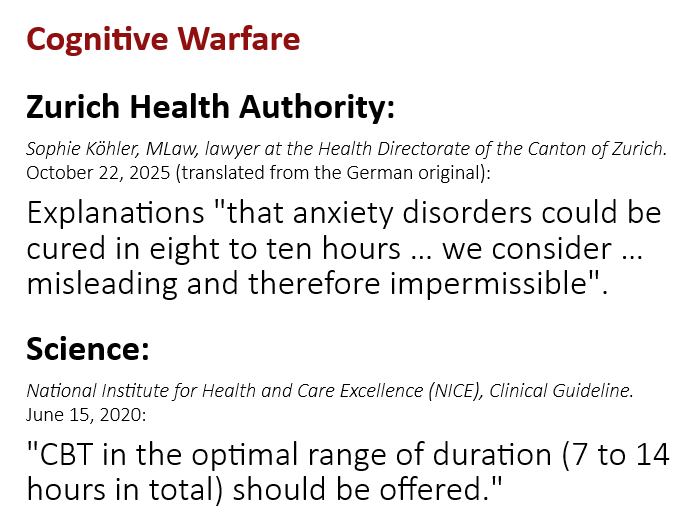
Fig. 1:
On October 22, 2025, the Health Directorate of the Canton of Zurich (Gesundheitsdirektion), under the political responsibility of SVP Government Councillor Natalie Rickli, declared explanations “that anxiety disorders could be cured in eight to ten hours” to be “misleading and therefore impermissible” (quotations translated from German). Set against this is the recommendation of the National Institute for Health and Care Excellence (NICE). This public institute evaluates the research evidence for the health system in England and derives treatment guidelines from it. Its guideline on generalized anxiety disorder and panic disorder in adults (CG113, version of June 15, 2020) recommends cognitive behavioral therapy for panic disorder totaling 7 to 14 hours and describes this range as the optimal duration of treatment. For most people, it provides for weekly sessions of one to two hours; treatment should be completed no later than four months after it begins. For other anxiety disorders, NICE guidelines in some cases specify longer courses of treatment. For panic disorder, the eight to ten hours the Directorate objected to therefore fall within the recommended range.
Read more → Cognitive Warfare in Zurich
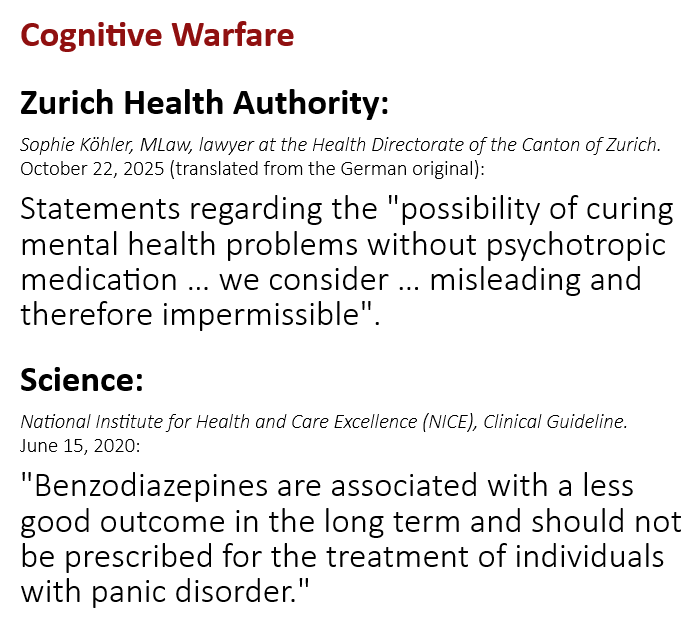
Fig. 2:
On October 22, 2025, the Health Directorate of the Canton of Zurich (Gesundheitsdirektion), under the political responsibility of SVP Government Councillor Natalie Rickli, considered information about the “possibility of being able to cure psychological complaints without psychotropic medication” to be “misleading and therefore impermissible” (quotations translated from German). The National Institute for Health and Care Excellence (NICE) develops treatment guidelines for the National Health Service in England based on the available scientific evidence. Its guideline on generalized anxiety disorder and panic disorder (CG113), in the version of June 15, 2020, states that people with panic disorder should not be prescribed benzodiazepines—that is, anti-anxiety sedatives such as diazepam—because these are associated with poorer outcomes in the long term. The guideline names complete relief of symptoms as the goal of treatment wherever possible. It ranks the recommended treatments by the documented duration of their effect: first, psychological therapy in the form of cognitive behavioral therapy (CBT); second, antidepressants; third, self-help based on the principles of CBT. Which of these treatments is offered should also depend on the patient’s preference. This presupposes that patients receive information about the possibility of treatment without psychotropic medication.
Read more → Cognitive Warfare in Zurich
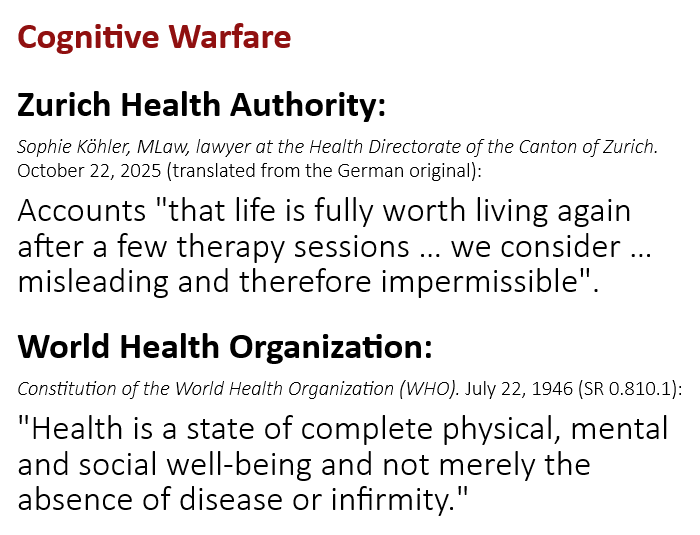
Fig. 3:
The Health Directorate of the Canton of Zurich (Gesundheitsdirektion), under the political responsibility of SVP Government Councillor Natalie Rickli, objects to the portrayal of a treatment success that is consistent with the World Health Organization’s (WHO) concept of health. On October 22, 2025, it classified reports “that a life is fully worth living again after a few therapy sessions” as “misleading and therefore impermissible” (quotations translated from German). The WHO is a specialized agency of the United Nations headquartered in Geneva. Its Constitution of July 22, 1946, is an international treaty in force for Switzerland as well and is published in the Classified Compilation of Swiss federal law under number 0.810.1. In its preamble, the States Parties declare as a basic principle: “Health is a state of complete physical, mental and social well-being and not merely the absence of disease or infirmity.” The yardstick, then, is not merely whether symptoms have disappeared, but whether a person is doing well physically, mentally, and socially. How few sessions an effective treatment may require is illustrated by the guidelines of the National Institute for Health and Care Excellence (NICE), which are cited on this page. Treatment success means not merely the disappearance of symptoms, but a life that is fully worth living again.
Read more → Cognitive Warfare in Zurich
Dr. Friedrich Weihenruh is a literary alter ego through which the author gives narrative form to his experiences as a psychotherapist. The stories are based on true events but have been fictionalized: to protect privacy and professional confidentiality, names, locations, and details have been changed. Any resemblance to actual persons is entirely coincidental.
Your Comment
Are you interested in contacting the author? Do you have remarks, suggestions, or additions regarding this article? Do you have personal therapy experiences? We welcome substantial feedback.