Who Ought to Present the Solution
In the article "Psychotherapy without Outcome Measurement" I showed that Switzerland pays for psychological psychotherapy without systematically recording whether patients get well as a result.1 In 2025, some 991 million Swiss francs were billed to basic health insurance for it, compared with 528 million in 2021.2 This article shows how that can be changed.
One would expect such a proposal to come from the professional associations of psychotherapists. The law even assigns them this task. Since April 2021, the associations of providers, that is, of those who treat patients at the expense of basic health insurance, have been required to conclude nationwide agreements on quality development with the associations of health insurers. Among other things, these so-called quality agreements must regulate how quality is measured and how the measurements are published.3,4 The first agreements were to be submitted one year after these provisions entered into force.5 For medical practices and for nutritional counseling, the agreements were submitted to the Federal Council in September 2025, and for occupational therapy in November 2025.6,7 For psychological psychotherapy, which has billed basic health insurance independently since July 2022, no such agreement has been submitted to date, as far as can be publicly ascertained. It is owed jointly by the associations of psychotherapists and of insurers.
What the associations of psychological psychotherapists have done on the question of outcome measurement is documented. When the federal government proposed in 2019 that the outcome of every psychotherapy be measured with validated instruments, the psychological and psychiatric professional societies rejected this in principle.8 Three associations, the Federation of Swiss Psychologists (FSP), the Association of Swiss Psychotherapists (ASP), and the Swiss Professional Association for Applied Psychology (SBAP), demanded in a joint position that the provision be deleted, and proposed first testing the measurement in a model project and later introducing it on a sample basis.9 To this day, no uniform, analyzable measurement of treatment outcome has been introduced in basic health insurance. The Federal Office of Public Health does state that an initial, progress, and outcome assessment is part of every psychotherapeutic treatment. But it is not uniformly recorded or analyzed, and according to the evaluation, the effect of the new regulation on the mental health of the population cannot be assessed.10
In 2025, the president of the Association of Swiss Psychotherapists (ASP), Gabriela Rüttimann, declared in a complaint filed on behalf of the association: "We are particularly annoyed by ... the claim that anxiety disorders can be cured in as little as eight to ten hours, or that life can be fully worth living again after just a few hours of therapy." Such statements, the complaint argued, "could raise false expectations among patients."11,12 The guideline of the British National Institute for Health and Care Excellence (NICE), which determines in England which treatments reflect the current state of scientific knowledge, recommends cognitive behavioral therapy totaling seven to fourteen hours for panic disorder.13
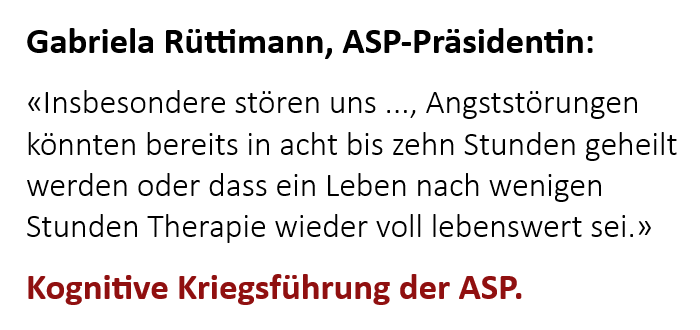
Fig. 1: Gabriela Rüttimann, president of the Association of Swiss Psychotherapists (ASP), declared on behalf of the professional association: "We are particularly annoyed by ... the claim that anxiety disorders can be cured in as little as eight to ten hours, or that life can be fully worth living again after just a few hours of therapy." This is cognitive warfare by the Association of Swiss Psychotherapists (ASP) against its members' patients and against effective psychotherapy.11,12
Finally, on November 17, 2026, a petition with more than 100,000 signatures opposing any additional hurdles to accessing psychological psychotherapy was submitted in Bern. It is directed against a motion of the Social Security and Health Committee of the National Council that demands a diagnosis made by a psychiatrist before any psychological psychotherapy begins. The petition is supported by the three professional associations of psychotherapists — ASP, FSP, and SBAP.14,15
Whose interests an association represents need not be guessed. A professional association represents the interests of its members; that is its purpose, and it is legitimate. It represents the interests of patients only insofar as they coincide with those of its members. On outcome measurement, they do not coincide. The patient wants to get well quickly. Whoever is paid per session has no financial incentive to heal quickly: every quick cure ends sessions he would otherwise still have billed, and they are lost to him if he cannot immediately fill the vacated slot. This is a statement about incentives, not about the intentions of individual psychotherapists.
The documented conduct of the three associations and their representatives matches this incentive — and unmasks them. In 2019, the associations demanded that outcome measurement be deleted from the draft ordinance and, for the time being, only tested in a model project. Gabriela Rüttimann, president of the Association of Swiss Psychotherapists (ASP), responded with a complaint to psychotherapeutic patient education stating that an anxiety disorder can be cured in eight to ten hours, although the NICE guideline for panic disorder recommends a treatment duration of exactly this order of magnitude. André Widmer, the former longtime president of the Education Commission of the Federation of Swiss Psychologists (FSP) and of the Zurich Cantonal Association of Psychologists (ZüPP), put his education on display by deriding someone who informs the public about effective psychotherapy as a "psychotherapeutic charlatan." And the associations support a petition against additional hurdles to accessing treatments whose outcome is not systematically recorded. Much can be said against the hurdle this petition opposes, and this article, too, proposes a different route; but I am not aware of any comparable effort by the associations to measure outcomes. From this I draw a conclusion that every reader can check against the evidence cited:
"These associations want no binding and comprehensive check on what is achieved by the treatments for which their members make the health insurers, and thus the premium payers, pay."
On this point, they represent not the patients, who need treatment that is effective and as short as possible, but the practitioners, who are paid for their time.
On the question of outcome measurement, the battle lines are thus drawn. On one side stand the patients and the premium payers, who want to know what a treatment achieves. On the other stand the associations of those who are paid for their time, not for the outcome. Anyone who wants to improve care therefore cannot expect the proposal to come from these associations. It has to come from outside. Here it is.
The proposal has seven parts, and I will go through them in this order. First: what is measured, namely the patient's condition and not his satisfaction with the individual hour. Second: why treatment must begin with a documented diagnosis. Third: who is obliged to measure, namely the psychotherapist and not the patient. Fourth: what is published, namely the outcome of every provider and every method. Fifth: how payment follows measured improvement. Sixth: what instruments the Federal Council already has at hand for this today. Seventh: which objections are justified. These are followed by an offer from the publisher to the cantons and the text of a motion that any member of Parliament can submit.
Dr. Dietmar Luchmann, LLC, the publisher of this journal, itself offers cognitive psychotherapy via video — in accordance with the guidelines of the National Institute for Health and Care Excellence (NICE), with a written summary of every session, for self-pay patients, in German or English, with no waiting period.
1. Understand the Method
2. Check Your Suitability
3. Apply for Admission
What Is Measured: The Condition, Not the Hour
The obvious idea would be to have the patient rate, after every session, what it has done for him. It is misleading. Such a rating measures how pleasant the hour was, not whether the patient has become healthier. A patient can experience every session as soothing and, after three years, have the same complaints as on the first day. Conversely, an effective session can be uncomfortable precisely because it attacks a pathogenic judgment to which the patient clings. Whoever has the hour rated is measuring the hour once again. What must be measured is the condition.
Validated questionnaires exist for this purpose and are completed before every session in the English program "NHS Talking Therapies."16 One, the PHQ-9 ("Patient Health Questionnaire"), asks nine questions about the signs of depression; the other, the GAD-7 ("Generalized Anxiety Disorder scale"), asks seven questions about the signs of an anxiety disorder. Each question essentially asks: Over the last two weeks, how often have you been bothered by this? The answers yield two scores whose course from session to session shows whether the patient is getting better. Both questionnaires may be reproduced, translated, and distributed without permission; in other words, they cost nothing.17 In Switzerland, they are not new. Since 2024, the psychosomatic rehabilitation clinics have used them in the national measurement plan to record patients' condition on admission and discharge, and the national comparative report sets the clinics' results side by side, risk-adjusted.18 I explain below what "risk-adjusted" means.
It is defined when a score indicates illness and when a change is more than chance. In the English program, a person counts as a clinical case, that is, as ill in the sense of the measurement, if he scores at least ten points on the PHQ-9 or at least eight on the GAD-7. A person counts as reliably improved if his score falls by at least six or four points, respectively; smaller fluctuations lie within the margin of measurement error.16 I explained this calculation in detail in the first article.1
In this program, however, England treats only depression and anxiety disorders. Swiss basic health insurance, by contrast, pays for psychotherapy for mental illnesses in general. How Swiss patients are distributed across diagnoses no one knows, because these data are not collected.10 It follows that the PHQ-9 and GAD-7 are suitable as a common core for all patients but are not sufficient for every disorder. For obsessive-compulsive disorders, trauma-related disorders, eating disorders, and other diagnoses, additional questionnaires tailored to the respective disorder are needed, of the kind the English program already uses for individual anxiety disorders,16 and age-appropriate versions are needed for children and adolescents. It should be up to an independent expert body, not Parliament, to determine which instruments these are. The motion at the end of this article therefore prescribes no particular instrument but requires validated, that is, scientifically tested, instruments.
Patient and psychotherapist see the progress curve immediately. This has a benefit of its own, if a small one: a meta-analysis, that is, a summary evaluation of 58 studies with 21,699 patients, found that feeding the scores back to the psychotherapist reduces symptoms somewhat more and makes dropouts rarer.19 The ninth question of the PHQ-9 also records thoughts of death or self-harm;16 if it is answered in the affirmative, the psychotherapist sees this before the session. The question about the benefit of the individual hour can remain as feedback to the psychotherapist. It does not count for payment or publication.
Interim summary: What is measured is not satisfaction with the hour but the patient's condition, using free, validated questionnaires that are already in use in England at every session and in Swiss rehabilitation clinics on admission and discharge.
A Documented Diagnosis Comes First
Measurement begins before the first session, and it begins with a question the law already asks: Is the patient ill? Basic health insurance covers services that serve the diagnosis or treatment of an illness.3 The Federal Council has affirmed this for psychotherapy: only services for conditions of clinical significance are paid for; according to case law, everyday problems and life crises without mental illness are not services of basic health insurance; and a physician's prescription always presupposes, in principle, an assessment of clinical significance.20
Whether this holds true in practice has come up in Parliament before. Under the title "Feel-good events are not treatments of illness," Motion 23.4108 demanded that everyday problems without clinical significance no longer be billed to basic health insurance and that psychotherapeutic treatments be discontinued if no reliable diagnosis of illness is available within a reasonable period. The Federal Council proposed that it be rejected. But it conceded that reliable data were lacking on whether basic health insurance pays for treatments of everyday problems without clinical significance, and it announced that the evaluation of the new regulation would also examine how indications are established, that is, the question of when a treatment is indicated.20 On May 7, 2025, the National Council rejected the motion by 127 votes to 64, with 3 abstentions.21
The evaluation has been available since June 2026. It does not answer the question, because it cannot. Diagnoses are not systematically recorded in the billing data, and the Federal Office of Public Health states that targeted analyses are impossible for lack of data on diagnosis and severity. According to the surveys conducted for the evaluation, the diagnosis is made predominantly by the psychological psychotherapists (77 percent) and only rarely by the prescribing physicians (12 to 13 percent).10 The formal diagnosis is thus usually not made by the prescribing physician, even though the Federal Council presupposes an assessment of clinical significance at the time of the physician's prescription, and the diagnosis does not appear in the data the federal government can analyze. The Federal Office of Public Health nevertheless sees no indication that additional rules are needed to ensure that indications are established appropriately, and it considers physicians and psychological psychotherapists in principle capable of recognizing and diagnosing a relevant mental disorder.10 That may be true; but without recorded diagnoses it cannot be verified. Whether "feel-good events" are being paid for, therefore, no one can say today, not even the Federal Council.
The remedy is an obligation that the Federal Department of Home Affairs itself proposed in 2019. Its draft ordinance called for "an initial, a progress, and an outcome assessment with validated instruments" in every psychotherapy.22 For the start of treatment, this means: the diagnosis is recorded according to the International Classification of Diseases (ICD), and the patient's condition is measured with the questionnaires. If the baseline score lies below the clinical thresholds, the illness must be documented with a disorder-specific questionnaire or justified in detail. If neither succeeds, the treatment is not a service of basic health insurance, because it does not address an illness. This achieves what Motion 23.4108 wanted, without a deadline for discontinuing treatment, and what Motion 26.4067 wants, without every patient having to find a psychiatrist before treatment begins: the severity is known from the first session, and treatments without clinical significance stand out.
On November 4, 2026, the Federal Council proposed that Motion 26.4067 be rejected. According to its reasoning, the motion would strain the scarce psychiatric resources, potentially lengthen waiting times, and create additional administrative work. It said, however, that it was prepared to examine further measures, provided there was a data-based analysis of the problem.23 As shown above, such an analysis is impossible without recorded diagnoses and measured courses of treatment. The measurement proposed here supplies exactly these data.
Interim summary: The law pays only for the treatment of illnesses, yet whether an illness is present is not recorded in any analyzable form. A documented diagnosis with a measured baseline score closes this gap, and it does so without making psychiatrists a bottleneck.
Who Is Obliged: The Psychotherapist, Not the Patient
The obligation to measure falls on the one who is paid. The psychotherapist must document that measurement took place before the session, just as he must document today that the session took place. The patient may decline to participate. The refusal is recorded, and the share of refusals is published for every psychotherapist. Anyone who reports "no measurement" conspicuously often for difficult patients thus becomes visible.
Coercing mentally ill people would not only be the first target of any countercampaign; it would also be the surest way to make the measurement founder on data protection. The Netherlands has seen what can make such a measurement founder. There, the data protection authority classified the data of a nationwide comparison of treatment outcomes as health data that should not have been processed in this way without the patients' consent, and the database was destroyed in 2019.24,25 Nor is compulsion necessary. Because measurement takes place at every session in England, an outcome score is available for more than 98 percent of those treated.16,26
The obligation must be enforced against the psychotherapist, not the patient, and this is no formality. Under the statutory default rule, the patient owes the practitioner the fee and has it reimbursed by the health insurer.3 If the insurer refused reimbursement because a measurement was missing, the patient would be left with the bill for an omission that is not his own. The law already has the right tool: providers who violate the statutory quality requirements are sanctioned; the sanctions range from a warning, the repayment of fees, and fines to exclusion from practicing at the expense of basic health insurance. The cantonal arbitration tribunal decides on this at the request of an insurer or an association of insurers.3
The measurement data go to an independent evaluation body in pseudonymized form, that is, without names. With each bill, the health insurer learns only whether measurement took place. Its medical adviser, to whom medical information is already sent today, sees the course of treatment only when a decision on continuing the treatment has to be made.
Interim summary: Whoever is paid is obliged. The patient retains the right to say no and bears no cost risk. Whoever does not measure must reckon with the sanctions the law already provides.
What Is Published: Every Provider, Every Method
A measurement that sits in a database no one can look into changes little. The results must be public, and in such a way that good and bad providers and methods are recognizable to everyone. The following are therefore published annually for every psychotherapist and every psychotherapy organization above a minimum number of cases, as well as for every psychotherapy method:
Completeness: For how many patients was measurement carried out, and how many declined?
Improvement: How many patients have reliably improved, and how many have recovered, that is, end up below the clinical thresholds?
Deterioration: For how many patients has the condition reliably deteriorated?
Effort: How many sessions did a treatment last on average, and what did one recovered patient cost basic health insurance? This last figure translates the title of this article into a key indicator.
Why for each provider? Because the differences between psychotherapists are large. In an English study of 119 psychotherapists with 10,786 patients, the share of recovered patients ranged, depending on the psychotherapist, from 23.5 to 95.6 percent.27 On the bill, both ends of this range look the same. Without measurement, those involved judge quality themselves, and they reach opposing verdicts. In the federal evaluation, most psychological psychotherapists considered quality to have remained the same (65 percent) or improved (23 percent), most psychiatrists to have remained the same (53 percent) or declined (39 percent).10 The one group tends to see an improvement, the other a deterioration, and neither verdict can be checked. Only published scores end this dispute.
No statistic, however, is beyond doubt in the strict sense, and a publication that concealed this would be unfair. Whoever treats few patients can do well or badly by chance, and whoever treats particularly severely ill patients fares worse without working any less well. Both can be taken into account. First, by a minimum number of cases below which nothing is published. Second, by risk adjustment: each provider's outcome is compared with what was to be expected for his patients given their severity at the start, diagnosis, age, and other characteristics. Third, by an expected range: only those whose results lie so far outside what could be expected that chance can be ruled out as an explanation are highlighted. In this way, good and bad outcomes become recognizable with a specifiable statistical certainty.
That this works has been tried and tested. The English program NHS Talking Therapies publishes its results for each service;26 its recovery rate rose from 37 percent in 2009 to 52 percent in 2018.28 In England, from 2013 onward, the outcomes of individual surgeons were also made publicly accessible; outside cardiac surgery, where this had happened earlier, it was the first time.29 In 2014, this publication covered some 5,000 surgeons and showed for each whether his results lay within the expected limits.30 In Switzerland, the Federal Office of Public Health has made quality indicators publicly accessible at the level of individual hospitals since 2012,31 and since July 1, 2012, the psychiatric clinics have recorded the symptom burden of, in principle, every patient on admission and discharge, with the results published for each clinic.32 The results of psychosomatic rehabilitation, measured with the PHQ-9 and GAD-7, are public as well: in the national comparative report, the clinics are identified only by numbers,18 but on its web portal the Swiss National Association for Quality Development in Hospitals and Clinics (ANQ) publishes the results for each clinic.33 For outpatient psychotherapy, there is nothing comparable.
Publication for each psychotherapist requires an explicit legal basis, because it concerns data about specific persons. The motion calls for it. Publication for each method, in turn, answers the question that the approval of methods leaves open: which of the methods recognized in Switzerland actually make their patients well. The decisive criterion for assigning a method can be the postgraduate training program the psychotherapist has completed, supplemented by the information given in the individual case. A method is then judged no longer by its origin but by its outcome.
Interim summary: Publication is by name, for each provider and each method, risk-adjusted and with an expected range. In this way, good and bad outcomes become recognizable with specifiable certainty, and to everyone, not merely to the authorities.
How Payment Works: Improvement Decides
Today, basic health insurance pays for at most 15 sessions of psychological psychotherapy per medical prescription, and before they run out, the psychotherapist reports to the prescribing physician.34 If treatment is to continue after 30 sessions, cost approval from the insurer is required, based on a report from the prescribing physician with a proposal for continuation. If a specialist in general internal medicine or in pediatrics issued the prescription, this report must additionally contain the case assessment of a psychiatrist.35 This check examines an application, not an outcome, and it is almost always passed: according to the psychological psychotherapists surveyed, 94 percent of requests for cost approval are granted.10
With measurement data, this becomes a review of the outcome. The reports after 15 and 30 sessions then contain the baseline score and the current score. If the curve after 30 sessions shows reliable improvement, continuation is approved without a further expert opinion. If it shows none, a psychiatrist's case assessment is required in every case, giving reasons why the treatment should continue and what must change in it. If the condition deteriorates, the treatment is reviewed immediately. This relieves the scarce psychiatrists where treatment works and deploys them where it does not. The Federal Office of Public Health is retaining the psychiatric case assessment and intends to improve its procedure;10 with measurement data, it gains an objective basis.
This is what the title means by paying for the cure and not for the hour. The hour continues to be paid for, but only as long as it demonstrably leads to a cure, or after a justified exception. Whoever heals has no trouble with this rule. Whoever does not heal must explain why he should continue.
The next stage, a share of remuneration that depends on the outcome itself, comes only afterward, for a reason the first article documented: money tied to a number too early corrupts the number.1 The English tariff rules for 2017 to 2019 required that the remuneration of services be linked to performance indicators, and the documented experience is mixed.36,37 In Washington State, patients with depression improved considerably faster after a quarter of the payments had been tied to quality indicators; but this was treatment coordinated by primary care physicians, which can be applied to other settings only with caution.38,39 The motion therefore demands that the Federal Council make a share of remuneration dependent on the measured outcome only after three years of reliable measurement, and that it submit draft legislation to Parliament insofar as a legal basis for this is lacking. Until then, cantons, insurers, or providers can test such forms of remuneration in pilot projects that the Department of Home Affairs can approve.40
Interim summary: First, payment follows measured improvement; later, once measurement is established, a share of remuneration follows the outcome itself. The sequence, as derived in the first article, is: measure, publish, and only then pay according to the outcome.
What the Federal Council Can Already Do Today
In my assessment, most of this proposal requires no new law. The Health Insurance Act gives the Federal Council and the Federal Department of Home Affairs, to which the Federal Office of Public Health reports, a series of instruments that have so far gone unused for outcome measurement in psychotherapy. I explain them one by one, so that anyone who wants to improve care can name them and demand that they be applied.
First, the benefits ordinance. In the Health Care Benefits Ordinance (KLV), the Department of Home Affairs determines the conditions under which basic health insurance pays for medical and psychological psychotherapy, such as who may prescribe it and when a report is due.34 It can change these conditions itself. In 2019, it had proposed making the initial, progress, and outcome assessment with validated instruments a condition of coverage.22 The smallest possible step would be to require the measured baseline score and the current score in the reports after 15 and 30 sessions. It would yield data from the first day.
Second, the four-year goals. The Federal Council sets the goals for quality development in basic health insurance for four years at a time and can adjust them during the period if the underlying conditions change substantially.3 The associations' quality agreements must be aligned with these goals. The current goals for 2025 to 2028 provide that a public overview of the quality of services is also to include patients' reports on treatment outcomes, so-called PROMs ("Patient Reported Outcome Measures"); mental health does not appear in them.41 The Federal Council can expressly declare outcome measurement in outpatient psychotherapy a goal.
Third, the quality agreements. The associations of providers and of insurers must conclude nationwide quality agreements that regulate, at a minimum, quality measurements, improvement measures and their review, the publication of the measurements, and sanctions for violations. The Federal Council must approve the agreements. If the associations fail to reach an agreement, it sets the rules itself. Individual providers must comply with the agreements, and this is a condition for practicing at the expense of basic health insurance.3,4 For psychological psychotherapy, as far as can be publicly ascertained, there is no such agreement more than four years after it began billing independently. The Federal Council can call on the contracting parties to agree on outcome measurement and can set the rules itself if no agreement is reached.
Fourth, the Federal Council's measures. Independently of the agreements, the Federal Council sets measures for quality development and for ensuring the appropriate use of services. As examples, the law cites obtaining the approval of the insurer's medical adviser before certain diagnostic and treatment procedures, in particular especially costly ones, and paying for especially costly or difficult treatments only if they are performed by providers qualified for them.3 On this basis, in my view, the Federal Council can prescribe a measurement that helps decide whether a psychotherapy continues.
Fifth, the Federal Quality Commission. This commission, in which the cantons, providers, insurers, insured persons, patient organizations, and experts are represented, advises the Federal Council and engages third parties to develop quality indicators and to conduct systematic studies. The Federal Council sets the commission's annual goals on its proposal, and the commission's costs are borne in equal thirds by the federal government, the cantons, and the insurers.3 So far, it has issued calls for tenders for projects standardizing patients' reports on treatment outcomes in orthopedics, cardiology, and rheumatology.31 The Federal Council can work toward making the development of outcome indicators for outpatient psychotherapy one of the commission's goals.
Sixth, the sanctions. Whoever violates the statutory quality requirements is sanctioned by the cantonal arbitration tribunal at the request of an insurer or an association of insurers, in the most extreme case by exclusion from practicing at the expense of basic health insurance.3 An obligation to measure without a sanction would be a recommendation. With one, it is an obligation.
Seventh, the pilot projects. Since 2023, the Department of Home Affairs has been able to approve, upon application, pilot projects that deviate from the Health Insurance Act, among other things to strengthen quality requirements. Applications can be submitted by, among others, cantons, providers, insurers, and patient organizations. A project lasts at most three years and can be extended once by three years; it is evaluated independently, participation is voluntary, and it must not cause basic health insurance any additional costs.40 Forms of remuneration by outcome could be tested here before they apply generally, provided the Department of Home Affairs approves such a project, for instance in the statutory area of "strengthening quality requirements."
Two parts of the proposal require Parliament: the legal basis that permits publication of the results for each psychotherapist, and remuneration that depends on the outcome, insofar as it is not possible under current law. Most of the rest, in my view, the Federal Council can order under current law. This can be urged by members of Parliament through their procedural requests, by the cantons, by the insurers as contracting parties to the quality agreements, and by the patient organizations that sit on the Quality Commission.
Interim summary: The Federal Council has the instruments. It can require measurement in the benefits ordinance, declare it a quality goal, set the rules of the quality agreement itself if the associations do not agree, assign the task to the Quality Commission, and have violations sanctioned. What is lacking is not instruments but their application.
Which Objections Are Justified
"The figures can be massaged." True. That is why the patient fills out the questionnaires alone and before the session, with a timestamp, and the psychotherapist cannot alter anything. Conspicuous patterns, such as courses of treatment that regularly improve by leaps and bounds shortly before the end of treatment with a particular provider, can be detected statistically. In an English survey of 650 of the program's staff, 41 percent said they had been asked to manipulate data.42 That is a reason for checks, not an argument against measurement.
"Practitioners will avoid difficult patients." Risk adjustment and the publication of each provider's baseline scores and refusal rates counter this. Anyone who treats only the mildly ill can be recognized by these figures.
"The effect only becomes apparent later." A follow-up survey six months after the end of treatment can be provided for this. Anyone who claims a late effect can document it there.
"This is bureaucracy." In Germany, a quality assurance procedure is being tested that requires the psychotherapist to provide more than a hundred items of information per case.43,44 The proposal described here requires the psychotherapist to provide the diagnosis at the start and hardly any additional information beyond that; the patient fills out the questionnaires.
"Data protection stands in the way." It imposes requirements, and they can be met: pseudonymized data at an independent body, nothing to the health insurer but the information that measurement took place, the course of treatment only to the insurer's medical adviser, and an explicit legal basis. The Dutch case shows what happens when this basis is lacking. The motion calls for it.
"Feedback alone improves little." That is true; the effect is small.19 The main gain from measurement is not the feedback to the individual psychotherapist but the knowledge of what the public is paying for.
"That costs money." The questionnaires are free. What the technical implementation costs will have to be shown by a call for tenders. It must be weighed against the sum about which the measurement provides information: some one billion Swiss francs a year for psychological psychotherapy alone.
A Note from the Publisher: An Offer to the Cantons
Whoever criticizes must show that he can do better. Whoever demands measurement must submit to it himself. Dr. Dietmar Luchmann, LLC, the publisher of this journal, is an American company. Should a German-speaking canton or a group of German-speaking cantons wish to have an outpatient anxiety clinic offering cognitive psychotherapy that works under the conditions this article demands for everyone, the company would be prepared to establish a branch in Switzerland for this purpose and to operate the clinic. For a company, establishing a branch in another country is an ordinary step; here, the initiative would come from the canton.
Measurement would take place before every session using the questionnaires described, the data would be analyzed by an independent body designated by the canton, and all results would be published, including the unfavorable ones.
The goal would be an average treatment duration below the midpoint of what the NICE guidelines recommend for the respective disorder. For panic disorder, NICE recommends cognitive behavioral therapy totaling seven to fourteen hours.13 The midpoint of this range is ten and a half hours. That such a treatment duration can be maintained in everyday care is no mere assumption. In 2004, the Berlin daily Der Tagesspiegel reported on my work, by then more than ten years long, at the Angstambulanz Stuttgart, an outpatient anxiety clinic where I treated patients as a psychotherapist billing the German statutory health insurance funds: "His maxim is: efficient treatments, limited to an average of ten hours."45 Even then, the average of ten hours required at my anxiety clinic was below this midpoint of today's NICE guidelines.
A cantonal anxiety clinic as a model project would be subject to the same requirements as any other provider; the treating psychotherapists would hold the licenses required in the canton. The offer is non-binding; form, financing, and licensing are governed by cantonal and federal law. One possible route is a pilot project, for which a canton can apply to the Department of Home Affairs.40
Why anxiety? Anxiety disorders, which include panic disorder and the phobias, are the most common mental disorders in Europe. An analysis of the studies from the countries of the European Union, Switzerland, Iceland, and Norway estimated that within a single year 14 percent of the population suffers from an anxiety disorder.46 At the same time, anxiety disorders can be treated effectively with cognitive psychotherapy in comparatively few hours. As early as 1994, the Bern psychotherapy researcher Klaus Grawe and his two coauthors stated in their analysis of 897 controlled psychotherapy studies that it is precisely the cognitive-behavioral methods that manage with astonishingly few sessions.47 What Grawe derived from controlled studies could be put into practice at the Angstambulanz Stuttgart in the everyday routine of German statutory health insurance. The proposed anxiety clinic would show publicly and verifiably what cognitive psychotherapy can achieve in a short time for the most common mental disorders. The offer contains no promise about the outcome. It contains the promise to publish the outcome, whatever it may be.
The Text of the Motion
A motion instructs the Federal Council to take a measure or to submit draft legislation to Parliament; as a rule, the mandate is given once both chambers have approved it.48 Members of Parliament can submit motions only during a session; committees can do so at any time. In the National Council, the text including its justification must not exceed 2,400 characters; in the Council of States, a justification is mandatory. If a procedural request is divisible in content and form, its points can be voted on separately.49 The German original of the following text meets these requirements; what follows is an English translation. Any member of the National Council or the Council of States can submit the German text unchanged in the 2026 winter session, and the Social Security and Health Committees of both chambers can adopt it as a committee motion at any time.
Psychotherapy at the expense of mandatory health insurance (OKP). Measure and publish outcomes, tie remuneration to improvement
Submitted text
The Federal Council is instructed, with regard to medical and psychological psychotherapy at the expense of mandatory health insurance (OKP):
1. to require that a diagnosis according to ICD be documented at the start of treatment and that the insured person's condition be measured with validated instruments before every session; the obligation lies with the provider, and the insured person may decline the measurement;
2. to base cost approval for the continuation of treatment on the measured scores and to require a psychiatric case assessment if no reliable improvement has been demonstrated;
3. to create the legal basis for an independent body to analyze the pseudonymized data and to publish the risk-adjusted results annually, including the share of declined measurements, for each provider above a minimum number of cases and for each psychotherapy method;
4. after three years of reliable measurement, to make a share of remuneration dependent on the measured treatment outcome and, insofar as a legal basis for this is lacking, to submit draft legislation to Parliament.
Justification
In 2025, some 991 million Swiss francs were billed to the OKP for psychological psychotherapy; in 2021, the figure was 528 million. No one systematically records whether patients get well. According to the FOPH's evaluation, data on diagnoses and severity are lacking, and the effect of the new regulation on the mental health of the population cannot be assessed. According to the psychological psychotherapists surveyed, 94 percent of requests for cost approval are granted; what is examined is an application, not the outcome.
The FDHA itself proposed an initial, progress, and outcome assessment with validated instruments in 2019. In the NHS Talking Therapies program, England measures every session and publishes the results for each service; the recovery rate rose from 37 to 52 percent between 2009 and 2018.
The motion pursues the goals of Motion 26.4067, namely curbing the rise in costs, steering supply, and making access easier for the more severely ill, with data rather than by making psychiatrists an additional bottleneck. The Federal Council proposes that Motion 26.4067 be rejected and makes further measures conditional on a data-based analysis of the problem; this motion creates the data this requires.
Whoever Pays Has the Right to Know What He Is Buying
The first article1 showed that Switzerland pays for the hour and knows nothing about the cure. This one shows that there is no objective reason for this. The questionnaires are freely available and already tried and tested in Switzerland, the legal bases for most of the proposal already exist in my assessment, and the federal government itself proposed measurement in 2019. What is missing is the resolve to implement it against the resistance of those who are paid for their time and who defend this business model, scandalous in terms of health policy, with cognitive warfare against informing the public about effective psychotherapy.11,12,47
"Whoever heals has nothing to fear from measurement. Whoever does not heal should not go on being paid without anyone noticing."
Criticism is cheap as long as it shows no way forward. This article shows one, together with the wording that Parliament needs for it. Whether it is taken is now up to the Federal Council and Parliament.
1 Luchmann, D.: Psychotherapy without Outcome Measurement: Paying for the Hour, Not for the Cure. Psychotherapie, November 17, 2026.
2 Bundesamt für Gesundheit: Dritter Monitoringbericht zur Neuregelung der psychologischen Psychotherapie: Kostenanstieg hat sich verlangsamt. Press release, November 2, 2026.
3 Bundesgesetz über die Krankenversicherung (KVG). SR 832.10, Art. 25, 42, 58, 58a, 58b, 58c, 58f, 58h, and 59.
4 Bundesamt für Gesundheit: Änderung der Verordnung über die Krankenversicherung (KVV): Umsetzung der Änderung vom 21. Juni 2019 des Bundesgesetzes über die Krankenversicherung betreffend Stärkung von Qualität und Wirtschaftlichkeit. Erläuterungen. [Entry into force on April 1, 2021; Art. 58a paras. 4 to 6 KVG.]
5 Bundesversammlung der Schweizerischen Eidgenossenschaft: Bundesgesetz über die Krankenversicherung (KVG) (Stärkung von Qualität und Wirtschaftlichkeit), Änderung vom 21. Juni 2019. Final vote text. [Transitional provision: first submission of the quality agreements one year after entry into force.]
6 prio.swiss; FMH; Schweizerischer Verband der Ernährungsberater/innen (SVDE): Qualität als gemeinsame Verantwortung. Press release, Bern, September 11, 2025. [Quality agreements for medical practices and for nutritional counseling submitted to the Federal Council for approval.]
7 Ergotherapie-Verband Schweiz (EVS); Schweizerisches Rotes Kreuz (SRK); prio.swiss: Qualitätsvertrag für die Ergotherapie beim Bundesrat zur Genehmigung eingereicht. Press release, Bern, November 27, 2025.
8 Eidgenössisches Departement des Innern, Bundesamt für Gesundheit: Änderung der Verordnung über die Krankenversicherung (KVV) und der Krankenpflege-Leistungsverordnung (KLV) betreffend Neuregelung der psychologischen Psychotherapie und der Zulassungsvoraussetzungen nicht-ärztlicher Leistungserbringer. Bericht über die Ergebnisse der Vernehmlassung. Bern, March 19, 2021, section 4.5.
9 Schweizerischer Berufsverband für Angewandte Psychologie (SBAP): Stellungnahme zur Änderung der KVV und der KLV betreffend Neuregelung der psychologischen Psychotherapie. September 9, 2019.
10 Bundesamt für Gesundheit: Formative Evaluation der Neuregelung der psychologischen Psychotherapie. Bericht des BAG. Bern, June 24, 2026. [Summary and chapters 6.5, 7, and 8: missing data on diagnoses and severity, who makes the diagnosis, approval rate of requests for cost approval, assessment of quality by the professionals, psychiatric case assessment, initial, progress, and outcome assessment, effect on mental health.]
11 Dr. Dietmar Luchmann, LLC: Association of Swiss Psychotherapists (ASP) "Disturbs" Scientific Psychotherapy Standards. Psychotherapie, February 16, 2026.
12 Luchmann, D.: Cognitive Warfare by the Association of Swiss Psychotherapists (ASP). Psychotherapie, March 16, 2026.
13 National Institute for Health and Care Excellence (NICE): Generalised anxiety disorder and panic disorder in adults: management. Clinical guideline CG113. London: NICE, 2011.
14 blue News (Keystone-SDA): Over 100,000 signatures in support of easy access to psychotherapy. November 17, 2026.
15 Kommission für soziale Sicherheit und Gesundheit des Nationalrates (SGK-N): Elektronisches Gesundheitsdossier: Geordneten Übergang vom EPD zu E-GD sicherstellen. Press release, August 21, 2026. [Section on psychological psychotherapy: Motion 26.4067, "Obligatorische Krankenpflegeversicherung: Gezielter Einsatz der Prämien- und Steuergelder."]
16 NHS England: NHS Talking Therapies for anxiety and depression Manual (formerly known as Improving Access to Psychological Therapies). Version 8, updated October 2026. [Table 2: methods recommended by NICE; Tables 8 and 9: questionnaires and thresholds; Appendix F: wording of the questionnaires.]
17 Nationaler Verein für Qualitätsentwicklung in Spitälern und Kliniken (ANQ): Patient Health Questionnaire PHQ-15, PHQ-9, GAD-7. Questionnaire used in the rehabilitation measurement. [Note on the forms: "No permission is required for reproduction, translation, display or distribution."]
18 Basedow, F.; Zembic, A.; Garuffi, G.; Tobler, S.: Nationaler Vergleichsbericht 2024. Psychosomatische Rehabilitation. Nationaler Messplan Rehabilitation. Bern: ANQ, September 11, 2025. [PHQ-9 and GAD-7 since 2024 instead of the HADS; measurement on admission and discharge; risk-adjusted comparison of the clinics, which are identified by numbers in the report.]
19 de Jong, K.; Conijn, J.M.; Gallagher, R.A.V.; Reshetnikova, A.S.; Heij, M.; Lutz, M.C.: Using progress feedback to improve outcomes and reduce drop-out, treatment duration, and deterioration: A multilevel meta-analysis. Clinical Psychology Review, 2021, 85, 102002.
20 Nationalrat: Sondersession Mai 2025: Tagesordnung EDI mit Texten. [Motion 23.4108 (Bircher) Graber, "Krankenversicherung. Wohlfühlveranstaltungen sind keine Krankheitsbehandlungen. Stopp der Verschleuderung von Prämien- und Steuergeldern!" with submitted text, justification, and statement of the Federal Council.]
21 Nationalrat: Abstimmungsprotokoll zur Motion 23.4108. May 7, 2025, Ref. 30594. [64 yes, 127 no, 3 abstentions.]
22 Eidgenössisches Departement des Innern: Krankenpflege-Leistungsverordnung (KLV), Änderung: Entwurf für die Vernehmlassung. June 2019, Art. 2 para. 1 let. b.
23 Das Schweizer Parlament: Motion 26.4067: Obligatorische Krankenpflegeversicherung. Gezielter Einsatz der Prämien- und Steuergelder. Curia Vista. [Submitted by the Social Security and Health Committee of the National Council on August 20, 2026; statement and proposal of the Federal Council of November 4, 2026: rejection.]
24 Skipr: Privacywaakhond tikt kwaliteitsinstituut ggz op de vingers. December 16, 2019.
25 Skipr: Akwa GGZ vernietigt betwiste oude ROM-data. August 9, 2019.
26 Clark, D.M.; Canvin, L.; Green, J.; Layard, R.; Pilling, S.; Janecka, M.: Transparency about the outcomes of mental health services (IAPT approach): an analysis of public data. The Lancet, 2018, 391(10121), 679-686.
27 Saxon, D.; Barkham, M.: Patterns of therapist variability: Therapist effects and the contribution of patient severity and risk. Journal of Consulting and Clinical Psychology, 2012, 80(4), 535-546.
28 Clark, D.M.: IAPT at 10: Achievements and challenges. NHS England, 2019. [With the annual recovery rates and treatment numbers from 2009 to 2018.]
29 NHS England: Major breakthrough in NHS transparency as consultant mortality data goes online for first time. June 2013.
30 NHS England: Consultant Outcomes Publication. November 19, 2014.
31 Eidgenössische Qualitätskommission (EQK): Qualitätsplattform und nationales Qualitäts-Monitoringsystem. Information zum Stand der Projekte der EQK. Bern, June 2026.
32 Nationaler Verein für Qualitätsentwicklung in Spitälern und Kliniken (ANQ): Messmanual Stationäre Erwachsenenpsychiatrie. From measurement year 2024, version 8.0.
33 Nationaler Verein für Qualitätsentwicklung in Spitälern und Kliniken (ANQ): Publikationskonzept Rehabilitation. Rehaspezifische Messungen, Version 7.0. Bern, approved on May 18, 2026. [Publication of the results on the ANQ web portal for each clinic or clinic site, for psychosomatic rehabilitation including PHQ-9 and GAD-7.]
34 Verordnung des EDI über Leistungen in der obligatorischen Krankenpflegeversicherung (Krankenpflege-Leistungsverordnung, KLV). SR 832.112.31, Art. 2 and Art. 11b.
35 Bundesamt für Gesundheit: Häufig gestellte Fragen: Weiterführung der psychologischen Psychotherapie nach 30 Sitzungen. [Cost approval under Art. 11b para. 3 KLV; case assessment when the prescription is issued by specialists in general internal medicine or in pediatrics.]
36 NHS England: IAPT Outcomes-Based Payment Approach. Slide set, March 2017.
37 NHS England: Paying for quality and outcomes: IAPT case studies. June 2018.
38 Unützer, J.; Chan, Y.-F.; Hafer, E.; Knaster, J.; Shields, A.; Powers, D.; Veith, R.C.: Quality improvement with pay-for-performance incentives in integrated behavioral health care. American Journal of Public Health, 2012, 102(6), e41-e45.
39 University of Washington: Payment innovation cuts depression time in half. April 20, 2012.
40 Bundesamt für Gesundheit: Krankenversicherung: Pilotprojekte zur Eindämmung der Kostenentwicklung (Experimentierartikel). [Art. 59b KVG.]
41 Bundesamt für Gesundheit: Ziele des Bundesrates zur Qualitätsentwicklung in der Krankenversicherung für die Jahre 2025-2028. Bern, March 2024, pp. 4 and 12.
42 British Sociological Association: NHS therapists are pressured to exaggerate success, research says. August 26, 2021. [Report on a survey by E. Cotton.]
43 Wissenschaftlicher Beirat Psychotherapie: Positionspapier zum QS-Verfahren Ambulante Psychotherapie.
44 Bundespsychotherapeutenkammer: BPtK: geplantes QS-Verfahren ambulante Psychotherapie nachteilig für Patientenversorgung. Press release, January 23, 2024.
45 Kast, B.: "Der Graben ist grösser denn je": Psychotherapeuten streiten darüber, welche Methode von der Kasse bezahlt werden soll. Der Tagesspiegel, Berlin, August 20, 2004, vol. 60, no. 19172, p. 25. [Including a report on the work of Dietmar Luchmann at the Angstambulanz Stuttgart.]
46 Wittchen, H.-U.; Jacobi, F.; Rehm, J.; Gustavsson, A.; Svensson, M.; Jönsson, B.; et al.: The size and burden of mental disorders and other disorders of the brain in Europe 2010. European Neuropsychopharmacology, 2011, 21(9), 655-679.
47 Grawe, K.; Donati, R.; Bernauer, F.: Psychotherapie im Wandel. Von der Konfession zur Profession. Göttingen: Hogrefe, 1994, pp. 696-703.
48 Parlamentsdienste: Faktenblatt Motion. Parliamentary dictionary.
49 Parlamentsdienste: Faktenblatt Parlamentarische Vorstösse. Parliamentary dictionary.
Your Comment
Are you interested in contacting the author? Do you have remarks, suggestions, or additions regarding this article? Do you have personal therapy experiences? We welcome substantial feedback.