Disclosure of a Conflict of Interest
Dr. Friedrich Weihenruh later called the makeup of the audience that evening demographically impossible. Students sat in front, retirees in back, and in between, no one. People between thirty and sixty were, he suspected, busy on a Tuesday evening earning the money they would later have no idea what to do with. The only exception sat in the first row: a student in her mid-thirties who, as would soon become clear, did not keep her questions to herself.
Weihenruh wore a black tie that made him look more solemn than he felt. He laid a single sheet of paper on the lectern and began without a greeting.
"In scientific journals, every article states who paid for the research and what interests its author has. This is called the disclosure of conflicts of interest. I consider it one of the few inventions of science that ought to be introduced into private life as well, and so I shall begin with it."
"First: you have paid in advance. I work only for payment in advance, and a lecture is no different from the movies or the opera: no one gets into the hall without a paid ticket. For you, this has an advantage. Since your money is already in my pocket, I have no need to tell you what you want to hear."
"Second: I am sixty-eight, which in my case is a statement of age and not a worldview."
"Third: I was married for forty years. My wife died half a year ago. The black tie is not a fashion statement. I was advised to wait with this lecture until the year of mourning was over. My wife would have said: Then wear a black tie and say what you have to say. As usual, I followed her advice."
It grew quiet, in that particular way a room grows quiet when three hundred people all at once do not know whether they are allowed to laugh.
"You may," said Weihenruh. "Tonight is about love, and one can speak about love only with humor or not at all. I mention the year of mourning only so that you know my bias. A widower who talks about love in old age is roughly as impartial as a winemaker who talks about wine. You may listen to him. You should not believe everything he says."
He picked up the sheet of paper.
"Let me tell you in advance what awaits you. I am going to show you five things. First, where the title of this evening comes from. Second, the origin of an old saying that has haunted me for years. Third, what young people suffer from, if not from love, and what they can do about it without turning seventy. Fourth, why love is not the same as sex. Fifth, what is left of it when one is old. At the end I shall tell you what I myself know about it, and explain why that is the part you should believe least."
"All of this hinges on a single distinction that I would like to explain to you tonight. If you take nothing else home with you, then please take this: it makes a difference whether one needs a thing or merely wishes for it. Anyone who needs a thing suffers want when it is missing. Anyone who merely wishes for it would like to have it but can also manage without it. The one is necessity, the other freedom. You will hear these two words often tonight."
"I shall also tell you right away how to measure this evening. In America a prize is awarded every year for research that, in the words of its organizers, first makes people laugh and then makes them think. It is called the Ig Nobel Prize, a play on the word ignoble.1 I have set myself the same order for tonight. If both succeed, it will have been almost psychotherapy, and you have already paid for that."
La mar
"Let us begin with the title. It is stolen from Ernest Hemingway, who in 1952 published a novella that all of you know or believe you know: The Old Man and the Sea.2 An old Cuban fisherman named Santiago has caught nothing for eighty-four days. On the eighty-fifth he goes out alone, farther than ever before, hooks a giant marlin, battles it for three days, kills it, lashes it alongside his skiff, and on the way home has to watch the sharks strip his catch down to the skeleton."
"What few people notice: this story is also a love story, and Hemingway supplies the clue himself. Santiago always calls the sea la mar, in the feminine, the way Spanish speakers do when they love it. The younger fishermen, who bought motorboats with the money from the shark-liver trade, say el mar, in the masculine. To them the sea is an adversary, a mere location, at times even an enemy. To the old man it is something that bestows its favor or withholds it, and when it turns savage or cruel, it does so, he believes, because that is its nature. Even the moon, we are told, works on the sea as it works on a woman."
Someone in the front muttered that this was merely grammar.
"Grammar is never merely grammar," said Weihenruh. "Note the difference: the young men have a motor, the old man has a sail. What a motor supplies is called a drive, and with that word we have already arrived at our subject. A man with a motor goes wherever the drive drives him. A man under sail must read the weather, understand the water, and adapt himself to something he does not control. The one conquers a territory. The other lives with a counterpart."
"The German translation, incidentally, made Santiago's beloved neuter: das Meer, although German had a feminine word ready to hand in die See. One can call that translation. One can also call it objectification."
"What brought me to this evening was a detail. Santiago's dreams no longer hold storms or women, great events or great fish, fights or trials of strength. Nor does he dream any longer of his late wife, whose photograph he took down from the wall because the sight of it deepened his loneliness. He dreams only of places now, and of the lions on the beach, romping at dusk like kittens."
"That is how a man dreams who no longer has anything to prove. Yet the next morning he gets up, goes out, and fights a great fish for three days. In his dreams he is already free, but not yet by day. I shall come back to this difference at the end of the evening."
"Hemingway himself knew what he was writing about. He was married four times. The question of whether one needs a woman he answered four times with yes and corrected three times in court.3 Two years before the novella he had published a novel, Across the River and into the Trees, in which a fifty-year-old colonel falls in love with a young contessa in Venice. The character unmistakably bore the features of a young Italian woman named Adriana Ivancich, with whom Hemingway had fallen in love.3 The critics savaged the book. Hemingway thereupon sent an old man without a woman out to sea and was rewarded with the Pulitzer Prize in 1953 and the Nobel Prize in 1954, whose citation expressly mentions the novella.4 The dust jackets of both books were designed by the same young woman, Adriana Ivancich. The old man at sea reached the bookstores wrapped in the young woman's jacket."
"In essence, Hemingway had already written The Old Man and the Woman, only under a different title, and failed with it. From this sequence I have learned that if you want a prize, you should begin with the woman and end with the sea. Tonight I am doing it the other way round. I am no longer in need of the Nobel Prize."
"But you don't even have it," the student called out, "the Nobel Prize, I mean."
"Precisely," said Weihenruh. "You have just anticipated the point of the evening for me. One can stop needing a thing without ever having possessed it. For the front rows, that is good news."
A Saying with a Pedigree
"I heard the saying that concerns us tonight many years ago, I no longer remember from whom, and it has not let go of me since: When I was in need of women, I lacked the money; when I had the money, I no longer needed them."
In the back rows a few heads nodded.
"I see the saying divides the hall roughly down the middle. Up front you know the first half, in the back the second. No one here experiences both halves at once. Therein lies the saying's tragedy."
"A well-known German version is attributed to Immanuel Kant: In my younger years, when I could have used a wife, I could not feed one; and now that I can feed one, I have no use for one.5 I must disappoint you. I have found no evidence for it, either in Kant's writings or in his early biographers. That speaks not against the sentence, only against Kant as its author."
"The vocabulary, however, is genuine. In his Metaphysics of Morals, Kant does indeed define marriage as the union of two persons of different sex for the life-long reciprocal possession of their sexual attributes. Sexual union itself he calls the reciprocal use that one human being makes of the sexual organs and capacities of another.6 Whoever put the line about use into Kant's mouth knew this passage."
An elderly gentleman in the last row wanted to know whether that was why Kant never married.
"I suspect that was why no woman married him," said Weihenruh. "Picture the situation. A professor in Königsberg asks a lady to unite with him for the life-long reciprocal possession of their sexual attributes. I know no woman who would answer that with yes. I know several who would answer it with an umbrella."
It took a while for the hall to settle down.
"It gets better. In the next paragraph Kant explains why, in order to sleep with each other, one must marry at all. In the sexual act, he writes, a human being makes himself into a thing, which conflicts with the right of humanity in his own person. This is permissible, he says, only under a single condition: that the one person is acquired by the other just as a thing and that the latter in turn reciprocally acquires the former; for in this way it regains itself and restores its personality."6
"Put more simply: two people acquire each other like a thing and get themselves back as persons in return. Each gives himself away and buys himself back in the same instant. Marriage, for Kant, is a buy-back deal with a personality guarantee. I have known couples who managed for a lifetime with less contract."
"Because Kant was thorough, he closes a loophole while he is at it. Someone might, after all, hit on the idea of acquiring from the other only the part that matters to him at the moment. Kant blocks this way out with a sentence I would present, framed, to everyone about to marry: But the acquisition of a member of a human being is at the same time the acquisition of the whole person, because the person is an absolute unity.6 By a member, as the context shows, Kant means exactly what you are now thinking of. He merely says it in a way that could be read aloud before ladies in Königsberg. Kant allows no partial deliveries. Anyone who wants one part gets the whole person, moods, mother-in-law, and snoring included, and life-long at that."
"To return to your question," Weihenruh said to the gentleman in the last row, "of why Kant stayed single: tradition offers an answer I like even better than mine. Twice, so the story goes, he became better acquainted with a woman who was visiting Königsberg, and both times he waited too long with his proposal.7 With him, this was method. For the Critique of Pure Reason he needed, as he wrote to Moses Mendelssohn, at least twelve years of reflection and some four to five months of writing it down.8 Visits, however, do not as a rule last twelve years. One of the greatest thinkers of the modern age remained a bachelor, if you like, out of sheer thoroughness."
"Back to our saying. The thought behind it is much older than Kant. In Measure for Measure, written around 1604, Shakespeare has a duke explain to a young man what life is worth, and in doing so he delivers both halves of our saying in a single breath.9 Youth, he says, doth beg the alms / Of palsied eld: it begs alms of trembling old age, because the old have the money. … and when thou art old and rich, / Thou hast neither heat, affection, limb, nor beauty, / To make thy riches pleasant."
"In 1867 the thought surfaces in an American theological journal. There it counts as one of the finest of the old epigrams, as pithy maxims are called, and as one that nearly every man of the world has experienced for himself.10 The author promptly put it into verse: In youth my passions were by want restrained, / And passion died in age when wealth was gained. The poem ends by saying that all our days pass in half-completed joys and close in disappointment."
"I shall come back to this disappointment, for it rests on a thinking error that can be corrected. For now, only this much: the old man of the epigram is disappointed because he measures old age by the yardstick of youth. He now has the money for something he no longer needs, and instead of rejoicing, he laments that he no longer desires it."
"The French have boiled the whole thing down to six words: Si jeunesse savait, si vieillesse pouvait. If youth only knew, if age only could. The printer and scholar Henri Estienne took the thought into his collection of proverbs in verse as early as 1594.11 He might have added: and if both knew what they actually want, they would not need the saying."
"So that you cannot accuse me of merely reciting bons mots, one more fact. In Switzerland the first half of our saying was for a long time the law of the land. Numerous Reformed cantons, among them Zurich and Bern, pursued a policy, from the seventeenth into the nineteenth century, designed to deter members of the lower classes from marrying. Aargau, which became a canton only in 1803, followed suit in the nineteenth century. Some made the marriage permit conditional on a minimum of assets.12 Only the Federal Constitution of 1874 stipulated that the right to marry must not be restricted on economic grounds.13 When I was in need of women, I lacked the money was therefore no sigh. It was an administrative act."
He put the sheet of paper down.
"That leaves the word that matters to me. The saying does not say: When I wished for women. It says: When I was in need of women. The German original uses the verb bedürfen, which goes back to the Old High German bithurfan, meaning to be needy, to have need of something. The needy were those who were poor and suffered want.14 In the nineteenth century, moreover, the German word for a need, Bedürfnis, served as a more refined term for the call of nature. A man who went to attend to his Bedürfnis in those days was looking not for a woman but for the privy. Language has long known what youth often forgets: a need is something you relieve. What you love is something else."
The State of Need
"Let us turn to youth and its state of need in the storm of hormones."
"A student once described to me how he once sat in a lecture behind a fellow student whom he knew only by the nape of her neck and her pinned-up hair. What the lecture was about he could no longer say; the nape and the hair he recalled at once. The following night he dreamed of them, and his body accomplished, without any help from him, what the day had not permitted. Physicians call this a nocturnal emission; the older medical term, still current in German, is pollution, from the Latin pollutio, meaning defilement. At this point medicine borrowed its vocabulary from the Church and never gave it back."
"At an American university, 283 students between eighteen and twenty-five were asked to keep count for a week of how often they thought about sex.15 The young men arrived at a median of nearly 19 thoughts a day, the young women at about half as many. The median is the middle value: half of those surveyed fall below it, half above. Some individuals reached 388, which makes me wonder when they found the time to count."
"The same young men thought almost as often about food and a good half as often about sleep. One should therefore not accuse them of thinking about only one thing. They think about three things. Food is the dining hall's department, sleep the lecture's, and for the third, nobody feels responsible."
"But let us not be unfair. A patient, twenty-three at the time, described her desire to me as a roommate who never moves out, never pays rent, and is loud at night. With that she described what young people go through with their own bodies. You never invited the roommate, you cannot get rid of him, and he behaves as though he were master of the house."
"Sophocles already knew this master of the house. At the opening of his Republic, Plato has the rich old Cephalus recount how someone once asked the aged poet how things stood with him and love, and whether he could still lie with a woman.16 Cicero rendered the answer in Latin: Di meliora! Libenter vero istinc sicut ab domino agresti ac furioso profugi.17 May the gods grant better! Gladly have I escaped from that, as from a rude and raging master."
"Arthur Schopenhauer read the same passage and, as always, went further: Plato judges far more correctly (at the opening of the Republic) in calling old age happy insofar as it is finally rid of the sexual drive that has incessantly disturbed us until then. The endless whims this drive produces, he wrote, sustain in a person a constant, mild madness.18 Schopenhauer meant that seriously. Tonight I mean it only by half."
"The other half is supplied, with reservations, by biochemistry. In Pisa, researchers measured a particular transport molecule for the neurotransmitter serotonin in the blood platelets of 20 people who had recently fallen in love. Its density was as low as in 20 patients with obsessive-compulsive disorder and markedly lower than in 20 healthy people.19 With so few subjects, this is no proof, rather a consolation: if you are in love and can think of nothing else, you have not become stupid. It simply takes a greater effort of thought to keep your brain chemistry under control."
"Goethe dispatched the whole matter in two lines. In the witch's kitchen Faust drinks a rejuvenating potion, and Mephisto remarks softly: Du siehst, mit diesem Trank im Leibe, / Bald Helenen in jedem Weibe.20 With this potion in your body, you will soon see Helen in every woman. Helen was the most beautiful woman of Greek legend. That is how Goethe describes what hormones do to perception. The two lines are almost two hundred years older than the modern potency pill and could nevertheless appear on its package insert, under side effects."
A gentleman farther back raised his hand. "Well, that business with Helen … for me it's still like that today."
"Then I congratulate you," said Weihenruh, "or I pity you. Which of the two, you must decide for yourself. That is what this evening is about."
"Arousal is a fact. It comes whether one has ordered it or not, and in the young it comes more violently. What torments the young, however, is less the arousal than the judgment they pass on it: I can't stand this. Albert Ellis, a psychiatrist from New York, coined an ugly but apt word for this judgment: I-can't-stand-it-itis.21 Ellis distinguished between a demand and a wish. I must have this is a demand, and if it goes unfulfilled, one despairs. I would like to have this is a wish, and if it goes unfulfilled, one is disappointed, but not desperate. That is precisely the difference between needing and wishing that I spoke of at the beginning."
"Ellis tried out his method on himself first. He was a shy young man who desired women and was afraid of every single one of them, above all of their no. In August 1933, at nineteen, he therefore prescribed himself a cure.22,23 For a month he sat down next to every woman who was sitting alone on a park bench in the Bronx Botanical Garden, in order to talk to her. There were a hundred and thirty. Thirty got up and left almost as soon as he sat down. With the remaining hundred he talked, some briefly, some at length. A single one agreed to a date. She did not show up."
"Ellis nevertheless considered the experiment a complete success, and he was right. Nobody, as he later summed it up, had pulled a stiletto to castrate him, nobody had vomited and run away, and nobody had called the police.24 He had tested his conviction that a no was unbearable against reality. The rejection was not unbearable, merely annoying. I must have her yes had become I would like her yes. After a month he had a hundred conversations behind him, one date that fell through, and no fear left. Many a psychotherapist would be content with that success rate. A good twenty years later he turned it into a method, Rational-Emotive Psychotherapy."
The student asked what one was supposed to do, then, other than wait until one turned seventy.
"Think," said Weihenruh. "It's faster and cheaper. Ellis was nineteen."
"About what?" asked the student.
"For instance, about what guides your choice," said Weihenruh. "For that is where the state of need does its greatest damage, not out of stupidity but out of biology. Let me show you with a beetle."
Do You Like What You See?
"In Western Australia there lives a jewel beetle with the lovely name Julodimorpha bakewelli. The female is brown and glossy, and her wing cases are covered with rows of fine dimples that shimmer in the sunlight. The males fly about searching for exactly this signal. In 1983 two entomologists, Darryl Gwynne and David Rentz, published an observation whose title deserves to be remembered: Beetles on the bottle.25 The males were trying to mate with discarded beer bottles."
Laughter.
"Don't laugh too soon. From a beetle's point of view, the bottles were the perfect female: brown, glossy, with a band of glass bumps along the lower edge that reflected the light much as the wing cases do, and above all larger than any female nature has ever produced. A superfemale. The males would not let go. Some perished in the blazing sun, others were eaten by ants, and a few had to be pried off the bottle by hand by the researchers."
"For this, the two researchers received the Ig Nobel Prize in 2011, which I mentioned at the beginning.1 The beetle is not stupid. It follows a rule that has proved itself over millions of years: the bigger, browner, and glossier, the more female. The rule always held, until human beings began bottling beer in brown glass and tossing the empties into the landscape."
"Ethology calls such a thing a supernormal stimulus: a dummy that exaggerates the features of the original and therefore works more powerfully than the original. Niko Tinbergen, who received the Nobel Prize in 1973 for his behavioral research, observed that an oystercatcher, a wading bird, would rather brood on a gigantic dummy egg than on its own, even though it can barely climb on top.26 Human beings now produce such dummies in series: in advertising, in film, on screens, in the filters young people use to beautify their photos. The world is full of beer bottles."
"We humans consider ourselves cleverer than the beetle. Arthur Schopenhauer relieved us of that illusion as early as 1844, and so solemnly that he can only be quoted in full: The ultimate aim of all love affairs, whether they are played out in the sock or in the buskin, is truly more important than all other aims in human life, and is therefore entirely worthy of the profound seriousness with which everyone pursues it. For what is decided by it is nothing less than the composition of the next generation.27 Sock and buskin were the shoes of actors in ancient comedy and tragedy. Schopenhauer means: whether a love story ends happily or sadly is a matter of indifference to nature, as long as children come of it."
"When two twenty-year-olds kiss for the first time on a park bench, they are, according to Schopenhauer, deliberating on the composition of the next generation, hence the profound seriousness."
"To achieve its purpose, nature dampens in lovers, of all things, the very instrument with which one examines a person. The London neurobiologists Andreas Bartels and Semir Zeki showed people in love pictures of their beloved in a brain scanner and reported in 2004 that activity sinks in those regions of the brain responsible for the critical assessment of other people and for negative emotions.28 So love really is blind, and precisely where one most urgently needs to see: in choosing the person with whom one will eat breakfast for forty years. Nature turns judgment down to a simmer just before the most important decision of one's life."
"That is why I tell you: think beforehand. At some point in young people's lives comes the moment when a young woman lets her last veil drop and asks: Do you like what you see? Young men ask the same question, except that they pull in their stomachs while doing so. Both are testing the beetle in the other."
"But one can also drop a different veil: the one behind which one hides one's thoughts, fears, and hopes. The young woman could turn the gaze away from her sexual attributes, as Kant would say, toward the depths of her soul, and then ask the same question: Do you like what you see? The young man could do the same. He would not even have to pull in his stomach."
"That this works was demonstrated experimentally by the psychologist Arthur Aron. He paired up students who did not know each other and gave them 36 questions that became more and more personal.29 The first was: If you could choose anyone in the world, whom would you like to have as a dinner guest? Toward the end came: If you were to die this evening without being able to speak to anyone again, what would you most regret not having told someone? And why haven't you told them yet? After just under an hour, these pairs felt closer to each other than pairs who had spent the same time making small talk. Two of the participants married each other half a year later.30 Aron nevertheless did not open a marriage bureau."
"Please note the decisive advantage of this method: it is the only form of baring oneself in which one stays fully dressed."
"A woman of seventy issues her invitation in this second way. She does not say: Look at me. She says: Look into me. And then she checks whether he likes what he sees, and above all whether it fits. In this she is not less demanding than the young woman but more so. The young woman checks whether she pleases. The woman of seventy checks whether he fits. The one drops her veils, the other her masks. And the man of seventy, if he is wise, no longer pulls in his stomach. He has realized that it does no good anyway, and he has learned that something else matters."
"About this test, a man who never passed it himself wrote something wise: Friedrich Nietzsche. In 1878 he wrote under the heading Marriage as a long conversation: When entering into a marriage one should ask oneself the question: do you believe you will be able to converse well with this woman into old age? Everything else in marriage is transitory, but most of the time spent in intercourse belongs to conversation."31
Someone giggled.
"Transitory means passing," said Weihenruh. "By intercourse Nietzsche meant social dealings, as people said back then. But the sentence holds true in today's sense as well. Work it out for a marriage of forty years: how many hours fall to the one and how many to the other. I won't do it here, so as not to discourage the younger among you."
"Nietzsche never married, any more than Kant or Schopenhauer did. He did try, though, only the other way round from Kant. In April 1876, in Geneva, he wrote a proposal of marriage to a young woman he had met only a few times. He asked her to summon all the courage of her heart so as not to be frightened by his question, and added: Not a word about the suddenness of my affection!32 She declined. Kant thought too long, Nietzsche too briefly, and neither of them married. The thinking I mean lies in between: not twelve years and not a few encounters, but as long as it takes to be able to answer Nietzsche's question."
"Three of the sharpest German thinkers on love and marriage were bachelors. That is roughly like having swimming explained to you by three men who know the water only from the shore."
"That is what I mean by thinking. The hormones ask about size and gloss. Thinking asks: does this character suit mine, and will I still be able to converse with this person in forty years? These questions protect against a hormonal misdirection that, as with the beetle, falls for the biggest stimulus. One need only ask them before the hormones do."
Psychotherapists Are Human Too
"The state of need is not a question of maturity. My own profession demonstrates as much. Psychotherapists are reputed to have their feelings under control. That is a rumor we put into the world ourselves, and it persists remarkably well."
"Of 575 psychologists in private practice surveyed in America in the mid-1980s, 87 percent stated that they had felt sexually attracted to a patient at least occasionally, the men considerably more often than the women.33 Nearly two-thirds felt guilty, anxious, or confused about it. Not even one in ten felt that their training had adequately prepared them for this situation. Back then, training treated the subject roughly the way my grandmother treated sex education: not at all, but emphatically."
"In forty years I have supervised a great many colleagues. Supervision is that form of case consultation in which an experienced psychotherapist helps another examine his own work. I have altered the details of the following story so that no one will recognize it, the person concerned included."
"An experienced, married colleague told me about a patient who spoke in her sessions at length and very vividly about the difficulties of his marriage, including those in the bedroom. After one of these sessions, she said, in the quarter of an hour before the next patient, she locked the door of her consulting room and three times in succession provided herself, by her own hand, with the relief she believed she needed after the conversation. She said, word for word: I had to."
"This is not a female peculiarity. A colleague confessed to me that after his sessions with a particular patient he drove home in January, at minus five degrees Celsius, with the car window open. He called it cooling off."
"Neither of them did anything wrong. There is a boundary here that must not be blurred. Feelings toward a patient are human. Any sexual act with a patient is the end of one's career in this profession, and for good reason. Both of them respected this boundary. She harmed no one, and he, at most, his bronchial tubes."
"But the colleague thought something false. She thought she had no choice. I had to. I asked her what would have happened if she had not had to. She reflected and said: Then I would have started the next session somewhat distracted. And then? Then it would have passed. The arousal was a fact; the 'had to' was a judgment. The body supplied the tension, and the head turned it into a command. I say this without reproach. Therein even lies the good news: a command one gives oneself is a judgment, and a judgment can be examined."
"Let me sum up what we have so far, for we are roughly halfway through. Youth is driven, and that is well documented, from Sophocles to the tally sheet. It suffers from an arousal it did not order and, on top of that, from a judgment it passes on that arousal: I can't stand this. And as long as it does not take on the effort of thinking, it chooses according to the rules of an Australian beetle — by the strongest stimulus. Arousal declines with age. The judgment does not. That can be examined. And now I ask you: when arousal declines, what is left of love? The answer depends on whether love and sex are the same thing."
Zeus's Stopgap
"The most beautiful answer to this question comes from a comic playwright. In Plato's Symposium, Aristophanes gives a speech on the origin of love, and it is so absurd that it must be true."34
"Human beings, Aristophanes relates, were originally spherical. Each had four hands, four feet, two faces, and a presumption the gods did not like. So Zeus cut them through the middle, the way, says Aristophanes, one cuts eggs with a hair. Ever since, each half has been searching for the other. In his account there were three kinds of spherical humans, male, female, and mixed, which explains all love relationships, same-sex ones included. In this respect the myth is further along than many a school curriculum."
"Schools like to leave out the next part. The severed halves found each other, embraced, longed to grow back together, and died of hunger and idleness, because they no longer wanted to do anything apart. Zeus took pity and resorted to an emergency measure. Until then the genitals had been on the outside, and people begot their offspring not in one another but in the earth, like cicadas. Zeus moved them round to the front. Now man and woman were to beget in embrace, and where that was not possible, there was at least to be satiety, so that people would come to rest, return to their work, and see to the rest of life."
He looked out into the hall.
"According to Aristophanes, then, sex is a divine emergency measure, invented so that humanity would not starve from constant embracing. Its express purpose is to let people get back to work afterward. I know management consultants who could not have put it more precisely."
"And then comes the thought that matters to me. When two halves have found each other, says Aristophanes, no one would believe it was the pleasure of love that made them rejoice so greatly in being together. The soul of each evidently wants something else, something it cannot say. It only senses what it wants and hints at it in riddles. If Hephaestus, the smith of the gods, came to them with his tools and offered to weld them together so that they would be one forever, in life and in death, not a single couple would refuse. This desire for the whole, Aristophanes concludes, bears the name Eros."
"Love is not the same as sex. It says so in Plato, twenty-four hundred years before it made it onto the first wall calendar."
"C. S. Lewis, the author of the Narnia books, said it in a single sentence in 1960: Sexual desire, without Eros, wants it, the thing in itself; Eros wants the Beloved.35"
"Four years earlier, in The Art of Loving, Erich Fromm had set down the right order: it is not sexual satisfaction that produces love; it is love that produces sexual happiness, and even a command of so-called sexual technique.36 Fromm was a psychoanalyst. One has to forgive him that. Even a psychoanalyst is occasionally right, mostly where he forgets psychoanalysis."
"The counter-test was supplied by a Frenchman. Nicolas Chamfort, a moralist in the French sense of the word, that is, a keen observer of human weaknesses, wrote that love as it exists in society is nothing but l'échange de deux fantaisies et le contact de deux épidermes, the exchange of two fancies and the contact of two skins.37 A perfect definition, only of sex without love. Chamfort knew this and therefore restricted it to society. He lived near the court and had illustrative material."
"And research? The American psychologist Bianca Acevedo and her colleague Arthur Aron, the man with the 36 questions, analyzed twenty-five studies in a meta-analysis in 2009, that is, in a statistical synthesis of many individual investigations.38 They distinguished between romantic love, with intensity, attraction, and sexual interest, and obsession, that anxious, clinging inability to let go of the first months. The result: romantic love without obsession was strongly associated with satisfaction in short and long relationships alike. Obsession, by contrast, went along with greater satisfaction only in short relationships, and with less in long ones. It is not sexuality that disturbs love. What disturbs it is anxious clinging, and that is nothing other than needing."
"Later, Acevedo and colleagues placed 17 people in the brain scanner who, after an average of twenty-one years of marriage, said they were still intensely in love, and showed them photographs of their spouses.39 What lit up were the brain regions that respond to reward and are familiar from the newly in love, but also regions associated with attachment and well-being that do not appear in the newly in love. One could say: the wanting remains, and the liking is added."
"Let us note: love and sex are two different things. They are connected, but they do not coincide. Anyone who confuses them mistakes Zeus's stopgap for the point of the whole exercise."
What the Old Do When No One Is Watching
"Perhaps you now expect me to tell you that in old age all of this stops and one is finally free. That would make a lovely lecture. It would, however, be wrong. That is why you get the data first. My own story I am saving, as announced, for the end."
"At the University of Chicago, researchers asked about 3,000 Americans between fifty-seven and eighty-five about their sex lives, chosen so that they mirrored the population of that age in miniature.40 In the youngest group, up to sixty-four, nearly three-quarters were sexually active; in the middle group, up to seventy-four, a good half; and in the oldest, still a good one in four. Sexuality declines, but it does not disappear. You just have to ask the seventy-five-year-olds."
"In Gothenburg, seventy-year-olds were surveyed again and again over more than thirty years, for the first time in 1971 and for the last in 2001, each time a new cohort.41 Among married men, the share who still had intercourse rose from a good half to two-thirds, among married women from a good third to more than half, and among unmarried women from almost zero to 12 percent. At the same time, the share of those who described their relationship as very happy rose as well. Today's seventy-year-olds are not the seventy-year-olds your grandparents were. One should therefore speak of love in old age only with the vintage on the label."
"I am particularly fond of one finding because it comes from a community of well-to-do people in California, where the second half of our saying applies. There, 806 women were surveyed, sixty-seven years old on average.42 Two in five said they never or almost never felt sexual desire. Nevertheless, the share of the sexually satisfied rose with age. Of those over eighty, about half were almost always or always satisfied."
"Less desire, more satisfaction: that sounds like a riddle, but it has a simple solution. Those who want less are sated more easily. Cicero noticed this long ago, and I shall come back to him."
"A study of more than 1,000 couples between forty and seventy in five countries, from Brazil to Japan, who had been together for twenty-five years on average, showed that frequent kissing and cuddling predicted the men's satisfaction with their relationship, but not the women's.43 Tenderness is, statistically speaking, a man's business."
In the hall, a few women nodded. The men did not move a muscle.
"The gentlemen confirm the finding," said Weihenruh. "Those who want to cuddle don't like to talk about it. The women in this study were sexually more satisfied the longer the relationship lasted. Whether they became satisfied because they stayed, or stayed because they were satisfied, cannot be read from such data."
"Old couples quarrel too. In the laboratory, 156 married couples were asked to discuss a problem in their marriage, and the partners' emotional behavior was analyzed utterance by utterance.44 The older couples argued less hostilely and more affectionately than the middle-aged couples. Presumably they simply know that they will be having breakfast with the same person the next morning."
"What older couples gain in the process is also years of life. We know this from the longest study of adult life there is. In 1938, Harvard University began following 268 young students through their lives, later also young men from Boston's poorer neighborhoods, and finally their wives and children. Robert Waldinger, who has directed the study for years, summed up its result in one sentence: Good relationships keep us happier and healthier. Period.45 Those who were most satisfied in their relationships at fifty were the healthiest at eighty, and that predicted more about aging than cholesterol levels did.46 One should therefore monitor one's marriage at least as attentively as one's blood lipids."
"What makes couples happy and what breaks them apart I have set out at greater length elsewhere, in an interview on affairs, infidelity, and the trust on which a partnership rests. It contains a sentence that probably no economist would sign and that is nevertheless true: Love is the only good that grows when you squander it. It also says how costly the opposite is. The U.S. Surgeon General, the country's top public health official, warned in 2023 that a lack of social connection and loneliness raise the risk of premature death about as much as smoking up to 15 cigarettes a day.47 A good marriage is accordingly the most pleasant form of smoking cessation."
"How directly a marriage affects the body was shown by the psychologist Janice Kiecolt-Glaser in Ohio. She brought 42 married couples into the hospital twice, for twenty-four hours each time, and used a small suction device to raise tiny blisters on their skin, that is, small wounds whose healing can be measured. On one occasion the partners were to support each other with a personal concern, on the other to discuss a point of contention in their marriage. After the quarrel, the wounds healed more slowly. In couples who were particularly hostile toward each other, they healed at only 60 percent of the speed of the more peaceable ones.48 Before a marital quarrel, then, one should not chop vegetables. Or one learns from the old couples to quarrel more kindly."
"John Gottman, who has been observing married couples in the laboratory for decades, considers contempt the most dangerous harbinger of divorce, more dangerous than quarreling itself. One of its most telling signs is an inconspicuous movement: rolling one's eyes. Couples who hold each other in contempt also suffer more often from infections such as colds and flu.49"
"I myself long believed that in old age only those incapable of genuine closeness still make so much of sex. It was a comfortable conviction for a man of my age. The data refuted me. In older couples, closeness and sexuality are not at odds. The kissing and cuddling I mentioned earlier belong to both. Two researchers at the University of Sheffield found that the importance older people attach to sex depends above all on whether there is a partner and whether their health cooperates.50 An old person without sex is therefore not automatically wise, often just alone or ill."
"My conviction had a second flaw, a logical one. If I say that only those incapable of genuine closeness make much of sex, then I can declare anyone who makes much of it incapable, and no counterexample can ever refute me. Logicians call this the No True Scotsman fallacy: no true Scotsman does such a thing, and anyone who does it is simply no true Scotsman. An assertion that has insured itself against every refutation no longer says anything."
"Part of my observation nonetheless stands. What matters is not whether sex takes place in old age, but what it is used for. In the Chicago study, 14 percent of the men took medication to enhance their potency.40 I pass no judgment on the medications themselves; that is a matter for physicians. What interests me is what a man takes them for. If he takes them in order to love, it is pharmacology. If he takes them to prove that he still can, it is need on prescription."
"As long as a man needs sex as proof, as proof of his potency or his worth, he is still in need of it. If he experiences it as an expression, he can take it or leave it. This fits with an American long-term study that followed more than 1,000 people in middle and later life for about ten years: those who felt older and thought worse of aging experienced sexuality as less pleasurable, even at the same frequency.51 The difference lay in the head."
Someone at the back called out that it was easy for a widower to talk. "Then it's easy to say that none of this matters much."
"You are thinking of the fox," said Weihenruh. "Aesop's fox, who cannot reach the grapes and then declares that they are sour anyway. The objection is legitimate, and I accept it. But I can reassure you. The grapes were sweet. They were just not the best thing about the vineyard."
Montaigne, the Sore Loser
"The strongest objection to everything I have said so far comes from Michel de Montaigne, the sixteenth-century inventor of the essay, and it runs: liberation from desire is not a virtue but a defeat."
"Montaigne hates, as he writes, that accidental repentance which age brings with it.52 He recalls a man of antiquity who was grateful to the years for having freed him from lust. The man meant, though Montaigne does not name him, is our Sophocles. Montaigne replies that he will never thank impotence for whatever good it may do him. And he adds that it is a wretched kind of remedy to owe one's health to disease."
"Montaigne was a sore loser. But he is right. A man who is chaste in old age because he can no longer be otherwise has not acquired a virtue. He has lost a capacity. Old age relieves one of the state of need, but it awards no medal for it."
"Montaigne had not wanted to marry at all. He confesses: De mon dessein, j'eusse fuy d'espouser la sagesse mesme, si elle m'eust voulu.52 Left to his own choice, he would have fled from marrying wisdom herself, had she wanted him. But, he adds, the custom and usage of ordinary life carry one along. He married because one married. One would think that a man who stumbles into marriage in this way would have nothing sensible to say about it."
"Yet the same Montaigne writes in the same book, in an essay on some verses of Virgil, a sentence that has accompanied me for decades: Un bon mariage, s'il en est, refuse la compagnie et conditions de l'amour : il tasche à representer celles de l'amitié.52 A good marriage, if there is such a thing, refuses the company and conditions of passion; it strives to imitate those of friendship."
"So Montaigne is right twice, and the two sentences do not contradict each other. Old age frees one from need, but this liberation is no merit. It is an opportunity, for instance for a marriage modeled on friendship. What becomes of the opportunity is decided not by the hormone level. It is decided by thinking."
"Cicero even saw a gain in this liberation. In Cato maior, his treatise on old age, he first concedes that the old no longer have so much quasi titillatio, a tickling, as it were, of the pleasures.17 But neither, he says, is there any longing for it, and nothing is burdensome that one does not miss. Then he tells the story of Sophocles and the raging master and closes with a sentence I would hang over my bed if I were the kind of person who hangs sentences over his bed: Quamquam non caret is, qui non desiderat; ergo hoc non desiderare dico esse iucundius. Yet he who does not desire lacks nothing. Therefore I say: this not-desiring is the more pleasant."
"Seneca put it even more succinctly. In place of pleasures, he writes to a younger friend, old age brings precisely this: nullis egere, to need nothing. Quam dulce est cupiditates fatigasse ac reliquisse! How sweet it is to have tired out one's desires and left them behind!53 The verb is decisive. Seneca does not say that the desires have died. He says that one has tired them out. Tiring out is an activity, not an illness."
"That liberation does not by itself lead to love is shown, once again, by Chamfort. In his maxims he reports of himself that as a young man he had les besoins des passions, the needs of the passions, and sought in society a distraction from cruel torments.37 At forty, he says, he lost the passions, and with them the torments, and from then on he no longer went out among people. The same liberation that leads others to love led him into seclusion. The biology was the same, the thinking different."
"On money in old age, Schopenhauer writes: Comfort and security are its chief needs: hence in old age one loves money even more than before, because it supplies a substitute for the strength that is lacking.18 Every bank would sign that sentence."
"Plato was wiser on this point. When Socrates asks the rich Cephalus whether old age is easy for him chiefly because he is rich, Cephalus answers with an anecdote about Themistocles.16 A man from the insignificant island of Seriphos had reproached the famous general for owing his fame not to himself but to his native city of Athens. Themistocles replied that had he himself come from Seriphos, he would not have become famous, but neither would the other man if he had come from Athens. Likewise, Cephalus concludes, a reasonable man does not bear old age in poverty altogether lightly, but an unreasonable one will not make peace with himself even with wealth. Money helps, but it does not make an unreasonable person content."
"Where in old age the money is there and the need is gone, a convenient excuse falls away: that one cannot afford love. Whatever is still missing then is not missing from the wallet."
"How much depends on thinking was shown by Becca Levy at Yale University. She analyzed the data of 660 people over fifty who had been asked about their attitudes toward their own aging in 1975 and were then followed for up to twenty-three years.54 Those who thought more positively about their own aging lived seven and a half years longer on average, even after age, sex, income, loneliness, and physical health were taken into account. A study of this kind cannot prove that the attitude prolongs life. But seven and a half years is a difference worth thinking about."
"Anyone who thinks badly of aging is in bad company in any case: the company of those who die sooner."
"So old age takes away the state of need and grants an opportunity. What becomes of it depends on thinking, on the distinction Albert Ellis described: between what one believes one needs and what one wishes for.21 Old age supplies the opportunity. Thinking supplies the state of mind."
Knowing
"But what remains when the state of need is over? Let me tell you with a word from the Bible, in the King James Version: And Adam knew Eve his wife; and she conceived.55"
A young man in the second row grinned.
"You are right to grin," said Weihenruh. "The Hebrew word means both, knowing and lying together, and the translators, Martin Luther among them, rendered it literally. So the Bible uses the word know for the sexual act. And that is the core of this evening: the young have the act and take it for knowledge. The old have the knowledge and no longer need the act as proof."
"The most important things in life are thinking, knowledge, and love, in that order, because each follows from the one before. Thinking leads to knowledge, and knowledge to love, for to love means to know the other: not the image one makes of him, but him. Anyone who knows himself to be known stops pretending. He can let himself fall without being treated like a customer who has to be kept happy. Young couples often cannot do this yet. Mature couples are more likely to."
"Max Frisch, in his diary, applied the biblical prohibition of images to love, under the heading Du sollst dir kein Bildnis machen, Thou shalt not make unto thee any graven image.56 It is precisely the person we love, he observes, whom we are least able to describe. In the process he reverses cause and effect with logical precision: love does not end because we know the other person. Because it ends, we declare him known. With that we have made ourselves an image, and an image is finished the moment one stops looking. One is never finished with knowing someone."
"Montaigne, who wished for a good marriage modeled on friendship, wrote of his friend Étienne de La Boétie, who died young, that if pressed to say why he loved him, he could only answer: Par ce que c'estoit luy, par ce que c'estoit moy.52 Because it was he, because it was I. The reason needs no image and no list of merits."
"There are data on this as well. William Swann and his colleagues at the University of Texas examined in 1994 how people want to be seen by their partners.57 During courtship they wanted above all to be seen positively, that is, better than they saw themselves. In marriage, by contrast, they wanted to be seen as they saw themselves, even where that self-image was unflattering. The suitor wants to be admired. The spouse wants to be known. Most of the divorces I have seen began with one of the two still courting and refusing to be known."
"What knowing looks like in everyday life was observed by John Gottman in newlywed couples. Partners make small bids to each other all day long. One looks out of the window and says: Look, a woodpecker. The other can look up and turn toward the woodpecker, or go on reading. The couples who were still married six years later had turned toward such bids in 86 percent of cases, the couples who had since divorced in only 33 percent.58 A marriage is decided at the kitchen window rather than in the bedroom."
"Gottman speaks of an emotional bank account into which every such turning toward makes a deposit.59 That brings us back to our saying and its money. In old age one has it, says the saying. The only question is in which account. Pay attention to the woodpeckers."
"Reliability, by the way, is the most underrated erotic quality. Anyone who knows where he stands can let himself fall. That sounds like Sunday school, and some hold the opposite to be true: desire needs uncertainty and distance, and that one no longer desires a partner one is sure of. The Israeli psychologist Gurit Birnbaum and her colleagues tested in three studies what there is to this, in the laboratory and in the everyday lives of couples. Those who experienced their partner as attentive and understanding desired that partner more, not less, and among women the connection was especially clear.60 Paying attention to the woodpeckers does not make one boring. It makes one desirable."
"Seneca, whom we met earlier tiring out his desires, also wrote down the right order for the same friend: post amicitiam credendum est, ante amicitiam iudicandum.53 Before friendship one should judge, after it trust. Many young couples do it the other way round. They trust first and judge afterward, and the final judgment is then handed down by a court."
"Before we married, my wife said to me: You are not as clever as you think, but cleverer than you behave. To this day I consider that a compliment, although it was not one. She had recognized who I was. I no longer had to put on an act for her, and I have rarely felt greater relief."
The student raised her hand again. "Does that mean you can't really love at our age?"
"No," said Weihenruh. "You simply cannot know yet whom you love. That is not a lack of feeling, it is a lack of data. Knowing requires observations, and observations require time. With thinking, however, you get there faster. Arthur Aron's 36 questions are a good start."
"Let us put it to the test," said Weihenruh, turning to the front rows. "Who among you has already experienced being with someone in front of whom you no longer have to pretend, and with whom you can let yourself fall? Feel free to raise your hand. I am not taking names."
At first nothing stirred. Then a few hands went up, hesitantly, most of them only halfway. The student kept hers down.
"So it can be done," said Weihenruh. "You don't have to turn seventy for that. You only have to stop looking for your matching half as though it were lying around somewhere, ready-made."
"With that I must correct Plato's beautiful image of the spherical humans. Aristophanes claims that the matching half already exists and need only be found. Relationship psychology calls this a destiny belief: two people are meant for each other, or they are not. Psychology has examined what follows from this belief.61 Those who believe in destiny tend to withdraw as soon as problems appear early on, because the problems prove to them that the other is not the right one. Those who believe instead that relationships grow over time and that one grows together through difficulties tend to try to shape the relationship, repair it, and preserve it."
"My wife and I were not a spherical human. We became one."
Weihenruh had a picture projected onto the wall.
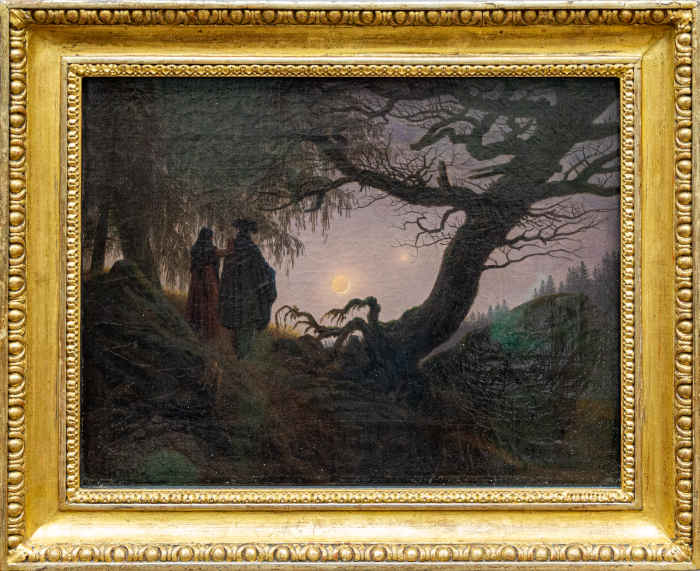
Caspar David Friedrich (1774–1840): Man and Woman Contemplating the Moon (Mann und Frau in Betrachtung des Mondes, also Mann und Frau den Mond betrachtend), around 1824, oil on canvas, Alte Nationalgalerie, Staatliche Museen zu Berlin. Image source: Staatliche Museen zu Berlin, Alte Nationalgalerie / Jörg P. Anders (public domain).
"Caspar David Friedrich painted this couple around 1824.62 Some years earlier he had painted the same scene with two men. Here a woman stands in the place of one of them. The art historian Eberhard Hanfstaengl suspected that Friedrich depicted himself and his wife Caroline.63 The two do not look at each other. They stand side by side, she leans on his shoulder, and both look in the same direction. Two people who have come to know each other no longer need to look at each other. Beside them stands a dead, half-uprooted oak. Friedrich often placed death in his pictures, more as a neighbor than as a threat."
"Erich Fromm, to praise him a second time, named four basic elements of love: care, responsibility, respect, and knowledge.36 Knowledge comes last in his list. I would have put it first. For me, only thinking would come before it. But then I am no psychoanalyst. I have merely watched closely for forty years."
"People like to think of introspection as the domain of psychoanalysts, and of sharp, logical thinking as the domain of logicians. That is a misunderstanding. Introspection and logic are not opposites but two ends of the same movement: anyone who thinks precisely sees deeper into himself, and anyone who looks deep into himself needs logic so as not to drown there."
"I have written elsewhere about the attraction that emanates from a thinking person, about the erotics of thinking and what it has to do with giftedness. Here I add just one observation, one that can be made only in old age: this attraction of thinking grows with the years, while most others fade."
Half a Sphere
"I now come to the part in which you should believe me least."
Weihenruh pushed the sheet aside and went on speaking without notes.
"Before I tell you about my wife, I must warn you. A sociologist, Helena Lopata, surveyed nearly 1,200 widows and found that they idealize their late husbands and their life with them, often to the point of sanctification.64 Lopata surveyed only widows. I have no reason to assume that widowers are immune to this, and this one least of all. Grant me the same discount you grant any salesman who praises his own wares."
"I can therefore prove nothing to you that a laboratory would accept. A single case never proves that it is so for everyone. If it holds, however, it proves that it can be done. Logicians call this an existence proof: it shows not that something is always so, but that it can be so. Anyone who claims that the love of old people is mere habit is refuted by a single counterexample. I studied such a counterexample for forty years at close range, with ever-growing expertise."
From the back rows came an interjection that the transcript did not catch. The hall laughed.
"No," said Weihenruh, "that is not what I meant. Or at least not only."
"In Plato, the spherical humans starve because they no longer want to do anything apart from each other.34 I am missing my other half, and yet I eat, as you can see, and work, as you can hear. I owe that to my wife. For forty years she showed me that one can want a person with all one's heart without needing that person like a crutch. I miss her every day. But missing is not needing, at least not for me."
"Those of you who heard or read my lecture on a painting by Émile Friant this summer may remember that I ended it with Baucis and Philemon. I must confess that I concealed something at the time. I was already a widower."
"In Ovid, the two old people ask the gods to let them keep their temple, and for a second, greater grace: Since we have spent our years in harmony, let the same hour carry us both away, so that I may never see my wife's grave, nor she have to bury me.65 The gods grant it, and the two become an oak and a linden standing side by side. My wife and I filed no such petition. It would not have been granted anyway, and my wife would have said that the gods had better things to do than to grant married couples an exemption from grief."
"Goethe brought the same couple back in the second part of Faust, as two old people whose hut beneath the linden trees stands in the way of the aged Faust's vast land-reclamation project.66 Faust wants them resettled. Mephisto takes care of the resettlement with three thugs; the hut burns, and the two old people die. Goethe was over eighty when he completed the work, and with it he wrote the most accurate forecast I know of the relationship between progress and old couples."
"The psychiatrist Colin Murray Parkes, who spent his life researching grief, wrote in 1972: The pain of grief is just as much a part of life as the joy of love; it is, perhaps, the price we pay for love, the cost of commitment.67 I pay it gladly."
"I was offered grief counseling. I looked into what research knows about it. A large review of the available controlled studies concluded that, in the long run, such services do little for bereaved people without particular distress. They are effective above all where grief actually makes people ill.68 I politely declined and prepared this lecture instead. It is cheaper, and you bear the side effects."
"Earlier I told you that a lack of connection is roughly as harmful as up to 15 cigarettes a day. By that reckoning I have been smoking for half a year without ever lighting a cigarette. I have therefore decided not to be lonely, merely alone."
Some laughed, others did not.
"I do not mean that as wordplay. Being alone is a fact: no one is there. Being lonely is a judgment. Research describes loneliness as the unpleasant experience that one's relationships are deficient in some important respect, because there are too few of them or not the right ones.69 Deficient, that is, measured against what one believes one needs. Loneliness is, in bookkeeping terms, the difference between budget and actual, and the budget one writes oneself. There it is again, our old word: lonely is the person who lacks someone he believes he needs. The actual I cannot change. The budget I can."
"I will not deceive you, though. The statistics are less generous than I am. According to a large review of 70 studies, even those who merely live alone carry an elevated risk of dying earlier.70 I drew from this the conclusion that lay closest at hand: I live alone, but I go out among people. I give lectures, for example. You, ladies and gentlemen, are my nicotine patch tonight."
"Paul wrote in his First Letter to the Corinthians what is read at weddings, and at funerals when the minister is good: For now we see through a glass, darkly; but then face to face: now I know in part; but then shall I know even as also I am known.55 I do not know what comes after death. I only know that I have been known. No one can take that from me anymore, not even death."
"And so, at the end, I am back with our saying: When I was in need of women, I lacked the money; when I had the money, I no longer needed them. It sounds like loss. Read correctly, it describes the opposite. The less I needed my wife, the more I loved her. Not because I needed her, but because I wanted her. That is the whole difference."
The Lions
"Let me close with Hemingway. His novella ends with a scene I could not have invented better myself."2
"Santiago returns to the harbor with the skeleton of his marlin. The next day, tourists on the terrace of a café see the huge white backbone with its enormous tail drifting among the empty beer cans in the water. A woman asks the waiter what it is. The waiter tries to explain what happened and says something about a shark. The woman understands that it was a shark and remarks that she had no idea sharks had such beautiful, shapely tails. Her companion had no idea either."
"Up in his shack the old man lies asleep on his stomach, the boy beside him, keeping watch. In his sleep the old man dreams of the lions."
"The tourists did not understand the trophy. The old man does not care. He is asleep. That is the freedom of old age. It does not consist in there no longer being a woman, but in no longer needing an audience to interpret one's own trophy correctly."
"Santiago's only mistake was that he went out too far, to prove something one more time. He says as much himself on the way home, to the dead fish. He loved the sea and nevertheless went out to wrest a trophy from it. That is what a man looks like who is already free in his dreams but not yet in his life. Today this man swallows pills at seventy to prove that he still can, and in the process forgets whom he loves."
"One is free only when both coincide: when one dreams of the lions and the next morning nevertheless does not go out too far. That can be learned at sixty-eight. But it can also be learned at twenty, if one is willing to examine one's own thinking. That is the core of cognitive psychotherapy. It does not turn a need into indifference, but into a wish."
He took the sheet from the lectern.
"At the exit there is a data sheet. My patients confirm on such a sheet, at the end, with their signature, what they have achieved. Please sign up only if you would like to receive the text of this lecture and the list of sources by email. What you have achieved tonight you will notice only later: by seventy at the latest, or, for the younger among you, if they are wise, tomorrow morning. Those who do not sign up will have to take my word for it. Or think for themselves, which is the better course anyway."
After the Lecture
When most people had already left, the student was still standing at the lectern.
"May I ask you something personal?"
"You may ask," said Weihenruh. "Whether I answer, I'll decide afterward."
"Earlier you asked who had already experienced being able to let themselves fall. I didn't raise my hand." She hesitated. "Can you explain to me how it's done? Or show me?"
Weihenruh looked at her for a while and tried not to form an image of her. He succeeded, as he later admitted, only by half.
"I explained it for ninety minutes," he said then. "Apparently that was not enough. The rest has to be practiced. The lights are still on in the café across the way. First you learn to let yourself fall without spilling your coffee."
"And what do the lessons cost?"
"You know I work only for payment in advance," said Weihenruh. "The coffee is on you."
He held the door open for her. Behind them, the custodian switched off the lights.
* * *
Cognitive Psychotherapy from Dr. Dietmar Luchmann, LLC, works on the thinking errors that cause the suffering — in writing, by video, or in a single-day block. Three paths, one goal.
1. Understand the Method
2. Check Your Suitability
3. Apply for Admission
Dr. Friedrich Weihenruh is a literary alter ego through which the author gives narrative form to his experiences as a psychotherapist. The stories are based on true events but have been fictionalized: to protect privacy and professional confidentiality, names, locations, and details have been changed. Any resemblance to actual persons is entirely coincidental.
The list of sources is available from the author, Dietmar Luchmann.
Your Comment
Are you interested in contacting the author? Do you have remarks, suggestions, or additions regarding this article? Do you have personal therapy experiences? We welcome substantial feedback.